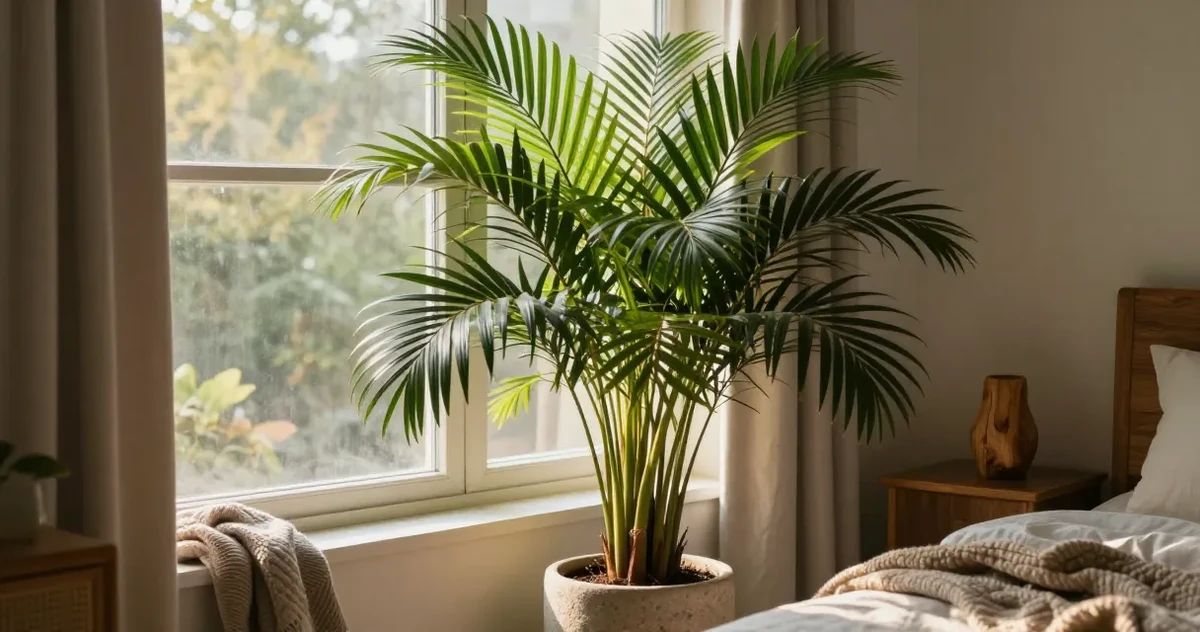
If your majesty palm keeps getting brown tips, yellow lower fronds, or that tired, dusty look no matter how carefully you water, you are probably not missing one magic trick. This palm is simply less forgiving indoors than the store tag usually admits. She wants brighter light, steadier moisture, and better humidity than the average living room gives without help.
The good news is that majesty palm decline usually follows a pattern. Once you stop treating every symptom like a watering problem, she gets much easier to read.
What Most Majesty Palm Guides Miss
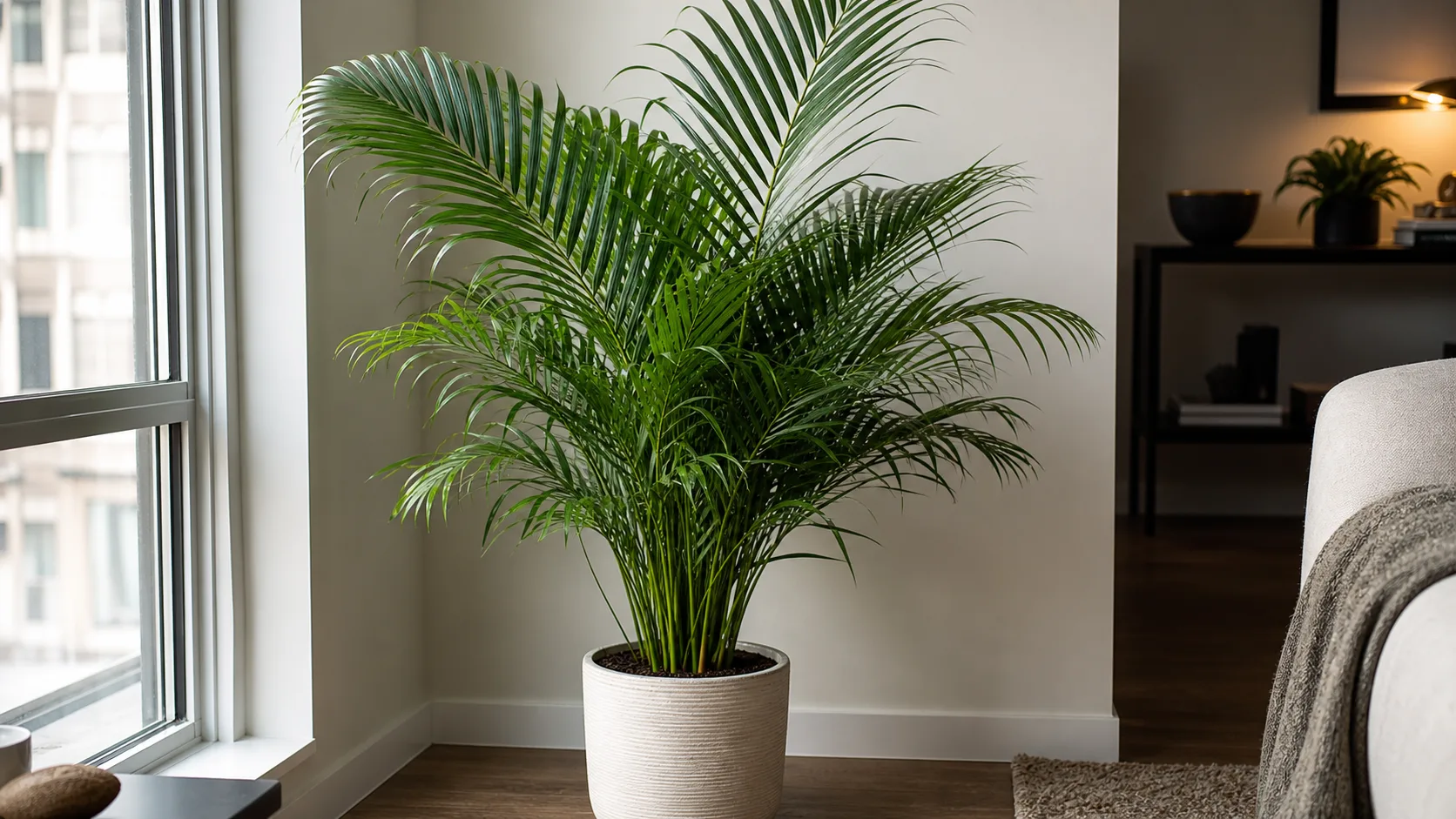
Strong window light and a stable location solve more Majesty palm problems than reflexively adding water.
Most majesty palm care pages give you the standard list: bright light, regular water, humidity, done. What they usually skip is diagnosis order.
The most common misdiagnosis is brown tips equals thirst. So people water more. But on this plant, brown tips can come from dry air, old fertilizer salts, roots sitting wet too long in weak light, or spider-mite stress starting to build. Adding more water can make the real problem worse.
Start with this order instead:
- Check light first. If she lives in a dim room, every other fix works worse.
- Check soil moisture below the surface. The top can feel dry while the root zone stays cold and wet.
- Check the room air. Crispy tips and mites both get more likely when indoor air is dry.
- Check the undersides of the fronds. Fine stippling or webbing changes the diagnosis immediately.
That sequence is what generic care guides usually miss. It keeps you out of the classic majesty-palm spiral: dim room, slow-drying soil, brown tips, more water, weaker roots.
Identification Snapshot
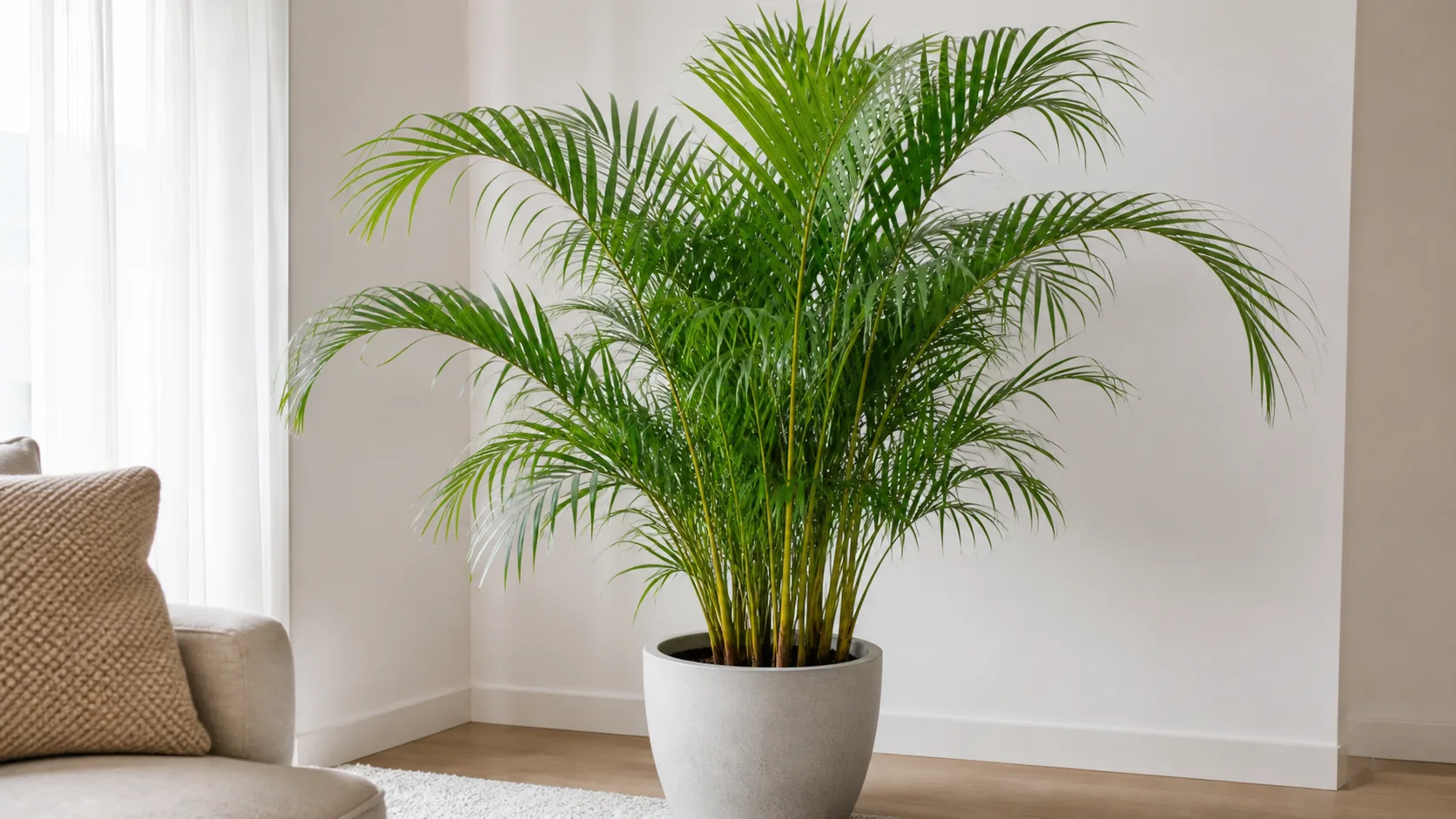
Arching feathered fronds and several stems in one pot are useful Majesty palm identification clues.
Before we troubleshoot, make sure you really have a majesty palm.
- Botanical name: Ravenea rivularis
- Indoor size: often around 5 to 10 feet indoors, according to North Carolina Extension
- Native habit: from wet areas of Madagascar, which helps explain why she likes steady moisture but still struggles when indoor roots lose oxygen
- Look for: feather-style fronds, several stems crowded into one nursery pot, medium to deep green leaflets, and a fuller look than a kentia palm
- Crowded pots are normal: North Carolina Extension notes that commercial growers often pot three or more plants together for a fuller look
That last point matters more than it seems. A multi-stem pot can dry unevenly, hide root crowding, and make one part of the plant look stressed before the rest catches up.
Why Majesty Palm Feels Hard Indoors
This is the reality check many owners needed before they brought one home. North Carolina Extension says majesty palm requires high humidity, bright indirect light, and consistent moisture and may be difficult to grow indoors. That is not failure on your part. It is the plant.
Costa Farms adds another useful clue: majesty palm is native to wet areas, not dry desert conditions. So while people hear “palm” and think drought tolerant, this one does not behave that way.
Still, “likes moisture” does not mean “keep the soil wet all the time.” Indoors, the real challenge is balance:
- strong enough light that the roots can actually use the water
- enough moisture that the fronds do not dry hard at the tips
- enough drainage and oxygen that the roots do not sit heavy and sour
- enough humidity that the plant is not always fighting the room
If your routine works for pothos or snake plant, that tells you almost nothing about whether it will work for majesty palm.
Quick Care Cards
| Care card | What helps | What usually goes wrong |
|---|---|---|
| Light | Put her right by a bright east window, or near a bright south window with filtered midday sun | She gets treated like a low-light palm and slowly weakens |
| Water | Water deeply when the top 1 to 2 inches feel slightly dry, then let excess drain | A fixed weekly schedule keeps the lower root zone wet too long |
| Humidity | Use a humidifier, grouped plants, or the most humid bright room you have | Quick misting gets mistaken for a real humidity plan |
| Soil and pot | Choose a draining mix and a pot with drainage holes | Decorative pots hide standing water and root stress |
| Pests | Check frond undersides every week | Spider mites get noticed only after webbing or fading spreads |
| Temperature | Keep her away from cold drafts and direct heater blasts | Frond damage gets blamed on watering when air movement is the real stress |
The Expert Layer, in Plain English
North Carolina Extension gives the most useful baseline here. It says majesty palm prefers 65 to 85°F and notes that yellow leaves can be caused by inadequate light, insufficient water, overwatering, lack of humidity, or nutritional deficiencies. In other words, yellowing is not a one-answer symptom.
The same source also warns that low humidity levels can bring unwanted insect pests. That matters because many owners treat humidity as an optional extra when it is actually part of pest prevention.
Costa Farms says average indoor humidity may be survivable, but above-average moisture in the air helps majesty palm thrive. That is the better way to think about her indoors. Survival and thriving are not the same thing.
If you share your home with pets, there is one easier piece of news. ASPCA lists majesty palm as non-toxic to cats, dogs, and horses.
Light Comes First
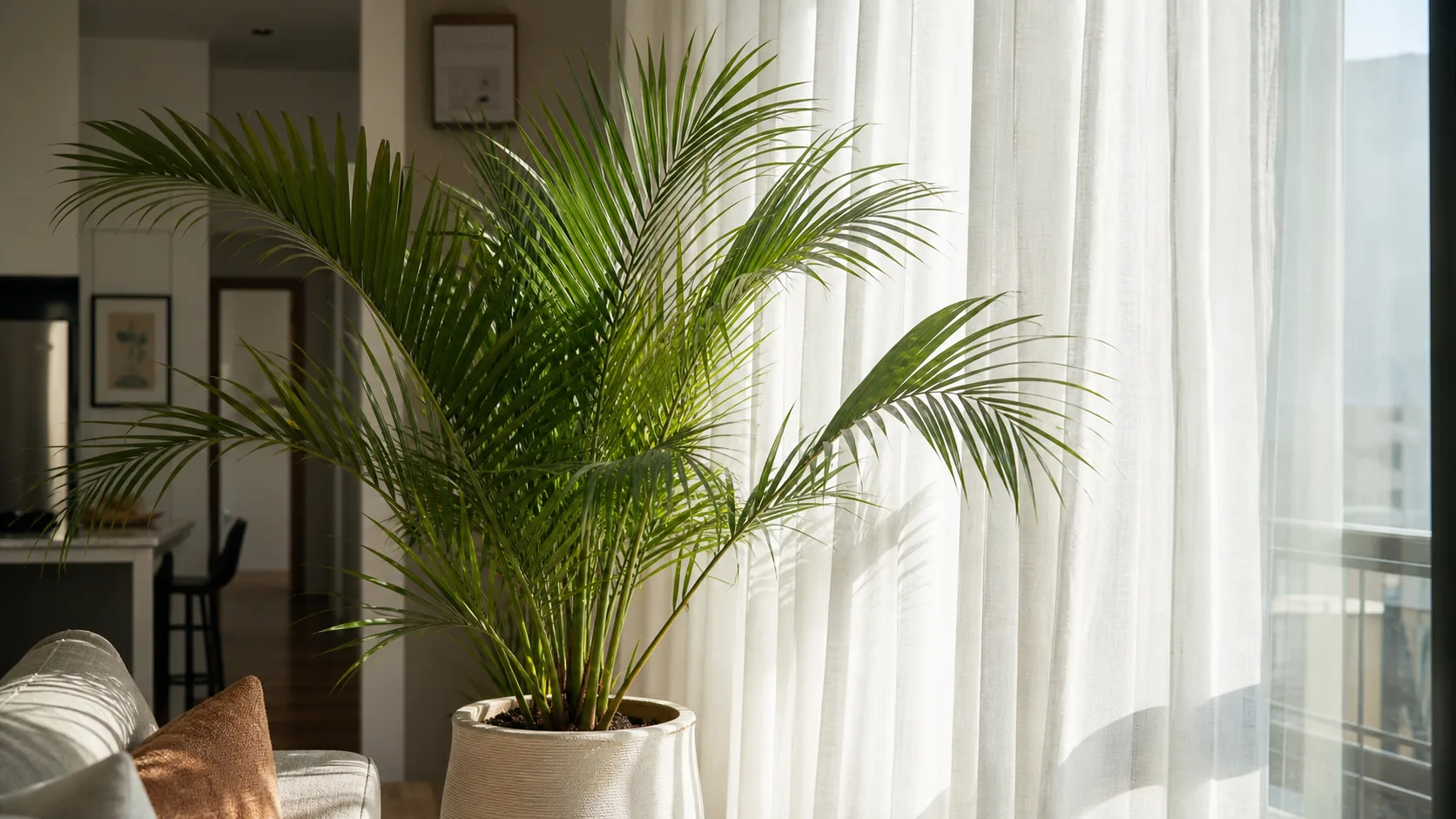
A sheer curtain softens strong sun while keeping a Majesty palm close to the brightest part of the room.
If you change one thing, change the light.
Majesty palm care indoors usually starts failing in a dim corner. Weak light slows growth, lowers water use, and keeps the soil wet longer. Then the roots struggle, lower fronds yellow, and the plant starts looking thirsty and tired at the same time.
A practical test: if you would not happily sit there and read during the day without turning on a lamp, the spot is probably too dim.
Best placements:
- right beside an east-facing window
- a few feet from a bright south-facing window with a sheer curtain
- a bright west exposure if the hottest afternoon sun is softened
Usually poor placements:
- deep interior corners
- dark north rooms
- any place where the palm is being used as furniture instead of placed for plant health
If your room is borderline, a grow light is usually more helpful than constantly changing your watering routine.
Watering: Even Moisture, Not Constant Wetness
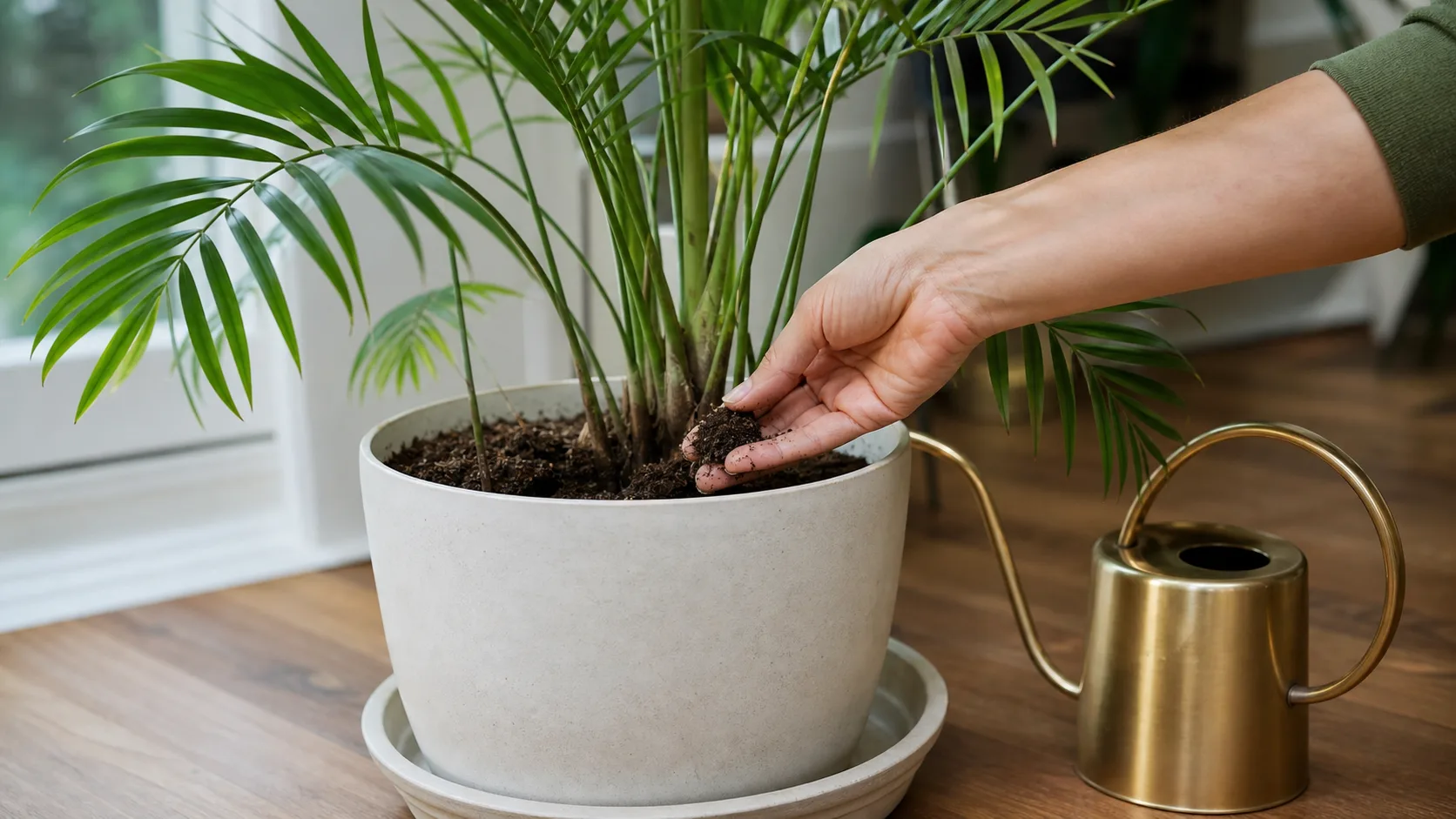
Check moisture below the surface before watering, then let the saucer drain.
This is where a lot of plant owners get trapped by mixed advice. Majesty palm likes moisture, but roots still need air.
Try this routine:
- Feel the soil 1 to 2 inches down.
- If that layer feels just lightly dry, water thoroughly.
- Let extra water run out fully.
- Empty the saucer or cachepot.
- Check again based on the plant, not the calendar.
A few symptom clues help here:
- Brown, crispy tips on mostly green fronds often point first to dry air, uneven watering, or salt buildup.
- Several yellow fronds with a pot that stays heavy for days point more toward weak light or wet-root stress.
- Soft decline at the base or sour-smelling soil is a stronger warning that the roots are struggling.
North Carolina Extension notes that overwatering can cause root rot. So “keep it moist” should never mean “keep it swampy.”
Humidity Is Not a Decorative Extra
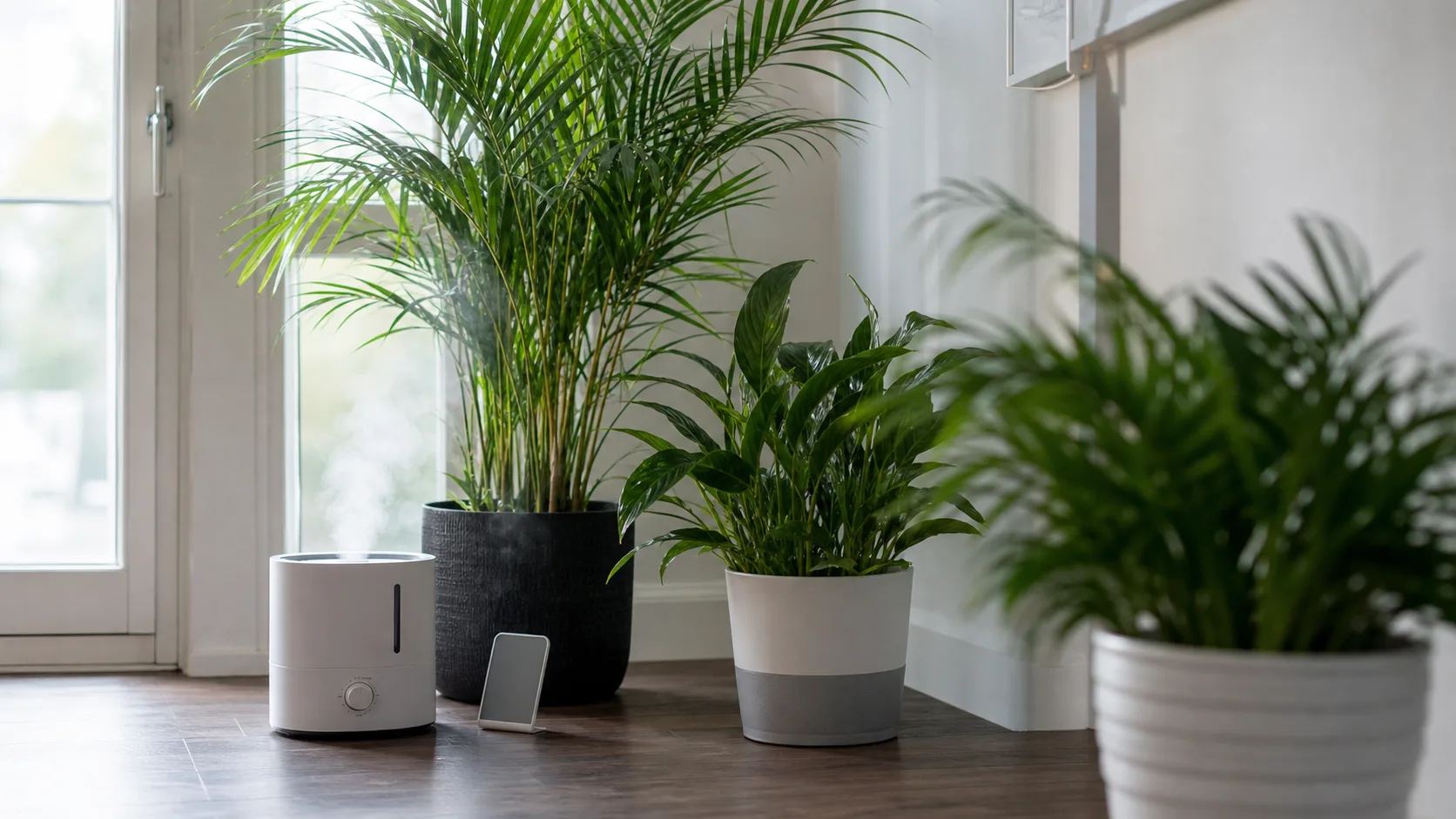
A cool-mist humidifier provides steadier humidity support than occasional leaf misting.
This is one of the biggest information gaps in majesty palm care indoors. Dry air is not just a cosmetic annoyance. It changes how this plant performs.
When humidity is too low, you are more likely to see:
- brown crispy tips
- edge crisping along leaflets
- fronds that look faded or dusty
- faster spider-mite pressure
A quick mist can make the leaves look refreshed for a few minutes, but it does not change the growing environment in a lasting way. A humidifier does more. So does putting her in a bright bathroom with decent airflow, if you have one. Grouped plants help a little too.
If your heat or AC has been running harder than usual and the tips suddenly worsen, do not ignore that timing.
Symptom Diagnosis Card
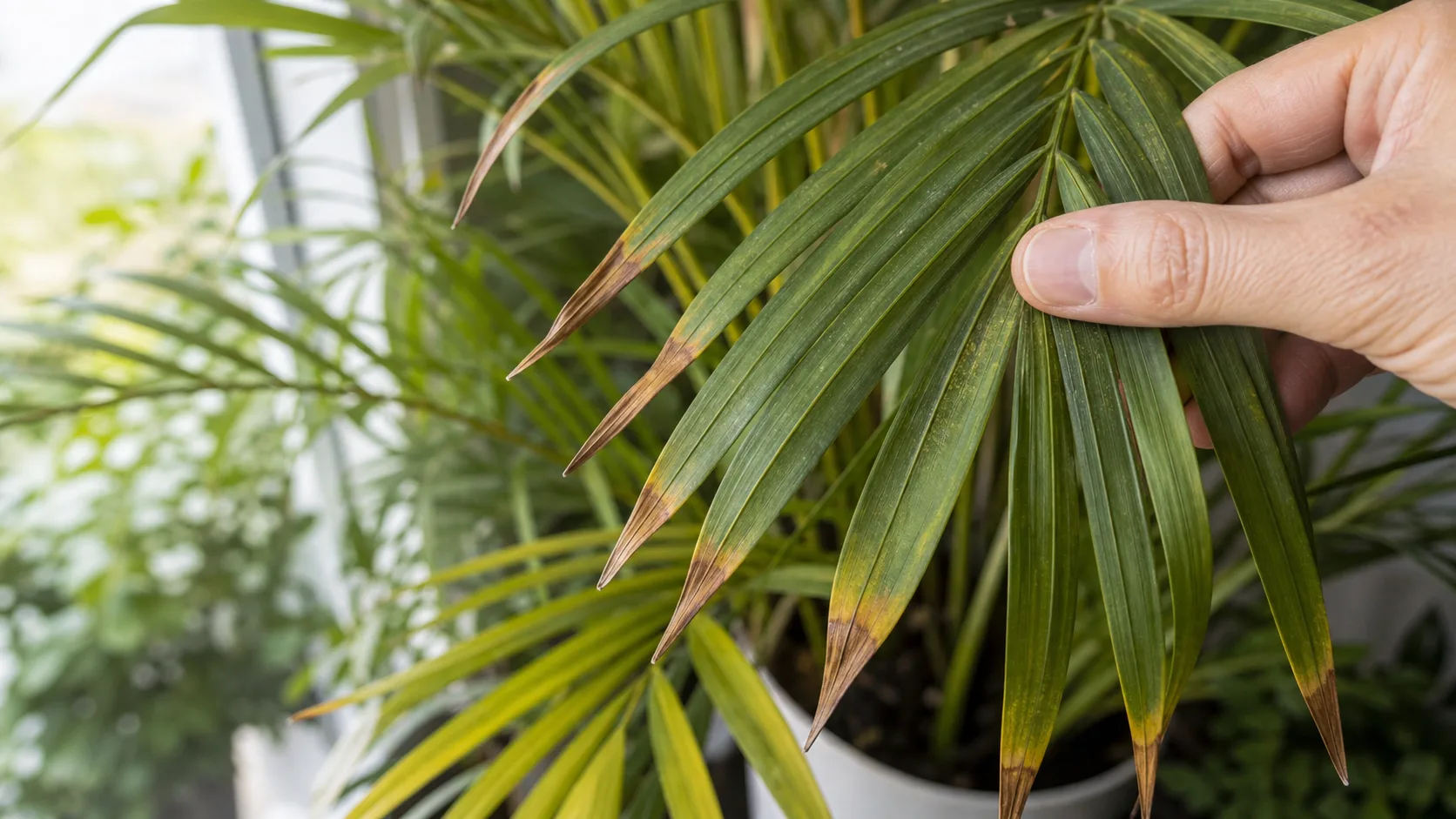
Brown tips, yellowing, and fine stippling are different clues, so inspect the whole frond before changing care.
| Symptom | Check first | Most likely cause | First move |
|---|---|---|---|
| Brown crispy tips, rest of frond still green | Room humidity, watering rhythm, water quality | Dry air, uneven moisture, or mineral buildup | Raise humidity, flush salts, then steady watering |
| One lower frond turning yellow | Overall vigor and age of frond | Normal aging | Prune only after most of the frond has faded |
| Several yellow fronds and heavy wet pot | Light and moisture at depth | Wet-root stress or light too weak for current watering | Move brighter, let soil dry a bit more between waterings |
| Pale, tired growth with little new growth | Light level | Not enough usable light | Move closer to window or add grow light |
| Fine stippling, fading, dusty look, webbing | Undersides of fronds | Spider mites | Isolate and start treatment immediately |
| Soft stem base or sour soil smell | Root zone | Rot risk | Unpot and inspect roots before watering again |
Majesty Palm Decision Tree
When she starts looking off, make one decision at a time.
- Is she getting strong bright indirect light? If not, fix that first.
- Is the soil still wet several days after watering? If yes, do not add more water yet.
- Are only the tips brown? Think humidity, salts, and consistency before panic-watering.
- Are whole fronds yellowing? Check whether the pot is staying too wet in not-enough light.
- Do you see stippling or webbing? Treat for mites now, because this usually gets worse on its own.
- Did something change recently, season, vents, window distance, repot, feeding? That change is often the clue.
Indoor Success Scorecard
Before you buy a majesty palm, or before you keep fighting one, score your setup honestly.
| Condition | 0 points | 1 point | 2 points |
|---|---|---|---|
| Light | Dim room or corner | Bright room but not right near a window | Bright-window placement with strong indirect light |
| Watering habit | Watering by schedule only | Soil checked sometimes | Soil checked every time |
| Drainage | No visible drainage or water sits hidden | Drainage exists but runoff is not always emptied | Full drainage and runoff always removed |
| Humidity | Dry heated or air-conditioned room | Average room | Humidifier, bright bathroom, or consistently humid space |
| Pest monitoring | Rarely checked | Checked now and then | Undersides checked weekly |
8 to 10 points: good chance of indoor success
5 to 7 points: possible, but she will need active attention
0 to 4 points: this may simply be the wrong palm for your room right now
This is not a scientific survival study. It is a practical screening tool built from extension guidance, grower advice, and the recurring problems indoor owners run into.
Common Problems
Brown tips
Brown tips are the most common complaint because several different stresses can create the same look. If the tips are dry and crisp but the fronds are otherwise green, start with humidity, salt buildup, and whether the soil has been swinging from quite wet to quite dry.
If you are unsure whether the issue is dryness or water quality, flush the pot once with plenty of plain water and let it drain completely. Then improve humidity and watch the next bit of new damage, not the already-brown tissue.
Yellow leaves
Yellowing is trickier. One older lower frond aging out is usually normal. Several yellow fronds at once, especially if the pot stays wet for a long time, usually point to the root zone staying too damp for the available light.
This is a good place to compare with our guide on why plant leaves turn brown, because the pattern of damage matters more than the color alone.
Spider mites
Majesty palm is one of those plants where regular checks are much kinder than late rescue. If you notice pale stippling, fading, or fine webbing, isolate her quickly. Then work through a full cleanup plan like the one in our guide to how to get rid of spider mites.
Curling or folded leaflets
If the leaflets are folding inward and feel dry, check moisture and humidity together. If they are curling while the pot stays wet, that points more toward stressed roots than simple thirst.
Stalled growth
If warm months pass without a fresh frond, suspect light first. Feeding a palm that cannot use the available light rarely fixes the real problem.
Lookalikes and Common Mix-Ups
| Plant | How it looks different | What care difference matters most |
|---|---|---|
| Areca palm | Lighter, looser, more fountain-like fronds | Usually a bit more forgiving indoors |
| Kentia palm | Darker, more spaced fronds and slower, elegant shape | Better tolerance for lower light |
| Parlor palm | Smaller leaflets and softer overall texture | Much easier in average household humidity |
If what you really want is a palm shape for a moderate-light room, majesty palm may not be your kindest option. If you mainly want a tropical look without the humidity battle, one of those alternatives may fit your space better.
Pet Safety
ASPCA lists majesty palm as non-toxic to cats, dogs, and horses, which is genuinely helpful if pets wander near your plants. That said, non-toxic does not mean good as a chew toy. Fronds can still be shredded, and repeated nibbling can upset a pet’s stomach.
If you want more forgiving plant options for a pet home, our list of cat-safe indoor plants is a useful next read.
Seasonal Note
Last updated: July 2026. Majesty palm care changes with the seasons more than many owners expect.
- Spring and summer: growth is stronger, the mix dries faster, and she can use more water because the light is doing more work
- Fall: this is when a summer watering routine quietly becomes too frequent
- Winter: dry indoor heat, shorter days, and slower soil drying create the classic mix of brown tips, weak growth, and hidden root stress
If your palm struggles every winter, that pattern is useful information. It usually means the room is too dim, too dry, or both for the same watering rhythm you used in summer.
If dry air is a recurring problem, our guide on humidity for plants indoors can help you choose a fix that actually changes the room, not just the leaf surface.
Common Mistakes
- Treating her like a low-light palm. She is not one.
- Watering on autopilot. Majesty palm punishes calendar care fast.
- Calling misting a full humidity plan. For this plant, that is usually not enough.
- Leaving runoff hidden in a cachepot. A lot of root stress starts there.
- Changing three variables at once. If you move, feed, repot, and change watering all in one week, you lose the trail.
- Ignoring the underside of the fronds. Spider mites love being noticed late.
A Practical Weekly Reset
If your majesty palm already looks rough and you want one simple recovery plan, try this for the next seven days:
- move her to the brightest suitable window you have
- check the pot for trapped water and empty any hidden reservoir
- inspect the undersides of fronds for stippling, webbing, or moving dots
- wipe dust off the leaves gently
- add a humidifier nearby if the room is dry
- do not fertilize until new growth and watering rhythm look steadier
That is often enough to tell you whether the plant was dealing with weak light, dry air, early pests, or wet roots.
Helpful Related Reads
If you are still sorting out whether the problem is dryness, pests, or a broader indoor setup issue, these guides can help:
If you are troubleshooting another common plant symptom, see Areca Palm Care Indoors: Light, Water, and Yellow Leaves for a focused diagnosis and recovery plan.
If you are comparing care routines for another houseplant, see Parlor Palm Care: Low-Light Tolerance Without Overwatering for a focused step-by-step guide.
Real User FAQ
How often should I water a majesty palm indoors?
There is no safe universal schedule. Check the top 1 to 2 inches of soil and water when that layer feels slightly dry. In brighter summer conditions that may be more frequent. In winter or weaker light, it may be much less.
Why does my majesty palm get brown tips even when I never let it dry out?
Because brown tips are not just a thirst signal. They often come from dry air, inconsistent moisture, or salt buildup from fertilizer or tap water. If the pot already stays wet for a long time, more water can make the roots less healthy, not more.
Do majesty palms need direct sun?
They need strong light, but harsh direct afternoon sun can scorch the fronds. Bright indirect light is the sweet spot for most indoor homes.
Is one yellow frond a problem?
Usually not. One older lower frond fading while the rest of the plant looks healthy is often normal turnover. Worry more when several fronds yellow together or the soil stays wet for too long.
Why are spider mites so common on majesty palm?
Because the same dry indoor conditions that cause tip damage also make this palm more vulnerable to mites. Weekly checks matter more here than with many easier houseplants.
Should I mist my majesty palm every day?
You can, but do not expect that alone to solve the problem. Misting is short-lived. A humidifier or a better room usually makes a much bigger difference.
Is majesty palm a good beginner plant?
Only if your home already has bright light and you are willing to check soil and pests regularly. For many beginners, a kentia, areca, or parlor palm is less stressful.
Methodology Note
This article was built around the indoor problems majesty palm owners actually run into: brown tips, yellow leaves, dry air, weak light, and spider mites. Factual care guidance was anchored to North Carolina Extension, Costa Farms, ASPCA, and supporting indoor-care references. Community-style pain patterns informed the diagnosis flow, but not as formal evidence or invented case data.
Final Take
Majesty palm does best when you stop asking, “How often do I water it?” and start asking, “What is the room telling me right now?” If the light is strong, the root zone drains well, the air is not bone dry, and you catch pest problems early, she becomes much more predictable. Not exactly easy, but readable, and that is what keeps a hard plant alive indoors.