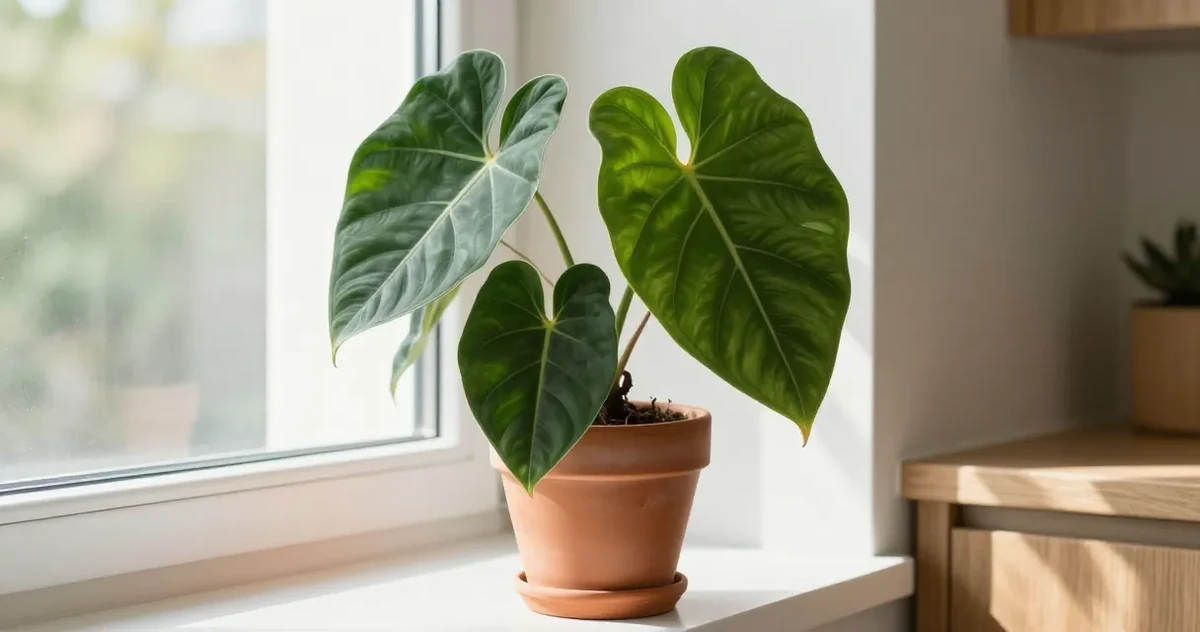
Most people bring home a philodendron because she seems easy, then one leaf turns yellow and suddenly nothing feels easy at all. You check the soil three times in one day, move her closer to the window, move her back again, and start wondering whether you are overwatering, underwatering, or somehow doing both.
That spiral is common, and usually unnecessary.
Philodendrons are some of the clearest communicators in the houseplant world. If you learn how to read her leaves, growth pattern, cataphylls, and soil dry-down, you can usually catch trouble early and fix it before she really declines.
For most indoor philodendrons, the care rhythm is simple: bright indirect light, soil that partly dries before you water again, and a pot that drains freely. The useful part is learning which type you have and what to check first when something changes. If yours has dark burgundy leaves with pink variegation, switch to the cultivar-specific Pink Princess philodendron care guide.
What Most Care Guides Miss
The most common philodendron misdiagnosis is assuming every yellow leaf means overwatering, or that every philodendron should be cared for like a pothos.
That is too generic to help when you are standing over the pot trying to decide what to do today.
Before you change everything at once, do two checks:
- Check the pattern. Is it one oldest leaf near the base, or several leaves across the plant? Is the newest growth affected, or only older growth?
- Check the growth habit. Is yours a trailing climber like heartleaf or Brasil, or a self-heading type like birkin or xanadu?
That one split changes the next step. A single older yellow leaf on a happy vining philodendron is often normal. Several yellow leaves plus wet soil points to root stress. A self-heading philodendron that stays damp too long often needs a gentler watering rhythm than a fast-growing heartleaf on a shelf.
If you start with the pattern instead of the panic, the answer usually gets clearer fast.
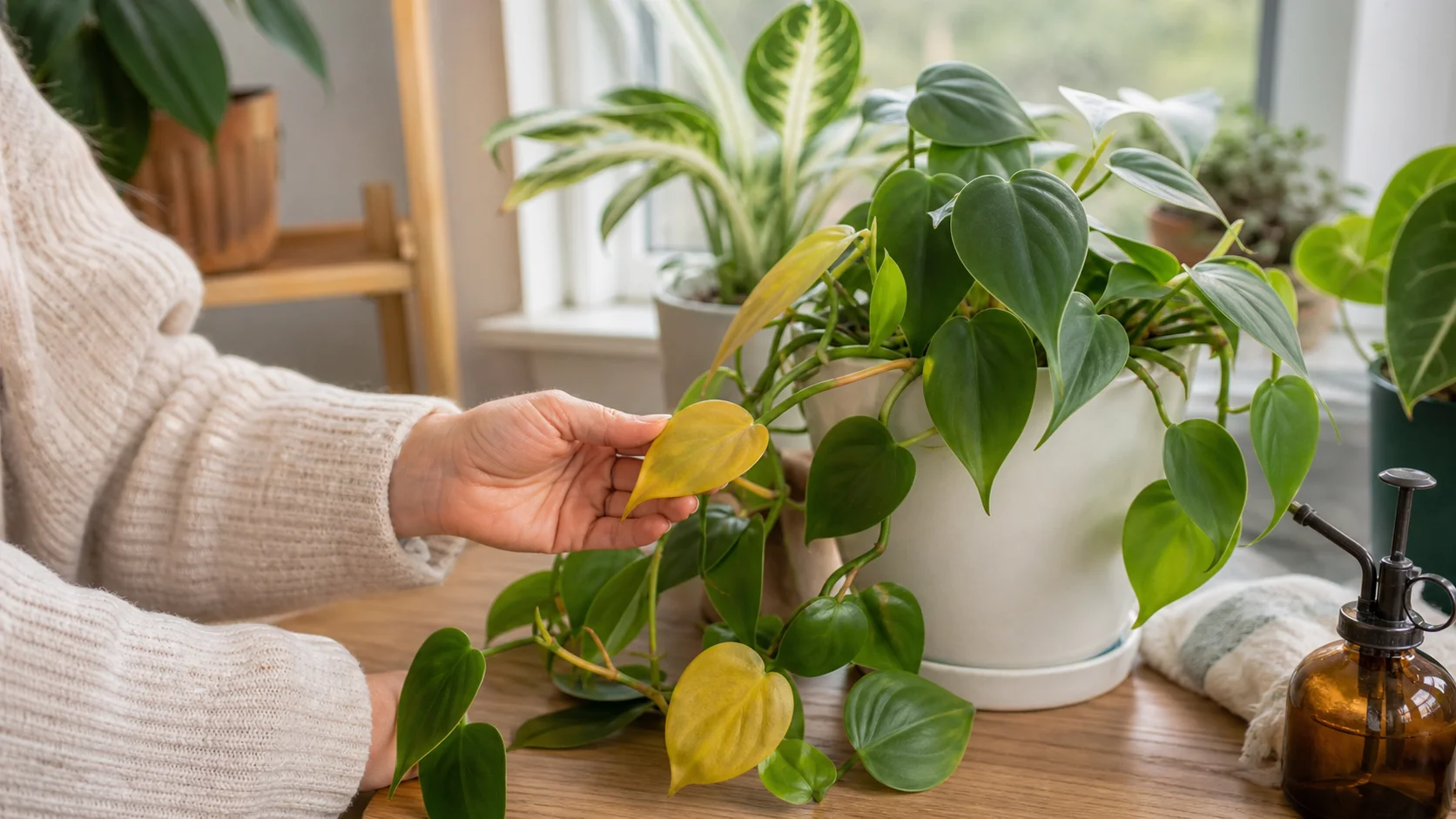
Read the yellow-leaf pattern and growth habit before changing a philodendron’s watering routine.
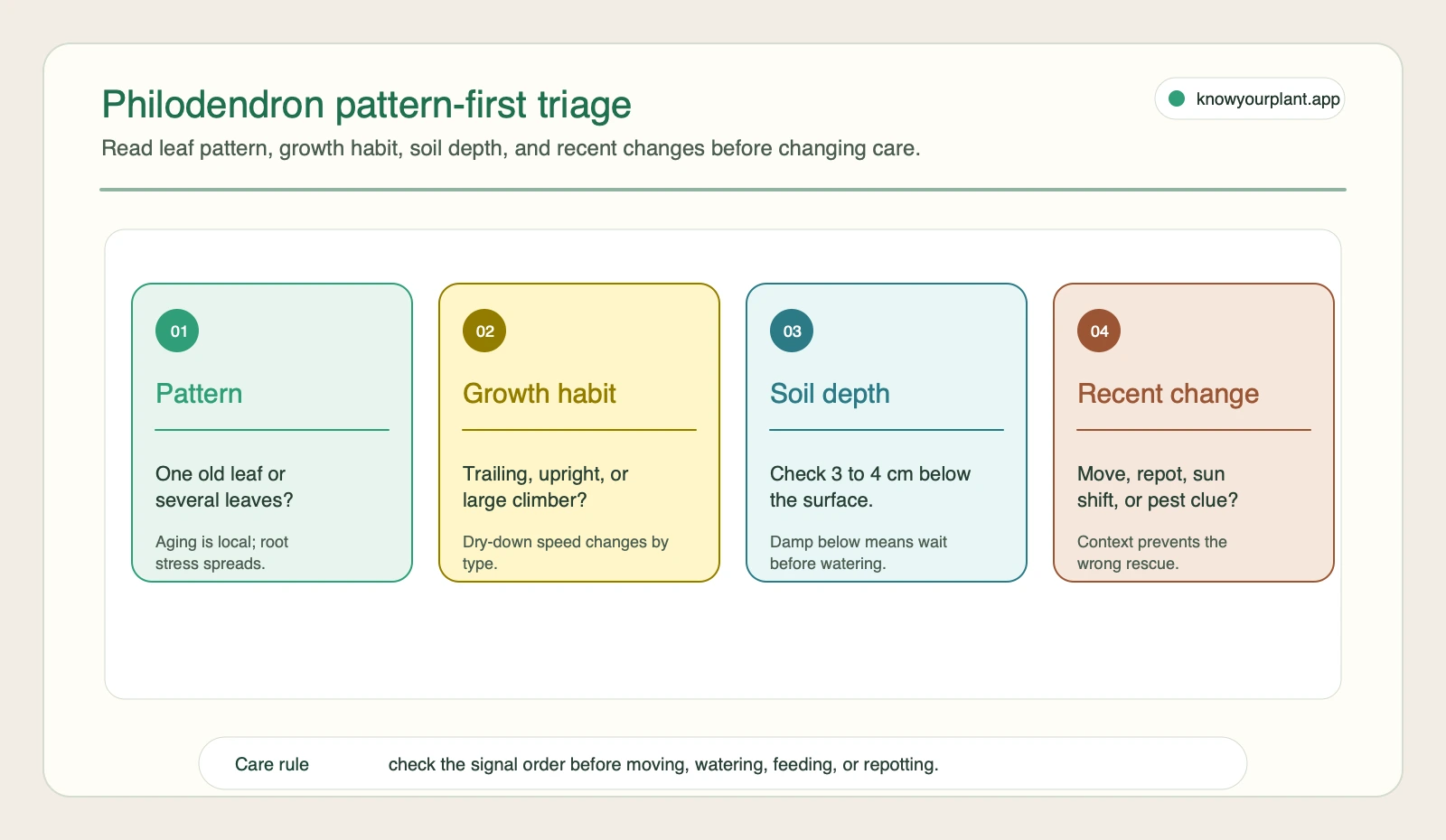
Use the triage cards before changing care: pattern, growth habit, soil depth, and recent context usually narrow the next step.
Identification Snapshot
Philodendrons are tropical aroids grown indoors for their leaves, not their flowers. Most common houseplant types fall into two big groups:
- Climbing or trailing philodendrons, like heartleaf and Brasil
- Self-heading philodendrons, like birkin, xanadu, and prince of orange
A quick way to recognize a philodendron is the cataphyll, the papery sheath that wraps a new leaf before it opens. That is one of the easiest clues that separates philodendron from pothos-like lookalikes.
Philodendron Care Cards by Type
| Type | Common examples | What she is like at home | What usually goes wrong first |
|---|---|---|---|
| Climbing or trailing philodendron | Heartleaf, Brasil, other small-leaf vines | Fast, forgiving, happy trailing or climbing | Low light, long leggy stems, watering too often |
| Self-heading philodendron | Birkin, xanadu, prince of orange | Upright, fuller, slower, takes more floor space | Wet mix lingering too long around the base |
| Large-leaf climbing philodendron | Bigger climbing collector types | Wants support, steadier light, more vertical space | Smaller leaves over time, weak support, uneven care |
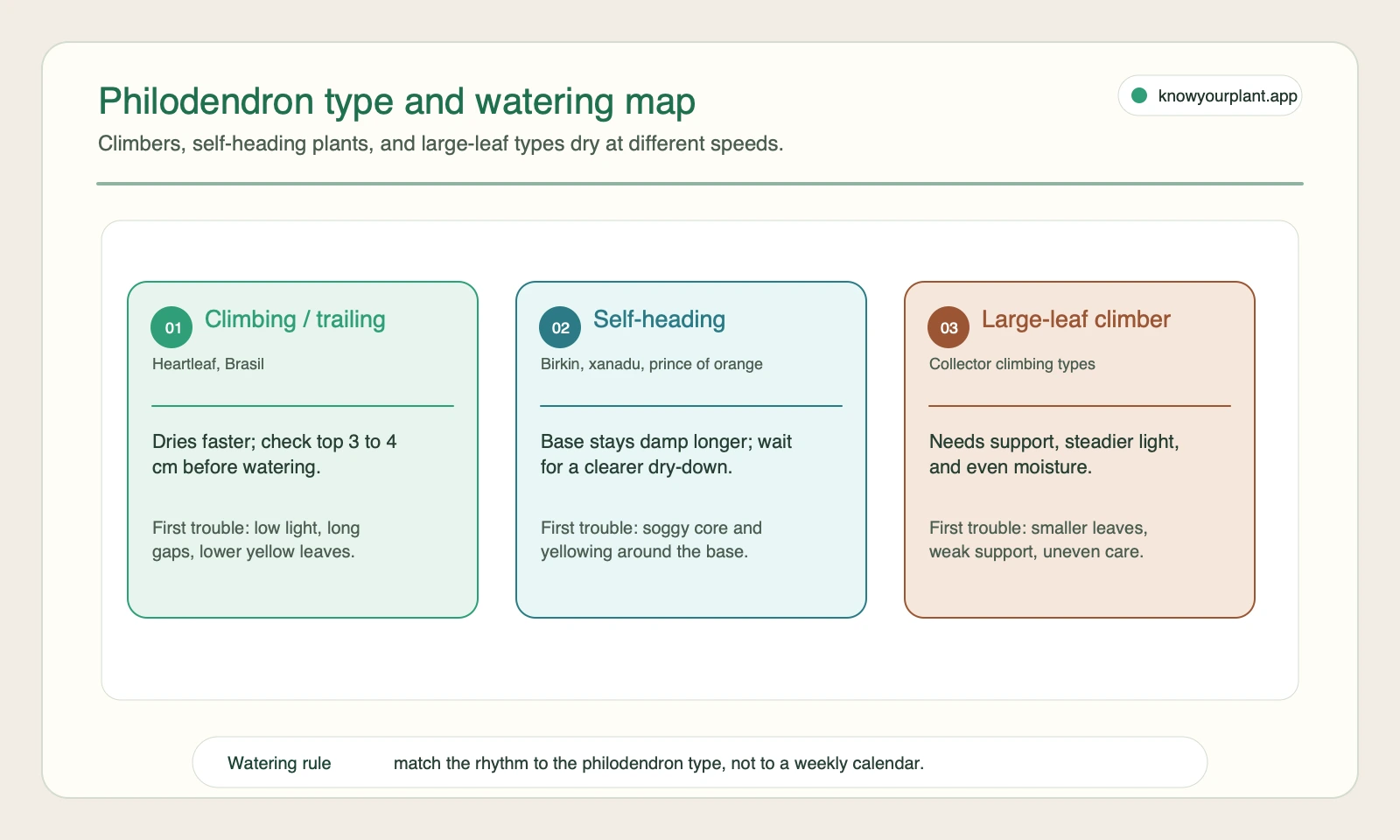
Use the map to match watering checks to the kind of philodendron you have, not a generic weekly schedule.
If you want the easiest fit for a normal indoor routine, heartleaf and Brasil are the friendliest starting point. The philodendron types guide compares the most common varieties before you choose one.
Getting to Know Your Philodendron Type
Climbing philodendrons
Heartleaf philodendron is the classic here. Long stems, heart-shaped leaves, and a very forgiving personality. If you have seen a plant trailing off a shelf or climbing a simple pole, it was probably this kind. Brasil is a variegated version with green and yellow streaking through the leaves.
These plants can trail just fine, but if you give them a moss pole or coir pole, they often respond with larger, more mature leaves. If you are growing this specific kind, the heartleaf philodendron care guide goes deeper.
Self-heading philodendrons
These grow upright from a central base instead of sending out vines. Birkin, xanadu, and prince of orange are familiar examples. They still like bright indirect light and airy soil, but they usually dry more slowly than a trailing heartleaf, especially once the pot gets full.
That is why people sometimes overwater them without realizing it. The top can look fine while the lower root zone stays damp for too long.
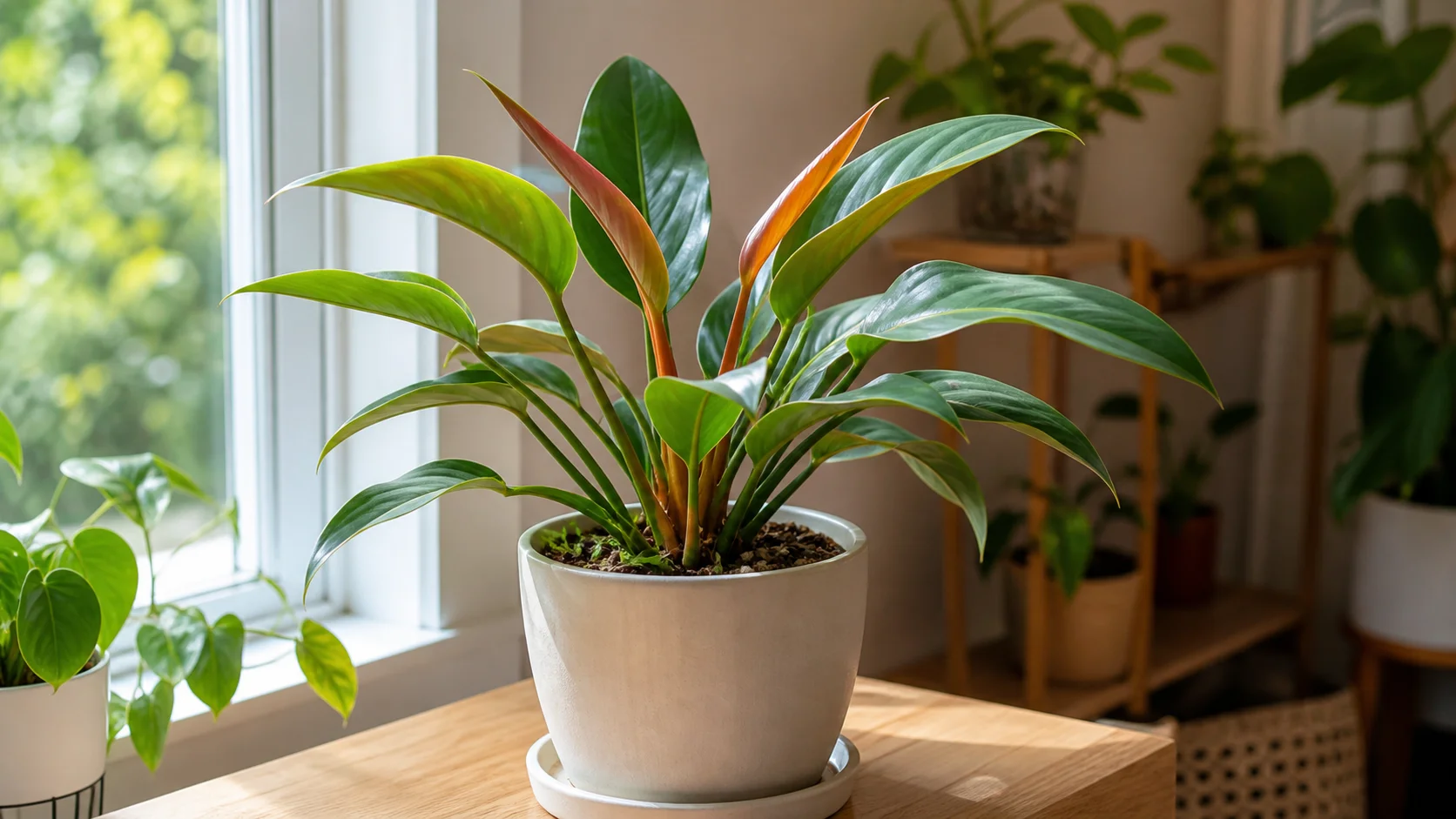
An upright philodendron grows from a compact central base and can hold moisture longer than a trailing type.
Lookalikes and Confused-With: Philodendron vs Pothos
People mix these up constantly, and honestly it makes sense. The leaves can look similar and both are easygoing tropical vines. The care overlap is real, but there are a few differences that matter.
| Clue | Philodendron | Pothos |
|---|---|---|
| New leaf emerges from | A cataphyll that dries and falls away | Directly from the vine without a cataphyll |
| Leaf feel | Usually a bit thinner and softer | Usually thicker and waxier |
| Growth habit | Often eager to climb if given support | Happy trailing, climbing, and generally tougher |
| Early stress signal | Smaller new leaves, pale growth, cataphyll clues | Less subtle, often just slower or leggier growth |
| Pet safety | Toxic to pets | Also not pet-safe |
If you are still unsure, the pothos vs philodendron guide walks through the differences side by side.
Reading Your Philodendron: What She Is Actually Telling You
This is the part most generic care guides skip, and it is the part that makes you feel calmer. Philodendrons usually show stress early, but you have to know what is normal first.
| Signal | Usually means | What to check next |
|---|---|---|
| Cataphyll dries and drops after a new leaf opens | Normal healthy growth | Nothing, leave it alone |
| Cataphyll stays wet, soft, or mushy | Moisture sitting too long or weak airflow | Check soil moisture and stem base |
| Whole plant droops evenly | Usually thirst on a climbing type | Check soil 3 to 4 cm down |
| Only one section stays limp | Possible root trouble in that part of the pot | Check for soggy mix or root stress |
| New leaves come in smaller than old ones | Something is limiting growth, often low light | Check placement before anything else |
| New growth comes in pale | Usually not enough light | Move closer to bright indirect light |
| Aerial roots appear | Normal climbing behavior | Guide them to support if you want |
A few of these are especially useful.
Cataphylls. On many climbing philodendrons, every new leaf emerges inside a papery sheath. Once the leaf opens, the sheath dries and eventually drops. That dry papery look is normal. A cataphyll that stays soft and soggy is the one worth investigating.
Leaf-size trend. One smaller leaf does not mean much. A clear run of smaller and smaller leaves usually means she wants more light, and sometimes a support to climb.
Aerial roots. They look dramatic, but they are not a distress signal. She is reaching, not suffering.
Symptom Diagnosis Card
If you came here because something already looks off, start here before you read the whole guide.
| What you see | Most likely cause | First check today | Do not do immediately |
|---|---|---|---|
| One older bottom leaf turning yellow | Normal aging | Is the rest of the plant growing well? | Do not repot for one leaf |
| Several yellow leaves and damp soil | Overwatering or poor drainage | Check soil depth and drainage | Do not water again |
| Pale, smaller new leaves and long gaps between leaves | Not enough light | Move her closer to a bright window | Do not fertilize first |
| Brown tips on otherwise healthy leaves | Dry air or uneven watering | Check room dryness and watering rhythm | Do not soak repeatedly |
| Fine webbing or dusty stippling | Spider mites | Look under the leaves | Do not leave her near other plants |
| White cottony bits at leaf joints | Mealybugs | Isolate the plant | Do not ignore a small patch |
Where Philodendrons Will Be Happiest
Philodendrons are often called low-light plants, and compared with fussier houseplants that is partly fair. Clemson notes that many philodendrons tolerate lower indoor light better than a lot of other tropical houseplants. But low light is not the same as no light.
A philodendron in a dark corner may survive for a long time, but she usually starts looking tired. The stems stretch, the leaf gaps get longer, and new growth comes in smaller and paler.
The sweet spot is bright indirect light. In normal home terms, that usually means:
- near an east window,
- a few feet back from a brighter south or west window,
- or right in front of a gentle north window if the room is not gloomy.
A practical check helps more than obsessing over numbers: if you could sit there and read comfortably during the day, it is probably a good starting point.
Variegated types like Brasil usually want a bit more light than all-green heartleaf philodendrons to keep their color strong. Self-heading types also keep a better shape when the light is decent.
If the plant is stretching toward the window or the spaces between leaves are getting longer, she wants more light. A grow light can help during darker months without forcing a full room reshuffle.
Watering: The Part That Trips Most People Up
Most philodendron trouble comes back to watering, and more specifically, watering too often rather than not enough.
The roots need air as much as they need moisture. If the mix stays wet for days and days, the roots stop breathing well, and the plant starts showing it through yellow leaves, limp growth, or a sulky overall look.
The simplest check is still the best one:
- push your finger into the soil about 3 to 4 centimetres,
- if it still feels damp there, wait,
- if the top layer is dry and the layer just under it is starting to dry too, that is a good time to water.
When you do water, water thoroughly until excess drains out. Then let her rest.
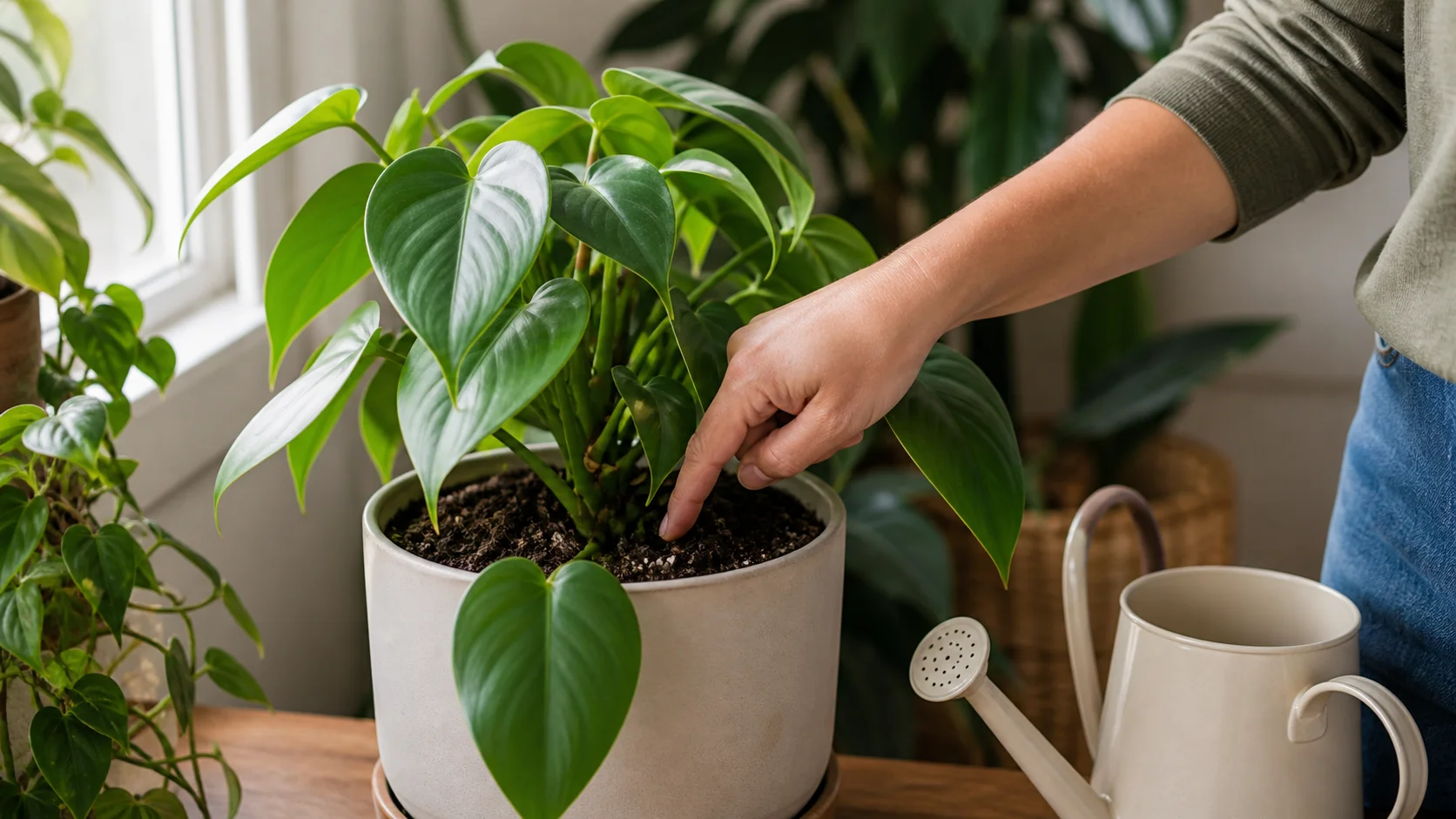
Check below the soil surface before reaching for the watering can, then water deeply only when the mix is ready.
Watering by growth habit
| Type | When to water | What overdoing it looks like |
|---|---|---|
| Heartleaf and Brasil | When the top few centimetres are dry | Yellow lower leaves, limp stems, mix staying wet too long |
| Self-heading philodendrons | Let the top layer dry well, then water deeply | Yellowing around the base, sluggish growth, soggy core |
| Large-leaf climbers | Similar to climbers, but watch pot size and support moisture | Droop with wet soil, stalled leaves, stress after uneven care |
If your philodendron is in a pot without drainage, or inside a cachepot that traps water below, that setup can create root stress quietly. It is one of the most common reasons people feel like they are “doing everything right” while the plant keeps declining.
Soil and Repotting
Philodendrons like a mix that holds some moisture but still lets plenty of air move through it. Heavy soil that stays wet is where root problems usually begin.
A simple reliable mix is:
- regular houseplant soil,
- plus extra perlite,
- plus a little orchid bark if you have it.
That gives you enough moisture retention without turning the pot into a swamp.
Repot when:
- roots circle the bottom,
- roots poke through drainage holes,
- the mix has compacted and stays wet too long,
- or the plant dries out unusually fast because the pot is full of roots.
Go up one pot size, not several. A much bigger pot holds extra wet soil around roots that are not using it yet.
If you are not sure whether it is really time, the step-by-step repotting guide helps you check without guessing.
Humidity and Temperature
Philodendrons are tropical, so warmth suits them. A normal indoor range of about 18 to 27°C is comfortable. Once temperatures drop much lower, especially near cold windows or drafty doors, growth slows and leaves can soften or droop.
Humidity helps, but you do not need to turn your flat into a greenhouse. Most common philodendrons handle normal home conditions fairly well if light and watering are right.
Where dry air shows up first is often in brown tips. If the tips crisp but the rest of the leaf looks fine, check for:
- a heater or vent nearby,
- a cold draft,
- very dry indoor air,
- or watering that swings from bone dry to soaked.
Grouping plants or using a pebble tray can help. Constant misting usually does less than people hope.
Feeding Without Overdoing It
Philodendrons do not need heavy feeding to stay happy. During spring and summer, a balanced liquid fertilizer at half strength every four to six weeks is usually enough.
If the plant is short on light, extra fertilizer will not solve that. It often just adds more stress to the root zone. Feed a healthy plant to support growth, not a struggling plant to force it.
If you want the simple version, feed during active growth and skip it during the darker slower months. The plant fertilizer guide covers that routine in more detail.
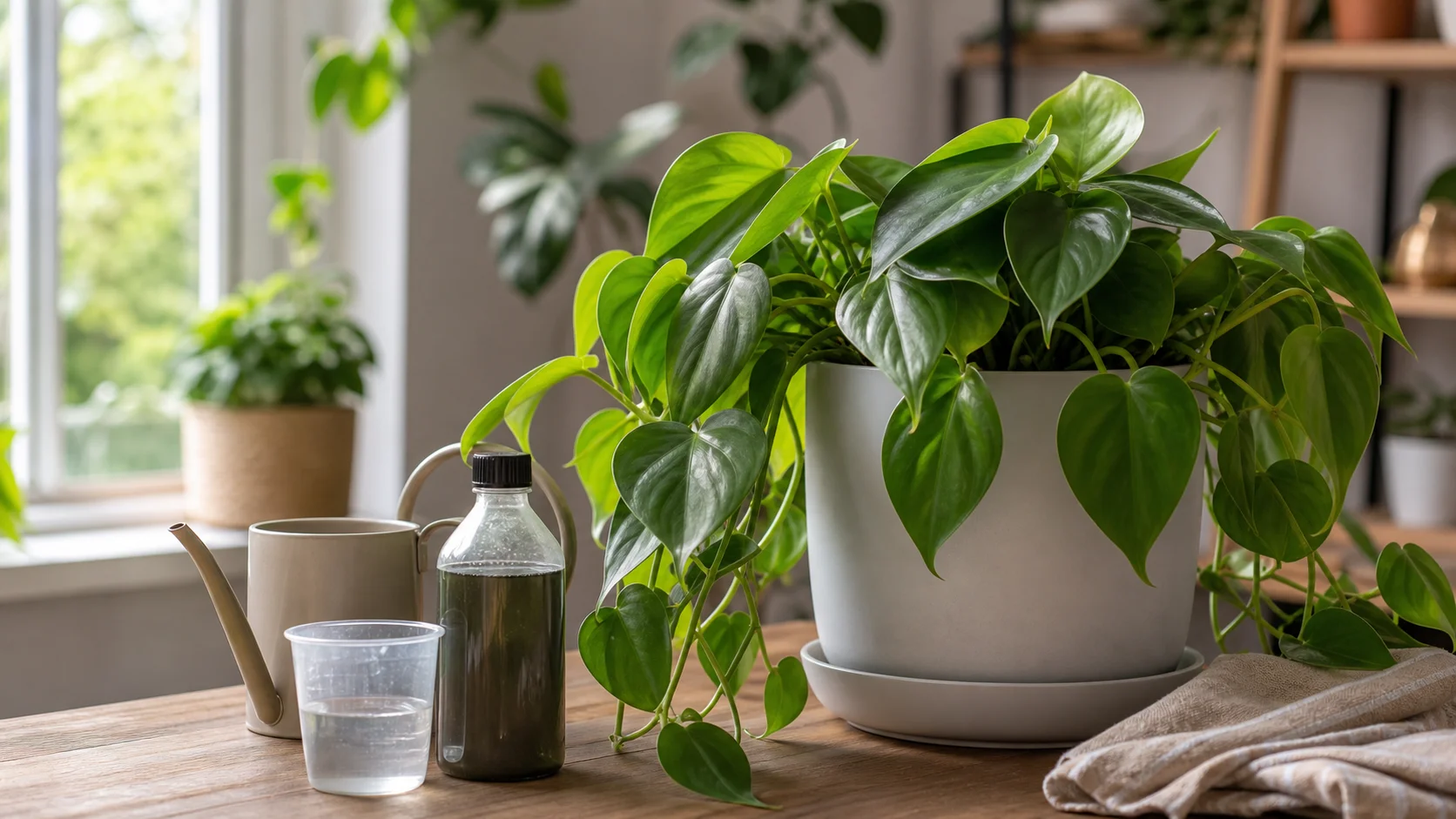
Dilute liquid feed and use it sparingly while a healthy philodendron is actively growing.
Seasonal Care Calendar
Philodendrons do not need a complicated seasonal plan, but a few small adjustments help a lot.
Spring. Growth starts waking up. Check whether the mix dries faster, restart light feeding, and repot if roots are crowded. This is also a good season for pruning and propagation.
Summer. This is usually her fastest growth period. Check moisture more often, especially in brighter rooms. Watch for spider mites and mealybugs in warm dry air.
Autumn. Growth slows. Water less often, stop feeding, and pay attention to whether the plant is stretching as daylight drops.
Winter. The mix stays moist longer, so do not water on autopilot. Keep her away from cold glass and drafts.
Common Problems: Yellow Leaves, Brown Tips, and Pests
Yellow-leaf decision tree
Yellow leaves make people panic, but the first split is simple.
If it is one older leaf near the base
That is often normal aging. Remove it if you like, then watch the rest of the plant.
If several leaves are yellow and the soil is still wet
This is the classic overwatering pattern. The roots are staying too damp and getting less oxygen than they need.
What to do now:
- stop watering until the mix dries more,
- empty trapped water from saucers or cover pots,
- check whether the soil smells sour or feels dense,
- and if the problem repeats, inspect the roots.
If yellowing comes with pale or undersized new growth
Think light first. A plant in weak light often cannot support strong new leaves.
If yellowing follows a move into stronger sun
Look for bleached or browned areas too. That is more likely light stress than watering trouble.
If the newest growth is the main area affected
Slow down and check context. Has the plant been moved recently? Is the mix staying wet? Are pests present? Is a new leaf getting stuck while unfurling? New-growth trouble is not automatically root rot.
UC IPM is helpful here because it treats yellowing and wilting as pattern-based problems, not single-cause problems. That is exactly how philodendron troubleshooting works in real homes.
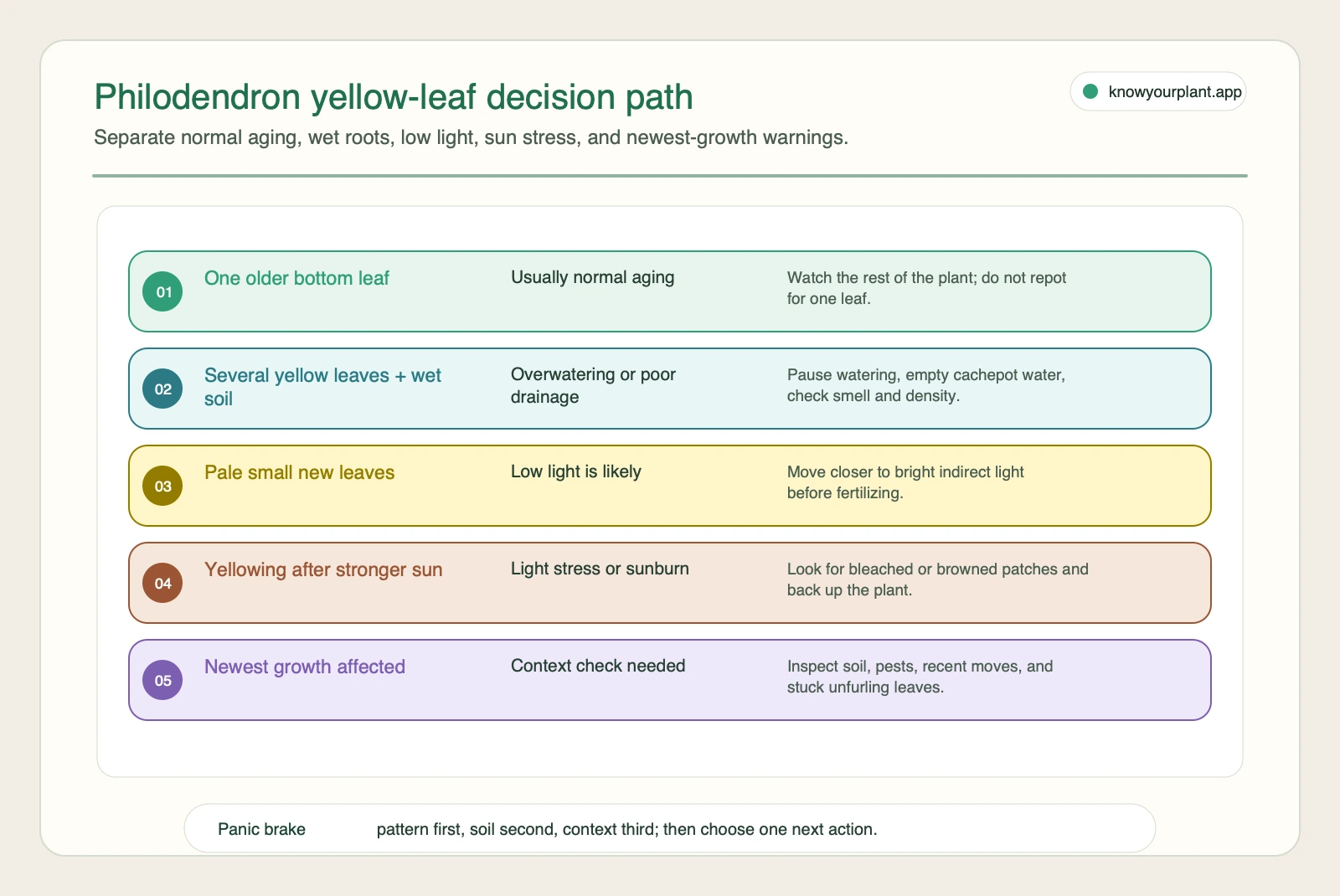
Use the decision path to separate a normal old leaf from wet roots, low light, sun stress, or newest-growth warnings before repotting.
Brown tips
Brown tips on otherwise healthy leaves usually mean one of three things:
- dry air,
- inconsistent watering,
- or heat and airflow stress.
If only the very tip is affected, think environment first. If the whole edge is crisping, check for direct sun or a heat source nearby.
Pests
Philodendrons can get spider mites, mealybugs, and scale, especially when the air is dry and the plant is already a bit stressed.
- Spider mites leave fine webbing and dusty-looking stippling.
- Mealybugs look like tiny bits of cotton tucked where leaves meet stems.
- Scale looks more like fixed brown bumps.
Check under the leaves when you water. If you spot pests, isolate the plant first. Then treat based on what you actually see. For light mealybug patches, 70% isopropyl alcohol on a cotton pad can help with direct contact. For broader treatment, the neem oil guide explains how to use it carefully. If the problem is spreading, the spider mite guide and mealybug guide are the next step.
Common Mistakes With Philodendrons
Treating every philodendron like one plant
Heartleaf, Brasil, and upright self-heading types do not dry at the same speed. That matters.
Watering because it has been a week
A calendar can remind you to check. It cannot tell you whether the roots are ready.
Potting into something too large
Extra wet soil around a modest root ball creates problems quietly.
Ignoring the support question
If a climbing philodendron keeps getting longer but not fuller, she may not need more water. She may need brighter light or something to climb.
Changing three things at once
If you move her, repot her, feed her, and change watering all on the same weekend, you learn nothing from the result. Change one thing, then watch.
Pet Safety
Philodendrons are not pet-safe. ASPCA and Merck both treat philodendron-type plants as containing insoluble calcium oxalates, which can irritate the mouth and digestive tract if chewed.
If a cat or dog bites the plant, move it out of reach and contact your veterinarian or poison control for guidance, especially if there is drooling, pawing at the mouth, vomiting, or obvious discomfort. If you need safer options, the cat-safe plants guide is a better place to browse.
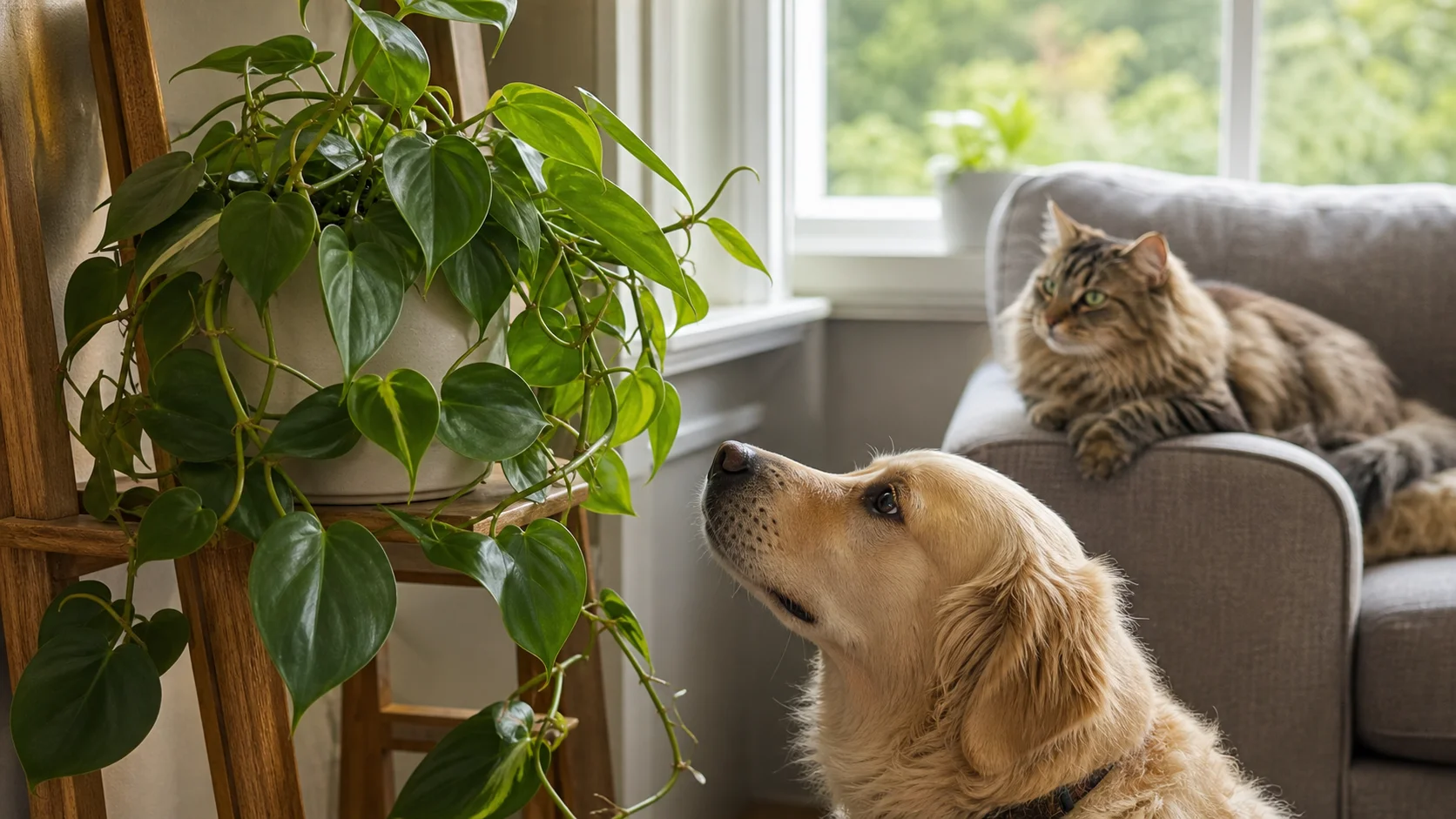
A curious pet can still reach trailing vines when the pot sits on a low shelf, so secure the whole plant beyond reach.
Propagation
Heartleaf and Brasil are some of the easiest houseplants to propagate, which is one reason people get attached to them so quickly.
Cut just below a node, the little bump where a leaf or aerial root emerges. Put the cutting in water or moist soil and keep it in bright indirect light. Roots usually appear within two to four weeks.
A few practical notes matter here:
- a healthy node matters more than extra leaves,
- several short cuttings make a fuller pot faster than one long cutting,
- and fresh cuttings like slightly steadier moisture than a mature plant.
If you want the full step-by-step, the plant propagation guide covers it in more detail.
If you are troubleshooting another common plant symptom, see Philodendron Yellow Leaves: Old Leaf, Wet Roots, or Light Stress? for a focused diagnosis and recovery plan.
Real User FAQ from Philodendron Owners
These are the questions that keep showing up in search snippets and plant forums, not just the tidy FAQ prompts that generic care roundups like to use.
Is a dried cataphyll normal, or does it mean my philodendron is stuck?
Usually normal if the leaf already opened and the rest of the plant still looks steady. A cataphyll often dries into a papery sheath after a new leaf emerges. Treat it as a warning sign only when it comes with stalled growth, soggy mix, or a soft stem base.
Why is one newer leaf yellow if the rest of the plant looks okay?
Do not jump straight to root rot. Recent moves, a leaf that struggled to unfurl, mild pest pressure, low light, or wet soil can all affect newer growth first. Check context before repotting: soil moisture, underside of leaves, and whether the plant was recently moved.
Are philodendrons really as easy as pothos?
Heartleaf types are close, but the care is not identical. Philodendrons usually give you more growth signals through cataphylls, leaf size, and climbing behavior, and self-heading types are less forgiving of constantly damp soil than a sturdy pothos.
How do I tell if my philodendron wants a pole or just better light?
Often both matter, but in different ways. If internodes are stretching and new leaves are shrinking, increase light first, then decide whether a climbing type would benefit from support. A pole will not fix soggy roots, but it can improve leaf size and growth habit once the basics are right.
Frequently Asked Questions
How often should I water my philodendron?
There is no useful fixed schedule for every home. Check the soil instead. Water when the top 3 to 4 centimetres feel dry and the layer underneath is starting to dry too. In brighter warmer rooms that may be about once a week. In winter it is often less.
Why are my philodendron leaves turning yellow?
Usually because the mix is staying wet too long, but not always. Start by asking whether it is one old leaf or several leaves, then check soil moisture. Wet soil plus multiple yellow leaves points to overwatering. Pale smaller new leaves point more toward low light.
Are philodendrons as easy as pothos?
Heartleaf philodendrons are very close. They are forgiving and beginner-friendly. The difference is that philodendrons often give clearer growth signals, and self-heading philodendrons are a little less tolerant of sloppy watering.
Can philodendrons grow in low light?
They can survive it, but they usually get leggier and smaller over time. Bright indirect light keeps the shape fuller and the leaves healthier.
What is the difference between a climbing and a self-heading philodendron?
Climbing types send out vines and can trail or climb. Self-heading types grow from a central base and stay more upright. Climbers usually dry faster and respond well to support. Self-heading types often need a slightly more careful watering rhythm.
When should I repot my philodendron?
Repot when roots crowd the pot, come through drainage holes, or the mix stays soggy or has broken down. Spring is easiest, but you can repot any time if the plant clearly needs help.
How do I make my philodendron fuller?
Prune long stems just above a node, root the cuttings, and plant them back into the pot. Better light and a support pole also help a lot.
Why does my philodendron have brown tips but otherwise healthy leaves?
That usually points to dry air, heater airflow, or uneven watering rather than a major health crisis. Check what changed in the room before assuming it is something dramatic.
Methodology and Editorial Trust
Author: KnowYourPlant editorial team
Reviewer: Editorial review completed for Research Pack remediation
Review status: Editorial review completed for this remediation pass
Last updated: 2026-05-26
This guide was rebuilt around the real confusion philodendron owners run into most often: yellow leaves that are not all the same problem, pothos-style advice being applied too broadly, and normal signals like cataphylls and aerial roots being mistaken for trouble.
For trust, the care and diagnosis logic here was aligned to Clemson Cooperative Extension guidance for philodendron forms, UC IPM troubleshooting guidance for houseplant decline patterns, and ASPCA plus Merck veterinary references for pet-safety limits.
Freshness Note
Philodendron basics do not change much, but cultivar naming, online advice, and shopping language change constantly. If your plant looks suddenly worse, trust the pattern you see in your home over a one-size-fits-all weekly schedule from a generic roundup.
A Good Starting Point
If you remember only three things, let them be these:
- match care to the kind of philodendron you actually have,
- check the soil before you water, not the calendar,
- and read the pattern of change before assuming the cause.
Philodendrons are forgiving, but they are also honest. She usually tells you what is wrong while the fix is still simple.
If you want a broader foundation for tropical houseplants, the indoor plant care guide for beginners is a helpful next step.
If you are still torn between thirst, too much water, low light, or pests, use KnowYourPlant to log a photo, track what changed, and get the next care step in one place: https://knowyourplant.app
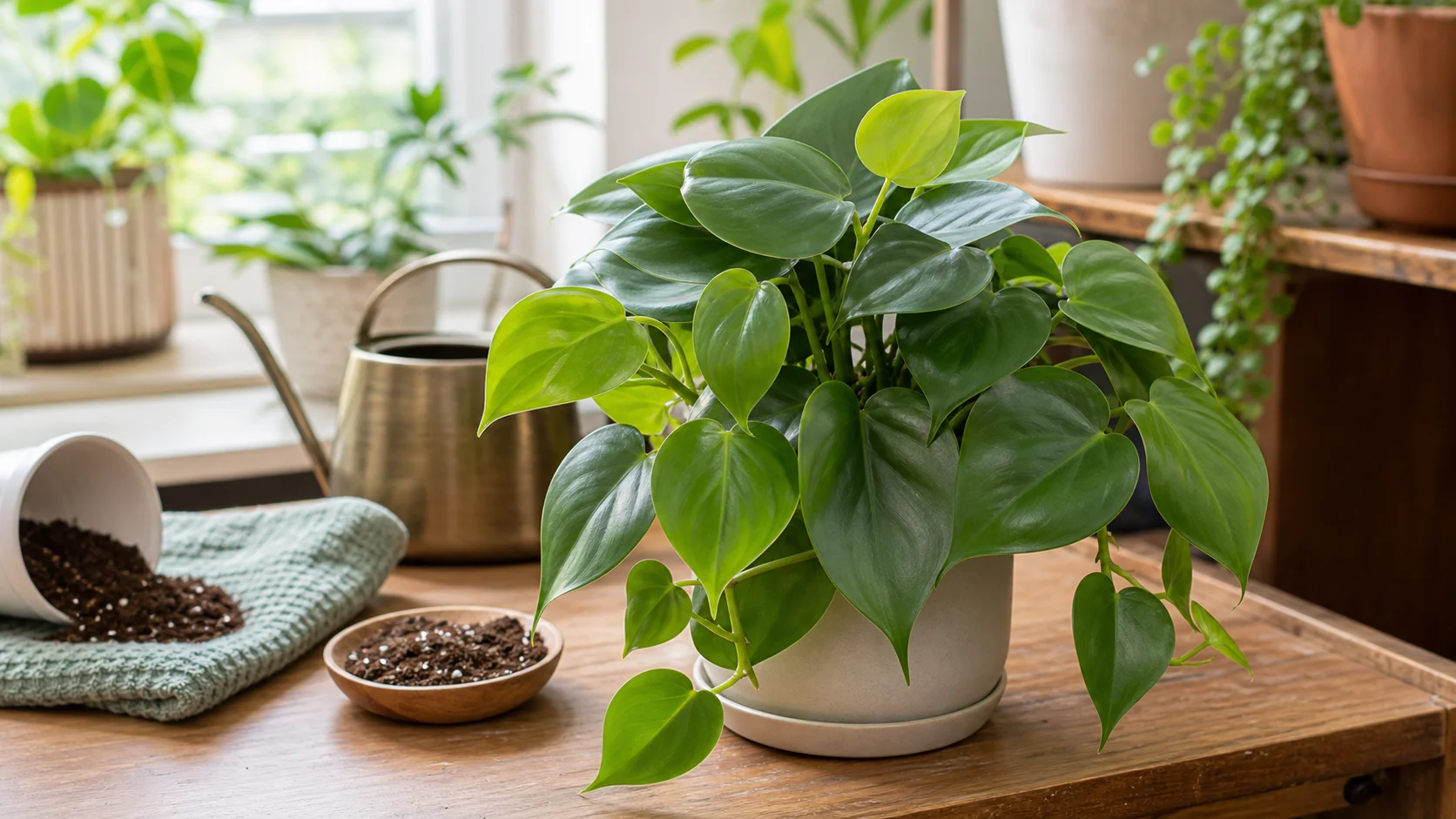
Start with the philodendron type, an airy mix, a draining pot, and a soil check before each watering.