If you just brought home your first rare plant, this guide is for you before it’s for anyone still deciding what to buy. You’ve paid real money for something that looked extraordinary in a seller’s photo, and now it’s sitting in your home looking completely still. No new leaves. Maybe some yellowing. You’re not sure if that’s normal or if something is already going wrong. Before the next purchase, use the guide to buying plants online for seller and shipping checks; for recurring surprise deliveries, compare the plant subscription box review first.
That’s the question most rare plant guides never answer. This one takes a different angle: first-month survival, honest 1-5 care risk ratings, and a plain answer to whether a plant is realistic for your home right now or better admired from a distance until your setup is steadier.
About this guide: This is a source-led buyer and care guide, not a personal grow-room diary. The buyer-safety sections were updated against current collector pain points plus ASPCA pet-toxicity listings, University of Minnesota Extension guidance on pests and Monstera propagation, Penn State Extension guidance on indoor humidity, and USDA APHIS rules around importing plants. Community discussion is used as qualitative signal, not as horticultural proof.
Rare Houseplant Identification Snapshot
Before you buy or intervene, get four basic signals straight. This is the fastest way to separate a rare plant that needs patience from one that needs a real correction.
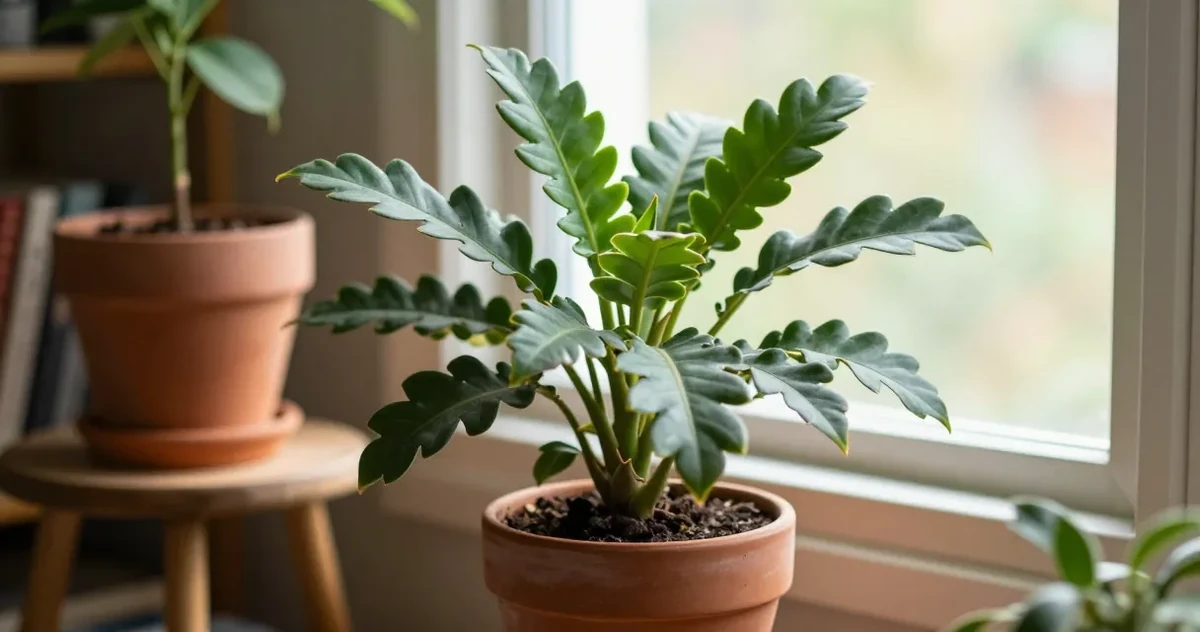
Stable foliage, distinct growth habits, and a realistic care setup provide the first signals for identifying a rare houseplant’s needs.
| Snapshot signal | What to check | Why it matters |
|---|---|---|
| Existing leaf condition | Are the current leaves holding firmness and colour? | Stable old growth usually tells you more than the absence of a new leaf in the first month. |
| Growth habit | Is this a crawler, climber, rosette, mounted fern, or succulent? | The right support, pot shape, and watering style depend on the habit as much as the species name. |
| Humidity sensitivity | Is it a normal-home plant, a humidity-lover, or a true collector setup plant? | Many expensive rare plants fail because the room, not the watering, is the mismatch. |
| Label credibility | Does the seller’s label match the plant form, price range, and provenance? | Rare-plant buying mistakes often start before care begins, especially with collector names like Monstera obliqua. |
What Most Rare Plant Guides Get Wrong
Most rare plant content is built around desirability. It tells you what a plant looks like, where it comes from, and why collectors want it. That’s useful when you’re deciding what to search for. It’s much less useful when you’re standing over a plant that hasn’t moved in three weeks wondering if you’ve already failed.
The most common misdiagnosis with rare houseplants is treating normal transition stress as a problem that needs fixing.
Plants shipped through the post go through temperature swings, root disturbance, and days of darkness. Most respond by doing almost nothing. They hold their existing leaves, skip visible growth, and spend time re-establishing roots before they do anything dramatic above the soil line.
The practical first check: look at the leaves the plant already has, not at the absence of new ones. If the existing leaves are holding colour and texture, the plant is coping. If existing leaves are yellowing, softening, or dropping, that is worth investigating. New growth is a bonus. Stable old growth is the real early signal.
How the Care Risk Rating Works
The original problem with most rare plant lists is that “easy” and “hard” stay vague. So this guide uses a formal care risk rating.
| Care risk | What it means in real life | Good fit for |
|---|---|---|
| 1/5 | Hard to mess up if light is roughly right and you do not overwater | Beginners with some plant basics |
| 2/5 | Forgiving, but has one care habit you need to respect | Newer plant owners ready for something unusual |
| 3/5 | Reasonable if your light and watering habits are already decent | Intermediate growers |
| 4/5 | Punishes drift in humidity, watering, or temperature | Experienced indoor growers |
| 5/5 | Buy only if your setup is already dialed in | Collector-level or very controlled homes |
If this is your first rare plant, stay mostly in the 1/5 to 3/5 lane. Rare does not have to mean miserable.
Quick Start: Best First Rare Plants vs Plants to Wait On
If you do not want to read all 20 entries before deciding, start here.
Best first rare plants
- Philodendron gloriosum
- Anthurium crystallinum
- Hoya obovata
- Haworthia cooperi
- Gasteria batesiana
Good for pet households
- Hoya obovata
- Variegated String of Hearts
- Rhipsalis baccifera
- Staghorn Fern
- Haworthia cooperi
- Gasteria batesiana
- Tillandsia xerographica
Wait until your setup is stronger
- Monstera obliqua
- Tacca chantrieri
- Calathea ‘White Fusion’
That shortlist is not about rarity prestige. It is about how likely the plant is to forgive a normal home.
Buyability Rubric: Is This Rare Plant Actually Worth Buying for Your Setup?
Before paying collector prices, score the plant on five practical dimensions.
| Dimension | Low-risk answer | High-risk answer |
|---|---|---|
| Care fit | Works in bright indirect light and ordinary home humidity | Needs cabinet, greenhouse, or constant humidity management |
| Failure mode | Decline is slow and reversible | Root rot, melt, pest spread, or shipping shock can compound fast |
| Sourcing confidence | Nursery-propagated, exact plant photos, clear seller history | Vague listing, stock photos, no node/root proof, unclear origin |
| Pet risk | Confirmed pet-safe by scientific name | Toxic to cats or dogs, or safety is unclear |
| Long-term value | Distinctive growth habit or foliage you can actually maintain | Mostly hype, price inflation, or a name you cannot verify |
If three or more of your answers land in the high-risk column, skip the purchase for now or downgrade to a hardier plant on the shortlist above.
Rooted Plant, Cutting, Tissue-Culture Starter, or Skip It?
Use this decision tree before checkout.
| If this sounds like you… | Best choice | Why |
|---|---|---|
| You want the lowest drama and do not already run a humidity cabinet | Buy a rooted plant | Recovery odds are better and you can judge the existing leaves and roots |
| You understand nodes, rot, and acclimation risk | Consider a cutting only with clear node and root proof | A cutting is cheaper up front but less forgiving after shipping |
| You are comfortable growing out a smaller plant slowly | Tissue-culture starter from a reputable nursery | Cleaner genetics and lower scam risk, but slower gratification |
| The listing is vague, suspiciously cheap, or missing root and origin details | Skip it | Rare-plant losses often begin at checkout, not in care |
Sourcing Checklist and First-Week Quarantine
Before you buy, ask for:
- the exact plant in the listing, not a reference photo
- visible node and root photos for cuttings and expensive aroids
- the seller’s weather policy and shipping origin
- confirmation that the plant is nursery-propagated if rarity or legality looks uncertain
- import or phytosanitary paperwork when a cross-border order requires it
After arrival:
- Photograph the plant and roots right away.
- Inspect leaf undersides, stems, petioles, soil surface, and roots for pests or rot.
- Keep the plant isolated from the rest of your collection for a quarantine period.
- Do not repot on day one unless rot, pests, or saturated media make intervention necessary.
- Let the plant rehydrate and stabilize before you change the light, medium, or watering rhythm.
Expert note: USDA APHIS rules can apply when plants cross borders, and ASPCA toxicity checks should be done by scientific name, not a casual seller label. For rare aroids and cuttings, University of Minnesota Extension’s Monstera propagation guidance is a good reminder that a viable node matters more than a pretty leaf.
Three Rare-Plant Patterns Worth Knowing Before You Buy
These patterns come up often enough in specialist rare-plant discussions to treat them as useful buying context, even without pretending they are formal statistics.
The first-month trap. New buyers often treat visible movement as success and stillness as failure. In reality, a shipped plant doing nothing for four weeks is usually acclimating, not declining.
The six-to-eight-week window. Rare plants, especially shipped or imported ones, often need a stabilisation window before they behave like themselves. That means no repotting spree, no panic fertilising, and no moving the plant every few days because nothing exciting is happening yet.
The obliqua problem. Monstera obliqua is one of the most commonly overclaimed names in the hobby. If a plant is being sold at an ordinary houseplant price with no convincing collector provenance, skepticism is smart. Buy Monstera adansonii intentionally if that is what you actually want. It is a good plant and does not need a fancier label to earn a place in your home.
Social Listening: What Collectors Actually Panic About
Recent collector discussions kept surfacing the same four anxieties in rare-plant communities:
- imported or shipped plants arriving in odd media, then leaving the owner unsure whether to move them into water, sphagnum, a humidity bin, or ordinary room conditions immediately
- the first six to eight weeks after shipping feeling ambiguous enough that people over-intervene before the plant has even stabilized
- Monstera obliqua labels creating confusion and overpayment risk when the plant is really adansonii-type material
- yellowing, curling, or stillness triggering panic even when the plant is showing normal shipping stress rather than real decline
Those community patterns are qualitative, not statistical. They still matter because they show where new collectors actually lose confidence and start making expensive mistakes.
Lookalikes and Confused-With Checks
| Plant or situation | Commonly confused with | What to verify before you buy or intervene |
|---|---|---|
| Monstera obliqua | Monstera adansonii and other obliqua-labeled adansonii types | Check provenance, mature leaf form, and whether the seller is offering collector-level proof instead of a dramatic label alone. |
| Full Hoya kerrii plant | the single heart-leaf cutting sold as a long-term plant | Make sure there is a node and active stem if you want future vine growth, not only a decorative rooted leaf. |
| Shipping stillness | “the plant is failing” | A plant doing very little for several weeks can be acclimating, especially after shipping or import. Judge the existing leaves before chasing new growth. |
| Leaf yellowing after arrival | a universal watering problem | Yellowing can come from shipping stress, root damage, or moisture mistakes. Inspect the root-zone pattern before reacting with more water or an immediate repot. |
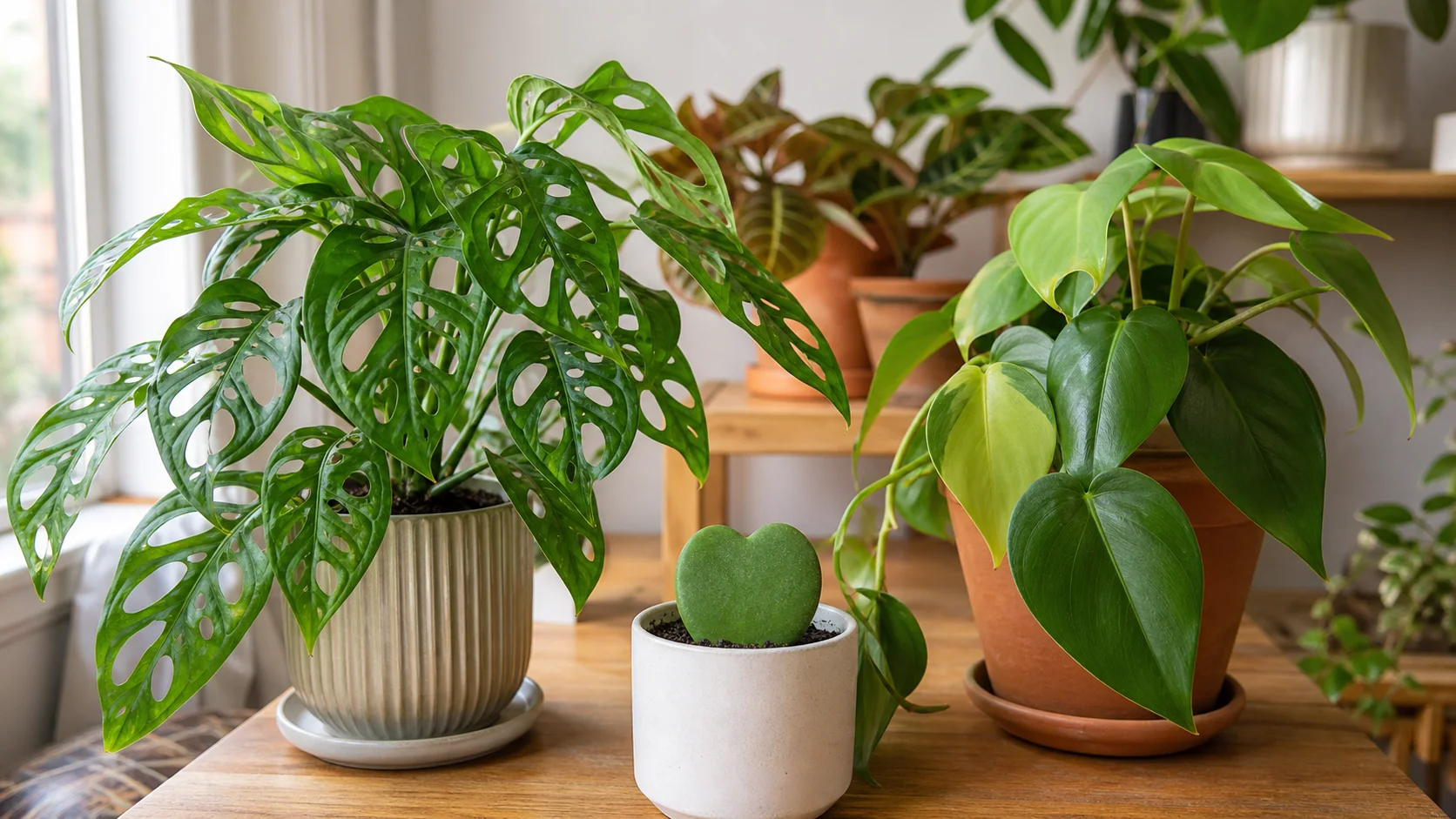
Comparing fenestrated Monstera foliage, a single heart-leaf cutting, and a full vine makes growth-form checks easier before buying.
First Month Survival Protocol
Most rare plant losses happen in the first eight weeks, usually because of well-intentioned interventions that stack extra stress on top of shipping stress.
Week 1: Place it and leave it
Put the plant where you already planned to keep it. Check the existing leaves. Are they holding colour and firmness? If yes, leave the plant alone.
Do not repot. Do not fertilise. Do not start hunting for a “better spot” on day two.
The only thing worth checking closely is soil moisture. If the mix is bone dry from shipping, water lightly. If it is already moist, do not add more just because the plant looks dramatic.
Weeks 2-4: Stable routine, nothing heroic
Start a consistent watering routine based on the care specs below. No fertiliser yet. The roots need to re-establish before they can use nutrients well.
If growth is slow, resist moving the plant around. Rare aroids especially stop cold when conditions keep changing. A quiet plant is not necessarily a failing plant.
Weeks 4-8: First honest assessment
By week four, look at the leaves the plant already has.
- If they are still holding firm, the plant has likely settled.
- If a new leaf is beginning to move, conditions are probably right.
- If existing leaves are yellowing or softening, check the roots and the moisture pattern before you do anything else.
If you need a low-drama rescue path for a stressed arrival, our how to repot plants guide covers when intervention actually helps instead of making things worse.
Common Rare-Plant Buying Mistakes
- buying the cheapest listing instead of the clearest listing
- paying for a dramatic species name without provenance or node proof
- skipping quarantine because the plant looks clean at first glance
- overwatering a stressed cutting because stillness feels like thirst
- ignoring pet toxicity because the plant is being sold as decor, not as a chewing risk
- importing or accepting cross-border shipments without checking whether paperwork or bare-root handling is required
Common Problems in the First 6-8 Weeks
| Symptom | Most likely explanation | Calm next step |
|---|---|---|
| Existing leaves stay firm but no new growth appears | normal acclimation | Hold the plant steady, keep light consistent, and judge progress over weeks, not days. |
| One or two older leaves yellow after shipping | transition stress or root disturbance | Check moisture, avoid fertilizing, and give the plant time before changing the setup. |
| Curled or soft leaves on a fresh import | humidity stress, root stress, or both | Raise humidity gradually, keep airflow moving, and avoid stacking repot stress on top of shipping stress. |
| Crispy edges on humidity-loving aroids or calatheas | dry air, drafts, or abrupt room changes | Move away from vents and dry heat, then improve humidity with a measured method rather than extra watering. |
| Mushy stem base or rotting succulent tissue | excess water or trapped moisture | Reduce watering, improve drainage or airflow, and intervene at the roots only if decline keeps spreading. |
Care Cards by Risk Group
Starter care cards
- Best beginner-friendly rare picks: Hoya obovata, Haworthia cooperi, Gasteria batesiana, Rhipsalis baccifera
- What they reward: restraint, bright-to-moderate light, and letting the mix dry appropriately
- What usually kills them: treating unusual plants like they need constant moisture or constant intervention
Intermediate tropical care cards
- Best fits: Philodendron gloriosum, Anthurium crystallinum, Philodendron melanochrysum, Alocasia ‘Black Velvet’
- What they reward: consistent bright indirect light, warm conditions, and a stable routine more than heroic humidity chasing
- What usually goes wrong: burying crawler rhizomes, letting wet soil linger, or moving the plant around every few days
Collector-only care cards
- Best fits only if your setup is already proven: Monstera obliqua, Tacca chantrieri, Calathea ‘White Fusion’
- What they reward: already-stable humidity, warmth, and experience noticing decline early
- What usually goes wrong: buying for rarity first and then trying to engineer the environment after the stress has started
First-month care card for shipped or imported plants
- Week 1: place the plant, assess the existing leaves, and resist repotting unless the medium or roots are clearly failing
- Weeks 2-4: keep the routine boring and consistent, because stability matters more than optimization here
- Weeks 4-8: judge the plant by whether old growth is holding and whether new decline is spreading, not by whether it is performing dramatically yet
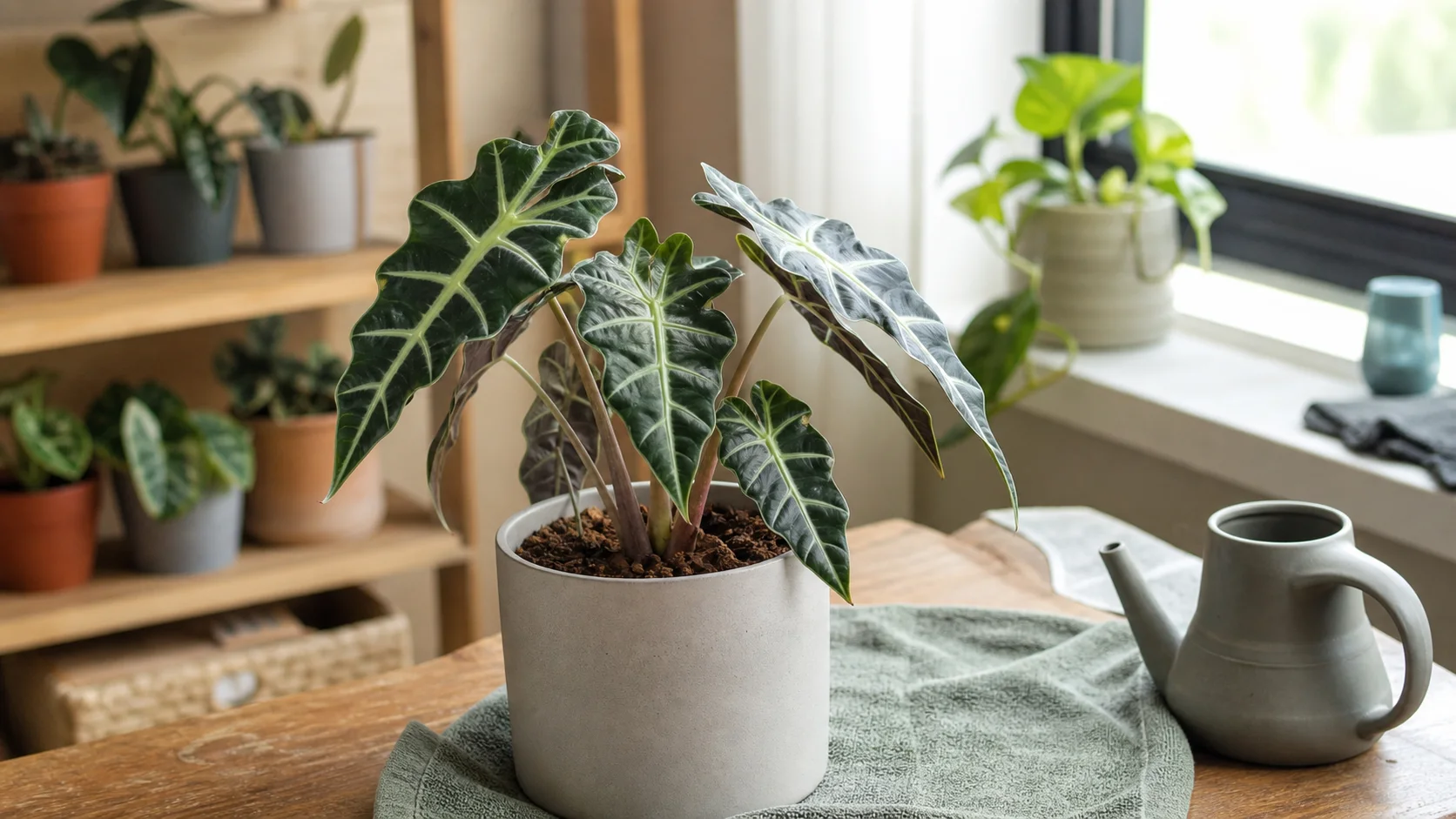
A stable bright-indirect position and restrained watering give a shipped rare plant time to settle before any major intervention.
Care at a Glance: All 20 Plants
| Plant | Care risk | Light | Humidity | Pet safe | First thing to watch |
|---|---|---|---|---|---|
| Philodendron gloriosum | 3/5 | Bright indirect | 60-70% | No | Rhizome staying above soil, not buried |
| Anthurium crystallinum | 3/5 | Bright indirect | 60-80% | No | Tip burn and petiole softening |
| Philodendron melanochrysum | 3/5 | Medium-bright indirect | 60-70% | No | Climbing support and pale new leaves |
| Alocasia ‘Black Velvet’ | 2/5 | Bright indirect | 50-60% | No | Wet soil lingering too long |
| Monstera obliqua | 5/5 | Bright indirect | 70-80%+ | No | Mislabeling before care even starts |
| Hoya obovata | 1/5 | Bright indirect | 40-60% | Yes | Soggy soil, not dryness |
| Ceropegia woodii variegata | 2/5 | Bright indirect | 40-50% | Yes | Variegation fading from weak light |
| Rhipsalis baccifera | 1/5 | Low-medium indirect | 40-60% | Yes | Base mush from overwatering |
| Selenicereus anthonyanus | 1/5 | Medium indirect | 40-60% | Yes | Limp stem joints after cold or overwatering |
| Platycerium bifurcatum | 3/5 | Bright indirect | 50-70% | Yes | Cutting off brown basal fronds by mistake |
| Tacca chantrieri | 5/5 | Shaded indirect | 70-80%+ | Yes | Humidity and warmth collapsing together |
| Tillandsia xerographica | 2/5 | Bright indirect | 50-70% | Yes | Water trapped in the base |
| Haworthia cooperi | 1/5 | Bright indirect | 30-50% | Yes | Overwatering in low light |
| Fenestraria rhopalophylla | 2/5 | Bright direct/indirect | 30-50% | Yes | Rot from “just one extra watering” |
| Lithops | 4/5 | Bright direct | 30-50% | Yes | Watering during leaf change |
| Gasteria batesiana | 1/5 | Low-medium indirect | 30-50% | Yes | Water sitting too long in heavy soil |
| Begonia maculata | 2/5 | Bright indirect | 50-60% | No | Mildew from stale, damp air |
| Oxalis triangularis | 1/5 | Bright indirect | 40-60% | No | Mistaking dormancy for death |
| Calathea ‘White Fusion’ | 5/5 | Medium indirect | 60-70%+ | Yes | Tip burn from low humidity or tap water |
| Hoya kerrii (full plant) | 1/5 | Bright indirect | 40-60% | Yes | Buying the single leaf instead of a real plant |
Best by Buyer Type
| If you want… | Best bets | Skip for now |
|---|---|---|
| First rare aroid | Philodendron gloriosum, Anthurium crystallinum, Philodendron melanochrysum | Monstera obliqua |
| Low-drama unusual plants | Hoya obovata, Rhipsalis, Haworthia, Gasteria | Tacca chantrieri |
| Pet-safer collector look | Hoya obovata, Rhipsalis, Haworthia, Staghorn Fern | Philodendrons, Anthuriums, Alocasias |
| A real challenge | Calathea ‘White Fusion’, Tacca chantrieri, genuine Monstera obliqua | None, if your setup is not ready |
Aroids: The Core of the Rare Plant World
Kew’s Plants of the World Online database lists more than 3,700 described species in the Araceae family, which includes monsteras, philodendrons, and anthuriums. Most will never show up in an ordinary garden centre. That gap between what exists and what is widely sold is exactly where much of the rare-plant market lives.
That also means many buyers end up with plants that are visually dramatic but much less forgiving than the common pothos or peace lily they started with.
If your home cannot provide at least bright indirect light for several hours a day, a lighting upgrade will help more than any fancy fertiliser. Our grow lights for indoor plants guide covers the practical setup side without overcomplicating it.
1. Philodendron gloriosum
Care risk: 3/5 | Good starting rare aroid
- Watering: Every 7-10 days. Wait for the top 2 cm of soil to dry before watering again.
- Humidity: 60-70%
- Temperature: Minimum 18C
- Light: Bright indirect, ideally 6+ hours daily
A crawler, not a climber. Gloriosum moves horizontally across the soil and sends up broad, heart-shaped leaves with pale veins. It is slow enough to make people nervous and steady enough to reward patience.
What matters most here is the rhizome. It should sit above the mix, not buried in it. A buried, wet rhizome is the fastest route to rot.
Green flag: A new leaf emerging tightly furled from the rhizome tip, with existing leaves staying dark and firm.
Yellow flag: Softness or discoloration on the rhizome itself, or an older leaf yellowing from the base outward.
2. Anthurium crystallinum
Care risk: 3/5 | Good starting rare aroid
This entry covers a foliage species. If yours has waxy red, pink, or white spathes, use the indoor anthurium care guide for the common flowering hybrids instead.
- Watering: Every 7-10 days. Let the top 2-3 cm dry, but do not let the mix go bone dry.
- Humidity: 60-80%
- Temperature: Minimum 16C
- Light: Bright indirect only
Crystallinum leaves are long, velvety, and dramatic enough to make people think the plant is harder than it is. The real trick is not exotic care. It is consistency.
This plant hates cold drafts and sudden shifts. It can also look slightly limp while adjusting to a new spot without anything being fundamentally wrong.
Green flag: A new dark leaf beginning to unfurl, with silver veining already visible.
Yellow flag: Yellowing appearing in the centre of an older leaf, or any translucent patch along the petiole near the soil line.
3. Philodendron melanochrysum
Care risk: 3/5 | Climber
- Watering: Every 7-10 days
- Humidity: 60-70%
- Temperature: Minimum 16C
- Light: Medium to bright indirect
Melanochrysum gives you those long velvet leaves that emerge bronze and deepen over time. It is more satisfying than gloriosum if you like visible progress, but it does need something to climb.
If you grow it without support, you usually get smaller, less impressive leaves and a plant that looks moodier than it really is.
Green flag: New bronze growth darkening steadily over a few weeks.
Yellow flag: Pale new leaves or limp older foliage when the soil is not actually dry.
4. Alocasia ‘Black Velvet’
Care risk: 2/5 | Compact
- Watering: Every 10-14 days. Let the top half of the soil dry first.
- Humidity: 50-60%
- Temperature: Minimum 15C
- Light: Bright indirect
This is one of the better rare-looking plants for ordinary homes. It stays compact, the leaves are dramatic, and it tolerates normal indoor humidity better than many larger alocasias.
The main thing that scares people is dormancy. If it slows down or drops leaves in winter, that is often rest, not death.
Green flag: Leaves upright and firm with strong white veining.
Yellow flag: More than one leaf yellowing at once in active growth, especially if the soil stays wet for more than a week.
5. Monstera obliqua
Care risk: 5/5 | High skepticism required
- Watering: Every 7-10 days, with consistent but not soggy moisture
- Humidity: 70-80% minimum
- Temperature: Minimum 18C
- Light: Bright indirect
Misidentification warning: Almost every plant sold as Monstera obliqua is really a Monstera adansonii. The adansonii is still worth growing. It just is not the same plant.
If you do find a genuine obliqua through a reliable collector source, it needs stable warmth, high humidity, and very little environmental drama. This is not the plant to learn rare-plant basics on.
Green flag: Mature leaves with extreme fenestration and new leaves forming with holes already visible.
Yellow flag: Crisp browning edges from dry air, or wilt despite moist soil.
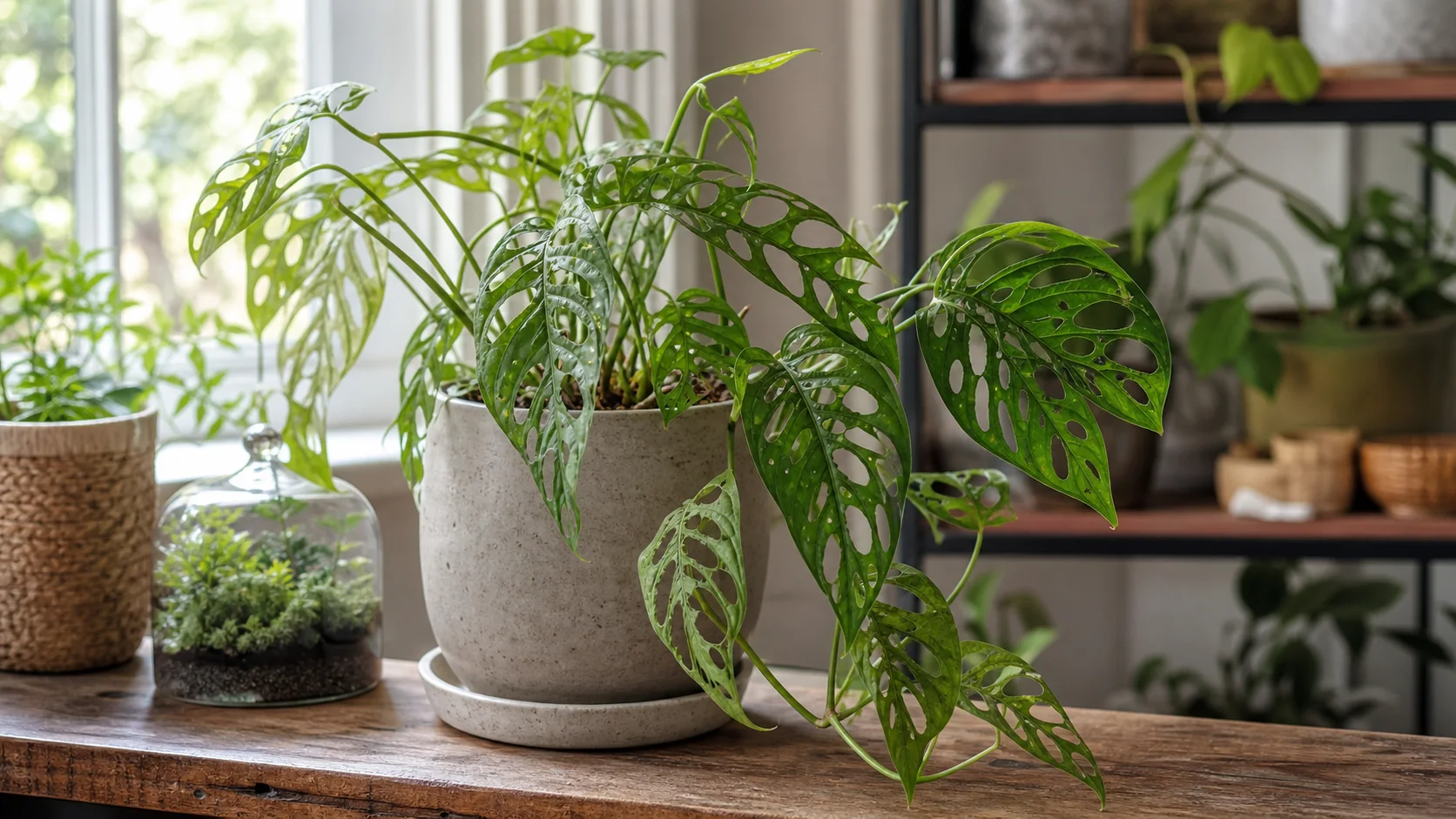
Extremely fenestrated, thin leaves and a stable warm, humid setup distinguish a collector-sourced Monstera obliqua from common lookalikes.
Trailing and Climbing Plants
6. Hoya obovata
Care risk: 1/5 | Very forgiving
- Watering: Every 10-14 days. Let the soil dry almost completely.
- Humidity: 40-60%
- Temperature: Minimum 15C
- Light: Bright indirect
If you want one rare-looking plant that does not punish you for being busy, start here. Thick leaves, silver flecking, and very little drama.
A full care walkthrough is in the hoya plant care guide, but the short version is simple: bright light, dry-down between waterings, and no soggy soil.
7. Ceropegia woodii variegata (Variegated String of Hearts)
Care risk: 2/5 | Needs more light than the plain form
- Watering: Every 10-14 days. Let the soil dry fully.
- Humidity: 40-50%
- Temperature: Minimum 10C
- Light: Bright indirect, with some gentle morning sun if possible
The cream and pink variegation is the whole point, and it fades if the plant sits too dim. This one is still friendly, but less forgiving than the plain green form if you under-light it and overwater it at the same time.
8. Rhipsalis baccifera
Care risk: 1/5 | One of the easiest plants on this list
- Watering: Every 10-14 days in summer, less in winter
- Humidity: 40-60%
- Temperature: Minimum 10C
- Light: Low to medium indirect
A jungle cactus that actually makes sense in dimmer rooms. If your rare-plant taste is stronger than your natural light, this is one of the best compromises in the guide.
Green flag: Fresh stem extension in spring and summer.
Yellow flag: Mushy stem bases or orange-yellow bleaching from too much direct sun.
9. Selenicereus anthonyanus (Fishbone Cactus)
Care risk: 1/5 | Fast-growing
- Watering: Every 10-14 days in summer, less in winter
- Humidity: 40-60%
- Temperature: Minimum 10C
- Light: Medium to bright indirect
This is one of those plants that looks unusual without asking for collector-level behaviour from you. The zigzag stems are the attraction, and the care is refreshingly normal as long as drainage is good.
Green flag: New zigzag growth pushing in warm months.
Yellow flag: Limp joints or soft brown patches at stem connections.
Statement Plants That Change a Room
10. Platycerium bifurcatum (Staghorn Fern)
Care risk: 3/5 | Mounted grower
- Watering: Soak when the basal fronds feel light and papery
- Humidity: 50-70%
- Temperature: Minimum 10C
- Light: Bright indirect
The classic mistake here is tidying away the brown basal fronds because they look dead. They are not dead clutter. They are part of how the plant anchors itself.
11. Tacca chantrieri (Bat Flower)
Care risk: 5/5 | Beautiful, but demanding
- Watering: Keep evenly moist
- Humidity: 70-80%+
- Temperature: Minimum 18C year-round
- Light: Shaded indirect
This is one of the few plants in the guide where “only buy if your setup is already right” is the honest answer. If your home is not warm and humid all year, it is probably not a fair fight for the plant.
12. Tillandsia xerographica
Care risk: 2/5 | No soil, but not no care
- Watering: Mist several times a week or soak briefly once a week, then dry fast
- Humidity: 50-70%
- Temperature: Minimum 10C
- Light: Bright indirect
Tillandsias are easy right up until they stay wet in the middle too long. Always shake off excess water and let air move through the base.
Green flag: Slow, steady leaf extension and a healthy silver cast.
Yellow flag: Softness or musty smell at the base.
Low-Drama Rare Succulents (Plants 13-16)
If you want unusual plants with minimal fuss, this group is your friend. The succulent care guide covers the broad rules, but these four all reward the same thing: restraint.
Shared care logic
- Bright to very bright light
- Very infrequent watering
- Fast-draining gritty soil
- No misting, no babying
13. Haworthia cooperi
Care risk: 1/5
The best succulent starter in this guide. Transparent leaf tips, gentle growth, and more forgiving than most people expect.
14. Fenestraria rhopalophylla (Baby Toes)
Care risk: 2/5
Lovely and compact, but less tolerant of “just a little extra water” than people assume.
15. Lithops
Care risk: 4/5
The care challenge is not complexity. It is timing. Watering during the wrong point in the leaf cycle can rot the plant from the inside.
16. Gasteria batesiana
Care risk: 1/5
One of the easiest unusual plants in the whole list, and a better low-light succulent option than most people realise.
Unusual Foliage Plants
17. Begonia maculata
Care risk: 2/5 | Eye-catching and fast
- Watering: Every 7-10 days
- Humidity: 50-60% with airflow
- Temperature: Minimum 15C
- Light: Bright indirect
A rare-looking plant that does not behave like a diva. The main risk is stale damp air, which invites mildew faster than most beginners expect.
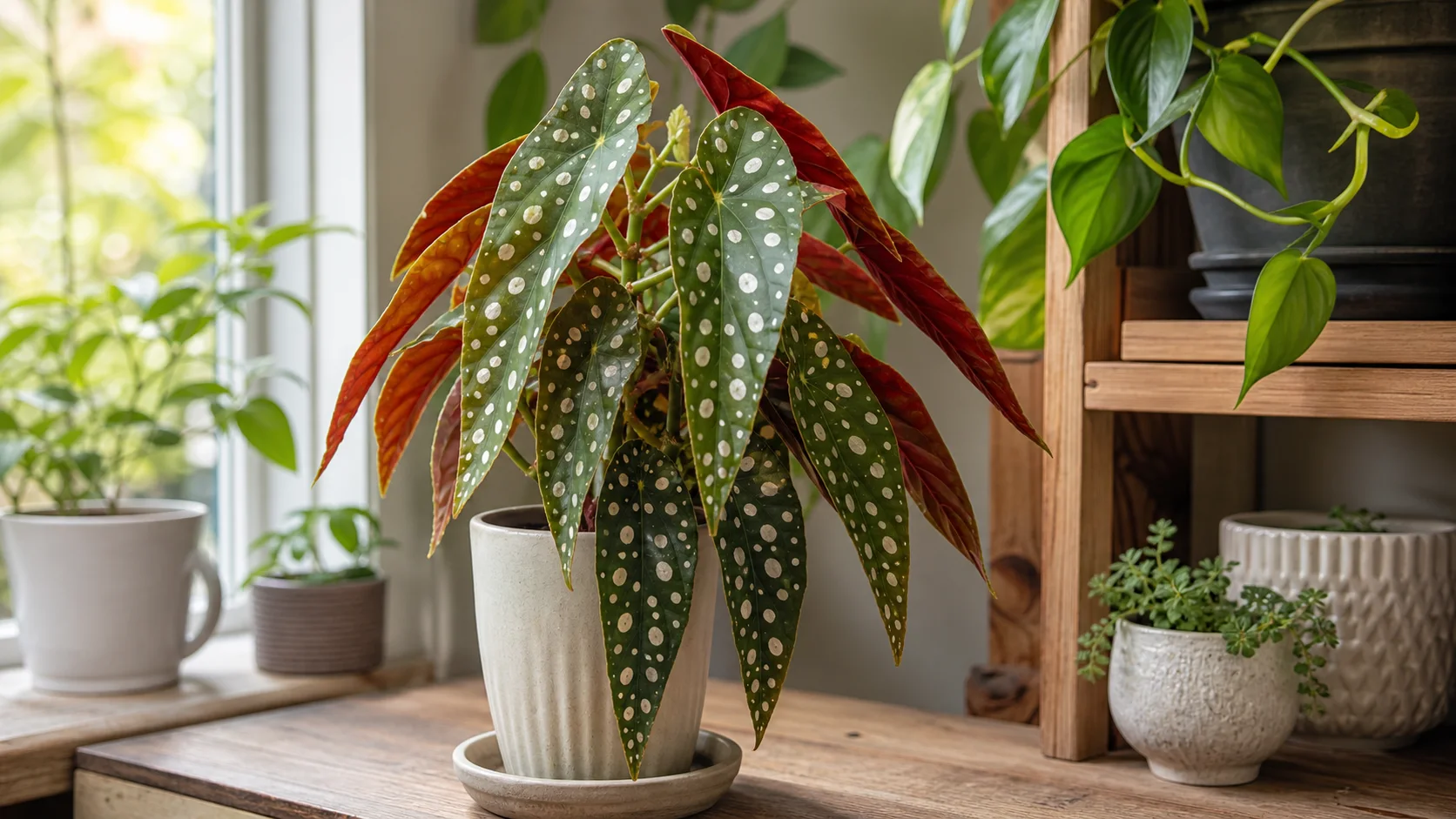
Silver-spotted leaves and red undersides stay healthy in bright indirect light when the plant has a draining pot and room for airflow.
18. Oxalis triangularis
Care risk: 1/5 | Easy, but surprising
- Watering: Every 7-10 days in growth, much less in dormancy
- Humidity: 40-60%
- Temperature: Minimum 5C
- Light: Bright indirect
The folding leaves and dormancy phase scare people the first time. Once you know the pattern, it becomes one of the most satisfying plants to keep.
19. Calathea ‘White Fusion’
Care risk: 5/5 | Experienced grower plant
- Watering: Even moisture with filtered, rain, or otherwise suitable low-mineral water
- Humidity: 60-70%+
- Temperature: Minimum 18C
- Light: Medium indirect
If you are not already succeeding with other calatheas, do not let this be your experiment. The calathea care guide is worth reading first, especially the humidity and water-quality parts.
20. Hoya kerrii (full plant)
Care risk: 1/5 | Only if it is a real plant
- Watering: Every 10-14 days
- Humidity: 40-60%
- Temperature: Minimum 15C
- Light: Bright indirect
Before you buy the heart leaf: A single heart-shaped Hoya kerrii leaf without a node usually will not become a real vine. It is a living decoration, not a plant that is likely to grow onward.
If you want a real growing plant, buy the full kerrii with a node and active stem, not the novelty leaf.
Seasonal Care Calendar
Spring (March-May)
- Aroids: Resume light feeding and slightly more frequent watering as growth returns.
- Alocasia ‘Black Velvet’: Watch for dormancy ending and fresh growth from the corm.
- Hoyas: Increase watering gradually and leave old flower spurs alone.
- Lithops: Only resume watering after the new leaf pair is fully formed and the old one is fully spent.
Summer (June-August)
- Aroids: Peak growth season, but also the season when dry air from air conditioning can quietly slow them down.
- Fishbone cactus and begonias: Usually their most active period.
- White Fusion: Humidity slips become obvious fast in summer if the room is air-conditioned.
Autumn (September-November)
- Aroids: Ease off fertiliser and let growth slow naturally.
- Black Velvet: Leaf drop can be dormancy, not disaster.
- Fishbone cactus: Slightly cooler conditions can help set up future flowering.
- Lithops: Stop watering during the leaf-change period.
Winter (December-February)
- Most aroids: Water less, protect from cold glass and heating vents, and do not expect much visible progress.
- Tillandsia: Keep watering, but make sure she dries quickly.
- Tacca chantrieri: This is when an ordinary cool house usually stops being enough.
- Hoyas: Brighter position, less water, no fertiliser.
A Note on Pet Safety
Many aroids in this guide, including philodendrons, anthuriums, and alocasias, contain calcium oxalate crystals and are not good choices for pets that chew foliage. The safer side of this list includes Haworthia, Gasteria, Lithops, Baby Toes, Rhipsalis, Tillandsia xerographica, and Hoya obovata.
Check pet safety by scientific name against the ASPCA database whenever a listing uses a collector nickname or shorthand. If you need more options, start with our cat-safe indoor plants guide.
Where to Start If You’re New to Rare Plants
If you want your first rare plant to feel achievable, not stressful, start with:
- Philodendron gloriosum if you want a rare-looking aroid
- Anthurium crystallinum if you love velvet leaves and already understand basic tropical care
- Hoya obovata if you want something forgiving
- Haworthia cooperi or Gasteria batesiana if you want unusual without humidity drama
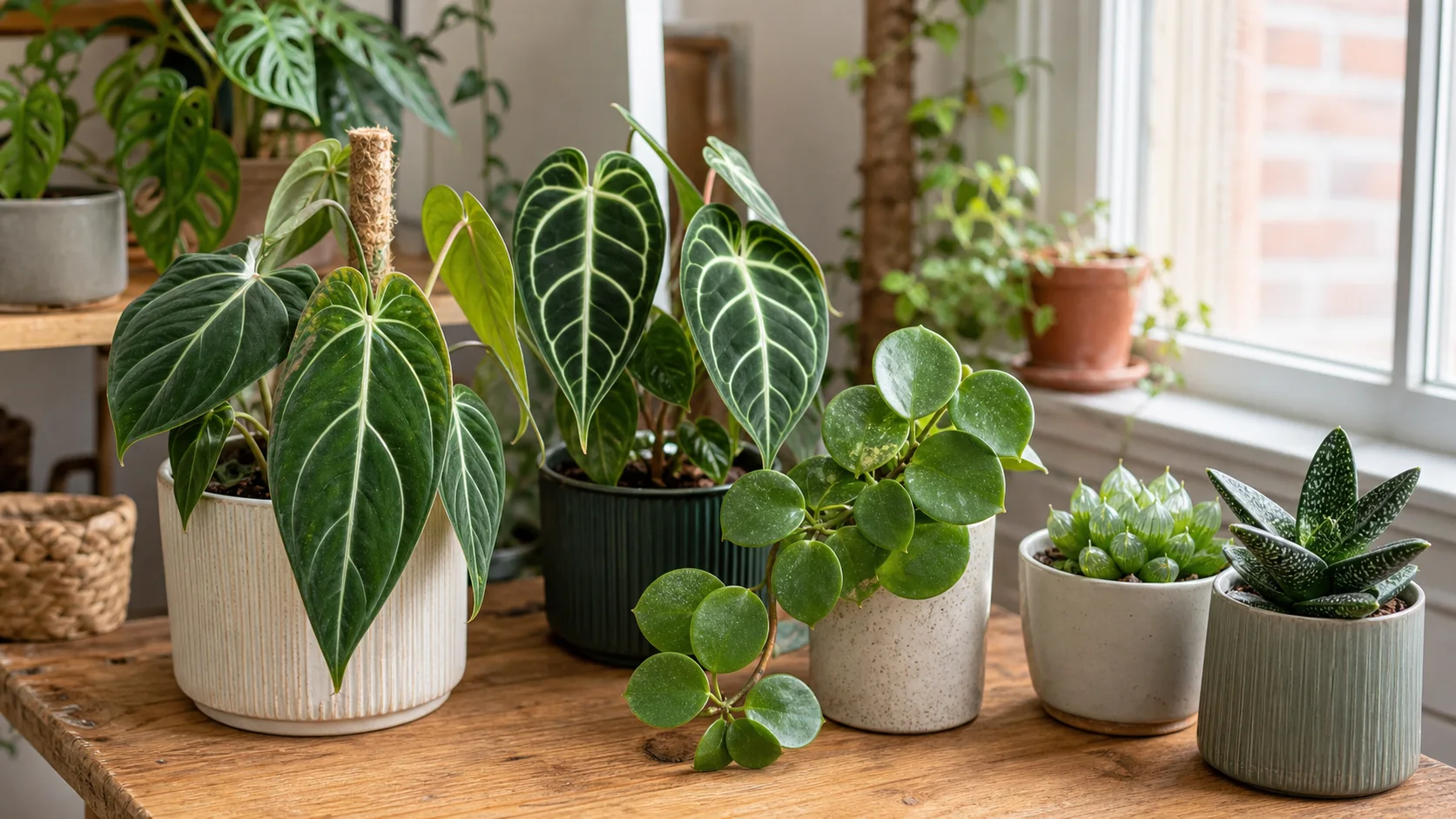
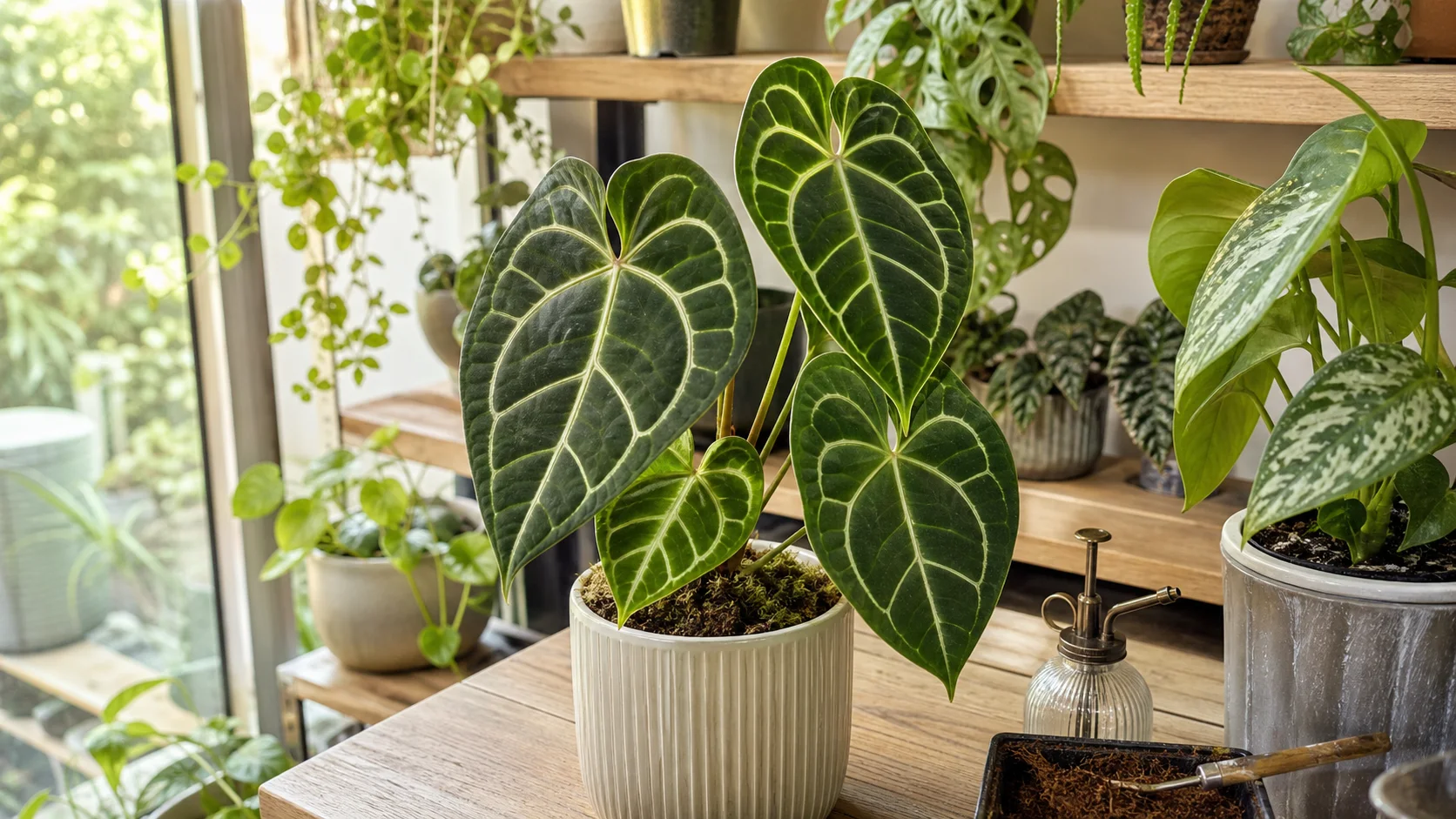
Velvet-leaf aroids, a forgiving Hoya, and low-drama Haworthia and Gasteria offer several realistic entry points into rare plants.
If your home has limited natural light, solve that before buying something more demanding. Grow lights for indoor plants will do more for your odds than buying a fussier plant and hoping.
The bat flower and real Monstera obliqua are interesting. They are not the best place to start.
Real User FAQ
These are the questions that show up most often in rare-plant communities after a plant arrives, not just the generic questions buyers ask before checkout.
What makes a houseplant “rare”?
Usually it means hard to find in mainstream garden centres, slower to propagate, or sold mostly through specialty growers and collector circles. It does not automatically mean harder to grow, but the overlap is common.
Why hasn’t my new rare plant grown anything since it arrived?
Because stillness is often acclimation, not failure. Look at the leaves it already has. If they are holding steady, the plant is probably settling.
Should I repot a rare plant as soon as it arrives?
Usually no. Unless the roots are clearly rotting or the medium is disastrously wrong, a rare plant is often better off being left alone for a few weeks first.
Are rare houseplants harder to care for than common ones?
Some are. Some are not. Hoya obovata, Haworthia cooperi, and Gasteria batesiana are easier than many people expect. White Fusion, Tacca chantrieri, and genuine Monstera obliqua really are demanding.
Where can I buy rare houseplants?
From specialty online sellers, swaps, and reputable collectors. Be cautious with very specific species names from sellers who cannot show convincing provenance or healthy-parent context.
Are rare houseplants toxic to cats and dogs?
Many aroids are. Philodendrons, anthuriums, and alocasias are risky for chewing pets. Several succulents and hoyas in this guide are safer.
Can I grow rare houseplants without a greenhouse or grow tent?
Yes, for most of this list. A warm room, decent light, and realistic plant choices will take you further than a collector wishlist with no setup behind it.
How do I know if a rare plant is worth the price?
Ask three questions: Does it fit my current light? Can I meet its humidity needs? Am I paying for a plant I can actually keep, not just admire online? If the answer to any of those is no, wait.
Methodology Note
This guide was updated using current rare-houseplant roundup results, collector-community discussions about scams, root rot, shipping stress, and pet safety, plus public sources from ASPCA, University of Minnesota Extension, Penn State Extension, and USDA APHIS. Community discussion was treated as qualitative signal, not as proof that a problem is universal.
It does not claim firsthand cultivation of every plant here. Where advice depends on extension guidance, pet-toxicity databases, or import rules, it is framed that way on purpose.
Freshness Note
Last reviewed on June 17, 2026.
Rare-plant prices, availability, seller reputation, and import rules can change quickly. Care difficulty changes more slowly. If a plant suddenly becomes cheaper or more visible online, that does not automatically make it easier, safer, or more ethical to buy.
If your new plant is sitting there doing nothing and you are trying not to overreact, KnowYourPlant is a good next step. You can confirm the species, keep the first-month reminders simple, and check whether a yellowing leaf is normal adjustment or the first sign she needs help.