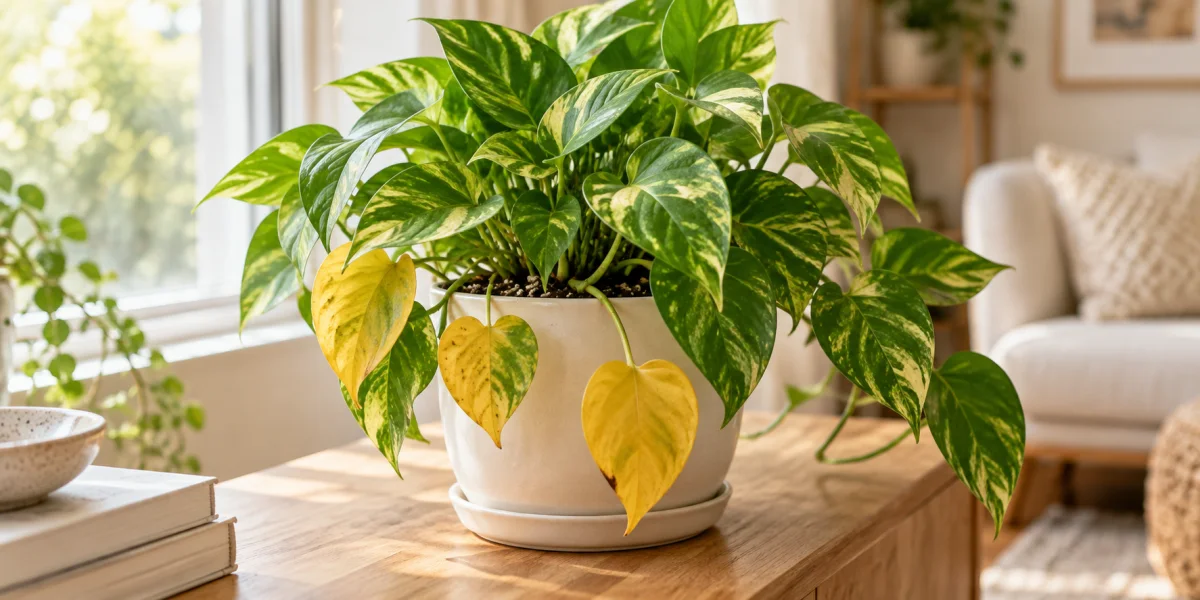
You noticed a yellow leaf on your pothos and immediately started second-guessing everything you have been doing. Was it too much water? Not enough? The light? Something worse?
Here is what most people do next: they pick the most likely-sounding answer and act on it. They hold back water, or add more, or move the plant across the room. And if they guessed wrong, the plant gets worse instead of better.
Yellow pothos leaves are easy to misread because the same symptom - a yellowing leaf - can come from causes that need opposite responses. Watering more does not help an overwatered plant. Fertilizing does not rescue roots that cannot absorb anything. The fix depends entirely on the cause, and finding the cause takes one physical check before you reach for the watering can.
This guide gives you a pattern-first way to read yellow pothos leaves, so the diagnosis leads the action instead of the other way around.
Symptom Diagnosis Card
| If you notice this | Check this next | Most likely direction |
|---|---|---|
| One yellow leaf near the base, healthy new growth | Whether it is one of the oldest leaves | Normal aging |
| Several yellow leaves plus wet mix or a heavy pot | Drainage holes, soil moisture, root smell | Overwatering or root stress |
| Yellow leaves after limp, thirsty vines | How dry the root ball gets between waterings | Underwatering or inconsistent watering |
| Pale vines, long internodes, slow drying soil | Window distance and seasonal light drop | Low light reducing water use |
| Spots, sticky residue, mushy stems, or distorted growth | Foliage, stems, roots, and pest presence | Disease, pests, or mineral stress |
Evidence from Clemson Cooperative Extension and the University of Maryland Extension supports a condition-first approach: check the potting mix, drainage, light, and symptom pattern before changing care.
What Most Care Guides Miss
Search for “pothos leaves turning yellow” and you will find dozens of articles that start with the same answer: probably overwatering. That is not wrong - overwatering is genuinely common. But it is not the only cause, and stopping there is where most diagnosis goes sideways.
Underwatering, low light, old age, root rot, and nutrient deficiency can all produce yellow leaves. They can look nearly identical from a few feet away. The common misdiagnosis is treating every yellow leaf as a watering problem, then adjusting water in one direction or the other without checking what the soil and roots are actually doing.
The first check is not the leaves at all. It is the soil and the pot weight.
Push your finger about 5 cm into the soil. Wet or dry? Then pick up the pot. Does it feel heavy for its size, or surprisingly light? Those two physical checks, combined with where the yellowing is happening, narrow the cause before you need to think about anything else. The University of Maryland Extension recommends checking moisture below the surface rather than watering on a fixed calendar.
Start With the Pattern, Not One Cause
Yellow pothos leaves tell different stories depending on where they appear and how quickly they spread. Reading the pattern first cuts through conflicting advice and tells you which possible cause is actually worth investigating.
| What you see | Most likely cause |
|---|---|
| One or two oldest leaves at the base of a vine, new growth looks healthy | Normal aging - prune and move on |
| Multiple lower leaves yellow, soil is wet, drainage slow or absent | Overwatering or root stress - hold off watering |
| Leaves yellow after the plant wilted and dried out repeatedly | Underwatering - rehydrate and stabilize your routine |
| Whole plant looks pale and washed out, vines stretch toward the window, soil dries slowly | Too little light - move before adjusting water |
| Yellow spots, lesions, sticky residue, or visible insects on leaves | Pests or disease - isolate and inspect closely |
| Yellow flecking with dark spotting or distorted new growth | Possible disease or mineral buildup - check soil and fertilizing history |
This pattern-first read is the practical shortcut the rest of this article builds on. You are not looking for one universal right answer. You are narrowing down which of several answers fits what you are actually seeing.
Quick Decision Tree for Yellow Pothos Leaves
- Is it only one or two oldest leaves? If yes, treat it as normal aging and monitor new growth.
- Is the soil still wet or the pot unusually heavy? If yes, pause watering and check drainage before doing anything else.
- Did the plant wilt hard before the yellowing started? If yes, rehydrate fully, then switch to a steadier watering rhythm.
- Is the plant pale, stretched, and drying slowly? If yes, increase bright indirect light before changing fertilizer.
- Do you see spotting, sticky residue, pests, or a sour smell from the pot? If yes, inspect roots and foliage for disease, insects, or rot.
This is the shortest path from symptom to action. It turns one ambiguous symptom into a sequence of checks you can verify.
The Causes of Yellow Pothos Leaves
1. Overwatering
Pothos roots need air as much as they need water. When soil stays consistently damp, roots cannot breathe, begin to break down, and lose the ability to pull up nutrients - even if those nutrients are right there in the mix. Leaves yellow from the bottom upward, and the potting soil often develops a sour or musty smell.
The pot weight check matters here. If the pot still feels heavy and the mix is damp well below the surface, hold off. Clemson advises allowing pothos potting mix to dry between waterings and using a container with good drainage. If you are unsure whether what you are seeing matches overwatering, the overwatered plant signs guide explains the full range of symptoms across different houseplants.
2. Underwatering
Pothos tolerates drought reasonably well, but repeated cycles of wilting followed by a deep soak create uneven stress. The plant struggles to maintain older foliage through those repeated dry spells, and leaves yellow and go papery before eventually dropping. The pot will feel noticeably light, the soil will be bone dry when you push a finger in, and the yellow leaves will be papery rather than soft or mushy.
If that is what you find, give the plant a thorough soak - water slowly until it runs freely out the drainage holes, let it drain completely, then let the top of the soil dry down before watering again. The goal is to stabilize the rhythm rather than compensate with a one-time flood.
3. Too Little Light
In low light, a pothos grows slowly and its water needs drop significantly. If you are still watering at the same pace you used when the plant was in a brighter spot, the soil stays wet far longer than the roots can tolerate. The result looks like overwatering - because effectively, that is what it is.
A pale plant with long, leggy vines sitting in a dim corner needs more light before anything else changes. Move it closer to a bright indirect window first, then reduce watering frequency until you see new growth picking up. This happens most often in winter, when shorter days mean even a “bright” windowsill gets less usable light than it did in July. The plant slows down, needs less water, and if the schedule does not adjust with it, the soil stays wetter than the roots can handle.
Seasonal note: Yellowing that starts in late fall or winter may reflect a light-and-watering mismatch rather than a new disease. If the room got darker but the watering routine stayed the same, check those two variables before assuming the plant needs fertilizer or a bigger pot.
4. Root Rot
Root rot is what happens when overwatering or poor drainage continues long enough. The roots turn brown and soft, and the plant cannot take up water even when you offer it - so yellowing continues even after you stop watering. The cycle becomes self-reinforcing.
UF/IFAS plant pathology guidance documents several pothos root and stem diseases and emphasizes sanitation and disease-free growing media. Persistent wetness and poor drainage are reasons to inspect the roots rather than add more water.
If you suspect root rot, slide the root ball out of the pot and look at the roots directly. Healthy roots are firm and white to pale tan. Rotted roots are brown or black, soft, and may smell of decay. Trim away the damaged sections with clean scissors, let the roots air briefly, and repot into fresh well-draining soil in a clean pot with clear drainage holes. If the damage is severe, the plant may not recover, but you can take stem cuttings from any remaining healthy growth and start fresh. The pothos propagation guide walks through exactly how to do that.
5. Normal Leaf Aging
Pothos shed their oldest, lowest leaves as they grow. If you see one or two yellow leaves at the very base of a long vine while the rest of the plant looks healthy and is putting out new growth, this is not a problem. It is the plant moving energy forward into new foliage.
Prune the yellow leaf cleanly at the stem, keep an eye on growth over the next week or two, and leave the rest alone. No investigation needed.
6. Nutrient Deficiency
A pothos that has been in the same potting mix for more than a year without any feeding may show general yellowing as nutrients deplete - particularly nitrogen. The change is usually gradual, starting in older leaves and moving slowly through the plant over several weeks, not days.
Clemson’s pothos guide recommends feeding during active spring and summer growth. Treat nutrition as a possible cause only after moisture, drainage, and light are in range; yellowing alone does not prove a deficiency.
One important point: do not fertilize a stressed plant. If the roots are damaged or the soil is soggy, adding fertilizer will not help and may cause salt buildup that damages what is left of the root system. Stabilize the plant first, wait for new growth, then apply a balanced liquid fertilizer at half the recommended strength.
7. Disease and Mineral Toxicity
Less common, but worth knowing about: the UF/IFAS disease guide documents Rhizoctonia blight and manganese toxicity in commercial pothos production. Do not diagnose either from leaf color alone. If yellowing comes with spreading lesions, distorted growth, or persists after you correct watering and light, isolate the plant and seek a local extension or horticulture diagnosis.
Recovery: What to Do After You Find the Cause
Work through these steps in order rather than making several changes at once. When you stack changes together, you cannot tell what actually helped.
- Check drainage first. Make sure water escapes freely from the pot. Roots sitting in standing water inside a cachepot is one of the most common hidden causes of persistent yellowing that seems to come back even after you adjust watering.
- Inspect the roots only if symptoms are spreading. You do not need to repot over one yellow leaf. Only check the root ball if the soil stays wet for more than a week or you notice a smell.
- Remove dead leaves and any mushy roots if you do repot. Clean your scissors with rubbing alcohol before and after to avoid spreading disease.
- Reset light and watering together. Moving to better light means the plant will need more water. Staying in lower light through winter means it needs considerably less. The two are connected - one change affects the other.
- Wait for active growth before fertilizing. Let the plant stabilize and produce healthy new growth before adding nutrients.
Common Mistakes That Make Yellow Leaves Worse
Watering on a fixed calendar instead of checking the soil. A pothos’s water needs shift with the season, the pot size, and the light level. A schedule that worked in August is likely too frequent by November.
Repotting at the first sign of yellow leaves. Most single-leaf yellowing does not call for repotting. Repotting a plant that is already stressed adds another stressor on top of the one you have not resolved yet. Use the pothos repotting guide to confirm whether root crowding, compacted soil, or changed watering behavior actually justifies the move.
Fertilizing to fix yellowing before ruling out root problems. If the roots cannot absorb nutrients, fertilizer sits unused in the soil and can cause salt buildup that makes things worse rather than better.
Leaving dropped yellow leaves on the floor. A stressed pothos may drop leaves more often than usual, and pothos is irritating to pets. Clear them up before a curious cat or dog finds them.
A Note on Pet Safety
ASPCA lists golden pothos as toxic to cats and dogs because it contains insoluble calcium oxalates; reported signs include oral irritation, drooling, vomiting, and difficulty swallowing. NC State Extension also lists poison characteristics for this species.
A yellowing or stressed pothos may drop leaves to the floor more frequently than a healthy one - which brings them within reach of a pet that notices wilting plant material. Keep fallen leaves cleared up. If you have an active chewer and want something less risky on a low shelf, cat-safe indoor plants covers alternatives that carry much lower risk. For any suspected ingestion, contact your vet right away.
When to Worry vs. When to Wait
Yellow pothos leaves are not automatically an emergency. One old leaf yellowing at the base of a long vine while the rest of the plant grows steadily? Prune it and give it a week. That is usually the whole story.
But when multiple younger leaves are yellowing at the same time, growth has stopped, the soil smells off, or the stems feel soft near the base - that is when to pull the root ball and take a proper look.
The goal is not to react to every yellow leaf. It is to understand what the plant is telling you, so your response helps rather than piles more stress onto a plant that is already struggling.
Methodology
This article was reviewed on 2026-09-09 against Clemson Cooperative Extension and University of Maryland Extension care guidance, UF/IFAS plant pathology guidance, NC State Extension, and ASPCA pet-safety information. Community discussions informed question wording only; they were not used as evidence for care or safety claims.
For a full guide on keeping pothos healthy through every season - light, watering schedules, variety differences, and long-term care - the KnowYourPlant pothos care guide has all of it. If you are not sure how often to water specifically, how often to water pothos walks through exactly how pot size, light level, and season change the answer. If the roots looked brown and soft when you checked, the root rot treatment guide covers how to assess the damage. If yellowing appears with spots, holes, scorch, or distortion, compare the full pattern in the leaf-damage identification guide before changing care.
Frequently Asked Questions
Why are my pothos leaves turning yellow even though I water it regularly?
Regular watering does not always mean correct watering. If the soil is not fully drying out between sessions, “regular” can mean the roots are sitting in persistently damp conditions - which produces the same yellowing as obvious overwatering. Check whether the top 5 to 7 cm of soil feel dry before you water, rather than going by the calendar. Also confirm the pot has clear drainage holes and is not sitting in a saucer of standing water between waterings.
Can yellow pothos leaves turn green again?
A fully yellow leaf is unlikely to become a useful green leaf again. Focus on correcting the underlying condition and watching the next leaves. Remove a yellow leaf when it detaches easily or when you prefer to tidy the plant; there is no need to strip every partly yellow leaf immediately.
How do I know if my pothos has root rot?
Slide the root ball out of the pot and look. Healthy roots are firm and white to pale tan. Rotted roots are brown or black, soft, and may smell like decay. If only a small portion is affected, trim the damaged sections with clean scissors and repot into fresh well-draining soil. If most of the root system is gone, take stem cuttings from any remaining healthy growth rather than trying to save the original plant.
Should I fertilize a pothos with yellow leaves?
Only after ruling out watering and root problems first. If the soil is soggy or the plant is visibly stressed with no new growth, fertilizing will not help and may cause salt buildup that makes things worse. If the plant is otherwise stable but has been in the same soil for over a year with no feeding, a diluted balanced liquid fertilizer at half the package rate can address nutrient depletion. Wait until you see new growth before you start.
Is it normal for some pothos leaves to turn yellow?
Yes. The oldest leaves at the base of a vine naturally yellow and drop as the plant grows. If you see one or two yellow leaves at the very bottom of a long trailing vine while the rest of the plant looks healthy and is making new growth, prune them cleanly and do not worry. The concern is when yellowing spreads to younger growth, happens quickly across multiple leaves at once, or arrives alongside soft soil or stems.
My pothos is in low light and the leaves are turning yellow - is it the light?
Likely yes, and here is the connection most articles skip: in low light, a pothos grows slowly and needs far less water than it would near a bright window. If you are still watering at the same rate as you would for a plant in good light, the soil stays wet longer than the roots can handle, and that leads to yellowing. Move the plant closer to a window if you can - even a few feet makes a real difference. If you cannot change the location, reduce watering frequency significantly and let the soil dry further between sessions.
How do I stop my pothos from getting yellow leaves in winter?
Winter is when yellow leaves show up most often, because shorter days mean less light and the plant’s water needs drop noticeably. The main adjustment is to water less and check the soil before every watering rather than going by a fixed schedule. Make sure the plant is getting as much indirect light as possible, and keep it away from cold drafts near windows or hot air blowing directly from heating vents. Hold off on fertilizing until you see growth pick back up in spring.