You bought it for those cream and green spheres. Little patterned pearls strung along slender stems, trailing over the edge of a pot like something hand-made. And then, slowly, you noticed the color fading toward plain green, or the pearls feeling less firm, or the crown thinning out and the strands looking sparse at the base.
That’s not bad luck. That’s a specific mismatch between what this plant actually needs and what most care cards say about it.
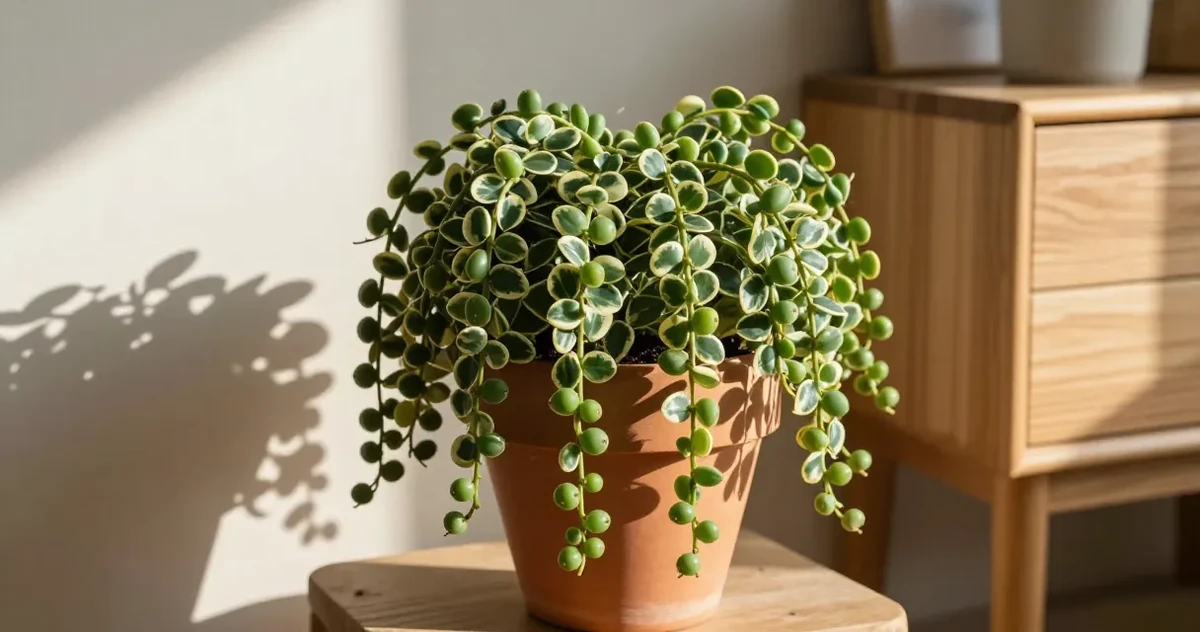
Variegated string of pearls (Curio rowleyanus, sometimes still sold as Senecio rowleyanus) is the same trailing succulent as the standard green form, but with pearls that carry cream, white, or pale yellow patches alongside the green. The pale sections don’t produce chlorophyll, and that one biological fact changes what the plant needs to hold its color indoors. If you’re starting from the basics and want the full rundown on the species first, this string of pearls care guide covers the green form. For the variegated version, this is where the care diverges.
Identification Snapshot
- Botanical name: Curio rowleyanus variegated form, often still sold under Senecio rowleyanus
- What it should look like: round pearls with cream, white, or pale yellow marbling alongside green tissue
- Growth habit: trailing succulent that looks best when stems spill from a shallow pot or hanging basket
- What healthy growth does: stays compact, keeps visible contrast in the pearls, and feels firm rather than mushy
- What usually goes wrong first: fading to greener growth in low light, or soft collapsing pearls when roots stay wet too long
If a plant has long smooth leaves instead of round pearls, or the basket is pushing plain green stems much faster than the rest, double-check the ID before changing care.
Not sure what plant you are caring for?
Open KnowYourPlant, snap a photo, and get the plant name plus care notes matched to the species in front of you.
Identify your plantConfused With: Similar Trailing Succulents and Reversion
| Plant or issue | What it looks like | Why it matters |
|---|---|---|
| Standard green string of pearls | Same round pearls, but solid green | Grows more vigorously and does not need the same level of light to hold decorative color |
| Fully reverted green strand on the same basket | One stem loses the cream patterning while the rest stays variegated | That stem can outgrow weaker variegated growth and should usually be trimmed back |
| String of bananas | Leaves are curved and elongated rather than bead-like | Similar succulent care, but not the same plant readers are usually trying to keep patterned |
| String of tears | Leaves are more teardrop-shaped than spherical | Easy to confuse at a quick glance, especially in small nursery pots |
Want a care schedule you do not have to remember?
KnowYourPlant sends watering, feeding, repotting, and seasonal reminders based on the plants you actually own.
Get care remindersWhat Most Care Guides Miss About the Variegated Form
The most common misdiagnosis with variegated string of pearls is treating it identically to the green species. The two plants look similar, but they have different energy budgets, and that gap is where most problems start.
UF/IFAS Extension explains that variegated plant sections without chlorophyll cannot photosynthesize and must depend entirely on the remaining green tissue. The whole plant is feeding itself through a reduced surface area. Compared to an all-green string of pearls, the variegated form grows a little slower, tolerates stress less gracefully, and responds to low light faster than you’d expect.
When light drops, the plant compensates by producing more all-green growth. The cream sections fade, and over time the whole basket drifts toward a plain green appearance. UF/IFAS also notes that vigorous all-green reversions in variegated plants can outgrow and eventually dominate weaker patterned growth if left untrimmed.
The fix isn’t more fertilizer, a new soil mix, or a changed watering schedule. It’s placement. Color loss in variegated string of pearls is almost always a light problem first. Get that right before adjusting anything else.
Save this plant plan before you forget the details.
Keep the plant, diagnosis notes, reminders, and care changes in KnowYourPlant so the next decision is based on your actual plant history.
Open KnowYourPlantWhat Real Growers Keep Getting Stuck On
The same trouble patterns show up again and again in real owner questions. Older baskets get sparse at the crown and people wait too long to restart them from cuttings. Decorative self-watering pots keep the roots too evenly moist for a trailing succulent that needs true dry-down. Indoor succulents moved outside too fast scorch on top and get treated like thirsty plants when the real issue is sudden exposure. And low indoor light leads growers to think the plant is “alive, so it must be fine” even while the pearls stretch, thin, and revert greener over time.
That doesn’t replace extension guidance, but it is useful context. It tells you where otherwise careful plant owners usually misread the plant.
Light: The Single Most Important Variable
Variegated string of pearls needs more light than the standard form. A bright spot near a south- or east-facing window is ideal indoors. If you can see open sky from where the pot sits, you’re likely in the right zone. If you’re squinting to read across the room, it’s too dim.
NC State Extension recommends bright indirect sunlight for indoor growing and notes that direct sunlight can cause pearl scorching. Direct morning sun through an east window is usually fine and helps the plant stay compact and vibrant. Midday or afternoon sun through south- or west-facing glass in summer can scorch the pearls, especially soft new growth. The goal is strong brightness without harshness: the kind of light where you’d reach for sunglasses outside, but diffused enough indoors that nothing casts a hard shadow on the plant.
If you want to move the plant outdoors for summer, do it slowly. Wisconsin Horticulture Extension recommends gradual acclimation before outdoor sun exposure. Even a plant in a genuinely bright indoor spot can burn when moved suddenly into full outdoor light. Start it in a shaded or dappled outdoor spot for a week or two, then shift toward more light over time. Browning on the top of the pearls immediately after a move is almost always sun exposure, not a watering problem.
When light is too low
In dim conditions, variegated string of pearls doesn’t just slow down, it changes. Strands grow longer and looser between pearls as the plant reaches for light. New growth comes in greener. The cream variegation fades. The plant can survive, but it won’t look like what you brought home.
If your best available window still feels marginal, a dedicated grow light is the most reliable fix. A bright grow light placed six to twelve inches above the basket for twelve to fourteen hours a day can keep variegation strong through winter or in rooms without south-facing windows.
Common Problems: Pearl Symptom Quick-Read
Before adjusting water, soil, or location, match what you’re seeing to the right cause. Most problems fall into one of five patterns:
| What you see | Likely cause | First check |
|---|---|---|
| Firm but slightly wrinkled pearls | Thirsty, ready to water | Confirm soil is fully dry, then water thoroughly |
| Squishy pearls or soft stem near the soil | Overwatering / root rot | Stop watering; consider repotting into fresh gritty mix |
| Bleached or brown patches on pearl tops | Sun scorch | Move away from direct afternoon light; acclimate slowly before outdoor use |
| New growth all green with no cream patches | Low light or genetic reversion | Move to brighter spot first; remove fully green strands to where variegation resumes |
| Sparse crown with long bare stems at the base | Natural age decline | Propagate several cuttings into a new shallow pot for a denser result |
Missouri Botanical Garden notes that shriveled pearls can come from overwatering, underwatering, or improper light conditions. That’s why matching the symptom carefully before acting matters far more than following a fixed weekly schedule.
Troubleshooting Decision Tree
- Touch the soil first. If the mix is still cool or damp below the surface, do not water yet.
- Check pearl texture. If pearls are firm but lightly wrinkled and the soil is fully dry, water thoroughly and let the excess drain away.
- Check the crown and stem base. If pearls feel soft or the stem near the soil is mushy, stop watering and move straight to a root-rot check or repot.
- Look at the top-facing pearls. If they are bleached, tan, or patched brown after a brighter placement change, treat it as scorch and back off harsh sun.
- Look at new growth color. If new strands are greener and longer between pearls, increase light before changing fertilizer or watering.
- Judge the age of the basket honestly. If the crown is bald and only a few strands remain, propagation is usually the better fix than endless rescue tweaks.
Watering: The Cue, Not the Calendar
The most common reason variegated string of pearls declines indoors isn’t underwatering. It’s roots sitting in moisture longer than they can handle.
Wisconsin Horticulture Extension is direct on this: root rot from overwatering is the most common cause of decline in string of pearls. The potting medium should dry out completely between waterings, and slightly shriveled pearls are the right cue to water, not a calendar date.
When healthy pearls are plump and firm, wait. When they start to look just slightly less taut or feel a little less firm than usual, that’s the cue to water. Soak the soil thoroughly, let it drain fully, and then leave it alone until the soil is completely dry again.
Seasonal timing: In a bright spot during summer, that might be every ten to fourteen days. In winter, even if your home stays warm, the plant’s pace slows and the soil holds moisture longer. Watering once every three to four weeks is normal in winter, and sometimes the right move is simply to wait another week before checking. Let the dry-down period guide you, not the season alone.
Soft, squishy pearls, especially near the base of the stems, point to too much water, not too little. If you catch it early, the steps in this root rot recovery guide apply to succulents just as well as to other houseplants.
The Container Matters More Than You Think
Shallow pots dry out faster than deep ones, and fast dry-down is exactly what this plant needs. Wisconsin Extension specifically recommends shallow containers for string of pearls because deep pots hold moisture around the roots longer than this plant can tolerate.
| Container type | Dry-down speed | Root rot risk | Suitable? |
|---|---|---|---|
| Shallow terracotta | Fast (moisture evaporates through walls) | Low | Yes, ideal |
| Hanging basket with liner | Fast to medium | Low to medium | Good option |
| Plastic nursery pot with drainage | Medium | Medium | Acceptable with gritty mix |
| Deep ceramic pot | Slow | Higher | Use only with a very fast-draining mix |
| Self-watering container | Very slow (reservoir below) | High | Not recommended |
Self-watering containers and mixed planters that stay consistently moist are genuinely risky for this plant. The roots need real dry-down time between waterings, not a steady moisture supply from a reservoir. Decorative pots without drainage holes, however nice they look, leave almost no margin for error on a plant this sensitive to overwatering.
Common Mistakes
- Treating it like a low-light trailing plant. Survival in dim light is not the same as keeping the pearls compact and patterned.
- Using a deep decorative pot because the strands look dramatic there. Deep containers stay wet longer than this root system likes.
- Watering on a weekly schedule. This plant responds better to pearl texture and fully dry soil than to calendar habits.
- Leaving fully green reversions in place. The green stems usually grow faster and gradually win.
- Trying to save a tired old basket forever. For sparse crowns, restarting from cuttings is often the most efficient care move.
Soil and Repotting
This plant wants fast drainage above everything else. NC State Extension recommends a cactus mix or a sandy-perlite blend for Curio rowleyanus grown indoors. A standard cactus and succulent mix cut with extra perlite works well: roughly one part perlite to two parts cactus mix. Water should run through almost immediately, not pool at the bottom of the pot.
If you’re unsure whether your current mix is doing the job, this guide to indoor potting soil explains what to look for and what to add when a bag mix isn’t gritty enough. For a refresher on the actual repotting process, this repotting guide covers the mechanics if it’s your first time doing it.
Repot only when the plant is clearly root-bound or when the mix has broken down and started holding moisture longer than it used to. Fresh soil every couple of years, or a full renewal from cuttings, usually does more good than frequent repotting.
Propagation: Maintenance, Not Failure
Variegated string of pearls doesn’t live forever in the same pot. After a few years, the crown naturally thins out and the longest strands can look leggy or bare near the base. That’s not the plant failing. It’s normal aging for a species that puts its energy into extending strands rather than refreshing the base.
Missouri Botanical Garden recommends restarting older string of pearls plants from stem cuttings after several years, because baskets naturally decline with age. Renewal isn’t rescue, it’s routine care.
When to restart: If the crown has thinned noticeably, with bare stems at the base and only a few active strands remaining, propagation is almost always faster and more effective than trying to nurse the existing roots back to fullness. A half-empty basket rarely fills back in on its own.
How to do it: Take several stem cuttings, four to six inches is plenty, and let the cut ends dry for a day or two. Then rest them on the surface of lightly moist cactus mix in a shallow pot without pressing them into the soil. Within a few weeks in bright conditions, new roots establish and the cuttings start to fill out. Starting a fresh basket this way gives you a denser, healthier plant than nursing a tired one.
If you want to keep the variegation strong in the new batch, choose cuttings from the most heavily patterned strands. Cuttings from sections that have already reverted to all-green will grow into all-green plants.
Managing Reversion
Variegated string of pearls can push out shoots that are fully green with no cream patterning at all. These all-green sections grow faster than the variegated ones because they’re photosynthesizing at full capacity. Left alone, they gradually take over the basket.
One useful distinction: if the whole plant is producing mostly green new growth, that’s more likely a light problem than a genetic reversion. Move the plant to a brighter spot first and give it a few weeks before concluding the plant has reverted. If specific strands are completely green with no trace of the cream patterning while the rest of the plant still shows variegation, that’s true reversion, and trimming is the right response.
When you find a fully reverted strand, trim it back to where the variegation resumes, or remove it at the soil level. It takes about two minutes, and doing it consistently is what keeps the look you brought the plant home for.
Seasonal Care Notes
- Spring and summer: This is the easiest time to grow fuller strands, root cuttings, and correct low-light stretch. Watch for faster dry-down in strong light.
- Fall: Reduce watering gradually as indoor light softens and growth slows.
- Winter: Expect longer gaps between waterings and weaker color in dark rooms unless you supplement with a grow light.
- Outdoor warm-season moves: Acclimate in stages. A brighter season is helpful only if the plant is hardened off slowly enough to avoid scorch.
A Note on Toxicity
String of pearls is toxic to cats, dogs, and humans if ingested. A high shelf or hanging basket is the practical solution, and it suits the plant’s trailing growth habit well. If you’re building out a collection and want to balance beautiful trailing plants with options safer for curious pets, this guide to cat-safe indoor plants is a practical starting point.
Plant ID + Plant Doctor
Not sure what your plant needs?
Snap a photo in KnowYourPlant to identify the plant, check yellow leaves, spots, wilting, or pests, and get a calm next step before the problem spreads.
Real User FAQ
How often should I water variegated string of pearls? There’s no fixed schedule that works across seasons. The right cue is pearl texture: when the pearls feel slightly less firm than usual or show a faint wrinkle, water thoroughly and then let the soil dry completely before the next watering. In a bright summer spot that’s often every ten to fourteen days. In winter or in lower light, it can stretch to three to four weeks. Follow the pearls, not the calendar.
Why are my pearls shriveling? Check both ends of the watering spectrum before assuming one cause. Firm wrinkles on otherwise healthy-looking pearls usually mean the soil has dried out and the plant is thirsty. Soft or squishy pearls, especially near the base of the stems, mean the opposite: too much water and likely some root damage. Missouri Botanical Garden notes that shriveling can come from overwatering, underwatering, or improper light, so matching the symptom to the cause before acting is more useful than adjusting water alone.
Why is my variegated string of pearls losing its cream color? Two common causes: low light and reversion. When light drops, the plant produces more all-green growth because those sections photosynthesize more efficiently. Move the plant to a brighter spot first and give it a few weeks. If specific strands are completely green with no trace of cream patterning while the rest still shows variegation, that’s genetic reversion: remove those strands so the variegated growth stays dominant.
Can I put variegated string of pearls outside in summer? Yes, but do it gradually. Wisconsin Horticulture Extension recommends acclimating succulents slowly before outdoor sun exposure. Start in a shaded or dappled outdoor spot for one to two weeks, then shift toward more light over time. Moving directly from indoor ambient light to full outdoor sun bleaches or browns the pearl surfaces, particularly on the side facing the sky.
What soil should I use? A cactus and succulent mix cut with extra perlite. NC State Extension recommends a sandy-perlite blend for this species. The mix should drain so quickly that water runs through almost immediately rather than pooling. If your current mix holds moisture for more than a week after thorough watering, it’s worth refreshing before the next growing season.
How do I know when to restart from cuttings instead of trying to revive the plant? When the crown has thinned noticeably, with bare stems at the base and only a few active strands left, propagation is almost always faster and more effective than pushing the existing root system back to fullness. Missouri Botanical Garden recommends restarting older plants from cuttings every few years as routine care. Take the healthiest, most patterned cuttings, let them callus for a day, and root them in a fresh shallow pot with gritty mix. The new basket will outpace the old one within a season.
Why did reversion suddenly get worse after moving the plant? If the plant moved from a bright spot to a dimmer one, the all-green sections accelerate: they grow faster in lower light and the patterned growth loses its edge. Move the plant back to a brighter location and trim any fully green strands. If it moved from outdoors to indoors at the end of summer, give it a few weeks to adjust before making other changes.
Is variegated string of pearls safe around pets? No. String of pearls is toxic to cats, dogs, and humans if ingested. A hanging basket or high shelf is the practical solution, and it suits the plant’s trailing growth habit anyway.
Methodology and Freshness Note
This methodology note reflects the June 2026 update. The guide was rebuilt using live search review, real owner questions, and primary-source verification from extension and botanical-garden references. The troubleshooting advice here is grounded first in NC State, Wisconsin Horticulture, Missouri Botanical Garden, and UF/IFAS guidance, then shaped by recurring grower mistakes seen in public Q and A threads. Those owner questions are useful qualitative signal, not statistical proof.
Sources: NC State Extension Gardener Plant Toolbox, Curio rowleyanus; Wisconsin Horticulture Extension, String of Pearls, Senecio rowleyanus; Missouri Botanical Garden Plant Finder, Curio rowleyanus; UF/IFAS Extension Charlotte County, Variegation sensation: variegated plants.