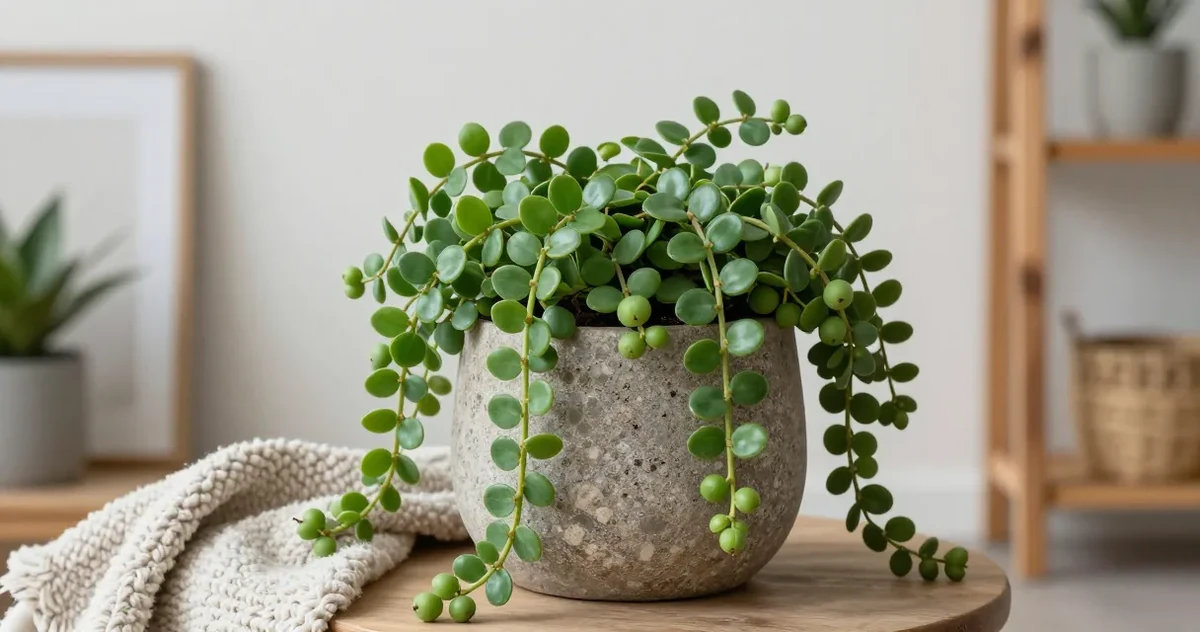
If you’ve got a string of pearls trailing off a shelf and want more of her, or you’ve snapped a strand by accident and want to salvage it, the process is genuinely straightforward – once you understand one thing most guides skip: this plant roots wherever a node touches damp soil, not from the cut tip alone. That single detail changes how you handle the stem, where you position it, and why some cuttings root beautifully while others go soft and mushy within weeks.
Identification Snapshot
Use this identification snapshot before you start cutting:
- Botanical name: Curio rowleyanus (often still sold under Senecio rowleyanus).
- What you are looking for: thin trailing stems with round bead-like leaves, not flat leaves or chunky upright stems.
- Why propagation works so well here: this plant can root from multiple nodes along the strand wherever those nodes stay in contact with lightly damp soil.
- What a good cutting looks like: plump pearls, firm stems, and at least three visible nodes on a healthy strand.
- One fast red flag: soft translucent pearls or a dark mushy stem base mean the cutting material is already stressed before you begin.
Not sure what plant you are caring for?
Open KnowYourPlant, snap a photo, and get the plant name plus care notes matched to the species in front of you.
Identify your plantLookalikes and Confused-With Cases
| Plant | Why people confuse it with string of pearls | Quick difference |
|---|---|---|
| String of bananas | Same trailing succulent habit and similar care advice | Leaves are curved and banana-shaped rather than round like beads |
| String of tears | Another cascading succulent sold in the same shops | Leaves look more teardrop-shaped and pointed instead of nearly spherical |
| Dolphin plant | Similar hanging-basket succulent with unusual leaf shapes | Leaves are shaped like tiny dolphins, not smooth pearls spaced along a thin stem |
Want a care schedule you do not have to remember?
KnowYourPlant sends watering, feeding, repotting, and seasonal reminders based on the plants you actually own.
Get care remindersCare Cards
| Care card | Best baseline for propagation | What to watch for |
|---|---|---|
| Light | Bright indirect light during rooting | Harsh direct sun dries strands before roots establish |
| Moisture | Barely damp mix, never soggy | Constant wetness turns the stem base soft and dark |
| Pot | Small shallow pot with drainage holes | Oversized pots keep too much mix wet for too long |
| Node contact | Keep three to five nodes touching the mix | Pearls can stay above the surface, but the nodes need contact |
| Timing | Spring and early summer root fastest | Winter cuttings stall easily and tempt people to overwater |
Save this plant plan before you forget the details.
Keep the plant, diagnosis notes, reminders, and care changes in KnowYourPlant so the next decision is based on your actual plant history.
Open KnowYourPlantWhat Most Propagation Guides Miss
The misdiagnosis that trips up most people: they treat string of pearls like a thick-stemmed succulent and apply the same playbook. Let the cut end callus for 24 to 48 hours. Stick the end into a small hole in the soil. Wait.
That works for a cactus with a 2-centimeter-thick base. It does not work as reliably for a plant with thin stems and hollow pearls. The cut end is not the main event. Multiple nodes along the full length of the stem are all potential rooting points – which means a cutting lying flat on the surface can establish roots in three or four places at once, while a cutting standing upright might root from one point or none if the base dries out or rots before roots form.
The practical check before you do anything: look at your cutting and count the nodes. Every small bump where a pearl meets the stem is a node. If you place three to five of those nodes in contact with barely damp soil, your cutting has three to five chances to succeed. If you fuss over the cut tip and leave the rest of the strand curled up above the soil, most of your rooting opportunities are wasted.
Generic succulent propagation advice is written for the average. String of pearls is specific enough to need her own rules.
Which Method Is Right for Your Goal
Before you cut anything, it helps to know what you’re actually trying to do. The cutting process is the same either way, but where you place the strand after you cut leads to two different outcomes.
If your goal is to fill out a sparse pot or create a bushier plant: lay the cutting flat across the soil surface. Roots form along the full length of the strand, and you get dense new growth rather than one or two trailing strands.
If your goal is to start a brand-new pot with trailing strands: insert cuttings upright with a few bare nodes tucked just below the soil surface. This creates the classic hanging silhouette more quickly.
If you want to root broken strands salvaged from an accident: water propagation works as a holding method, but move the cuttings to soil once roots are 1 to 2 cm long.
Knowing which outcome you want before you start saves you from wondering why your propagation didn’t look like what you pictured.
Propagation Decision Tree
Use this quick decision tree before you plant the cutting:
- You want the same pot to look fuller fast: lay several strands flat across the soil surface and pin them so multiple nodes stay in contact with the mix.
- You want a brand-new trailing pot: strip the lower pearls from each cutting and insert a few bare nodes upright into a small shallow pot.
- You only have snapped or rescue strands right now: use short-term water rooting only as a bridge, then move the cutting into soil once roots are about 1 to 2 cm long.
- Your cutting keeps drying out before it roots: shorten it to a healthier section with more plump pearls and improve node-to-soil contact instead of watering more heavily.
Choosing and Cutting Your Strands
Look for a healthy strand that’s at least 10 to 15 cm long with plump, firm pearls. Strands where the pearls feel soft, wrinkled, or sparse aren’t ideal starting material – they’re already stressed, and a stressed cutting has less energy to push out new roots.
Use clean scissors or snips and cut just below a node. NC State Extension recommends cuttings in the range of 7 to 12 cm, which gives you three to six nodes for rooting without wasting a long healthy strand.
On callusing: most succulent guides tell you to let the cut end dry for 24 to 48 hours before planting. For string of pearls, an hour or two is enough. Her stems are thin enough that a full 24-hour rest risks dehydrating the pearls before you’ve even planted. The cut surface just needs to be dry to the touch – not hardened into a thick callus like you’d want on a cactus or a chunkier succulent. For how callusing compares across different succulent types, the succulent care guide has a clear breakdown.
Two Ways to Root in Soil
Lay the Strand Flat on the Surface
This is the right method if your goal is to fill out a sparse pot or create a fuller, bushier plant. Lay the cutting horizontally across the surface of lightly damp, well-draining potting mix. Cactus mix works well, or standard potting soil combined with around 50 percent perlite to ensure quick drainage. Gently press the stem down so it has contact with the soil along several nodes, but don’t push the pearls below the surface – the pearls need air; the nodes need contact.
Pin the strand in place with a bent paperclip or a small stone if it keeps curling up. In a few weeks you’ll see fine white roots reaching down from the nodes and new growth beginning from the tips. Epic Gardening confirms that laying a cutting flat on the soil creates a bushier plant because roots can form at every point of contact along the stem, not just one location.
Insert Cuttings Upright
If you want trailing strands from a new pot rather than a mound of growth, this approach gives a cleaner result. NC State Extension recommends removing the bottom three or four pearls to expose nodes on the lower 3 to 4 cm of the stem, then placing those bare nodes just into the surface of the soil. You’re not burying the cutting deep – you’re ensuring node contact without smothering the whole strand. A pencil makes a useful guide hole so you don’t damage the nodes pressing them in.
Use a small pot with drainage holes. Shallow pots work especially well here because they dry faster between checks, which reduces rot risk while roots are still forming.
What Real Owners Get Stuck On
Community search snippets around string of pearls propagation repeat the same trouble spots, even when the basic cutting steps seem simple:
- New growth can appear before obvious roots. That makes people think a water cutting is established when it may still be unsupported below the surface.
- Flat-laying versus upright planting causes constant confusion. The right answer depends on whether you want a fuller pot or a new trailing pot, not on a single universal rule.
- The callusing step gets overcomplicated. Many owners wait too long because general succulent advice is written for thicker stems than string of pearls actually has.
- Flowering and pruning timing makes people hesitate. Healthy long strands can still be propagated during active growth, but non-flowering stems are the easiest choice.
Soil vs. Water vs. Surface Layering: How They Compare
| Method | Speed to rooting | Rot risk | Transplant shock | Best use case |
|---|---|---|---|---|
| Lay flat on soil | 3–4 weeks | Low if soil is barely damp | None | Filling out a pot, bushy look |
| Insert upright in soil | 3–5 weeks | Moderate (base can sit wet) | None | Starting a new trailing pot |
| Water propagation | 5–8 weeks | Low in water, higher at transition | Moderate | Rescuing broken strands, short-term holding |
Soil propagation is more reliable for most owners. The natural rooting habit of this plant – roots forming wherever stems touch damp soil – means that well-placed cuttings in gritty potting mix have multiple opportunities to root, while water-rooted cuttings develop a different root structure suited to wet conditions and often struggle at the transition to soil.
Expert Note
Wisconsin Horticulture and NC State Extension agree on the part that matters most here: string of pearls roots best when several nodes contact a lightly moist, well-drained mix rather than sitting in soggy soil. That is also why shallow pots, airflow, and restraint with watering matter more than fancy rooting products.
Water Propagation: What to Expect
String of pearls can root in water, but it’s slower and less reliable than soil. If you try it, suspend the cut end just above the waterline with the nodes sitting at or just below the surface. Change the water every few days to keep it fresh and oxygenated.
Here’s where people get confused: the cutting may push out new pearl growth or even a tip bud before you see any roots at all. New growth up top does not confirm that roots are forming below. Check the submerged nodes directly. If you see fine white threads beginning to extend from the nodes, that’s real progress.
Epic Gardening notes that water-rooted string of pearls cuttings are delicate and should be moved to soil before the roots get too long. Roots that develop in water for several weeks don’t adapt as easily to soil because they form a structure suited to wet conditions. Move them when roots reach 1 to 2 cm.
Aftercare: Keeping Rot Out
Root rot is the main thing that kills propagated string of pearls before they get a chance to establish. NC State Extension explicitly warns that soggy wet soil during propagation leads directly to root rot in this plant. A few habits make a real difference here.
Mist instead of water. While roots are forming, avoid soaking the soil. A light mist every few days keeps the surface just barely damp – enough for nodes to reach toward moisture, not so much that the stem sits in wet mix. Wisconsin Horticulture specifically recommends misting the soil surface rather than watering deeply until roots have established.
Skip the plastic dome. Some propagation guides suggest covering cuttings with a humidity dome. String of pearls doesn’t need it, and trapped humidity around thin stems in soil is a fast path to stem rot.
Give her bright, indirect light. Direct sun during the rooting phase dries the soil too fast and stresses a cutting that can’t yet drink efficiently. A spot near a bright window but out of direct rays is ideal.
Leave her alone. It’s tempting to tug gently on the stem to test whether it’s anchored. Resist this for the first month. Young roots on string of pearls are delicate, and disturbing them early can set back rooting by weeks.
If you see cuttings going soft or discolored at the base, the root rot treatment guide walks through how to catch the problem before you lose the whole cutting.
Plant ID + Plant Doctor
Not sure what your plant needs?
Snap a photo in KnowYourPlant to identify the plant, check yellow leaves, spots, wilting, or pests, and get a calm next step before the problem spreads.
When to Take Cuttings
Spring and early summer are the best times to propagate string of pearls. Epic Gardening and NC State Extension both point to active growth season as the window when cuttings root fastest and most reliably. Longer days support faster rooting, and the plant’s energy reserves are at a high point.
Cuttings taken in autumn or winter can root, but they’ll take longer and need a warmer spot – ideally somewhere consistently above 18°C. In cool conditions the rooting process can stall for weeks without visible progress, which causes a lot of owners to overwater trying to help. That’s usually what tips a cutting from “slow to root” to “gone soft and rotting.”
If your plant is in flower, those small white blooms with a faint cinnamon scent are a sign she’s happy. You can still take cuttings, but choose non-flowering stems when possible. A stem putting energy into a bloom has less to spare for rooting.
What Healthy Rooting Looks Like (And What Doesn’t)
It helps to know what you’re actually waiting for, because string of pearls doesn’t give obvious signals until roots are already well established.
Signs rooting is happening: after three to four weeks in good conditions, you’ll notice gentle resistance when you brush your fingertip across the stem – it won’t slide freely across the surface anymore. Shortly after, new pearl growth appears at the tip of the cutting. Both of these together are reliable progress signals.
Signs something is wrong: pearls that were plump when you planted become soft or wrinkled within the first week. The base of the stem darkens or turns mushy. These are rot or dehydration signals, and the cause is almost always excess moisture or insufficient airflow rather than a problem with the cutting itself.
Signs of stalled rooting: the cutting looks unchanged after six weeks – no new growth, no wrinkling, but no rooting resistance either. In cool conditions this can happen with slow but healthy cuttings. Try moving the pot somewhere slightly warmer (above 20°C) and reducing misting frequency slightly to encourage the cutting to reach toward moisture rather than sit in it.
Common Problems and Quick Fixes
| Problem you see | Most likely cause | First fix to try |
|---|---|---|
| Pearls wrinkle within the first week | Cutting was weak to begin with or the strand is dehydrating before roots form | Recut to a firmer section, shorten the strand, and improve node contact instead of soaking the mix |
| Stem base turns dark and mushy | The mix stayed too wet or the cutting was buried too deeply | Remove damaged sections, restart with fresh airy mix, and keep only the nodes in contact with the surface |
| No roots after several weeks | Cool temperatures, weak light, or poor node contact | Move the pot somewhere warmer and brighter, then repin the strand so more nodes touch the mix |
| Water-rooted cutting stalls after transfer | Roots adapted to water and struggled with the jump to heavy soil | Pot up while roots are still short and use a gritty mix that dries quickly |
| New growth appears but the strand still lifts easily | Top growth started before full anchoring | Keep conditions steady and check the nodes directly instead of assuming the cutting is established |
Common Mistakes
- Treating the cut tip as the only place that matters instead of giving several nodes direct contact with the potting mix.
- Leaving cuttings in water too long, then expecting the transition into soil to feel effortless.
- Using a deep or oversized pot that stays wet long after a shallow rooting tray would have dried.
- Watering harder every time rooting feels slow, which usually turns a slow cutting into a rotting one.
A Note on Pet Safety
String of pearls is toxic to cats and dogs according to the ASPCA. When you’re cutting and handling strands, keep pets away from the workspace and dispose of trimmings where they can’t be reached. Propagation usually produces a few stray pearls on the table or floor, and those are exactly the kind of thing a curious cat will investigate. The cat-safe indoor plants guide has safer alternatives if you’re arranging a space where pets roam freely.
For the Mother Plant After Propagation
Taking cuttings is also good maintenance for the mother plant. Older, longer strands that have become sparse toward the top benefit from being trimmed back, and those trimmings become your propagation material. The mother plant responds by pushing out new growth from existing nodes – which is how a sparse, stringy plant becomes a full, trailing one over time. For more on keeping the mother plant healthy before and after propagation, the string of pearls care guide covers watering, light, and soil in detail. If the mother plant is patterned, use the variegated string of pearls care guide to choose cuttings that will keep the cream-and-green growth.
Real User FAQ
How long does string of pearls take to root from cuttings? In soil during spring or summer, most cuttings show roots within three to four weeks. You may see new pearl or tip growth before that, but new growth up top does not confirm rooting. Look for gentle resistance when you brush the stem after a month. In water, rooting takes five to eight weeks and is less reliable overall.
Should I let string of pearls cuttings dry out before planting? One to two hours is enough. Unlike thicker-stemmed cacti, string of pearls stems are thin enough that a full 24-hour or longer callusing period risks dehydrating the pearls before you start. The cut surface just needs to feel dry to the touch – not hardened like a cactus callus.
Why are my string of pearls cuttings going soft and mushy? Soft, mushy cuttings almost always point to excess moisture. Either the soil was too wet when you planted, or the stems were misted too heavily. Remove the affected sections, let the remaining healthy part rest for an hour, and replant in fresh, barely damp mix. Hold off misting entirely until you see signs of new growth.
Is it better to propagate in water or soil? Soil is more reliable. The plant naturally roots wherever stems touch damp soil, so any well-placed cutting in gritty potting mix has multiple opportunities to root along its length. Water propagation works as a short-term holding method for broken strands, but the roots that form are more fragile and the transition to soil adds stress.
Can I propagate string of pearls from a single pearl? No. Individual pearls are leaves, not nodes, and they don’t have the tissue needed to form roots. You need a section of stem with at least one node intact. If you’ve lost most of a strand and only have one or two nodes left, that’s still workable – but cuttings with three to five nodes succeed far more reliably.
How do I make my propagated plant look fuller instead of just getting one or two strands? Take multiple cuttings at once and plant them in the same pot. Lay three to five strands flat on the soil surface around the rim, anchoring each at several points. Each strand roots independently along its length, and the combined new growth fills in much faster than a single cutting ever would.
What pot and soil should I use for propagation? A small shallow pot with drainage holes, around 8 to 10 cm in diameter. Shallow pots dry out faster between checks, which reduces rot risk during the rooting phase. For soil, cactus or succulent mix is best, or standard potting mix combined with around 50 percent perlite. Avoid dense, moisture-retaining mixes.
When can I start watering normally after propagation? Once the cutting is clearly anchored and new growth is forming at the tips, begin transitioning to a normal watering routine. For string of pearls, that means waiting until the top 2 to 3 cm of soil are dry before watering, then watering thoroughly and letting the pot drain completely. That transition usually happens around four to six weeks after planting – sometimes longer in cooler conditions.
Freshness Note
This article was refreshed in June 2026 to match current propagation questions, especially the repeated confusion around water rooting, callusing, and whether to lay strands flat or tuck nodes upright into soil.
Methodology Note
This guide was updated using May 2026 search checks for string of pearls propagation questions plus recurring owner-confusion patterns surfaced in public Reddit snippets. Step-by-step propagation and safety claims were checked against Wisconsin Horticulture, NC State Extension, Epic Gardening, and ASPCA. Community posts were used only as qualitative signals about where owners get stuck, not as proof on their own.
Sources
- Wisconsin Horticulture, String of Pearls, Senecio rowleyanus, accessed 2026-05-27
- NC State Extension Gardener Plant Toolbox, Curio rowleyanus, accessed 2026-05-27
- Epic Gardening, How To Propagate String Of Pearls in 3 Easy Steps, accessed 2026-05-27
- ASPCA, String of Pearls, Toxic and Non-Toxic Plants list, accessed 2026-05-27