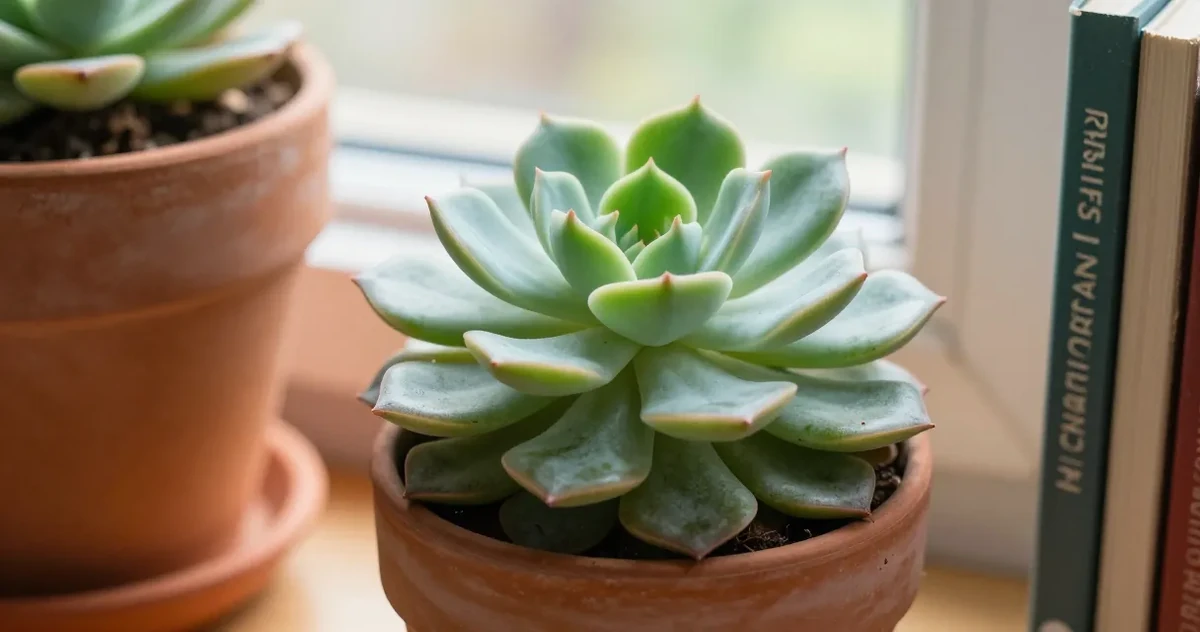
Someone hands you a succulent cutting, or you bring home an unlabeled pot from a market because the shape caught your eye. Now it is sitting on your windowsill and you want to know what you actually have. Succulent identification is more approachable than most guides make it look, as long as you start with the right question.
That question is not “which of a thousand species does this match?” It is: “what shape is this plant, and what are its leaves telling me?” If you are asking what type of succulent do I have?, start with one full-plant picture, then use close-ups of the leaf tip, stem, and any flower stalk to narrow the answer.
Identification Snapshot
Before you chase an exact species name, lock in these four visible clues:
- Growth habit first: trailing, stemmed, or rosette-forming cuts the field down faster than any color match.
- Leaf edge second: smooth, toothed, or rough edges separate many of the common indoor lookalikes immediately.
- Offsets and stem base third: pups at the base point you toward aloe, haworthia, or echeveria-type plants, while a branching trunk points toward jade.
- Pet-safety flag: if the plant might be aloe, jade, or string of pearls, treat the ID as a placement question too, not just a naming exercise.
Not sure what plant you are caring for?
Open KnowYourPlant, snap a photo, and get the plant name plus care notes matched to the species in front of you.
Identify your plantSucculent Identification by Picture: A Visual Key
A single front-facing picture can hide the most useful clues. Use a full-plant photo to choose a growth form, then zoom in on the feature in the second column. This will usually get you to a useful group even when a cultivar or hybrid prevents a confident species-level name.
| What stands out in the picture | Zoom in on this | Likely group | How to separate the closest lookalikes |
|---|---|---|---|
| Pointed or spiky leaves in a rosette | Leaf edge, terminal point, and surface | Aloe, Agave, Haworthia, or a pointed Echeveria/Graptopetalum type | A hard terminal spine and toothed edge favor aloe or Agave; translucent tissue can indicate a window-leaved group, while raised bands can support Haworthia; a soft point on a smooth, powdery leaf favors Echeveria or Graptopetalum. |
| A flower stalk above a fleshy base | Where the stalk emerges, flower shape, and the leaves below it | Flowering aloe, Haworthia, Echeveria, or Kalanchoe type | Treat the flower as confirmation, not the whole ID. Include the basal leaves: tubular flowers above toothed upright leaves suggest aloe, while clustered flowers above broad opposite leaves suggest Kalanchoe. |
| A tall plant with a visible stem | Branching pattern and spacing between leaves | Jade/Crassula, a columnar cactus, or a stretched rosette succulent | Oval leaves on woody branches favor jade. Ribs or areoles point toward a cactus. A rosette lifted on a long bare stem may simply be etiolated from low light rather than a naturally tall species. |
| Stems trailing over the pot | Individual leaf shape and how leaves attach | String of pearls, donkey’s tail, string of hearts, or another trailing succulent | Round beads favor string of pearls; densely overlapping plump teardrops favor donkey’s tail; thin paired hearts favor string of hearts. Photograph one full stem rather than only the pot. |
If none of those rows fits, take a top-down picture and ask three questions: Is it a rosette, a branching plant, or a trailer? Are the leaf edges smooth, toothed, or rough? Is the point soft or a hard spine? Those observations are more reliable than color, which changes with light, water stress, and season.
What Most Identification Guides Miss
Most guides treat succulent identification as a picture-matching exercise. You browse a gallery of 75 types, compare thumbnails, and hope for a match. In practice, this almost never works, because the same Echeveria can look rose-pink outdoors and blue-green inside, and two completely different genera can look nearly identical at a glance.
The real misdiagnosis trap: beginners try to match by color first. Color is the least reliable trait for succulents. Light intensity, water stress, and season can shift a plant’s coloration dramatically. The same individual can look like two different species depending on the conditions it has lived in, or even the time of year.
The practical first check: ignore color entirely and describe the plant’s shape and structure. Where do the leaves attach? Does the plant branch, trail, or stack in a rosette? Are there offsets at the base? Those structural traits do not change when the plant moves from a sunny patio to a shaded windowsill. Color does.
According to Encyclopaedia Britannica, succulents are defined by water-storing tissues that may be located in leaves, stems, or roots, which is exactly why their physical form is so distinctive and why that form is the most stable identification clue you have.
A practical approach is to learn the main succulent families and growth forms first, since flowering is inconsistent and picture-list browsing is not an efficient identification method.
Want a care schedule you do not have to remember?
KnowYourPlant sends watering, feeding, repotting, and seasonal reminders based on the plants you actually own.
Get care remindersStart With Growth Form, Not Species Name
The single most useful first step is to describe how the plant is shaped overall. Most indoor succulents fall into one of three growth habits, and knowing which immediately rules out large groups.
Rosette-forming types
These arrange leaves in a circular layered pattern from a single central point, like a permanent flower that never fully closes. The leaves fan outward and overlap slightly.
- Echeveria is the most common rosette succulent sold indoors. It has smooth, paddle-shaped leaves in shades that range from silver-blue to coral depending on light. The rosette is flat and open.
- Graptopetalum looks similar but tends to produce flatter, more pointed leaves with a slightly powdery or waxy surface. The rosette often feels more compact and the tips are sharper.
- Haworthia also forms rosettes, usually smaller and denser, and often shows distinctive markings or translucency near the leaf tips that no other common indoor succulent replicates.
Stemmed and branching types
These have a clearly visible fleshy or woody stem with leaves growing from it. According to NC State Extension, jade plant (Crassula ovata) is identified by its oval, succulent entire leaves on branched thick stems that slowly develop a miniature tree silhouette, quite different from anything rosette-forming.
Aloe vera also has a visible stem base, though it maintains a long-leafed upright arrangement rather than branching horizontally. NC State Extension notes that aloe spreads by offsets and eventually produces tubular yellow-orange flowers once mature.
Trailing and hanging types
These send stems sideways and downward rather than upward. String of pearls, donkey’s tail, and string of hearts all belong here. If your succulent is spilling over the rim of the pot rather than building upward, you are looking at a trailing type, which narrows the possibilities quickly. For a closer look at caring for one of the most popular trailing succulents, see the string of pearls care guide.
Save this plant plan before you forget the details.
Keep the plant, diagnosis notes, reminders, and care changes in KnowYourPlant so the next decision is based on your actual plant history.
Open KnowYourPlantRead the Leaves: The Traits That Actually Separate Lookalikes
Once you have the growth form, the leaves give you the next level of detail. Experienced plant owners who ask for community identification help are almost always steered toward these small traits: not color, not overall size, but specific leaf details.
Leaf thickness
Very plump, nearly spherical leaves point toward Sedum or some Crassula species. Leaves that are firm and fleshy but still clearly flat or paddle-shaped are more common in Echeveria and its hybrids. If the leaves feel soft and the whole plant deflates slightly when pressed, that is a watering clue as much as an identification clue. The plant may be underwatered.
Leaf edges and tips
Run a finger carefully along the edge of one leaf from base to tip.
- Smooth edges with no texture: Echeveria, jade, Graptoveria hybrids
- Fine teeth or small serrations that catch your fingertip: aloe, some agave
- Tiny raised bumps or rough ridges along the margin: Haworthia
The leaf tip is equally diagnostic. A hard terminal spine you can feel with your fingertip points toward aloe or Agave. A soft rounded or gently pointed tip without any spine suggests Echeveria, jade, or a hybrid. In one identification case shared in a plant community, a user could not find a match in any picture gallery, but describing the flat rosette with pointed leaf tips and a slightly powdery surface led an experienced gardener directly to Graptopetalum filiferum, based entirely on those two small morphological details.
Translucent windows
If a leaf has a small glassy or frosted-looking area near its tip, you may be seeing translucent tissue that admits light to the leaf interior. Many Haworthia species show this clearly, but the feature is not exclusive to that genus; other window-leaved succulents, including Lithops and Fenestraria, use similar tissue. Combine it with growth form, surface texture, banding, and offsets before naming the plant.
Lookalike Matrix: Common Indoor Succulents Side by Side
This comparison covers the succulents beginners most often confuse, using only traits visible without tools or flowers.
| Trait | Echeveria | Haworthia | Jade Plant | Aloe Vera | String of Pearls |
|---|---|---|---|---|---|
| Growth form | Flat rosette | Dense rosette | Branched stem | Upright rosette | Trailing stem |
| Leaf shape | Paddle, smooth | Narrow, banded | Oval, entire | Long, tapered | Spherical |
| Leaf edges | Smooth | Slightly rough | Smooth | Toothed/spined | Smooth |
| Leaf tip | Soft point | Firm, sometimes spined | Rounded | Hard spine | Pinched point |
| Translucent window | No | Often yes | No | No | No |
| Offsets | Yes, at base | Yes, dense clumps | Rarely | Yes, freely | Stem cuttings only |
| Pet safety | Generally safe | Generally safe | Toxic (ASPCA) | Toxic (ASPCA) | Toxic (ASPCA) |
Pet-safety note: According to ASPCA, both jade plant and aloe vera are toxic to dogs, cats, and horses, even though aloe gel is often marketed as edible for humans. If you have pets, correctly identifying these two common succulents matters beyond aesthetics. String of pearls is also toxic to pets. For a full overview of houseplants safe for cats, see cat-safe indoor plants.
Care Cards for the Succulent Types People Confuse Most
Once you have a likely match, sanity-check it against the care pattern below. If the care profile feels wildly wrong for your plant, go back and re-check the ID.
Echeveria and Graptopetalum-type rosettes
- Light: brightest window available, often with direct sun or supplemental light
- Watering pattern: let the whole pot dry, then water thoroughly
- Best ID clue: flat powdery rosette, smooth leaf edges, no hard terminal spine
Haworthia-type rosettes
- Light: bright indirect light or gentle morning sun
- Watering pattern: dry fully, then rewater a little sooner than jade or aloe
- Best ID clue: small dense rosette with windows, banding, or raised texture
Jade plant
- Light: bright light, but less hungry for all-day direct sun than echeveria
- Watering pattern: allow the mix to dry deeply; cold wet soil is the big risk
- Best ID clue: oval leaves on a branching stem that slowly becomes trunk-like
Aloe vera
- Light: bright light with a sharply draining mix
- Watering pattern: soak, drain, and wait until the root zone is dry again
- Best ID clue: upright fleshy leaves with toothed margins and a firm spine at the tip
Offsets and How the Plant Spreads
Many succulents produce offsets, small new plants that push up from the base or roots of the parent plant. Noticing this behavior narrows your options fast.
- Aloe vera produces offsets freely. They can crowd the pot over time, and the offsets often look like miniature versions of the parent plant but may be paler.
- Haworthia tends to produce dense clumps of offsets over a few years, eventually filling the container with a tight colony.
- Echeveria offsets cluster tight against the main rosette, sometimes tucked under the outer leaves.
A plant multiplying at the base may belong to one of these commonly offsetting groups, but offsets are not exclusive to them. For detailed guidance on aloe vera’s offset behavior and how to separate pups without damaging roots, the aloe vera care guide covers the timing and technique.
Common Problems That Lead to the Wrong ID
| What you notice | What it usually means | What to check next |
|---|---|---|
| A rosette suddenly looks stretched and loose | Low light changed the shape, not the species | Compare new growth to older compact leaves before renaming it |
| Leaves flush red, orange, or purple | Stress coloring from sun or drought can mimic another variety | Re-check leaf shape, edges, and stem form instead of color |
| Lower leaves drop while the top still looks healthy | Normal aging or a watering issue can distract from the real ID | Look at offsets, stem structure, and root-zone condition together |
| A plant seems different only when it flowers | You waited for a seasonal clue that may show up late or inconsistently | Use flower traits as confirmation, not the first sorting step |
| Two candidates still feel equally plausible | Hybridization or juvenile growth is blurring the usual clues | Use a top-down photo, leaf-edge close-up, and stem-base shot for a final check |
How Light, Temperature, and Growth Cycles Change Appearance
The same succulent can look significantly different as light, temperature, water availability, and its own growth cycle change. Calendar seasons are only a rough proxy: timing differs by species, hemisphere, latitude, and whether the plant lives indoors or outside.
During active growth, new leaves may make the plant look closer to nursery reference photos. In many temperate Northern Hemisphere homes this overlaps with brighter spring or summer conditions, but winter-growing species and Southern Hemisphere seasons do not follow that shorthand.
During stronger sun, heat, or water stress, some Echeveria and Graptopetalum types can flush red, orange, or purple. That color may be a reversible environmental response rather than proof of a different variety, but color alone cannot tell you whether the plant is healthy.
During lower light or a species-specific rest period, growth may slow and stress colors may fade toward green or blue-grey. Do not assume every succulent becomes dormant in the same months. If leaves are dropping, check moisture, roots, pests, and light before calling the change seasonal.
Flowering time is species- and condition-dependent. A flower stalk can support an identification when the basal leaves and growth form are visible too, but its calendar date is not a reliable genus test across climates or hemispheres. Do not wait for a flower before using the structural clues.
Practical takeaway: if a succulent recently moved between environments, factor in changes in light and temperature before concluding you have an unusual type. Describe the structural traits and record the conditions the plant came from.
When Color Can Mislead You
Leaf color is one of the least reliable identification clues for succulents, and this trips up beginners consistently. The same Echeveria that glows deep orange-red in a sunny outdoor spot will fade to blue-green after a few months on a shaded windowsill. Heat stress, light intensity, drought, and seasonal shifts can all change the apparent color of the same plant significantly.
In plant community identification threads, owners regularly describe a succulent with reddish leaf backs or unusual coloring and get conflicting answers, because experienced gardeners immediately note that sun exposure or recent stress could explain the color shift in multiple directions. A confident identification is not possible from color alone without structural detail.
Treat color as a secondary confirmation, something you check once you have already narrowed the field by shape and leaf structure.
Plant ID + Plant Doctor
Not sure what your plant needs?
Snap a photo in KnowYourPlant to identify the plant, check yellow leaves, spots, wilting, or pests, and get a calm next step before the problem spreads.
Decision Tree: Narrow an Unknown Succulent by Visible Traits
Use this flow before reaching for a picture gallery or posting in a forum. Work from the largest clue down to the smaller ones.
Step 1 – Is the plant trailing or hanging?
- Yes: trailing type (string of pearls, donkey’s tail, string of hearts). Check leaf shape: spherical = string of pearls; flat teardrops stacked tightly = donkey’s tail.
- No: go to Step 2.
Step 2 – Does the plant have a visible branching stem above soil?
- Yes: stemmed type. Oval leaves plus tree silhouette = jade. Long tapered leaves plus upright rosette plus toothed edges = aloe.
- No: go to Step 3.
Step 3 – The plant forms a rosette. How large and open is it?
- Wide, flat, paddle-shaped leaves with smooth edges: Echeveria or Graptoveria hybrid.
- Small, dense, narrow leaves with banding or translucent windows near the tip: Haworthia.
- Flat rosette with slightly powdery leaves and sharper tips than Echeveria: Graptopetalum.
Step 4 – Still uncertain? Take a close-up of a single leaf edge and a top-down view of the whole rosette. Those two angles resolve most beginner ambiguities. Note whether the plant may be showing seasonal stress coloring before concluding the identification is impossible. If you want a faster answer, a plant identification app can confirm the match from a photo before you change any care.
Photo Checklist Before Asking for an ID
If you post to a plant forum or use an identification app, these angles give you the best chance of a fast, confident answer.
- Top-down view of the full plant
- Side view showing stem height and how leaves attach
- Close-up of one leaf margin from base to tip
- Close-up of the leaf tip (spined or soft?)
- Base of the plant, including any offsets
- Note whether the plant is currently in unusual conditions (very low light, recently brought indoors from outdoors)
- Note whether color may be stress-induced or seasonal (very red, very pale, or different from when you bought it)
Care Implications of Getting the ID Right
Identification is not just a labeling exercise. Knowing what you have changes how you care for it.
- Haworthia tolerates lower light than almost any other common succulent. Putting it in a bright south window is unnecessary and can cause bleaching.
- Echeveria needs more light than most indoor spaces naturally provide and will etiolate (stretch toward light) quickly in dim spots. If your rosette is elongating, use the succulent grow-light setup guide to test distance, timer duration, and edge coverage instead of guessing from fixture height alone.
- Jade plant is far more drought-tolerant than aloe but responds badly to cold drafts. Its branched stems also need a heavier, more stable pot as the plant matures.
- Aloe vera stores water in its leaves efficiently and roots rot quickly in poorly draining soil. The succulent care guide covers soil mix ratios and watering thresholds in more detail, which applies to most rosette-forming types as well.
- Any succulent with leaves dropping unexpectedly may be reacting to a species-specific rest period, overwatering, root stress, or pests rather than an identification problem. The succulent leaves falling off guide covers that symptom if you notice leaf loss alongside your identification work.
Approximately 10,000 succulent species exist worldwide according to botanical estimates, but the plants you are likely to encounter in garden centers and as gifts represent a small handful of genera. Getting comfortable with five or six growth forms covers the identification needs of most everyday succulent owners.
Real User FAQ
How do I identify a succulent I received as a gift or cutting? Start with growth form. Is it trailing, stemmed and branching, or forming a rosette? Then look at the leaf edges (smooth, toothed, or bumpy), the leaf tip (soft or spined), and whether offsets are forming at the base. Those four traits together will narrow most common indoor succulents to one or two candidates without needing a flower.
What is the easiest succulent to identify at home? Jade plant is one of the most recognizable because its oval fleshy leaves on branching woody stems look unlike any rosette-former. Aloe vera is also distinctive once you notice the firm toothed leaf margins and the hard spine at each tip. Both are immediately recognizable once you know what the structural traits are, even if you have never seen them labeled.
Can I identify a succulent from leaf color alone? Not reliably. The same species can appear orange-red in full sun and blue-green in a shaded window. Color shifts with light intensity, drought stress, and season. Use color as a secondary check after you have already narrowed the field by shape, leaf structure, and growth habit.
What is the translucent window near a leaf tip, and which succulents have it? A translucent window is a glassy or frosted patch that admits light into the leaf tissue. It is conspicuous in many Haworthia species, but also occurs in other window-leaved succulents such as Lithops and Fenestraria. On a compact nursery rosette it can support a Haworthia identification, but confirm with leaf texture, banding, clumping habit, and overall growth form.
My succulent is producing small plants at its base. What does that tell me? Offsets at the base are a useful identification clue. Aloe vera often offsets and the pups can look lighter-colored than the parent. Many Haworthia form dense clumping colonies over time, while some Echeveria produce offsets close to the main rosette. These are common candidates, not the only possibilities, so confirm with leaf structure, growth form, and the stem base.
Is aloe vera safe for pets? No. According to ASPCA, aloe vera is toxic to dogs, cats, and horses. The toxicity is present in the plant even though aloe gel is often considered safe for topical or dietary human use. If you have pets, this distinction matters when placing the plant. Haworthia is a commonly recommended non-toxic alternative that looks similar to aloe when small and tolerates lower light conditions.
How do I tell Echeveria and Graptopetalum apart? Both form flat rosettes with fleshy leaves, and hybrids between them (sold as Graptoveria) blur the line further. In general, Graptopetalum leaves tend to be slightly flatter, more pointed at the tip, and often have a powdery or waxy surface that feels more pronounced than Echeveria. The rosette on Graptopetalum tends to sit tighter and more compact. For practical care purposes, both genera have nearly identical water and light needs, so a confident species match matters less than knowing you have a rosette-forming type.
When should I use a plant identification app instead of doing it manually? Use an app when two options still seem equally possible after working through growth form, leaf edges, leaf tip, and offsets, or when the plant has unusual features you cannot place with a beginner’s key. A top-down photo combined with a close-up of the leaf margin gives an app the best chance of a confident match. Apps also help when the plant may be a hybrid, since hybrid traits can fall between what either parent looks like in a written description.
Methodology
This guide was built by comparing current search results with the identification problems people repeatedly bring to plant communities, then checking the stable ID clues against Britannica, NC State Extension plant pages, and ASPCA pet-safety references. Community threads were used to surface real confusion points, like waiting for flowers, over-trusting color, and mixing up near-identical rosettes, but not as stand-alone proof.