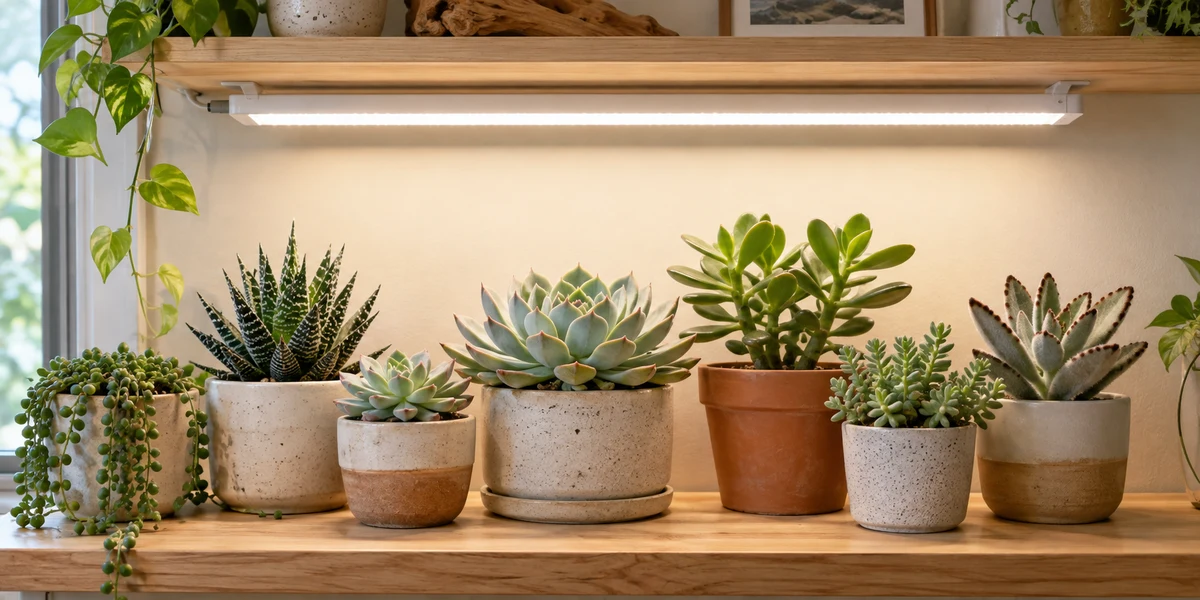
A good succulent grow-light setup is measured, not guessed. Start at the fixture maker’s recommended hanging height, put the light on a timer for about 14 hours, check the center and edges of the shelf, and judge the next two weeks of new growth. If the plant keeps stretching, improve intensity or coverage. If new bleaching appears, back the light off and acclimate more slowly.
There is no safe universal LED distance. Two fixtures mounted 8 inches above a plant can deliver very different amounts of light, and the edges of the same fixture can be much dimmer than its center. The useful question is not simply, “How many inches?” It is: How much useful light reaches this plant, for how long, and how is the plant responding?
Quick Succulent Grow-Light Setup
| Decision | Practical starting point | What confirms it |
|---|---|---|
| Fixture | A broad-spectrum white LED or fluorescent fixture that covers the full plant footprint | The maker provides a coverage or intensity map at a stated height |
| Distance | Use the maker’s recommended height; do not copy a distance from a different lamp | Center and edge readings are reasonably even, and foliage does not heat or bleach |
| Duration | About 14 hours on a timer for a grow-light-only shelf; count natural and artificial light together | New growth stays compact without exceeding 16 total hours of light |
| Placement | Directly above the plants, with leaves below the fixture’s useful coverage area | Plants at the shelf edges do not lean or stretch faster than plants in the center |
| Review | Record one baseline, change one variable, and reassess new growth after 10–14 days | New leaves are tighter and better aligned; old stretched growth will not shrink |
The 14-hour starting point is a setup test, not a rule for every succulent. University of Minnesota Extension gives a specific fluorescent-light reference of 6–12 inches above succulents for 14–16 hours a day. LED output varies too much to transfer that distance blindly. University of Maryland Extension advises keeping total illumination at no more than 16 hours because plants need a dark period.
First Confirm Which Succulent You Have
“Succulent” describes a water-storage strategy across many unrelated plants, not one care profile. A sun-hungry Echeveria, a shade-tolerant Haworthia, a jade plant, and a holiday cactus can respond differently to the same shelf.
Use the succulent identification guide if you are unsure of the genus. Identification changes three parts of this setup:
- Intensity: compact rosette succulents often need more indoor light than forest cacti or some Haworthia and Gasteria species.
- Photoperiod: kalanchoe and holiday cacti can use day length as a flowering signal, so a long evening light cycle may delay blooms even when vegetative growth looks healthy.
- Acclimation: a plant grown in a shaded shop needs a slower transition than one already living beside a sunny window.
This is also why “full sun” on a tag is not a lamp setting. A tag describes a broad outdoor exposure, while a fixture delivers a particular intensity across a particular footprint.
Choose the Fixture by Output and Footprint
For one small pot, a suitably bright bulb or compact panel may be enough. For a row of pots, bars that span the shelf usually make even coverage easier. A large panel can work for a wider group if its published coverage matches the actual growing area.
Prioritize these details over colored-light marketing:
- A coverage or PPFD map at a stated height. A single wattage number does not show how evenly light reaches the shelf.
- A footprint that fits the plants. Measure the occupied width and depth, not just the shelf itself.
- Adjustable height. The plants will grow, and different species may need separate tiers.
- A reliable timer. Consistent duration makes the setup easier to evaluate.
- Manageable heat and safe mounting. Follow the fixture instructions, keep electrical connections away from water, and leave the stated ventilation clearance.
A broad-spectrum white light makes inspection easier because leaf color remains natural. Plants can grow under several lamp types; the general indoor grow-light guide compares bulbs, bars, and panels in more detail. This page stays focused on setting one up for succulents rather than ranking products.
How Far Should a Grow Light Be From Succulents?
Use the height stated for your fixture’s coverage data. If the maker recommends 12 inches for the published map, begin at 12 inches above the highest leaf, not above the pot or shelf. Record the distance so you can repeat it.
Distance matters because intensity falls quickly as the lamp moves away from the leaves. Maryland Extension specifically notes this relationship. But “closer” is not automatically “better”: output, optics, heat, and species all change the safe working distance.
Follow this adjustment sequence:
- Mount the lamp at its recommended height.
- Check the leaf temperature after the light has been running. Foliage should not feel heated by the fixture.
- Map the center, corners, and shelf edges with the same meter and phone position.
- Run the setup consistently for 10–14 days.
- If only the edge plants stretch, fix coverage before lowering the entire fixture.
- If every plant stretches, either lower the lamp within its safe range, lengthen the day without exceeding 16 total hours, or use a higher-output fixture.
- If pale or papery patches appear after the change, raise or dim the lamp and acclimate more gradually.
For fluorescent tubes, the University of Minnesota’s 6–12-inch reference is a useful starting range. For LEDs, use the individual product’s map because a decorative 10-watt lamp and a high-output panel cannot share one meaningful distance rule.
How Long Should Grow Lights Stay On?
For a shelf with little useful daylight, start with about 14 hours on and 10 hours off. A basic timer removes daily variation. If the plants also receive strong window light, the lamp may need to run for fewer hours; count the combined day rather than treating window and fixture time separately.
South Dakota State University Extension says most succulents need at least 6–8 hours of light and that artificial light can make up for inadequate window light. That does not mean six hours under any lamp equals six hours of sun. Duration cannot fully compensate for a fixture that is too weak or too far away.
Use these guardrails:
- Keep a consistent daily cycle instead of alternating very long and very short days.
- Do not run the lamp continuously. Keep total illumination at 16 hours or less.
- For flowering kalanchoe, holiday cacti, and other day-length-sensitive plants, check species-specific flowering guidance before extending the evening.
- Recheck the timer after a power outage and whenever seasons change.
Measure Coverage Without Pretending a Phone Is a PAR Meter
A handheld light meter is best for measuring visible light. A phone app can still reveal relative differences across a shelf. UF/IFAS Gardening Solutions notes that phone measurements vary by device and method but are usually useful for approximating changes.
That distinction is important. Lux is weighted to human vision; plants respond to photosynthetically useful photons. Do not treat a phone lux number as a universal succulent target or convert it mechanically into PPFD. Use it to answer comparative questions:
- Is the edge half as bright as the center?
- Did lowering the fixture increase light at every pot?
- Does a tall plant shade the rosette behind it?
- Is the window contributing meaningful light at the time you measured?
A Five-Point Shelf Map
Measure at leaf height, with the sensor facing the lamp, at the same time of day. Record five positions: center, front left, front right, back left, and back right.
| Position | Baseline | After adjustment | What changed? |
|---|---|---|---|
| Center | ___ lux or foot-candles | ___ | |
| Front left | ___ | ___ | |
| Front right | ___ | ___ | |
| Back left | ___ | ___ | |
| Back right | ___ | ___ |
Calculate each edge as a percentage of the center: edge reading ÷ center reading × 100. The percentage is a uniformity check, not a plant requirement.
Worked Example: One Strong Center, Weak Edges
These numbers are illustrative, not a product test or a recommended target. Imagine a phone app reads 10,000 lux in the center, 4,200 at the left edge, and 3,800 at the right edge. The edge pots receive only 42% and 38% of the center reading. If those plants stretch while the center stays compact, the evidence points to coverage, not an across-the-board timer problem.
A better test would be to add a second bar, use a wider fixture, or rearrange the footprint, then repeat all five measurements. Lowering one narrow lamp might brighten the center while making edge uniformity worse.
Worked Example: A Uniform but Weak Setup
Suppose all five readings are close to one another, but every rosette continues producing longer gaps between new leaves after two weeks. Uniformity is good, yet intensity or duration is still inadequate. Change one variable: lower the lamp within the manufacturer’s safe range or extend the timer modestly. Record the new setup and wait for new growth before changing something else.
This small experiment is more useful than buying another lamp based on wattage alone because it tells you whether the actual problem is coverage, intensity, or time.
Read the Plant: Too Little Light, Enough Light, or Too Much?
| What you observe | More likely explanation | Best next check |
|---|---|---|
| Longer gaps between new leaves; rosette opening upward | Too little usable light, called etiolation | Compare new growth with older compact growth; check center and edge readings |
| Stem or rosette leaning in one direction | Uneven light | Map both sides; place the fixture directly overhead rather than relying on rotation alone |
| New growth is compact and evenly oriented | Current setup is supporting form | Keep distance and timer stable |
| Sudden pale, white, tan, or papery patches after a light change | Excess intensity or inadequate acclimation | Raise or dim the lamp; compare damage with the plant sunburn guide |
| Soft translucent leaves, a mushy base, or wet mix | Moisture or root trouble, not a reason to add more light alone | Check drainage and roots with the root rot guide |
| Only old stretched leaves look loose, while the new center is compact | The setup is now working | Judge the new growth; old tissue will not shorten |
South Dakota State University Extension describes long, lanky growth as a lack-of-light sign. Maryland Extension also lists spindly growth, leaning, fading color, and poor growth among low-light responses, while excessive light can pale or brown leaves.
Acclimate a Succulent to Stronger Light
Do not move a plant from a dim shop shelf straight under the fixture’s maximum output. Even a species that prefers strong light can bleach or scorch when intensity rises abruptly.
Start higher or dimmer than your planned setting, then increase exposure in steps over one to two weeks. Watch the surfaces closest to the lamp. If pale or papery areas appear on those leaves soon after a change, pause and reduce intensity. Illinois Extension similarly recommends a gradual transition when succulents move into stronger outdoor light because unfiltered sunlight can burn leaves.
Stress color is not a precise meter. Red or purple pigment can be normal for some cultivars and can also respond to temperature or water stress. Treat a color change as one observation, not proof that the lamp is correct or harmful.
What a Grow Light Can and Cannot Fix
A better setup can make future growth more compact. It cannot compress an already elongated stem or move old leaves back together.
If the new center is compact, leave the plant alone unless the stretched shape bothers you. If you want to restart a severely elongated rosette, first identify the species and use an appropriate propagation method; not every succulent roots the same way. The indoor succulent care guide covers how light, soil, and watering interact, while the plant propagation guide explains why the cutting point and callusing step vary.
A lamp also cannot repair root rot. More light may change how fast the mix dries, but it does not make a pot without drainage safe. Keep using the succulent’s dry-down and root-health signals rather than watering more automatically after installing a light.
A Two-Week Setup Test
Use this log to avoid changing several variables at once.
Day 0: Record the Baseline
- Identify the plant as closely as possible.
- Photograph it from the side and directly above.
- Record fixture model, power setting, height above the highest leaf, timer, and shelf position.
- Take the five-point light map.
- Note whether the mix is dry, damp, or wet; do not change watering just because the lamp is new.
Days 1–3: Check Safety and Acclimation
- Confirm the timer actually switches off.
- Check for unexpected heat at leaf level.
- Look for new pale or papery patches on the lamp-facing surface.
- If damage appears, reduce intensity; do not wait two weeks to stop active burn.
Days 10–14: Compare New Growth
- Recreate the two photographs from the same angles.
- Compare only the newest leaves and spacing.
- If the center plants improve but edge plants do not, change coverage.
- If all plants still stretch, change one variable: distance, output, or duration.
- If new growth is compact, keep the setup stable and review it again after a month.
Common Setup Mistakes
- Copying a height from another lamp. The same distance can produce a very different intensity.
- Measuring from the shelf instead of the leaf. Tall and short pots then receive different light.
- Trusting the bright-looking center. The edges may be far weaker even though your eyes adapt to both.
- Using hours to compensate for a very weak fixture. A longer day cannot make an ornamental lamp high-output.
- Changing distance, timer, and watering together. You lose the ability to tell which change helped.
- Evaluating old growth. Only new growth shows whether stretching has stopped.
- Ignoring species and flowering cues. A long photoperiod can be wrong for a plant you are trying to bring into bloom.
Frequently Asked Questions
How far should a grow light be from succulents?
Start at the fixture maker’s recommended height, measured from the highest leaf. There is no universal LED distance because output and optics vary. University of Minnesota’s 6–12-inch guidance is specifically for fluorescent tubes over cacti and succulents, not every LED. If edge plants stretch while center plants stay compact, fix coverage before lowering the lamp.
How many hours should a grow light be on for succulents?
About 14 hours is a practical starting point for a grow-light-only shelf. Include strong window light in the total and do not exceed 16 hours of illumination per day. Adjust after observing new growth, and check species-specific flowering requirements for kalanchoe and holiday cacti.
Why is my succulent stretching under a grow light?
The fixture may be too weak, too far away, on for too little time, or uneven across the shelf. Map the center and edges at leaf height. If only the edge plants stretch, you have a coverage problem. If every plant stretches, test one change to intensity or duration and reassess the next 10–14 days of growth.
Can a regular white LED bulb grow succulents?
It can if it delivers adequate light across the plant for an appropriate duration. “Regular” and “grow” labels do not prove intensity. A broad-spectrum white lamp with published output information is easier to evaluate than a bulb sold on color claims alone.
Will a grow light repair an etiolated succulent?
It will not shorten the stretched section that already exists. A successful setup produces tighter future growth. You can keep the old form or, if the species supports it, propagate healthy growth after the plant stabilizes.
Do succulents need darkness?
Yes. Do not run the lamp continuously. Maryland Extension recommends no more than 16 total hours of illumination for indoor plants so they receive a dark period. Flowering responses make darkness especially important for some kalanchoe and holiday cacti.
Sources and Review Notes
This guide was reviewed on September 9, 2026 against University of Maryland Extension’s indoor-lighting guidance, University of Minnesota Extension’s cacti and succulent guide, South Dakota State University Extension’s indoor succulent guide, UF/IFAS guidance on measuring houseplant light, and Illinois Extension’s current succulent-care summary.
The worked meter readings are illustrative examples created to explain the method. They are not measurements from a named fixture, controlled trial results, or species-specific light targets.