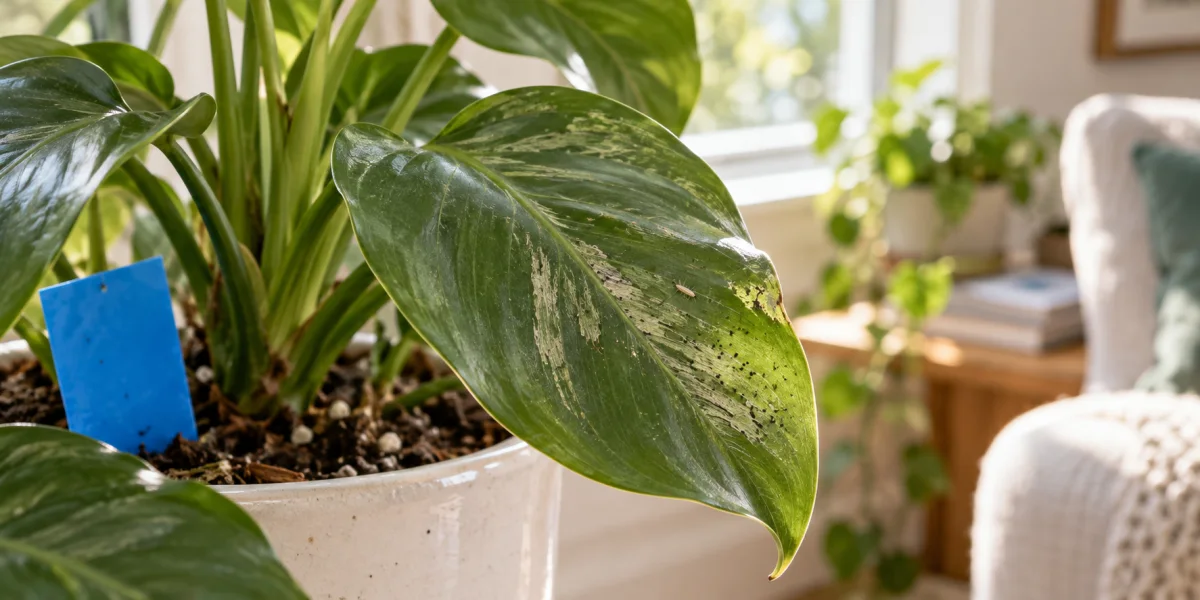
If your plant’s leaves are developing silvery streaks, papery patches, or tiny black specks and nothing in your care routine has changed, thrips are worth ruling out before anything else. They’re one of the harder indoor pests to catch early because by the time the damage is obvious, the insects themselves may have already moved to new growth or dropped into the soil. Most people discover the damage long before they ever see the bugs.
Thrips are tiny, slender insects, often no more than 2 millimeters long, that feed by puncturing surface cells. The Royal Horticultural Society’s thrips guide describes the characteristic silvery discoloration, black excrement spots, and distorted growth that can follow feeding in buds or shoot tips. Many pest species also place eggs in plant tissue, which is one reason exposed insects can disappear before the infestation is finished.
Thrips Symptom Diagnosis Card
Before you spray anything, make sure you’re looking at active thrips and not old scars or a different pest entirely.
| What you see | More likely active thrips | More likely old damage | More likely something else |
|---|---|---|---|
| New leaf coming in silvered or twisted | Yes | No | Possible broad-mite damage if distortion happens without frass |
| Black specks on leaves or near the midrib | Yes, especially if they smear | No | Could be ordinary dirt only if there is no silvering at all |
| Static papery patch on an older leaf | No | Yes | Sun scorch or old mechanical damage can look similar |
| Fine webbing in leaf joints | No | No | Spider mites are more likely than thrips |
What Thrips Damage Actually Looks Like
The hardest part about thrips is learning to tell active damage from old damage. The two look completely different, and confusing them leads to either unnecessary panic or false hope.
Signs of active infestation:
- Fresh silvery or bronze streaking on new, tender growth
- Distorted, curled, or stunted emerging leaves
- Black specks (frass) on leaf surfaces, especially undersides
- Tiny moving dots on leaf undersides or inside unfurling buds
Signs of old, healed damage:
- Static brown or silver patches that aren’t spreading
- Scarred, papery areas on older leaves that have already fully opened
- No new distortion on the newest leaves coming in
This distinction matters a lot. Once thrips damage a leaf, that leaf doesn’t recover. The discoloration stays. The silvery patches or streaks are permanent scars. If you’ve treated and the marks aren’t spreading to new growth anymore, that’s actually a good sign, even though the older leaves still look rough. The goal isn’t to make existing leaves look better. It’s to stop the damage from moving forward.
How to Actually Find Them
Thrips are small enough that most people discover the damage long before they ever see the insects. Knowing where to look makes inspection much faster.
Start with new growth and unopened buds. Thrips are drawn to the softest, most tender tissue on the plant, which is where they feed and where females lay their eggs. If you have a plant with a new leaf just starting to unfurl, hold a sheet of white paper underneath and tap the bud gently. Any dislodged thrips will show up as tiny dark or golden specks on the white surface, some moving, some not.
Check leaf undersides next. Larvae tend to cluster there, feeding in groups before moving on. On large-leaved plants like monstera, check along the edges of new leaves before they fully open. On smaller-leaved plants, work through the newest growth at the growing tips.
If everything looks fine but you’re still suspicious, wait a day and check again. Feeding happens in waves, and a plant can look clean between bursts of activity.
What Most Thrips Guides Miss
Most articles about thrips cover what they are, then recommend neem oil or insecticidal soap. What those guides usually skip is why those treatments so often feel like they do nothing, even when you’re doing everything right.
The answer is the life cycle. Colorado State University Extension explains that eggs are inserted into plant parts and that later immature stages of common houseplant thrips can develop in soil, where foliar sprays cannot reach them. A plant can therefore look clean between exposed generations even though the life cycle has not ended.
Missouri Botanical Garden reports that nymphs feed for about 7 to 14 days and that, in most species, full-grown nymphs drop to the soil to pupate. Development time varies with species and temperature, so a calendar is a monitoring framework rather than a universal pesticide schedule.
The practical upshot: one treatment may reach only the stages exposed that day. If a pesticide label calls for repeat applications, follow its interval exactly rather than improvising a stronger dose or a shorter schedule.
UC Integrated Pest Management notes that thrips often feed in protected plant parts and recommends repeat applications only as directed while pest thrips and susceptible tissue remain present. A clean-looking inspection is encouraging, but new growth and repeat checks are better evidence than one quiet day.
Expert Note: Why Repeat Treatment Matters
These sources line up on the same point: thrips are hard to clear because different life stages can occupy different places at the same time. Feeding stages may be sheltered in buds, eggs may be embedded in tissue, and later stages of many species may be away from the leaves.
That is the core treatment logic for indoor plants. Recheck because the biology creates multiple opportunities for a population to reappear; reapply a product only when its label says to do so.
The First Steps: Isolation and Assessment
Before you treat anything, move the plant away from your others. Ideally to a different room, but even a shelf or corner separated from your main collection buys meaningful time. Then check every plant that was nearby for silvery streaking or frass. Thrips spread easily, especially if plants were touching or growing close together.
If you have limited space: you don’t need a dedicated room to isolate effectively. A bathroom, a corner behind a door, or a windowsill at least a meter away from your main plants all work. The goal is to stop casual movement between plants, not laboratory-level quarantine. Even setting the affected plant on a surface by itself, away from anything touching it, reduces the spread risk significantly.
Then assess how far along the infestation is:
- One or two leaves affected, new growth mostly clean: likely caught early. Isolate, remove exposed insects, and monitor new growth while following any product label.
- Several leaves affected, some new growth distorted: more established. Remove heavily damaged tissue where practical and plan several weeks of inspection and label-directed control.
- Most growth affected, plant visibly stunted: weigh available isolation space against recovery time. One heavily infested plant in a small home can put an entire collection at risk.
- New purchase or rescued plant showing early signs: quarantine it before it joins the group. Missouri Botanical Garden recommends isolating newly acquired plants for two to three weeks to reduce indoor introductions.
For most early-to-moderate cases, treatment is absolutely worth attempting.
Thrips Quarantine Decision Tree
Use this when the infestation is real but your space is limited.
- If one plant has fresh silvering and the others still look clean: isolate that plant now, inspect neighbors the same day, and start a three-week monitoring log for the isolated plant.
- If the affected plant is a brand-new purchase or rescue: keep it fully separate for the whole treatment window, even if symptoms look mild after the first spray.
- If two or more nearby plants show fresh frass or distorted new growth: treat them as one outbreak zone, not as separate one-off cases.
- If one plant is heavily infested and you do not have the room or energy for three more weeks of quarantine: discard that plant first to protect the rest of the collection.
That last branch is not failure. It’s a containment choice when the collection is worth more than one badly infested plant.
A 21-Day Monitoring Framework
Because thrips have distinct life stages, a quiet inspection immediately after treatment can create false confidence. Use this framework to organize inspection and isolation. It does not replace the directions on a pesticide label; legal uses, repeat intervals, and whether soil application is allowed differ by product and location.
Day 0 - Start
- Prune heavily damaged growth where practical and bag the removed material before carrying it past other plants.
- Rinse the plant under a gentle shower or wipe down all leaves, focusing on undersides and buds.
- If you use a pesticide, choose one labeled for the plant and indoor setting, test a small area first, and apply only to the sites and at the rate stated on the label.
- Move the plant to isolation.
Days 5 to 7 - Recheck
- Check new growth first. Any distortion or fresh silvering means the infestation is still active.
- Remove exposed insects again. Reapply a product only if its label’s repeat interval has arrived.
- Recheck all plants that previously shared space with this one.
Days 12 to 14 - Recheck again
- Inspect buds, shoot tips, leaf undersides, and fresh growth rather than judging old scars.
- If exposed thrips remain, continue the product’s labeled program. UC IPM reports that spinosad is generally more effective against thrips than soaps or oils, but it must be legal and labeled for the intended plant and setting. Do not apply it to flowering plants accessible to pollinators.
Days 19 to 21 - Assessment
- Clean new growth and no detected insects are good signs; keep inspecting because old scars cannot show whether control worked.
- If fresh damage or insects remain, extend isolation and reassess the identification, coverage, and label-directed program.
- Return the plant only after repeated inspections show no active signs.
Do not declare success after one inspection. Eggs or protected life stages may remain, depending on the species. Use clean new growth and repeated inspections as your evidence.
For a closer look at how neem oil works against houseplant pests and when it’s the right tool, the neem oil for plants guide covers application method and realistic expectations before you start.
When to Keep Treating vs. When to Let a Plant Go
Most plants caught early can recover. But thrips are one of the few houseplant pests where a severe infestation in a small space makes discarding one plant a legitimate way to protect everything else.
| Situation | Recommended approach |
|---|---|
| 1 to 2 leaves affected, new growth mostly clean | Isolate, remove exposed insects, and follow a label-directed program if needed |
| Several leaves affected, some new growth distorted | Isolate, remove heavily damaged tissue, and monitor closely for several weeks |
| Most growth affected, plant visibly stunted | Assess isolation capacity; discard if collection is at risk |
| Only plant you have, still producing some healthy growth | Usually worth managing with repeated inspection and label-directed control |
The old damaged leaves are not going to change regardless of what you do. Use new growth as your indicator, not the scarred older leaves.
Common Mistakes That Make Treatment Take Longer
Stopping after one quiet inspection. One application may reach the exposed insects without reaching eggs or protected stages. Keep inspecting on the cadence recommended by the product label and judge fresh growth, not the temporary absence of visible adults.
Applying a pesticide somewhere the label does not allow. Many thrips species have stages away from exposed leaf surfaces, but that does not make every foliar product safe as a soil drench. Follow the allowed application sites on the label and combine treatment with isolation, inspection, pruning, and cleanup.
Assuming one rinse ended an established infestation. Rinsing and wiping can remove exposed adults and larvae and may be enough for a very small problem, but it cannot confirm that protected stages are gone. Continue inspecting even when a rinse appears successful.
Returning the plant to the group too soon. Keep the plant separate while fresh damage or insects are still appearing. Reintroducing it after one clean-looking day risks spreading the problem across the collection again.
Watching the old scars instead of the new growth. The silvery patches on leaves that were already damaged when you started are not getting worse. If you’re tracking those as your indicator, treatment will always feel like it’s failing. The only reliable signal is whether new growth is coming in undamaged.
What to Watch During Treatment
Check the plant every few days. The main question is whether new growth is coming in clean. Distorted or silvered new leaves mean the infestation is still active. Clean, normal new growth, even if older leaves still look rough, means you’re making progress.
Keep checking your other plants too. Thrips can be active on a neighboring plant for several days before visible damage starts. Any plant that shared space with the affected one is worth a close inspection each time you check on the treated plant.
One pest that’s easy to confuse with thrips: spider mites. Both produce silvery or bronze discoloration, and early damage from both can look similar at a glance. The key difference is pattern and webbing. Thrips damage tends to show as streaks and broader patches, often with black frass specks. Spider mite damage looks like fine stippling, an even and distributed speckling, and mite infestations produce fine webbing in leaf joints and along stems. Thrips leave no webbing. If you see webbing, you’re looking at mites, not thrips, and the treatment approach changes. The spider mites guide covers the specific signs and treatment steps since mixing them up wastes time. If neither pattern fits, use the leaf-damage identification guide to compare pest injury with disease, scorch, and physical damage.
For monstera owners trying to separate normal leaf variation from active pest pressure, the monstera care guide has a useful breakdown of common leaf problems specific to that plant.
A Note on Timing and Seasons
Warm conditions can shorten the thrips life cycle; UC IPM notes that development from egg to adult can take as little as two weeks in warm weather. That makes frequent inspection especially important, but the pesticide interval still comes from the label rather than a universal calendar.
Recovery takes patience. Most plants, if caught before the infestation is overwhelming, can put out healthy new growth within a few weeks of consistent treatment. The old scars stay. New leaves come in clean. That’s the real sign the work is done.
How We Verified This Guide
The diagnosis and management claims were rechecked on September 9, 2026 against the linked RHS, Colorado State University Extension, Missouri Botanical Garden, and UC IPM guidance. Product directions vary, so this guide defers dosage, allowed sites, safety precautions, and repeat intervals to the current label.
Frequently Asked Questions
How long does it take to get rid of thrips on indoor plants?
Expect to monitor for several weeks. Eggs of many pest species are embedded in plant tissue, and later stages of many species may be in soil or protected plant parts. If a product requires repeat applications, use the interval on its label; do not assume every product belongs on a five-to-seven-day schedule.
Can thrips kill a plant?
A severe, untreated infestation can cause significant decline, especially on smaller plants with less leaf mass. The damage is cumulative: continued feeding destroys more surface cells and can leave emerging growth distorted or stunted. Most plants will not die quickly from thrips, but a persistent infestation can keep weakening the plant and spoil new growth.
Do thrips live in the soil?
For many species, part of the life cycle can occur in soil or leaf litter after the feeding stages leave the plant. Other species use protected sites on the plant. This explains why leaf inspections can miss part of the population, but it does not mean an unlabeled pesticide should be poured into potting mix.
How do I know if thrips are gone?
Look for repeated inspections with no insects, no fresh frass, and no new silvering or distortion. Old damaged leaves will not change, so they are not a reliable indicator. Keep the plant isolated until fresh growth remains clean through the monitoring window appropriate to the product and pest pressure.
Are thrips contagious between plants?
Yes. Winged adults can move between nearby plants, and close contact makes spread easier. Isolate an affected plant promptly and check every plant that shared its space, even if those neighbors still look clean.
What’s the difference between thrips damage and spider mite damage?
Both cause silvery or bronze discoloration, but the pattern differs. Thrips damage tends to show as streaks or broad silvered areas, often with black frass specks visible on the surface. Spider mite damage looks like fine stippling, an even and distributed speckling, and mite infestations produce fine webbing in leaf joints and along stems. Thrips leave no webbing. If you see webbing, you’re looking at mites, not thrips, and the treatment approach changes accordingly.
Should I throw away a plant with thrips?
Only as a last resort, and only if the infestation is severe enough that weeks of isolation aren’t realistic in your space, or if one heavily infested plant is a genuine risk to everything nearby. Most infestations are worth attempting to manage when isolation, repeated inspection, and label-directed follow-up are practical. If you do decide to discard a plant, bag it before moving it through your plant area so you don’t spread thrips on the way out.
Can I use neem oil to treat thrips?
Neem-based products may suppress exposed thrips when the formulation is labeled for the plant and setting, but protected stages can escape contact. UC IPM reports that spinosad is generally more effective against thrips than oils and soaps. Use only a locally legal, labeled product, follow its directions, and protect pollinators by never applying spinosad to flowering plants they can visit.
Sources reviewed September 9, 2026: UC IPM — Thrips, Colorado State University Extension — Managing Houseplant Pests, Missouri Botanical Garden — Thrips, and RHS — Thrips. Reviewed by the KnowYourPlant editorial source review.