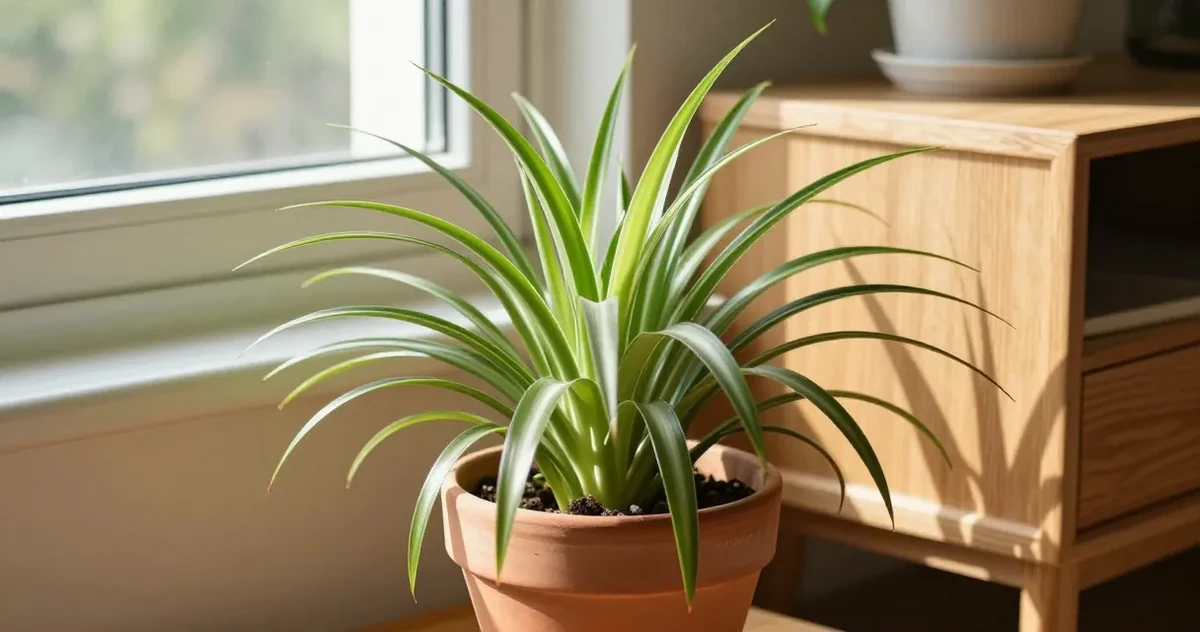
If you are looking at a spider plant wondering whether the “easiest houseplant you can own” label actually holds up, or trying to figure out why yours keeps getting brown tips despite careful watering, this guide is for you.
The short version: spider plant (Chlorophytum comosum) is one of the most forgiving houseplants you can own, genuinely non-toxic to cats and dogs, and impressively generous with new plantlets. The air-purifying claim that follows it everywhere is a different story, and we will get to that honestly.
Spider Plant Identification Snapshot
- Scientific name: Chlorophytum comosum
- What it looks like: arching, grassy leaves that rise from a central crown, often with green-and-white striping
- Growth habit: mature plants send out long runners with dangling spiderettes, which is why they work so well in hanging baskets
- Why it feels forgiving: thick, fleshy roots store water, so the plant handles missed waterings better than many tropical houseplants
- Best expectation reset: a young spider plant can still be healthy and beginner-friendly before it starts making babies
Spider Plant Lookalikes and Common Mix-Ups
If the plant label says Chlorophytum comosum, the benefits and care guidance in this article applies whether the leaves are mostly green or green with white striping. The more common confusion is not the species, but the claim attached to it.
| Common mix-up | What to keep in mind |
|---|---|
| A young spider plant with no babies yet | It is still the same plant. Plantlets usually become a real benefit later, once the roots have settled in and the plant is slightly potbound. |
| “Pet-safe” versus “pet-proof” | ASPCA non-toxic means the plant is safer around cats and dogs, not that pets will leave it alone. Chewing is still one of the most common household frustrations. |
| “Air-purifying plant” versus practical air filter | The realistic benefits are forgiving care, easy propagation, and flexible placement. The clean-air claim is the one that needs the most skepticism. |
What Most Care Guides Miss About Spider Plant Benefits
The SERP is full of spider plant benefit lists that read like they came from the same index card. Nearly every one mentions air purification, easy care, and pet safety as standalone benefits and then stops there, as if those three points have equal weight and zero caveats.
That framing creates two real problems. First, it treats a lab-derived air-quality finding as a practical home benefit when the research behind it does not support that translation. Second, it compresses “pet-safe” into a simple yes/no, when cat owners routinely discover that non-toxic does not mean the plant will survive the cat, or that the cat will stop going after it.
There is also a quieter misdiagnosis built into most “easy houseplant” framing: it implies that if you are getting brown tips, you are doing something wrong. Usually you are not. Brown tips on spider plant are almost always a water-quality or salt issue, not a care failure. The distinction matters because chasing the wrong fix – adjusting light, changing watering frequency – wastes months while the real cause, tap water fluoride or salt buildup, stays in place.
The more useful frame is this: spider plant has a small set of genuinely strong benefits and one very overclaimed benefit that deserves a straight answer rather than a listicle bullet. Knowing which is which is what helps you decide whether this plant belongs in your home.
What Real Owners Keep Running Into
The recurring owner questions around spider plant are surprisingly consistent, which is useful because it shows where the glossy benefit lists leave people hanging.
- Air-quality expectations stay sticky. People still search for spider plant as a home air-fixing plant, especially when someone in the house is sensitive to dust or smells.
- Cat chewing changes the pet-safety conversation. The plant is non-toxic, but plenty of cat owners still end up troubleshooting shredded leaves and repeated nibbling.
- Brown tips are the real beginner frustration. Owners often change watering or light first, even when the more likely issue is tap-water chemicals or salt buildup.
- Propagation is exciting, then confusing. The plantlets are a real benefit, but people still get stuck on when to separate them and why babies sometimes stall before rooting.
Not sure what plant you are caring for?
Open KnowYourPlant, snap a photo, and get the plant name plus care notes matched to the species in front of you.
Identify your plantWhy Spider Plant Has Stayed Popular for So Long
Some plants trend. Spider plant endures. The reason is less about aesthetics and more about behavior: it tolerates the kinds of conditions that quietly end other houseplants.
Forget to water for two weeks? Spider plant stores moisture in its thick, fleshy roots and keeps going. Low-light apartment? According to NC State Extension, spider plant tolerates deep shade better than many other houseplants, though growth slows in very dark spots. Never fertilized it once? It will still grow, just slowly.
That forgiving nature is the real core of what makes it a genuine beginner plant, not a marketing label. Wisconsin Horticulture Extension notes that spider plant is “especially popular with beginners because it is very easy to grow and propagate, tolerant of neglect, and able to thrive in nearly any type of condition.” That assessment comes from a land-grant university extension program, which is part of why it holds up.
It also makes babies. Long, arching stems eventually produce small plantlets – sometimes called spiderettes or pups – that dangle from the mother plant and root easily in water or soil. For anyone who wants to propagate a plant without much fuss, this is one of the lower-stakes entry points you will find.
For the complete routine behind those benefits, the spider plant care guide covers light, watering, feeding, repotting, and seasonal adjustments in one place.
Want a care schedule you do not have to remember?
KnowYourPlant sends watering, feeding, repotting, and seasonal reminders based on the plants you actually own.
Get care remindersThe Real Spider Plant Benefits
It Handles Imperfect Care Remarkably Well
Most houseplant struggles come down to watering mistakes, lighting mismatches, or inconsistent routines. Spider plant is genuinely tolerant of all three, within reason. Illinois Extension confirms it “prefers bright light but is very adaptable to medium light” and should be allowed to dry between waterings – meaning it forgives both under-watering and uneven schedules, not just one.
The fleshy root system is a real structural advantage. Unlike tropical plants that store almost nothing and wilt fast, spider plant roots buffer moisture well enough to carry the plant through an irregular week or a short trip. A plant that forgives early mistakes is the kind of plant that builds confidence without requiring you to overhaul your routine overnight.
For a wider look at building a care routine around a first plant, indoor plant care for beginners covers the fundamentals that apply here and across most easy houseplants.
It Is Actually Safe Around Pets, With One Honest Caveat
This one holds up. The ASPCA lists spider plant (Chlorophytum comosum) as non-toxic to both cats and dogs. No asterisk, no fine print about species variation. If your cat takes a bite, the plant itself is not the danger.
What you will notice, though, is that cats are often drawn to spider plants specifically. They chew the leaves, sometimes repeatedly, and while the plant is not toxic, repeated chewing leaves it looking ragged and reinforces a habit that is hard to break. A separate area with cat grass or catnip is often more effective than moving the spider plant higher, though hanging placement does help.
So: safe, yes. Completely hands-off with a cat in the house, not always. The ASPCA classification answers the toxicity question definitively; it does not answer the placement and behavior question that most cat owners actually run into.
If you are building a pet-safe collection more broadly, the guide to indoor plants safe for cats covers more non-toxic options and placement strategies across different light levels.
Propagation Is One of the Easiest You Will Try
When a spider plant is comfortable and moderately potbound, it sends out long runners with small plantlets at the ends. Those plantlets can be rooted in a glass of water until root nubs appear, then potted into moist soil. Illinois Extension notes that spider plants “produce plantlets when potbound,” which explains why a plant recently moved into a large container often holds off on sending out babies – it needs to settle and feel some root pressure first.
The most common frustration is waiting for pups that never come on a newly purchased or freshly repotted plant. Give it time. Once the roots have some constraint, the runners follow naturally.
The most common failure when the pups do arrive: separating a plantlet before visible root nubs have developed. Waiting until you can see at least a few small white roots makes a meaningful difference in success rate.
Propagating a spider plant also gives you something tangible to pass along, which is part of why this plant has persisted as a household staple for generations. For a broader look at the mechanics, how to propagate houseplants from cuttings and divisions walks through the steps that apply here.
It Works Well in Hanging Baskets and on High Shelves
The arching growth habit and trailing runners look good in a hanging basket or on a high shelf where the stems can cascade downward. This makes it practical for rooms where floor space is limited, where a trailing plant suits the layout better than an upright one, or where keeping it out of reach of pets is a priority.
For a wider look at what works well in that kind of placement, indoor hanging plants that work in real homes has options across light levels and growth habits.
Save this plant plan before you forget the details.
Keep the plant, diagnosis notes, reminders, and care changes in KnowYourPlant so the next decision is based on your actual plant history.
Open KnowYourPlantBenefit vs. Reality: A Scorecard
| Claimed Benefit | Reality Check |
|---|---|
| Easy for beginners | Strong. Fleshy roots tolerate missed waterings; adapts to medium light. Genuinely forgiving of imperfect routines. |
| Safe for cats and dogs | Strong with a caveat. ASPCA-verified non-toxic. Cats still chew it, so placement still matters. |
| Produces lots of plantlets | Context-dependent. Happens reliably once the plant is potbound and settled. Newly purchased plants often wait. |
| Works in hanging baskets | Strong. Arching habit and trailing runners suit this placement naturally. |
| Purifies indoor air | Overstated. See the section below. |
The Benefit That Needs Context: Air Purification
You will see spider plant on almost every “air-purifying houseplant” list. The origin of that claim is NASA research conducted in small, sealed, low-ventilation chamber environments. In that context, plants did absorb certain volatile organic compounds.
The problem is that your living room is not a sealed chamber. A 2019 review of the field, summarized by Drexel University, found that “claims that potted plants improve indoor air quality are vastly overstated” and that normal ventilation dilutes VOC concentrations much faster than any realistic number of potted plants can remove them in real indoor environments.
To match the air-scrubbing rate shown in controlled lab studies, you would need an implausibly high density of plants per square meter of floor space. Spider plant is a fine plant. It is just not a home air filtration system, and treating it as one leads to unrealistic expectations.
Buy it for what it genuinely does: tolerates low maintenance, looks good in the right spot, and is safe around pets. That is already a strong case without the air-purifying talking point.
Common Problems With Spider Plant and Quick Fixes
“Easy to grow” is genuinely true for survival. It is less true for the plant looking good consistently. Here are the specific frustrations most owners run into even when they are doing things right.
Brown leaf tips despite careful watering. This is the most common complaint, and it almost never comes from watering frequency. The usual culprits are fluoride and chlorine in tap water, salt buildup from fertilizer accumulating in the soil over time, or inconsistent moisture across waterings. Wisconsin Horticulture and NC State Extension both list these alongside low humidity as the main tip-burn causes. Switching to filtered water and flushing the soil every few months helps more than adjusting light or water schedule.
If the damage keeps returning, use the spider plant brown tips diagnostic guide to separate water-quality, fertilizer-salt, humidity, sun, and root causes before changing the routine again.
For a broader look at why leaves brown and what to check first, why plant leaves turn brown at the tips and edges covers the pattern across multiple houseplants.
Direct sun scorching. Spider plant handles low light well, but direct sun causes leaf scorch fairly quickly. A spot that gets afternoon sun through an uncovered south or west window is often too much.
Cat keeps chewing it. The non-toxic classification does not discourage cats. If your cat has already shown it will eat anything within reach, strategic placement matters more than the ASPCA label.
No babies after months of waiting. Plantlet production is tied to the roots feeling some constraint. A freshly repotted plant or one in a generously sized pot will often wait until the root system fills out before sending runners. This is normal, not a sign something is wrong.
Very dark spots stalling growth. Spider plant tolerates shade better than most, but a completely dark corner will produce a sparse, slow-growing plant. Some light near a north window is enough; a room with no windows is not.
Plant ID + Plant Doctor
Not sure what your plant needs?
Snap a photo in KnowYourPlant to identify the plant, check yellow leaves, spots, wilting, or pests, and get a calm next step before the problem spreads.
Is Spider Plant the Right Fit for You?
Spider plant is a good match if:
- You want something that tolerates a less-than-perfect watering routine
- You have cats or dogs and need a verified non-toxic option
- You want to try propagating without a steep learning curve
- You have a hanging basket spot that needs a plant
- You are building confidence as a newer plant owner and need something forgiving
- You have filtered water or are willing to switch for one plant
It is less satisfying if:
- You want bold, dramatic tropical foliage as a statement plant
- You have hard tap water and are not willing to adjust your water source – brown tips will keep coming
- You are hoping for a measurable improvement in home air quality
- Your cat has already demonstrated it will eat anything within reach regardless of placement
- You need a plant that produces babies quickly after purchase
The honest summary: spider plant earns its reputation through real structural advantages – root resilience, light adaptability, low fertilizer dependence. The air-purifying talking point is not one of those advantages. Everything else mostly holds up, with the caveat that “easy” refers to survival, not always to perfect appearance.
Spider Plant Care Cards
Light: Bright indirect is ideal; medium light works fine. Avoid direct sun, which scorches the leaves. A north-facing window or a few feet back from a south or west window is usually right.
Watering: Allow the top half of the soil to dry before watering again. The fleshy roots tolerate dry spells better than overwatering. If tips are browning and the soil feels consistently moist, back off on frequency.
Water quality: If you have hard tap water or heavily treated municipal water, switching to filtered water or leaving tap water to sit overnight before using it can reduce fluoride and chlorine tip burn. This single change helps more owners than any lighting adjustment.
Fertilizer: A half-strength balanced liquid fertilizer once a month during spring and summer is enough. Over-fertilizing leads to salt buildup, which contributes to tip burn.
Repotting: Spider plant tends to push roots through drainage holes when it needs a larger pot. According to Illinois Extension, it produces plantlets most freely when slightly potbound, so there is no urgency to size up the moment roots appear. Moving up one pot size when roots are crowded is usually sufficient.
Humidity: Average household humidity is fine. Very dry air from heating systems in winter can worsen tip browning. A pebble tray with water under the pot is a simple way to raise local humidity without much effort.
Real User FAQ About Spider Plant Benefits
Does spider plant actually purify the air?
Not in any practical sense in a real home or office. The origin of this claim is NASA-era research conducted in sealed, low-ventilation chambers. A 2019 review summarized by Drexel University found that potted plants do not improve indoor air quality at any realistic plant density because normal ventilation moves air far faster than plants can filter it. Spider plant is a good houseplant, but that should not be the reason you buy it if air quality is your goal.
Is spider plant safe for cats?
Yes. The ASPCA classifies Chlorophytum comosum as non-toxic to both cats and dogs. If a cat eats a leaf or chews the tips, it is not in danger from the plant itself. The practical issue is that cats are often drawn to spider plants and will chew repeatedly, which damages the leaves and reinforces the habit. Hanging placement or providing an alternative like cat grass tends to be more effective than relying on the cat to lose interest.
Why does my spider plant have brown tips even though I water it carefully?
Brown tips on spider plant are almost always a water quality or salt issue rather than a watering frequency issue. Fluoride and chlorine in tap water are a common cause, and so is salt buildup from fertilizer accumulating in the soil over time. Wisconsin Horticulture and NC State Extension both list these alongside low humidity and inconsistent moisture as the main tip-burn culprits. Try switching to filtered water, flushing the soil every few months to clear salts, and pulling back on fertilizer frequency if you have been applying it regularly.
When will my spider plant start making plantlets?
Usually once it is slightly potbound and has settled into its environment. Illinois Extension notes that plantlet production picks up when the plant is potbound. If you recently bought or repotted your spider plant, expect to wait several months. A very large pot will also delay the behavior because the roots have room to spread before they feel constrained enough to trigger runners.
How often should I water a spider plant?
A rough guide is every 7 to 10 days in spring and summer, less in winter, but the more reliable check is the soil itself. Let the top half of the soil dry out before watering again. Spider plant’s fleshy roots store moisture well, so underwatering is less damaging than overwatering in most home conditions. If the leaves are slightly limp and the soil is dry, water thoroughly. If the soil still feels damp and tips are browning, hold off.
Can spider plant grow in low light?
Yes, better than most tropical houseplants. NC State Extension notes that spider plant tolerates deep shade better than many alternatives, though growth will slow and variegated varieties may lose some leaf contrast in very dark spots. A north-facing windowsill or a spot several feet from a window is generally fine for survival and slow growth.
Is spider plant hard to propagate?
Not once the mother plant is producing runners. The plantlets that form at the ends of long, arching stems can be placed in a glass of water until root nubs appear – usually within a few weeks – and then potted into moist soil. The main failure point is separating the plantlet before visible root nubs have developed. Waiting until you can see at least a few small white roots improves success significantly.
Does spider plant need to be repotted often?
Not especially, and repotting too eagerly will actually delay plantlet production. Spider plant performs well and pushes out runners most reliably when the roots are slightly constrained. Move it up one pot size when roots are clearly crowding the drainage holes or circling densely at the bottom of the pot, not preemptively. Once per year or even less is normal for an established plant.
If you want a simple reminder when it is time to water, fertilize, or check on your spider plant through the seasons, KnowYourPlant lets you set care reminders and run a quick diagnosis check if something looks off, all from a photo.
Methodology and Source Check
This article was updated on June 20, 2026 using the same evidence set behind the current spider plant benefits research work: live search review from late May 2026, owner questions surfaced in Reddit and forum snippets, and reference material from Wisconsin Horticulture, NC State Extension, Illinois Extension, the ASPCA, and Drexel’s summary of the 2019 Nature review on indoor air quality. Community threads were used to understand recurring owner confusion, not as proof on their own.
Written by the KnowYourPlant editorial team. Last updated June 20, 2026.
Care information reflects guidance from Wisconsin Horticulture Extension, NC State Extension Gardener Plant Toolbox, and Illinois Extension. Pet safety classification from the ASPCA. Air-purifying claim context from Drexel University’s summary of the 2019 Nature review on indoor air quality and potted plants.