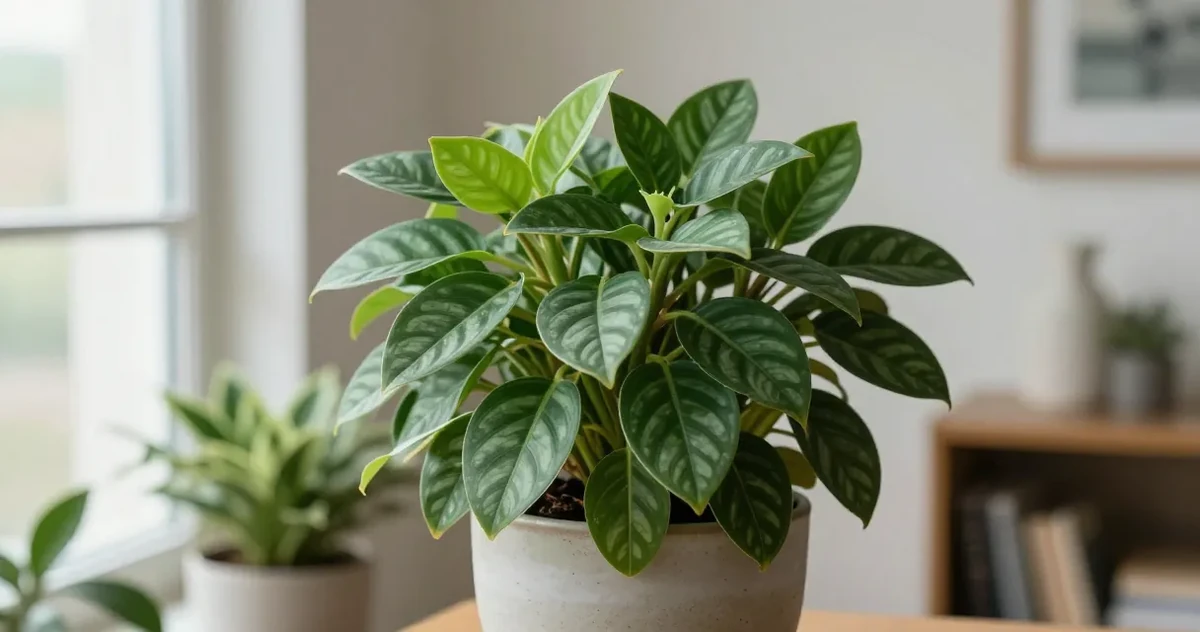
Most people end up with a peperomia before they’ve fully decided to get one. You spot a small, cheerful plant at the garden center, the tag says “easy care,” and it comes home with you. Then a few weeks later, black patches appear on the leaves, or the edges go brown, or the plant just stops looking right - and the care card you saved doesn’t explain why.
Here’s the part most care guides leave out: peperomia varieties are not interchangeable. Peperomia is one of the largest tropical genera, with over 1,000 described species and dozens sold as houseplants. The watermelon peperomia, baby rubber plant, ripple peperomia, raindrop peperomia, and hope peperomia you’ll find at a typical garden center look different, grow differently, and react differently to the same care mistake.
Treating them all the same is where most peperomia problems start. This guide helps you tell the main types apart, match the right one to your actual space and routine, and recognize early signals before they become harder to fix. Start with the complete peperomia care guide for the genus-wide light, watering, soil, and seasonal baseline, then use this page to adjust for the variety you actually own.
Identification Snapshot
| If your plant has… | You likely have… | Growth form | Best first placement check |
|---|---|---|---|
| Rounded leaves with silver-green striping | Watermelon peperomia | Rosette | Bright indirect light, keep water off the leaves |
| Thick glossy spoon-shaped leaves | Baby rubber plant | Upright to semi-trailing | Medium light is fine, but do not leave soil wet |
| Deeply rippled or corrugated leaves | Ripple peperomia | Compact rosette | Filtered daylight, porous mix, no misting |
| Large teardrop leaves with a glossy finish | Raindrop peperomia | Upright | Bright indirect light, protect from direct sun |
| Small coin-like leaves on trailing stems | Hope peperomia | Trailing | Hanging basket or high shelf, let stems signal thirst |
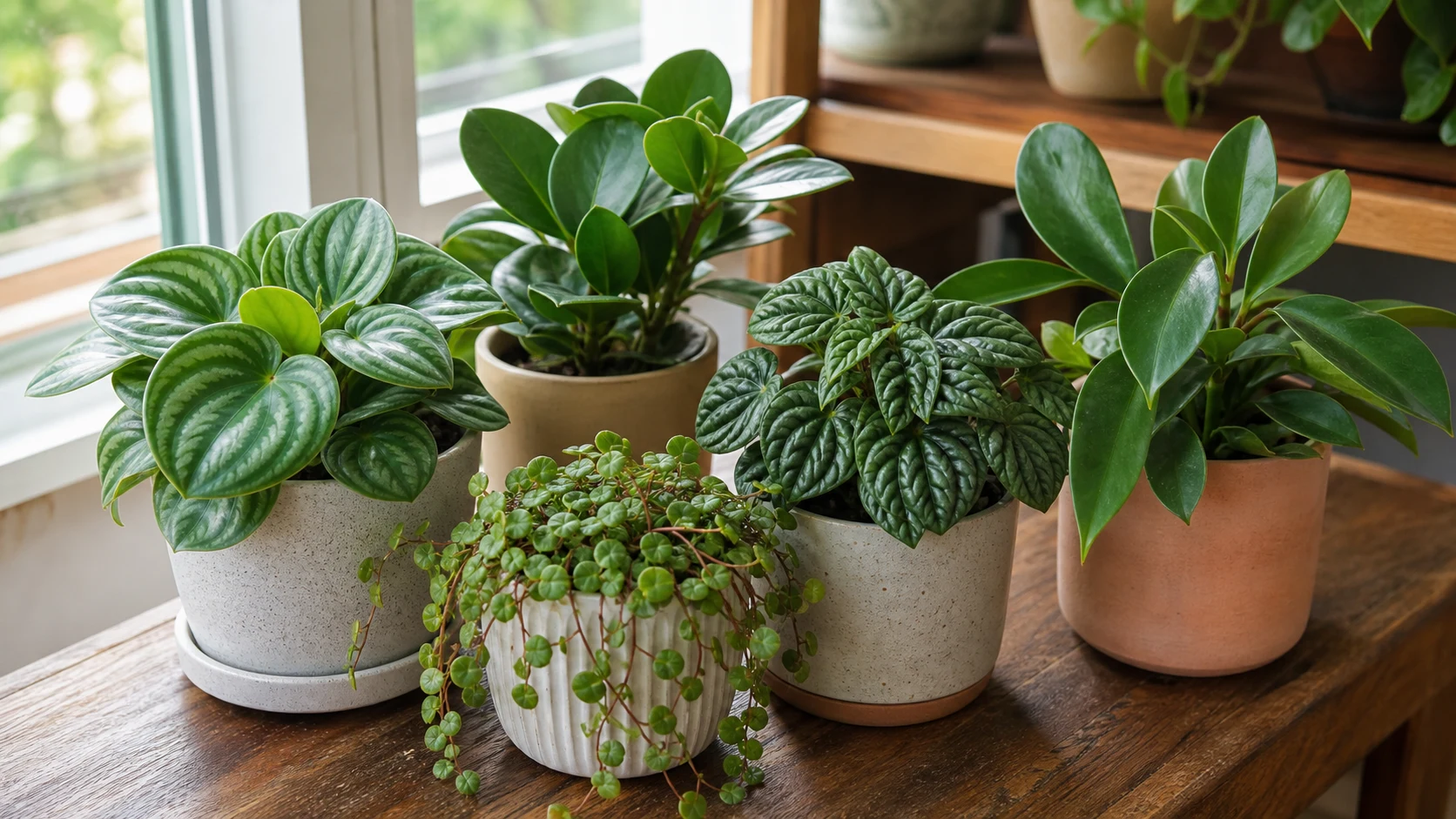
Leaf shape, texture, and growth habit make the main peperomia varieties easier to identify before adjusting their care.
Lookalikes and Plants Peperomias Get Confused With
- Baby rubber plant is not the same as a rubber tree. Peperomia obtusifolia stays compact and has softer, smaller leaves than Ficus elastica, which grows much larger and has thicker, broader foliage.
- Raindrop peperomia gets confused with Chinese money plant. Peperomia polybotrya has teardrop leaves with a pointed tip, while Pilea peperomioides has flatter round leaves on longer petioles.
- Hope peperomia can blend in with trailing succulent-type houseplants. The easiest tell is the leaf arrangement: Hope grows small round leaves in pairs along flexible stems instead of forming the heavier chains you see on string-of-nickels style plants.
If the leaves are deeply quilted rather than thick or glossy, compare them with the Moon Valley pilea care guide before following peperomia advice.
What Most Care Guides Miss About Peperomias
The standard peperomia article tells you: bright indirect light, well-draining soil, water when the top inch is dry. That’s the broad genus advice, and it isn’t wrong. But it leaves out the part that actually costs you plants.
Different peperomia varieties have meaningfully different tolerances for the same care mistake. A baby rubber plant can sit in soil that stayed slightly damp a few extra days without visible consequence. A watermelon peperomia in the same situation may develop black cracked patches on the leaf surface that don’t reverse. Ripple peperomia’s corrugated leaves trap moisture in the ridges, making leaf spot more likely even when you’re being just as careful as you are with your other plants.
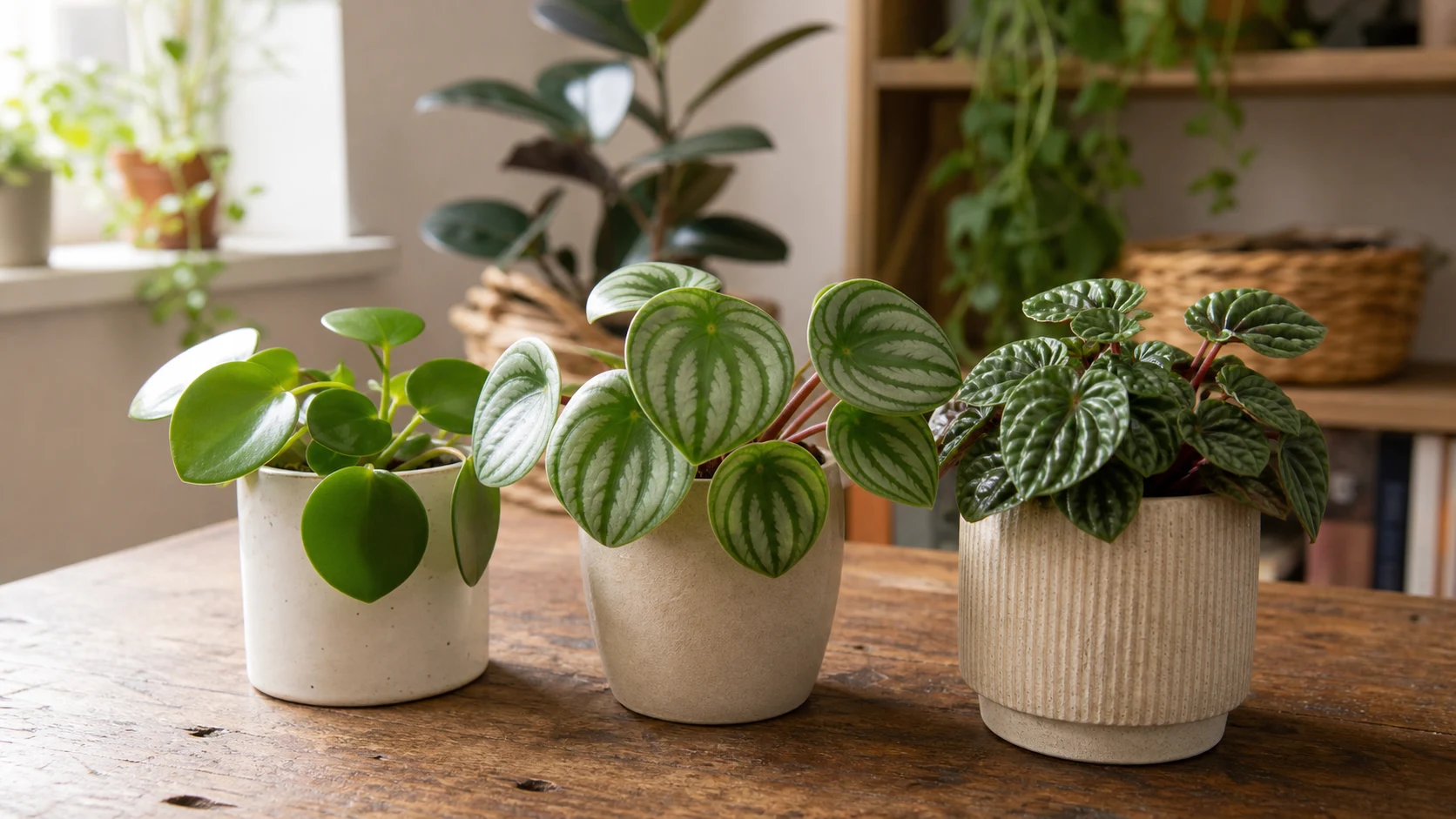
Smooth, striped, and corrugated peperomia foliage signals different tolerances even when the plants share the same room.
The common misdiagnosis: assuming “I’m following peperomia care advice” covers whatever variety is in front of you. Most peperomia care advice is averaged across a very diverse genus.
The practical first check: Before adjusting your watering schedule or moving the plant, identify which variety you actually have. Growth habit (upright vs. trailing vs. rosette), leaf texture (smooth vs. rippled vs. waxy), and leaf thickness are the fastest way to understand your plant’s tolerance range. The symptom you’re seeing is almost always a consequence of that variety’s particular limits - not a random malfunction.
Peperomia at a Glance: Comparing the Main Types
| Variety | Growth habit | Foliage cue | Watering sensitivity | Best indoor fit | Pet safe? |
|---|---|---|---|---|---|
| Watermelon peperomia | Rosette | Striped, rounded leaves | Moderate - black patches from wet soil | Bright windowsill, desk | Yes (ASPCA) |
| Baby rubber plant | Upright / semi-trailing | Thick glossy leaves | Moderate - tolerates some inconsistency | Shelf, office, medium light | Yes (ASPCA) |
| Ripple peperomia | Compact rosette | Corrugated, velvety texture | Higher - root rot and leaf spot risk | Filtered daylight rooms | Yes |
| Raindrop peperomia | Upright | Thick teardrop-shaped leaves | Moderate - spot-prone in direct sun | Bright indirect spot | Not confirmed |
| Hope peperomia | Trailing | Small round coin-like leaves | Visible cue when thirsty - stems droop | Hanging basket, high shelf | Yes |
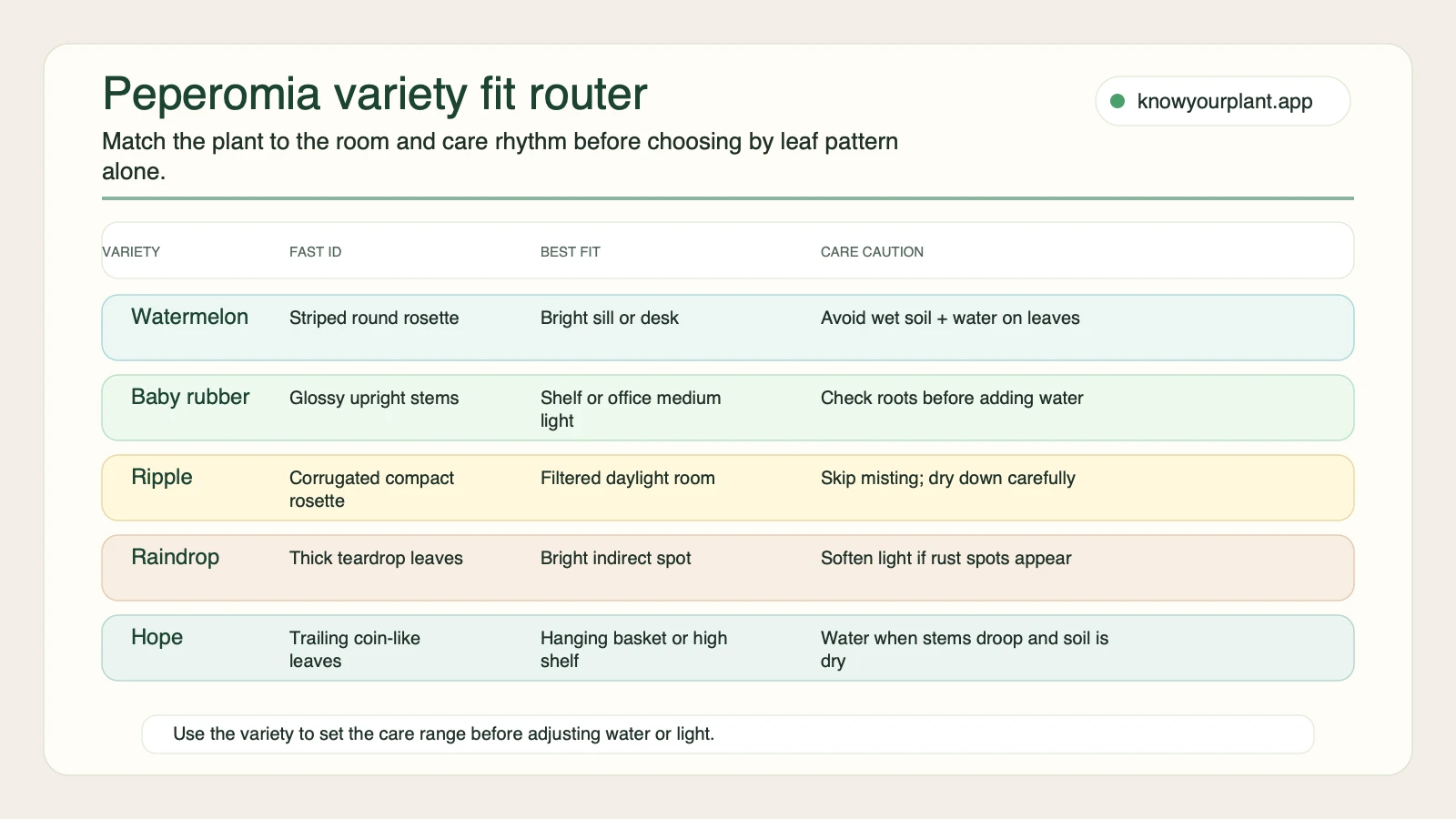
Use the router to match each peperomia type to the room, care rhythm, and first caution before choosing by leaf pattern alone.
Which Peperomia Forgives Care Mistakes - and Which Doesn’t
This is the ranking that most roundup articles skip. There’s a real difference in how quickly each variety shows distress, and knowing it matters as much as knowing the generic care rules.
Baby rubber plant is the most forgiving. It tolerates a wider light range, handles some watering inconsistency, and gives you visible early signals - drooping leaves, a slightly dull surface - before anything becomes irreversible. If your schedule isn’t perfect or your room light is variable, start here.
Hope peperomia is also forgiving in a different way: its trailing stems droop noticeably when it’s thirsty, which gives you a clear read before the plant is stressed. It’s less tolerant of sitting in wet soil than baby rubber plant, but the visible thirst cue makes up for a lot if you’re still learning your watering rhythm.
Watermelon peperomia sits in the middle. It’s manageable with consistent care, but it reacts more quickly to wet soil and is less tolerant of low light combined with slightly-too-frequent watering. The black patch problem that catches new owners off guard is real, and the patches don’t heal.
Raindrop peperomia is similar - not fragile, but the rust-colored spots that appear from direct sun or watering stress can look alarming and resist easy diagnosis, which trips people into unnecessary interventions.
Ripple peperomia is the most sensitive of the common types. The corrugated leaf texture holds moisture, the plant needs drier soil more consistently than the others, and it’s more susceptible to root rot and leaf spot - especially in lower-light conditions where the soil takes longer to dry out.
This spectrum isn’t about which plant is “harder” in absolute terms. All of them are manageable. It’s about which one fits your actual care rhythm. A plant that shows distress quickly in the wrong conditions isn’t a bad plant; it’s a mismatch for inconsistent watering or a dimmer room.
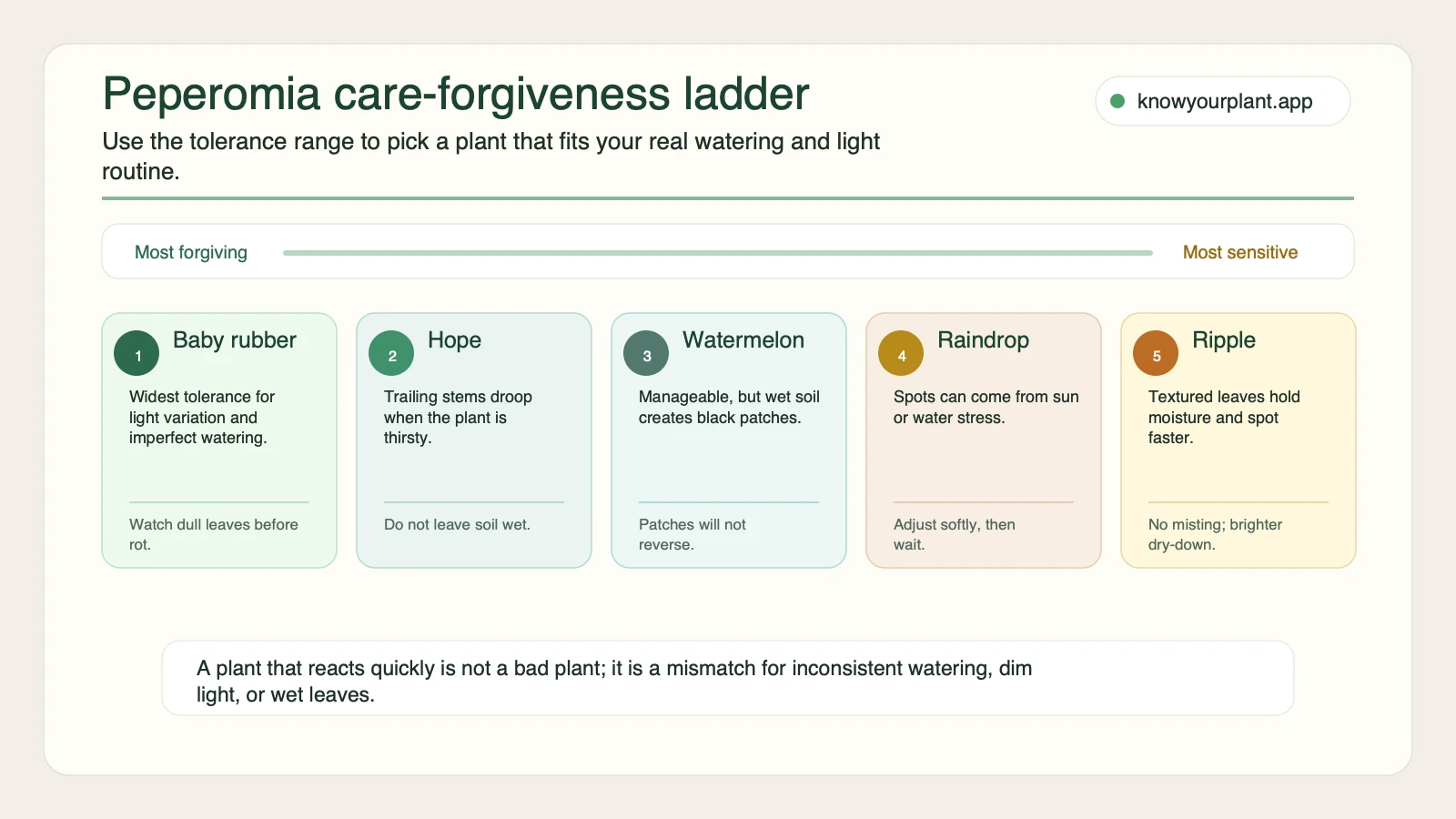
The ladder turns the forgiveness ranking into a care-fit decision: pick the variety whose tolerance matches your real light and watering consistency.
The Most Common Peperomia Varieties, Up Close
Watermelon Peperomia (Peperomia argyreia)
The striped, rounded leaves that look exactly like a watermelon rind have made this one of the most recognized peperomia varieties in recent years. It grows as a low rosette, stays under 30 cm, and fits comfortably on a desk or narrow shelf.
According to NC State Extension, watermelon peperomia prefers bright indirect light and should be watered only after the top of the soil has dried down. It is non-toxic to cats and dogs. Direct sun bleaches or scorches the striped pattern. The thick leaves store some moisture, but they are not succulent-thick, and the plant does not do well with dramatic swings between soaking wet and bone dry.
The recurring confusion for watermelon peperomia owners is black cracked patches that appear even when watering seems careful. These are typically caused by wet soil that stayed wet too long, water sitting on the leaf surface, or a combination of low light and slightly-too-frequent watering. Once the patches form, they do not heal. The response is to let the soil dry fully, improve airflow, and check whether the pot’s drainage hole is actually clear.
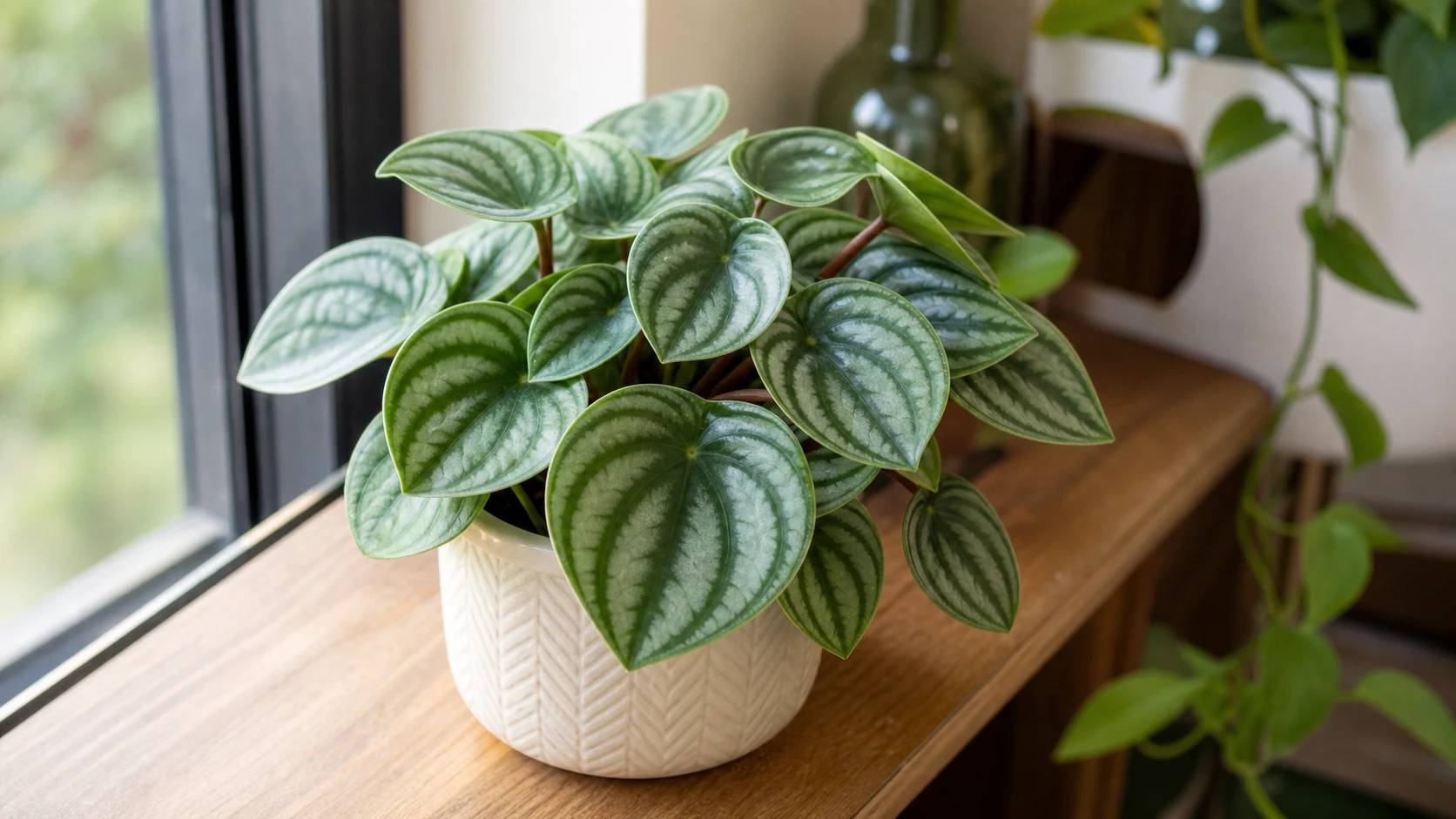
A healthy watermelon peperomia keeps its silver-striped rosette compact in bright indirect light with dry leaf surfaces.
Baby Rubber Plant (Peperomia obtusifolia)
The name is misleading - this is not related to the rubber plant (Ficus elastica). Baby rubber plant has thick, glossy, dark green leaves on upright or semi-trailing stems, sometimes variegated with cream. Our Peperomia obtusifolia care guide goes deeper on watering, variegation, and propagation if this is the type you brought home. NC State Extension notes it tolerates lower light for periods and handles some watering inconsistency better than more sensitive types, though overwatering will still cause root rot.
Brown edges and spots on baby rubber plant are a consistent source of diagnostic confusion. The symptoms can look like root rot, dryness, heating-vent stress, and humidity issues all at once - and sometimes multiple causes are active at the same time. A useful triage step: check the roots and soil. If both look and feel dry, the browning is more likely from heating-vent proximity or low humidity than from overwatering. This misread leads owners to water more and worsen the problem.
ASPCA lists baby rubber plant as non-toxic to dogs and cats, making it a practical choice for pet households.
Ripple Peperomia (Peperomia caperata)
Ripple peperomia is compact and rosette-shaped, with deeply corrugated leaves that have a velvety texture. It is frequently asked about for low-light placement - specifically whether it can survive a bedroom or office with limited natural daylight and only overhead artificial lighting.
NC State Extension describes ripple peperomia as preferring medium light and a well-draining, porous potting mix, noting it is susceptible to root rot and occasional leaf spot. A room with filtered natural light from a nearby window, or one that gets reasonable indirect daylight through part of the day, keeps it growing steadily. Rooms that rely only on overhead fluorescent lighting are borderline - the soil takes longer to dry out under low light, which increases root rot risk over time. If that is the only spot you have, the grow lights guide for indoor plants is the most practical next read before you assume ripple peperomia cannot work in the room.
The corrugated leaf surface traps moisture and debris, creating conditions for leaf spot. Avoid misting, keep water off the leaves during watering, and use a porous potting mix that does not stay wet for days.
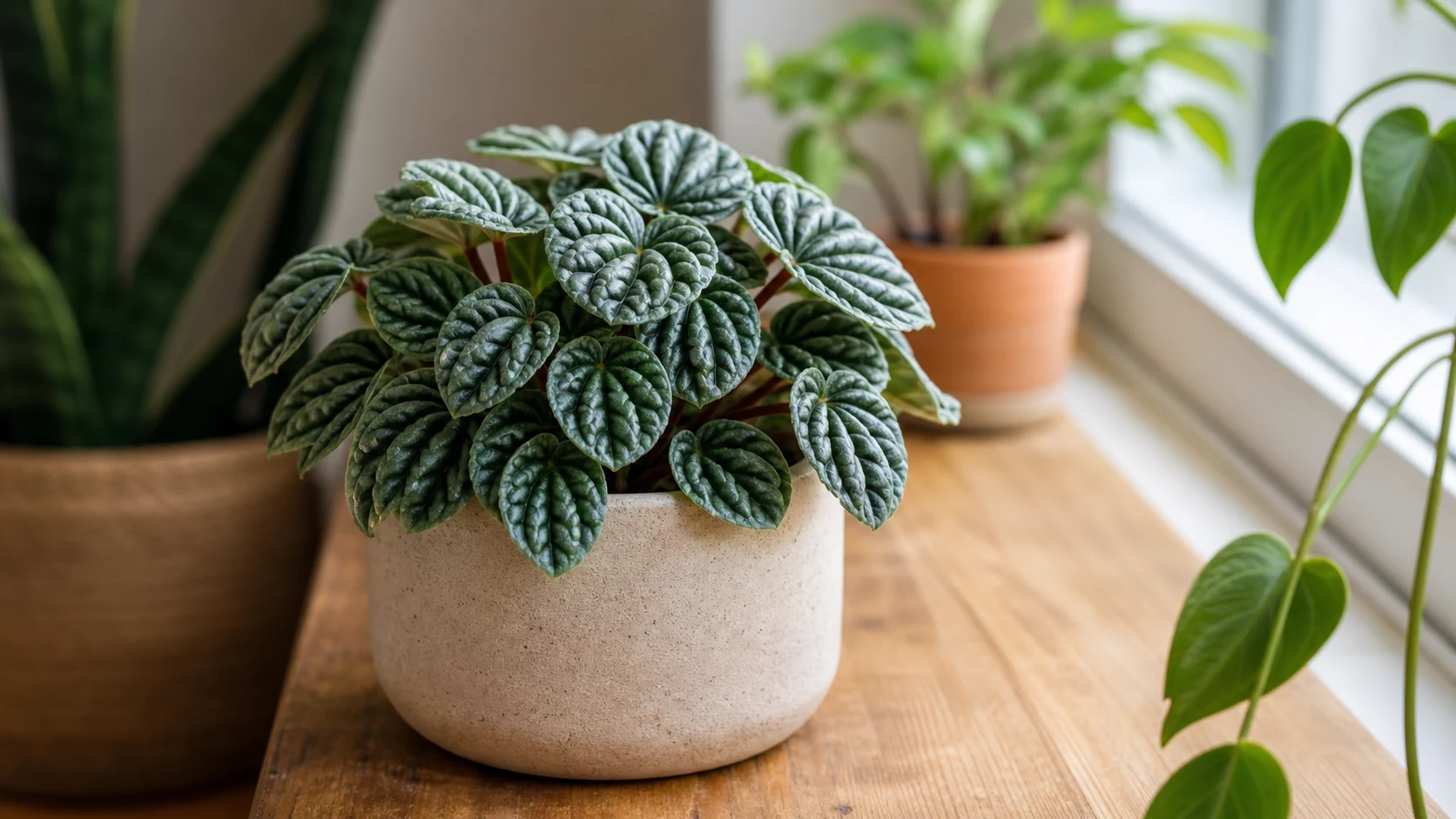
Filtered window light supports a compact ripple peperomia while its textured leaves stay dry and well ventilated.
Raindrop Peperomia (Peperomia polybotrya)
Raindrop peperomia has thick, glossy, teardrop-shaped leaves that give it more visual weight than the compact rosette types. It grows upright, reaches a bit larger than most desk peperomias, and has become a collector favorite.
The recurring problem is rust-colored or copper-toned spots that appear without obvious cause. Owners who check for pests, rinse the leaves, and still cannot identify the source often cycle through unnecessary interventions. These spots are generally caused by one or more of: direct sun scorch, a localized fungal response, or watering stress - but the visual appearance does not cleanly separate those causes. If spots appear under seemingly good conditions, moving the plant to softer light and letting the soil dry fully between waterings is the lowest-risk first adjustment.
Hope Peperomia (Peperomia rotundifolia or Peperomia deppeana hybrid)
Hope peperomia is a trailing type with small, round, succulent-like leaves on cascading stems. It is built for hanging baskets or trailing off a high shelf. The care is similar to other peperomias - bright indirect light, infrequent watering - but the trailing habit makes the plant easier to read. When stems start to droop slightly and leaves feel less plump, it is ready for water. That visible thirst signal makes it more forgiving for owners who have not yet settled into a watering schedule.
How to Choose the Right Peperomia for Your Space
Filter by where you will put the plant and how consistent your care routine actually is - not by leaf pattern alone.
Bright windowsill or well-lit shelf (indirect light most of the day): Watermelon peperomia, raindrop peperomia, baby rubber plant. All three do well with consistent indirect light and will not tolerate long periods of wet soil.
Medium-light room - filtered daylight through a window, no direct sun: Baby rubber plant, ripple peperomia. Baby rubber plant is more tolerant of light variation. Ripple peperomia needs the soil to dry between waterings more reliably in lower light.
Hanging basket or trailing display: Hope peperomia. The trailing stems and small leaves look best with some vertical space. It also shows thirst more visibly than rosette types.
Pet household: Watermelon peperomia and baby rubber plant both have confirmed non-toxic status from ASPCA and NC State Extension. Hope peperomia is generally considered low-risk as well. For a full comparison of pet-safe options alongside other houseplants, the cat-safe indoor plants guide covers more species.
Lower light tolerance matters most: Baby rubber plant is the most forgiving of the common types. Ripple peperomia can manage medium-low light but needs drier conditions to compensate. Watermelon and raindrop peperomia both want more consistent brightness.
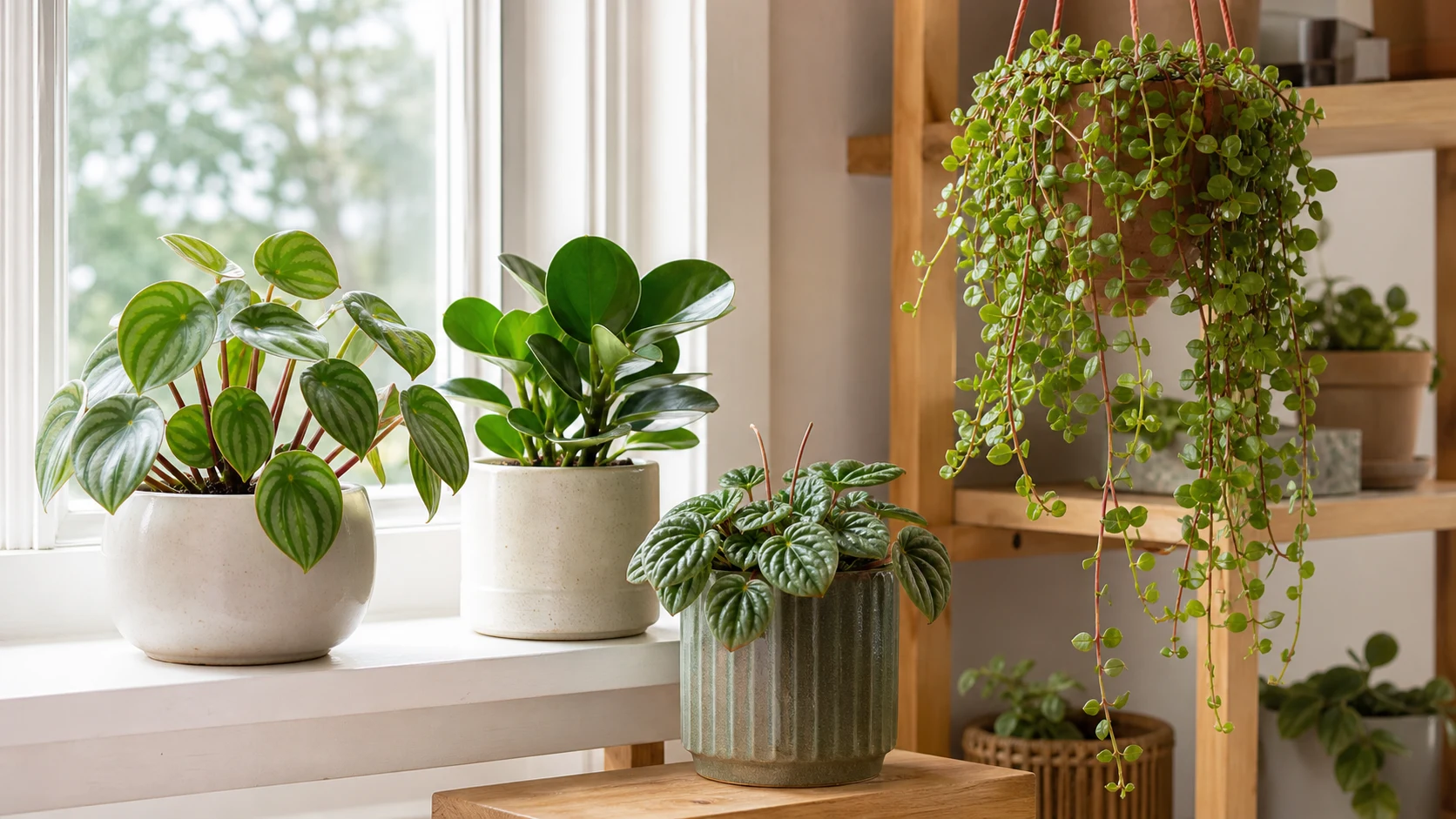
Match rosette and upright peperomias to steady window light while giving trailing Hope peperomia room to cascade.
For more help choosing between easy-care compact plants, the easy houseplants for beginners guide has overlapping recommendations worth comparing.
The Mistake That Catches Most Peperomia Owners
Treating every peperomia identically is the most consistent failure pattern across the genus. A few specific mismatches that come up repeatedly:
Copying one variety’s watering schedule to all your peperomias. A baby rubber plant watered every 10 days may be fine. A watermelon peperomia on the same schedule may be pushed into wet-soil stress if your light conditions differ or the season has shifted.
Assuming brown spots always mean overwatering. On baby rubber plant, brown edges and spots can come from dry air, heating-vent proximity, or inconsistent watering in either direction. Checking the roots and soil before changing your watering frequency prevents the “I watered less, it got worse” spiral.
Misting ripple peperomia. The corrugated surface holds water between ridges, and misting adds moisture in exactly the places where leaf spot starts. Skip misting for textured-leaf varieties entirely.
Keeping smooth-leaved and textured-leaved varieties in the same spot and assuming identical results. Watermelon peperomia and ripple peperomia may look similar in size, but ripple is more sensitive to the combination of low light and any soil wetness.
Overreacting to rust-colored spots on raindrop peperomia. The most common first response - more water, more humidity, more fertilizer - often makes things worse. The lower-intervention approach (move to softer light, let soil dry fully, wait two to three weeks) resolves many spot issues without chemicals.
Common Problems Across Peperomia Varieties
Yellowing lower leaves: Almost always overwatering or soil that stayed wet too long. Check whether the pot drains fully after watering.
Mushy stem base: Root rot. Remove the plant from the pot, trim damaged roots, let the root ball air dry for a few hours, and repot into fresh, barely-moist mix with good drainage.
Brown leaf edges: Low humidity, heating-vent proximity, or irregular watering. Check which is physically closest to the plant before changing your watering schedule.
Black patches on leaf surface (especially watermelon peperomia): Wet soil combined with low light, or water sitting on the leaf surface after watering. Improve drainage and water at the base.
Pale or bleached leaf pattern: Too much direct sun. Move the plant further from the window or add a sheer curtain between the plant and the glass.
Rust or copper spots (especially raindrop peperomia): Move to softer light and let the soil dry fully before watering. If spots stop spreading after two to three weeks, light or watering stress was the cause. If they continue, consider a fungal cause.
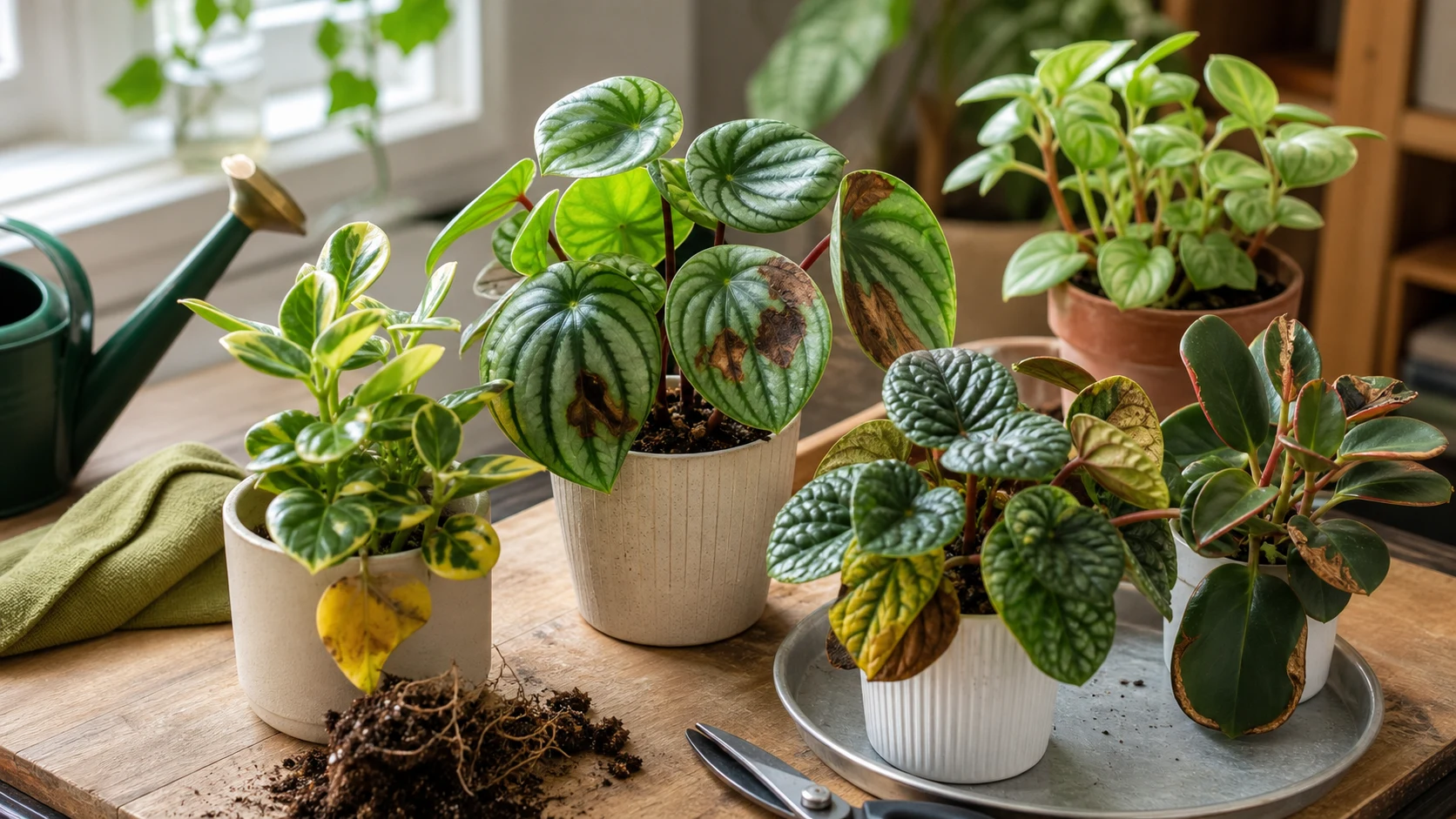
Compare yellowing, black patches, and browned edges before checking drainage, roots, light, and watering one variable at a time.
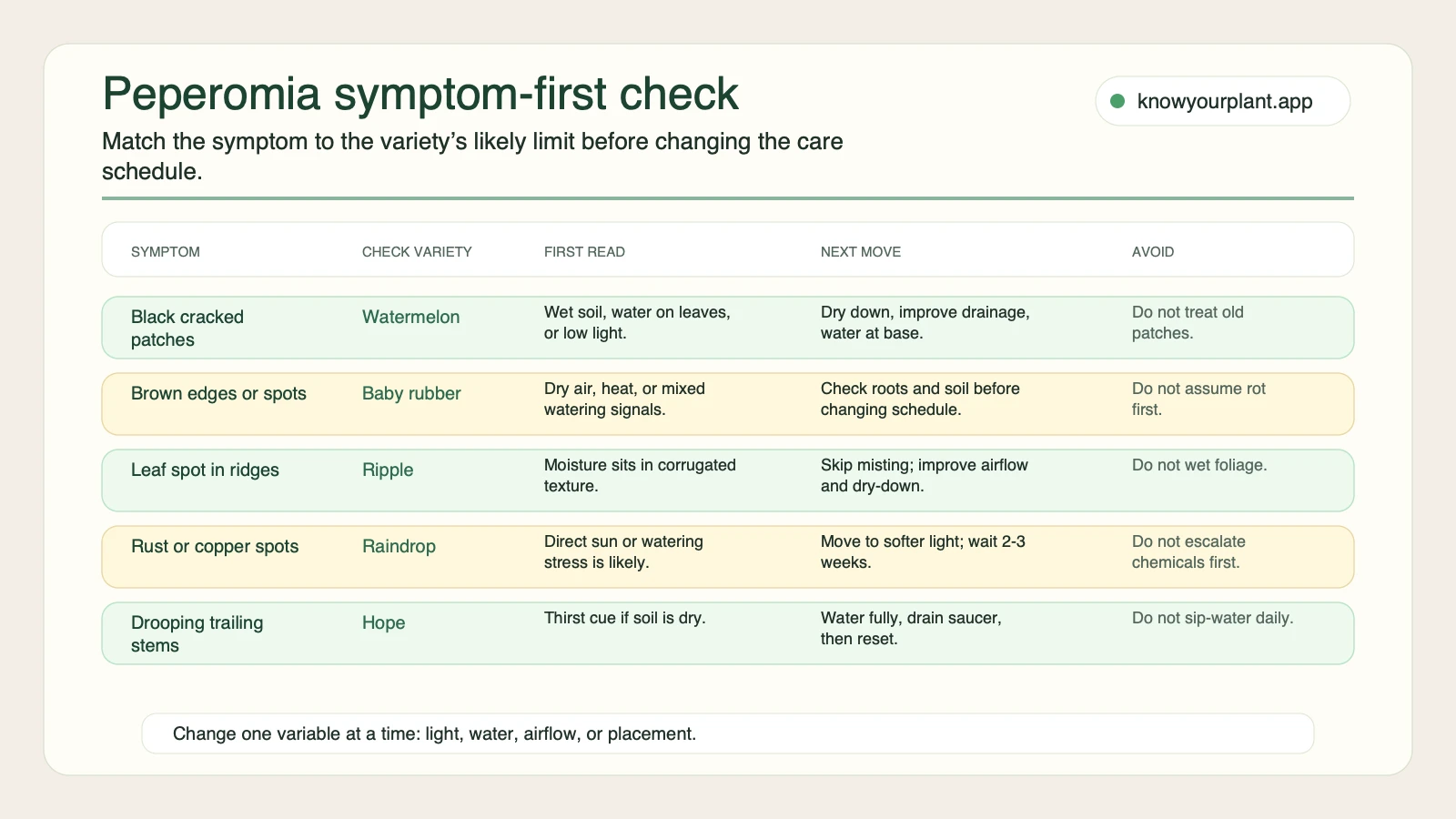
The symptom check keeps diagnosis tied to the variety: change one variable at a time instead of watering, misting, or treating every peperomia the same way.
For a broader look at symptom patterns across houseplant types, the overwatered plant signs and fixes guide and why plant leaves turn yellow guide cover overlapping territory worth reading alongside this one.
Methodology Note
Last updated: 2026-06-19.
This guide uses NC State Extension genus and species pages for care claims, ASPCA listings for pet-safety confirmations, and recurring owner questions from Gardening Stack Exchange for the real-world confusion patterns around black patches, brown edges, low-light placement, and rust-like spots. The extension and ASPCA sources support the direct care guidance. The owner threads were treated as qualitative signal about common diagnosis mistakes, not as proof of one universal cause.
Real User FAQ
These are the questions owners most often ask after choosing a peperomia or noticing that one variety is reacting differently from another.
Which peperomia variety is easiest for beginners?
Baby rubber plant (Peperomia obtusifolia) is the most forgiving of the common types. It handles lower light for periods, tolerates some watering inconsistency, and gives you clear visual signals - drooping leaves, a slightly dull appearance - before the problem becomes serious. Watermelon peperomia is also manageable for beginners as long as it gets consistent indirect light and you let the soil dry between waterings.
Can peperomia grow in low light?
Some types tolerate medium-low light better than others, but none of the common varieties thrive in true low light. Baby rubber plant and ripple peperomia can manage in rooms with filtered daylight from a nearby window. Watermelon and raindrop peperomia want more consistent brightness and become more vulnerable to root rot as light decreases, because the soil takes longer to dry out. A spot with reasonable indirect daylight through most of the day is safer than relying on overhead artificial light alone.
Why does my watermelon peperomia have black patches?
Black cracked patches on watermelon peperomia leaves are almost always caused by wet soil that stayed wet too long, water sitting on the leaf surface, or a combination of low light and slightly-too-frequent watering. NC State Extension confirms watermelon peperomia needs the top of the soil to dry down before the next watering. The patches do not reverse once they form, so the response is to improve drainage and watering habits going forward - not to try to treat the existing damage.
Are peperomia plants safe for cats and dogs?
Watermelon peperomia and baby rubber plant are both confirmed non-toxic by ASPCA and NC State Extension for cats and dogs. Hope peperomia is generally considered low-risk as well. For a full rundown of pet-safe houseplant options, the cat-safe indoor plants guide is a useful reference.
How often should I water peperomia?
There is no reliable day-count answer because it depends on pot size, soil type, light level, season, and which variety you have. The rule that works across most peperomia types: water when the top 3-4 cm of soil feels dry to the touch. In spring and summer with good light, that might be every 10-14 days. In autumn and winter, or in lower-light rooms, it can stretch to 3 weeks or longer. The risk of overwatering is higher than the risk of underwatering for almost every peperomia variety.
Why are my peperomia leaves turning yellow?
Yellow leaves on peperomia are most often caused by overwatering or wet soil that did not drain fully. Lower leaves yellowing first, while upper leaves stay green, is the classic overwatering pattern. Check the soil - if it feels wet or the pot feels heavy, hold off watering and make sure the drainage hole is clear. Less commonly, yellowing can come from very low light or a pot that is significantly too large for the root ball, since excess soil stays wet longer. Fertilizer deficiency is rarely the first culprit on slow-growing peperomias.
Can I keep multiple peperomia varieties together?
Yes, they are compact enough to group well. The practical caution is not to water them all on the same schedule without checking each plant individually. A baby rubber plant and a ripple peperomia in the same light spot may dry out at different rates depending on pot size and soil mix. Check the soil for each one rather than treating them as a single unit.
Do peperomia plants need fertilizer?
Peperomias are slow growers and light feeders. A diluted balanced liquid fertilizer once a month during spring and summer is enough - NC State Extension notes that overfeeding causes more problems than underfeeding for most peperomia types. Skip fertilizing from October through February when growth naturally slows. Salt buildup from too-frequent fertilizing shows up as brown leaf edges and tip burn, which is easy to confuse with dryness or humidity stress.
Peperomia varieties reward a small amount of up-front thinking about which type you are working with. The genus shares broad care principles, but the plant in your hand has its own tolerance range, its own visual stress signals, and its own relationship with light, moisture, and airflow. Start from the variety - not the generic advice - and most peperomias are genuinely low-maintenance over the long run.