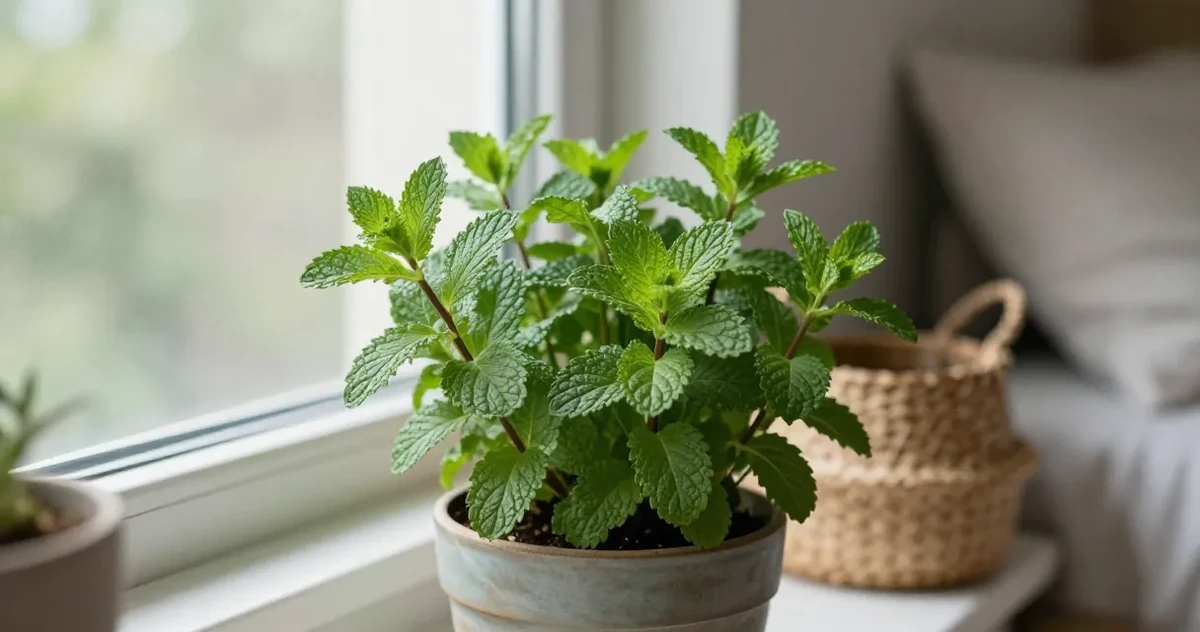
How to Grow Mint Indoors: Care, Harvesting and Varieties
Your mint looked great for a few months. Now it’s leggy, the center looks exhausted, and no amount of watering seems to help. If that sounds familiar, the problem almost certainly isn’t your care routine – it’s what most mint plant care guides never actually explain about how mint behaves in a container.
Mint is a fast-growing perennial that spreads through underground runners called rhizomes. In a garden bed it can take over everything around it. In a pot, that same energy has nowhere to go – so it cycles through the root mass, exhausts the center, and starts declining from the inside out. More water and fertilizer don’t fix this. Division does.
Once that clicks, the rest of mint care makes sense. If you’re building out a kitchen herb collection alongside your mint, our indoor herb garden guide covers light positioning, container setup, and harvesting schedules for common herbs together, and the basil plant care indoors guide helps if basil is the higher-maintenance partner on the same windowsill.
Identification Snapshot
If the label just says “mint,” look for the traits that matter indoors before you decide how to grow it:
- Square stems and opposite leaves: the classic mint-family structure that helps distinguish it from softer-stemmed grocery herbs.
- Strong scent when a leaf is rubbed: healthy mint should smell obvious and clean, not faint or grassy.
- Fast tip regrowth: a happy plant replaces pinched tips quickly, which is why regular harvesting keeps it productive.
- Spreading roots rather than one deep taproot: mint fills a pot sideways through rhizomes, which is why wide containers outperform tall narrow ones.
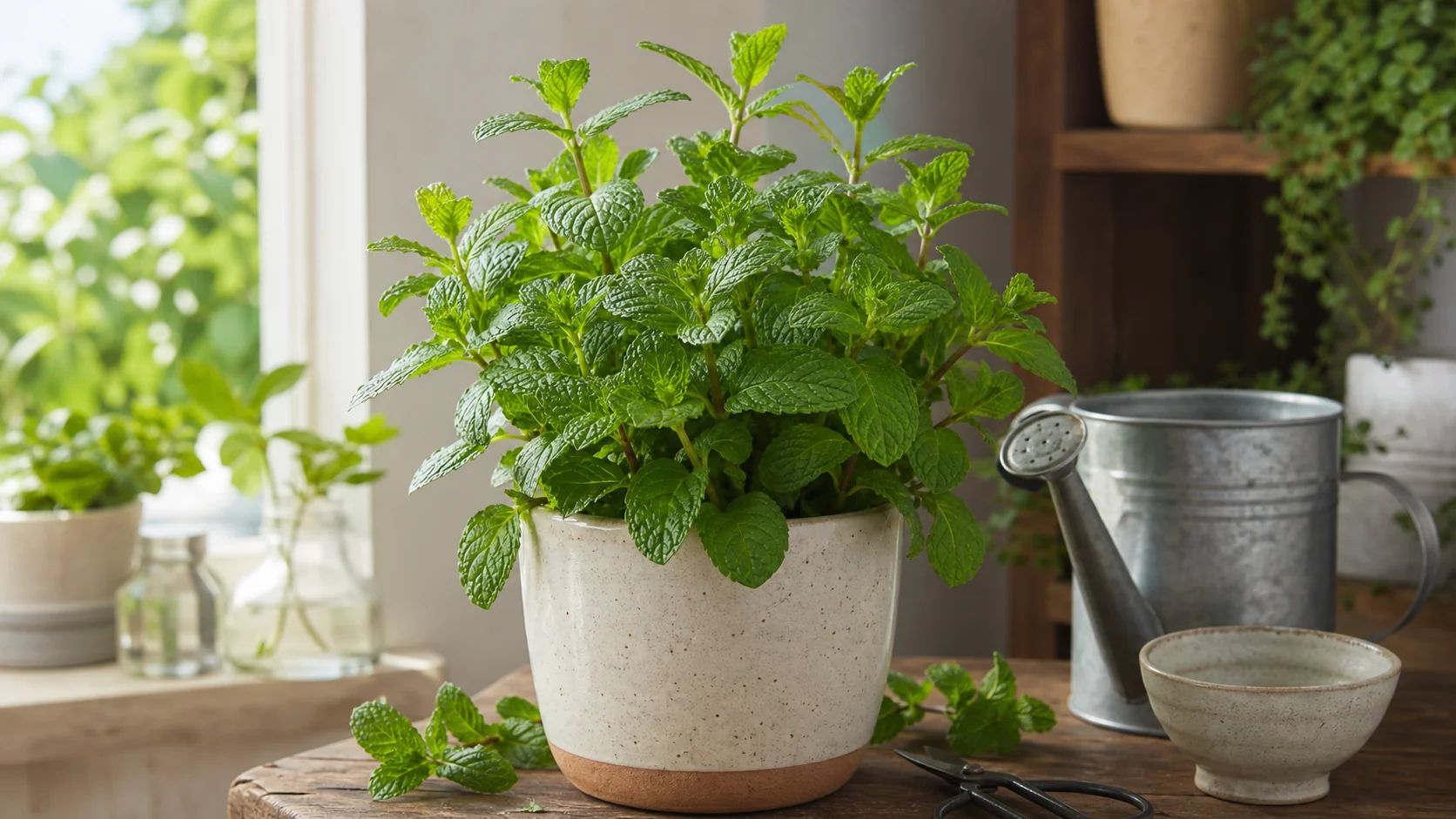
Opposite serrated leaves, fresh tips, and a wide pot make useful mint identification clues indoors.
Lookalikes and Confused With
| If your plant is labeled… | Often confused with | Why it matters indoors |
|---|---|---|
| Spearmint | Peppermint | Peppermint has a sharper menthol flavor and does not come true from seed, so propagation choices differ. |
| Moroccan mint | Spearmint | Moroccan mint is usually sweeter and a bit more compact, which makes it friendlier for tea pots and smaller windowsill containers. |
| Chocolate mint | Peppermint | The growth habit is similar, but chocolate mint is usually kept more for fragrance and novelty than for heavy kitchen use. |
| Generic nursery “mint” | One stable culinary variety | Mixed labels make flavor, vigor, and propagation expectations less predictable, so watch the plant’s behavior instead of assuming every mint acts the same. |
Care Cards
| Variety | Light indoors | Moisture style | Container note | Best use |
|---|---|---|---|---|
| Spearmint | Bright window, ideally south or west | Evenly moist, never swampy | Excellent in a wide pot | Everyday cooking, tea, cocktails |
| Peppermint | Brightest spot you have | Slightly thirstier than spearmint | Good, but divide on time | Tea, baking, stronger flavor |
| Moroccan mint | Bright light with gentle afternoon heat | Even moisture | Very good for smaller containers | Sweet tea, compact herb setup |
| Chocolate mint | Bright light | Moderate, with good drainage | Good in a dedicated pot | Fragrance, novelty, mixed herb corner |
What Most Mint Care Guides Miss
Nearly every mint guide on the internet tells you the same three things: mint is easy, keep it moist, grow it in a pot. That’s all true. What they skip is why potted mint declines even when you’re doing everything right.
The common misdiagnosis: When mint starts producing small leaves, goes woody in the center, or loses vigor after a year or two, most growers assume it needs more water, more fertilizer, or better light. These are reasonable guesses. They’re usually wrong.
Why generic advice falls short: Mint spreads through rhizomes. As it fills a container, the center of the root mass gets older, more compacted, and progressively less productive. The outer edges may still look healthy while the inside is running out of energy. Adding nutrients feeds growth the plant can’t sustain on an exhausted root system.
The practical first check: Tip the pot on its side and slide out the root ball. If the roots are circling the walls, the center looks dense and brown rather than white and active, or the lower half of the pot is packed with old fibrous roots – division is the answer, not fertilizer. Bonnie Plants recommends periodic lifting and replanting as standard mint maintenance for exactly this reason.
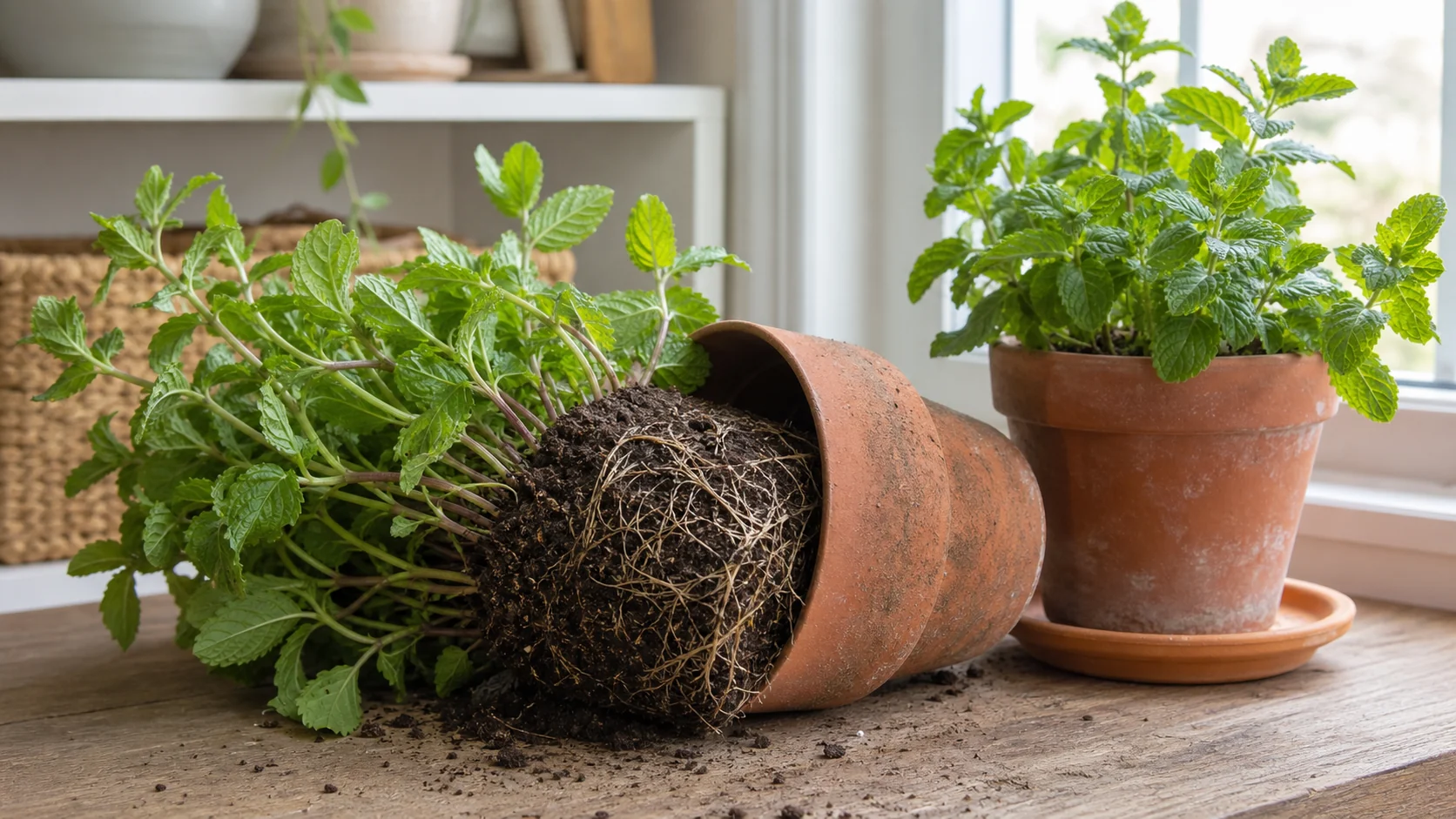
A crowded, circling root mass explains why extra water or fertilizer cannot revive tired potted mint.
This is the single most useful thing to know about growing mint in a pot, and most guides leave it out entirely.
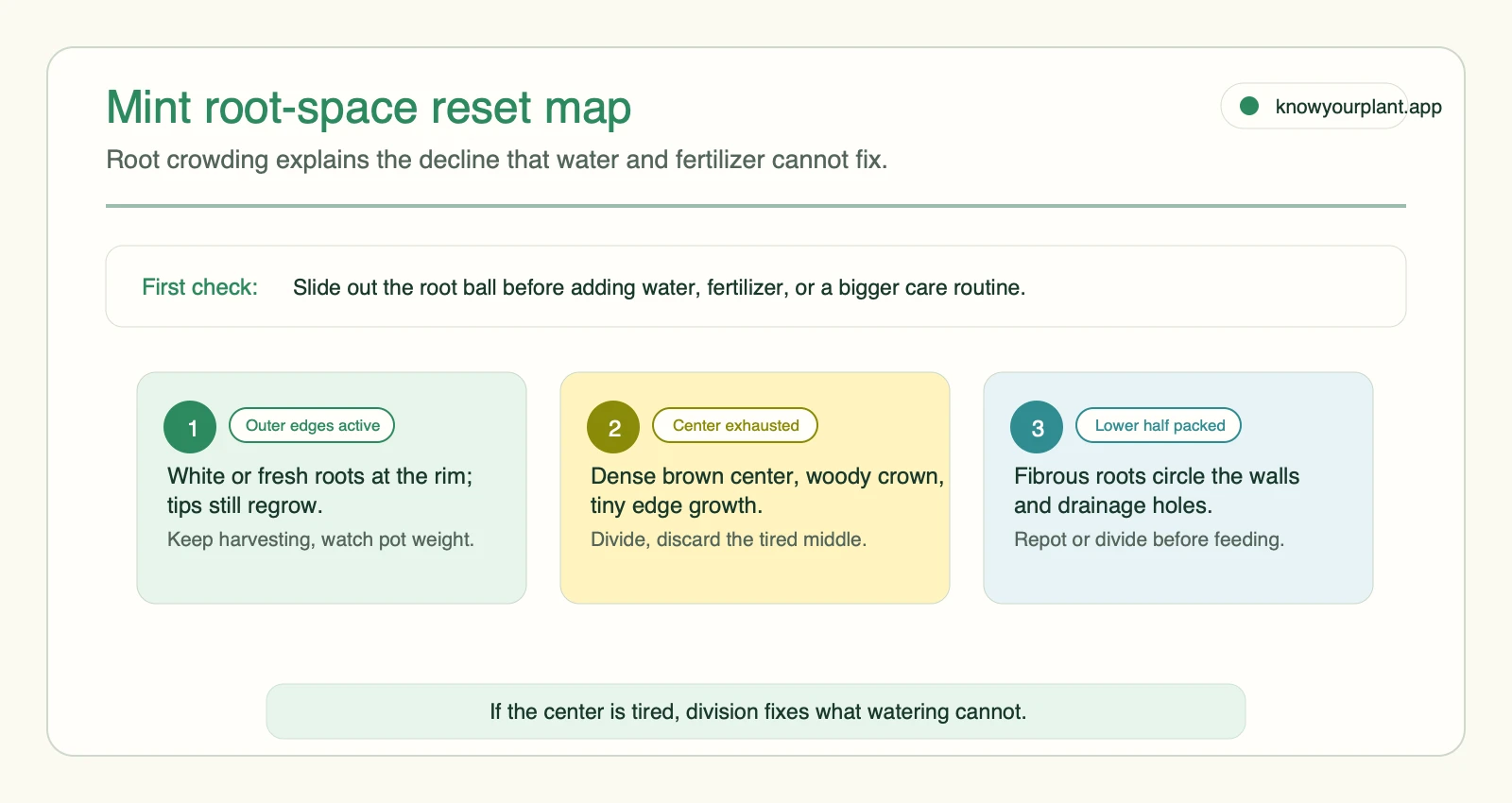
Use the root-space map before adding more water or fertilizer to a tired potted mint.
Quick Symptom Triage
Before adjusting care, match what you’re seeing to the most likely cause:
| What you’re seeing | Most likely cause | First action |
|---|---|---|
| Leggy stems, small pale leaves | Not enough light | Move closer to a bright window or add a grow light |
| Lower leaves yellowing, soil feels heavy and cold | Overwatering | Let soil dry out, check drainage holes are clear |
| Drooping, crispy leaf edges, soil pulling from pot sides | Underwatering | Water thoroughly and let drain fully |
| Woody center, bare stems, small new leaves at edges | Root-bound and exhausted | Divide and repot in fresh mix |
| Leaves with orange or brown pustules | Rust (fungal) | Remove affected leaves, improve air circulation |
| Vigorous but sprawling, runners escaping the pot | Needs containment | Move to a wider shallow pot, plan to divide soon |
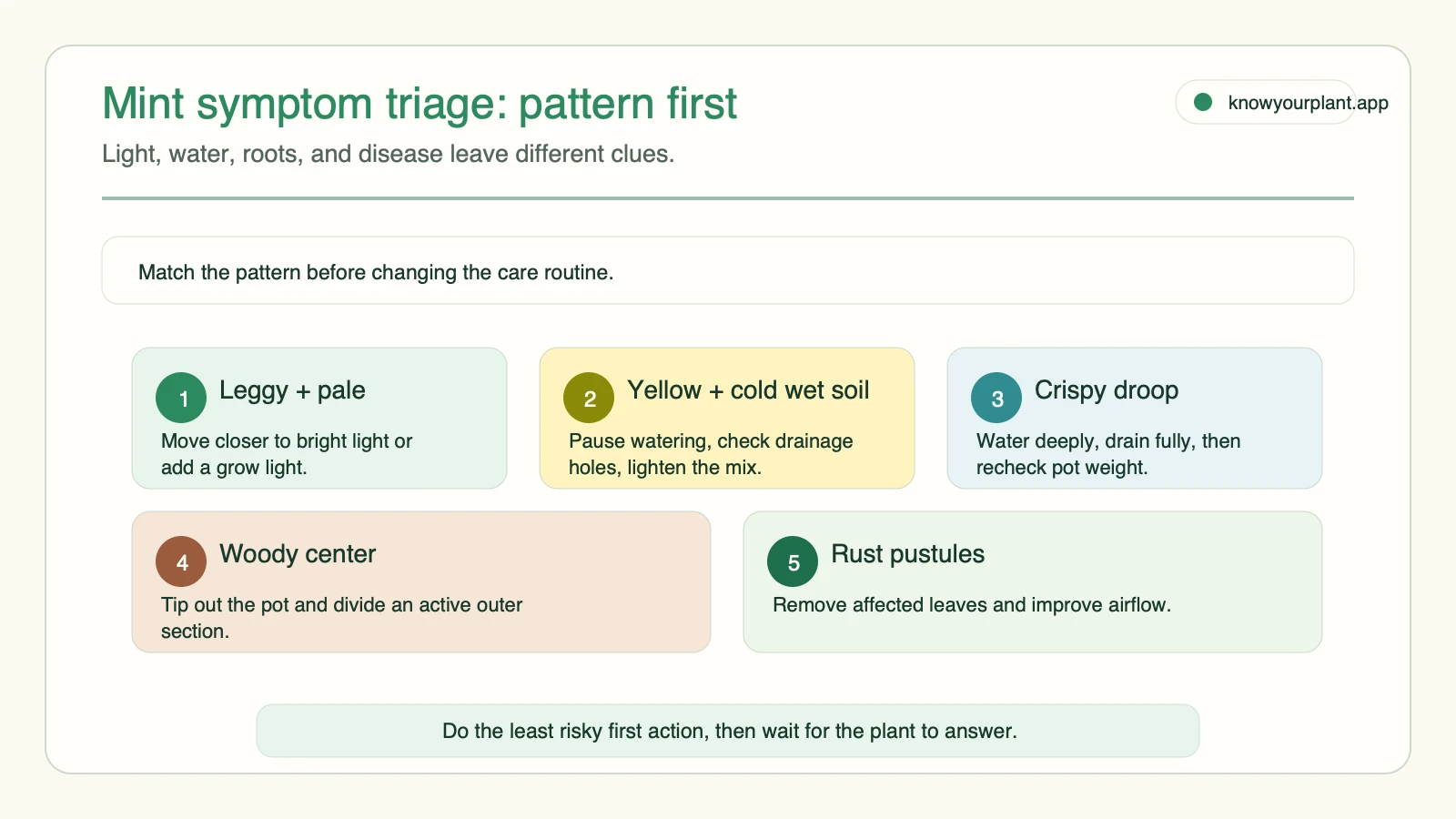
Use the symptom triage to choose the least risky first action before changing the whole care routine.
What Mint Actually Needs
Light
Mint wants more light indoors than most people give it. A spot near a south or west-facing window – somewhere that gets bright light for most of the day – is a solid starting point. East-facing windows work too, if yours gets genuine morning sun rather than dim ambient glow.
According to NC State Extension, spearmint (Mentha spicata) thrives in full sun in organically rich, moist, well-drained soil and only tolerates partial shade – it doesn’t prefer it. Indoors, that tolerance gets tested fast by the combination of weaker light and dense potting mix. The result is usually leggy, weak-stemmed growth rather than a full, bushy plant.
If your indoor mint is stretching toward the light, producing small pale leaves, or refusing to bush out no matter how often you water, the answer is almost always more light – not more fertilizer or a different watering schedule.
In winter, when natural light drops considerably, a grow light placed close to the plant can make the difference between a mint that ticks along and one that sulks until spring. Our guide to grow lights for indoor plants covers the setups that work well for herbs and small containers.
Water
Mint likes consistent moisture, but it doesn’t like sitting in wet soil. The practical check: push your finger about an inch into the pot. Still damp? Wait another day. Dry at that depth? Water thoroughly, then let it drain fully. If you tend to second-guess the timing, our guide on how often to water indoor plants gives a broader framework for reading pot weight, soil depth, and season together.
The most common watering mistake is going by schedule instead of soil feel. Dense indoor potting mix – especially in a glazed ceramic pot with slow drainage – holds water longer than it looks like it does. If the lower leaves are yellowing and the soil feels heavy and cold, you’re likely overwatering. If the leaves are drooping and crispy and the soil has pulled away from the pot edges, it’s thirsty.
Soil and Drainage
Standard potting mix works, but it often holds more moisture than indoor mint is comfortable with. Adding perlite to the mix – roughly a quarter to a third by volume – improves drainage and gives roots more air between waterings. Some indoor growers use a 50/50 perlite-to-potting-soil blend, particularly in humid climates or low-light setups where pots dry slowly.
Whatever mix you use, the pot needs drainage holes. Mint tolerates briefly wet soil but develops root rot quickly when water has nowhere to go. If you’re working with a container that drains slowly or the roots have been sitting wet, our root rot treatment guide covers how to catch it early and what to do.
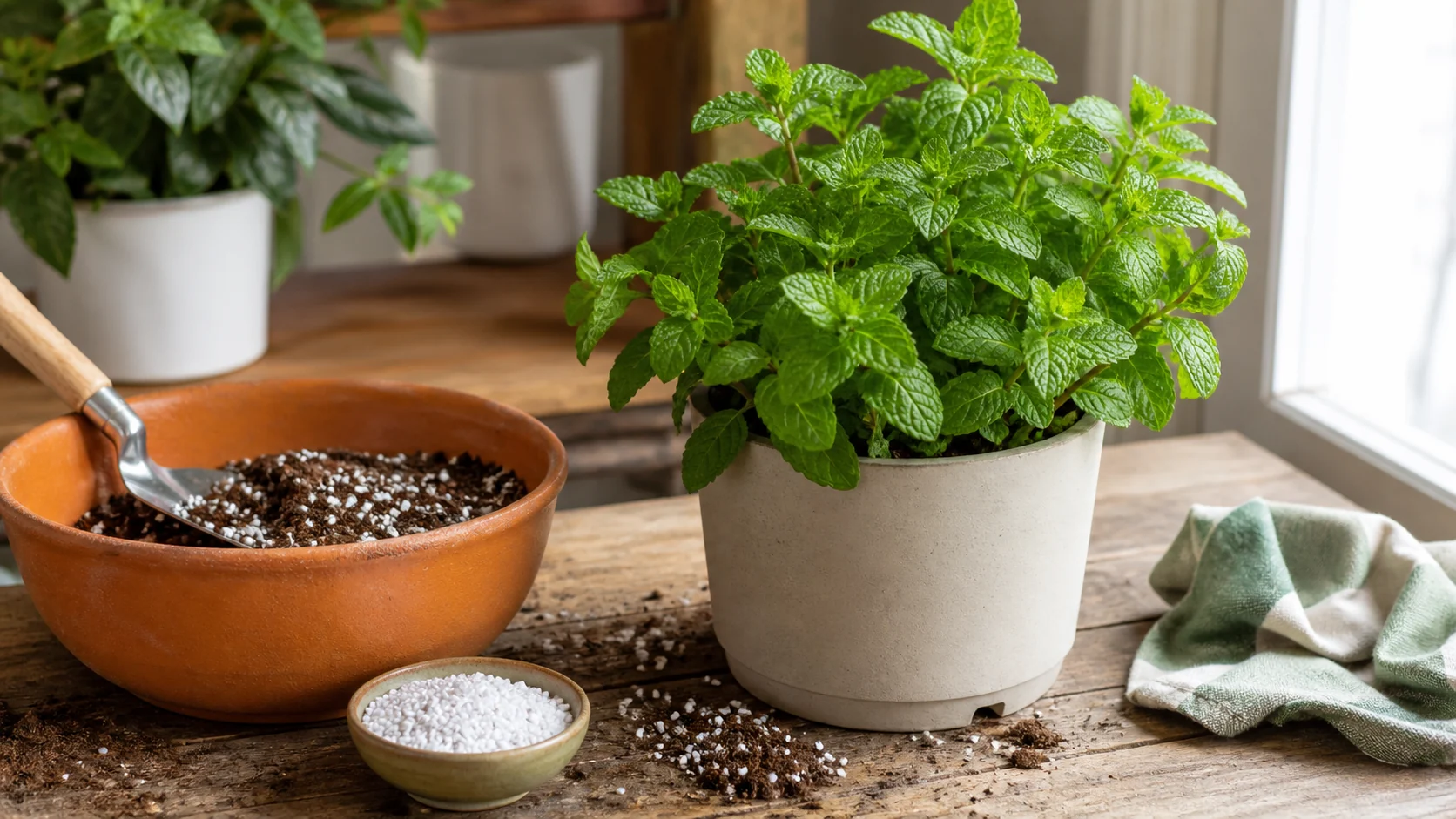
Perlite opens dense potting mix so indoor mint roots get more air between waterings.
Fertilizing
Mint in a container benefits from light feeding during the growing season. A balanced liquid fertilizer diluted to half strength, applied once a month from spring through late summer, supports steady leaf production without pushing growth so fast the plant exhausts itself. Skip fertilizing from October through February – mint slows considerably in winter, and feeding a slow-growing plant in low light does more harm than good.
For more on feeding container plants well, our plant fertilizer guide covers timing, ratios, and the signs of over-feeding.
Choosing a Container
A pot that’s too small will exhaust mint fast. A 6-inch pot works for a young plant in the short term, but mint fills root space quickly. A 10- to 12-inch pot gives it room to spread, extends the time before the plant needs dividing, and keeps it productive for longer.
Go wide and shallow rather than tall and narrow – mint spreads horizontally through rhizomes, not deep, and a wide pot matches how it actually grows. NC State Extension notes that mint is best grown in a container specifically because it spreads rampantly through rhizomes and rooting stems; the container is the containment strategy, and pot size determines how long that strategy holds.
Terracotta dries out faster than glazed ceramic, which helps with drainage but means more frequent watering in warm months. Our terracotta pots guide covers when that tradeoff makes sense for herbs.
Harvesting Mint
Harvesting is maintenance, not just collecting. Pinching the growing tips – the top two or three pairs of leaves on each stem – encourages branching, keeps the plant full, and prevents it from going leggy.
Cut from the tips, not from the base. Pulling individual leaves from the middle of a stem barely affects the plant’s shape; pinching the tip redirects energy into side shoots and new growth.
The Royal Horticultural Society advises that mint is best harvested from fresh young shoot tips, which produce the most concentrated flavor. That lines up with what most indoor growers observe: the newest growth tastes better and smells better than older leaves from deeper in the plant.
When you see flower buds forming, remove them. Once mint flowers, the energy shifts toward seed production, the leaves shrink, and the flavor weakens. Regular tip harvesting often keeps flowers from forming in the first place.
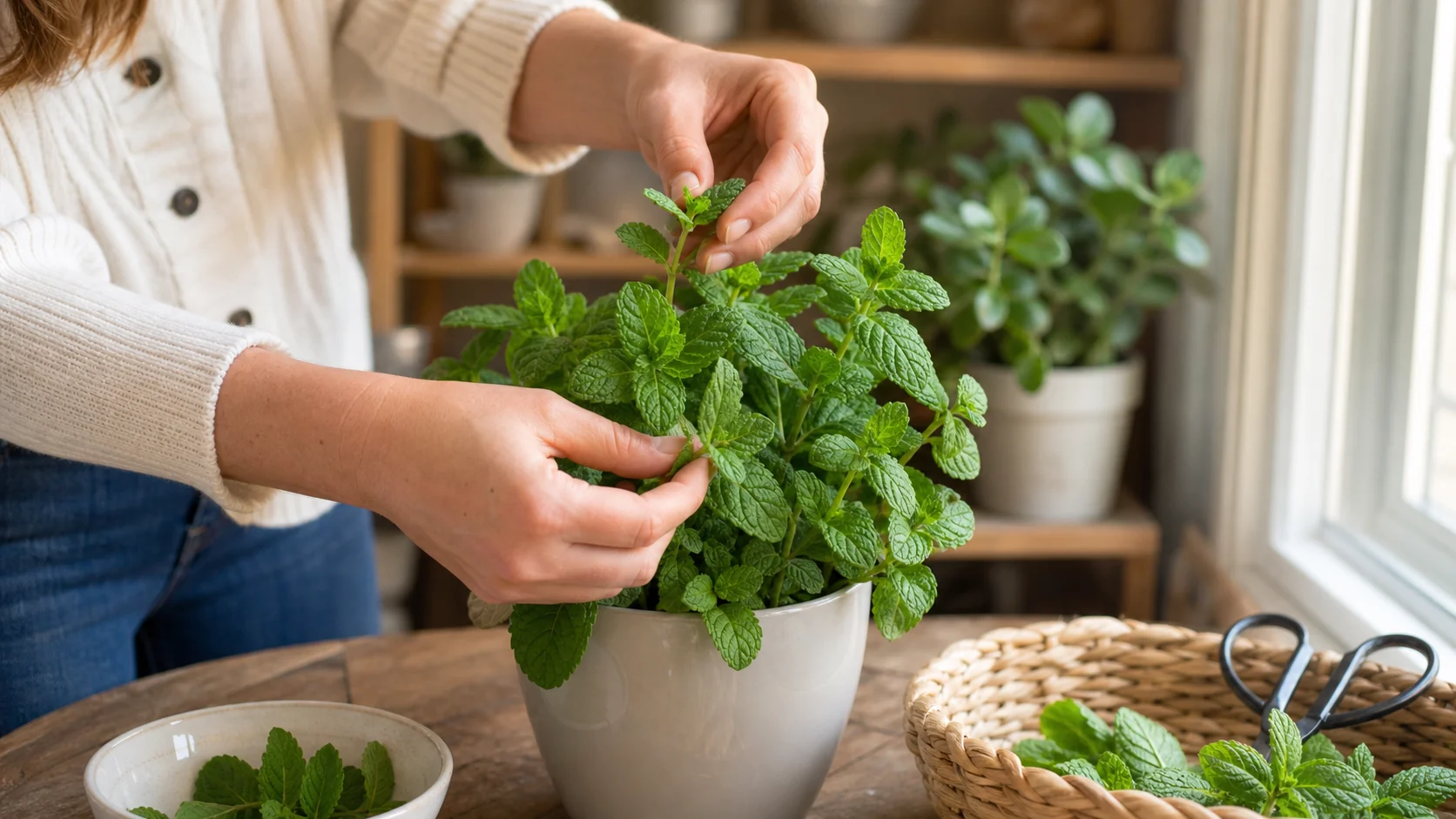
Pinching the top leaf pairs redirects mint into bushier side growth while collecting the most flavorful tips.
Seasonal Care Calendar
Mint’s needs shift across the year, even indoors. Here’s what to focus on each season:
Spring (March–May): Growth picks up quickly. Increase watering frequency as the plant wakes up and start monthly light feeding again. If the plant was cut back over winter, it should push new shoots from the base within a few weeks of improving light. Spring is also the best time to divide and repot – the plant recovers fast with warming temperatures and longer days.
Summer (June–August): Peak growing season. Harvest regularly from the tips to keep growth bushy and prevent flowering. Check soil more often – mint in a terracotta pot can dry out within a day or two in warm weather. If runners are reaching the pot edges or escaping drainage holes, consider moving to a larger container before the center exhausts itself.
Autumn (September–November): Slow watering frequency as days shorten and the plant’s growth rate drops. Stop fertilizing by late October. If the plant has flowered and flagged, cut stems back by about half to encourage tighter new growth before temperatures drop further.
Winter (December–February): Expect reduced vigor regardless of how well you care for it. The RHS notes that mint dies back completely over winter in outdoor conditions; indoors, it keeps growing but slowly. Reduce watering, skip feeding entirely, and move the pot to your brightest windowsill. A grow light can help if you want to keep harvesting through the darker months.
Varieties Worth Growing in a Pot
Not all mints behave the same in a container indoors. Here’s a comparison of the most practical options:
| Variety | Flavor Profile | Vigor | Container Fit | Best Use |
|---|---|---|---|---|
| Spearmint (Mentha spicata) | Clean, classic | Moderate | Excellent | Cooking, tea, cocktails |
| Peppermint (Mentha x piperita) | Sharp, high-menthol | Vigorous | Good | Tea, baking |
| Moroccan mint | Sweet, mild | Compact | Excellent | Tea, smaller pots |
| Chocolate mint | Subtle cocoa notes | Moderate | Good | Fragrance, novelty |
Spearmint is the most reliable all-purpose choice. Moderately vigorous, classic clean flavor, well-suited to cooking and tea. A good place to start if you’re choosing a variety for the first time.
Peppermint has a sharper, higher-menthol flavor. It’s a hybrid that can’t be grown from seed reliably – you’ll need cuttings or a division from an existing plant. Slightly more moisture-hungry than spearmint, which can be a factor in smaller indoor containers.
Moroccan mint is a spearmint variety with a sweeter, less intense flavor and compact growth. Popular for tea and tends to stay manageable in smaller containers.
Chocolate mint has dark stems, a subtle cocoa-adjacent scent, and handles container life well. More of a novelty than a kitchen workhorse, but it’s reliable indoors with good light.
Propagating Mint: Seed, Cuttings, or Division
How you start a new plant depends on which variety you have and how quickly you need it.
| Method | Speed | Reliability | Works for | Notes |
|---|---|---|---|---|
| Division | Fast – days | Very high | All varieties | Best way to replace a tired plant quickly |
| Stem cuttings | Medium – 1–2 weeks | High | All varieties | Cut below a leaf node, root in water |
| Seed | Slow – 2–4 weeks | Variable | Spearmint, Moroccan mint | Not reliable for peppermint (sterile hybrid) |
Division is the fastest reset for a tired indoor mint. Tip out a healthy plant, pull the root clump apart by hand, discard the woody exhausted center, and repot a young outer section in fresh potting mix.
Stem cuttings work well if you want to start a new pot without losing the original. Cut a 10 to 15 cm stem just below a leaf node, strip the lower leaves, and place it in a glass of water until roots form – usually within one to two weeks. Once roots are 2 to 3 cm long, move it into potting mix.
Seed is the slowest and least predictable route. It works for spearmint and Moroccan mint, though germination can be slow and uneven. Skip it for peppermint – as a sterile hybrid, it won’t reliably come true from seed, and germination is poor.
When to Divide, When to Repot, and When to Just Prune
Not every declining mint needs the same fix. Here’s how to read the signs:
Prune if: The plant is leggy, stretching toward the light, or has been allowed to flower. Cut stems back by a third to half, pinch flower buds, and move it to a brighter spot. The plant still has a good root system – it just needs redirecting.
Repot if: The plant is clearly root-bound (roots circling the pot walls, poking through drainage holes) but the center still looks healthy and white. Move up one pot size, use fresh mix, and give it two weeks before resuming feeding.
Divide if: The center of the root ball looks brown, dense, and tired, new growth is only coming from the outer edges, or the plant has been in the same pot for more than a year without any intervention. Pull the root clump apart, discard the exhausted center section, and repot a healthy outer division in fresh mix. This is a reset, not a rescue – the new division will bounce back fast.
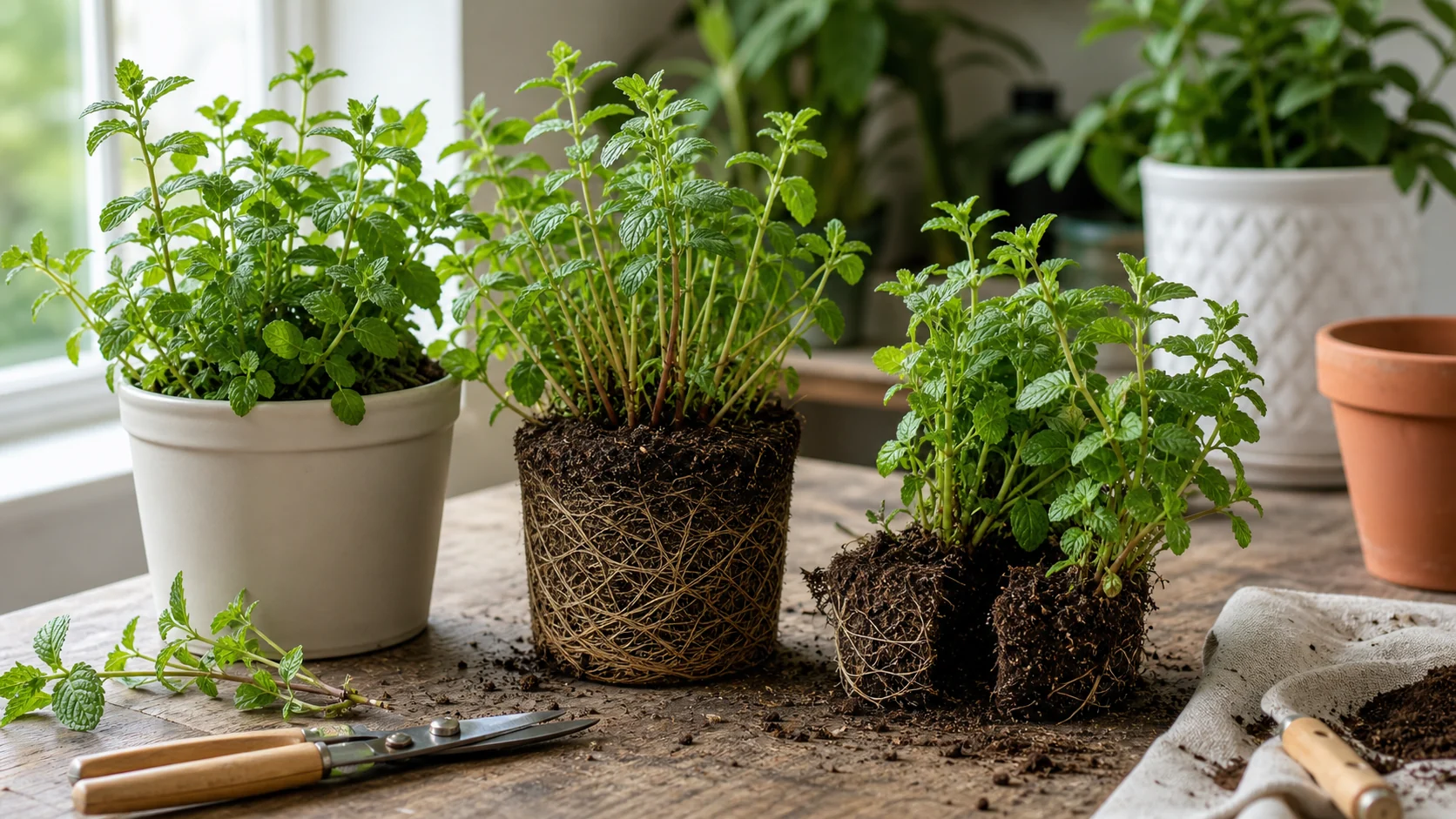
Plant shape and root condition reveal whether tired mint needs pruning, a larger pot, or division.
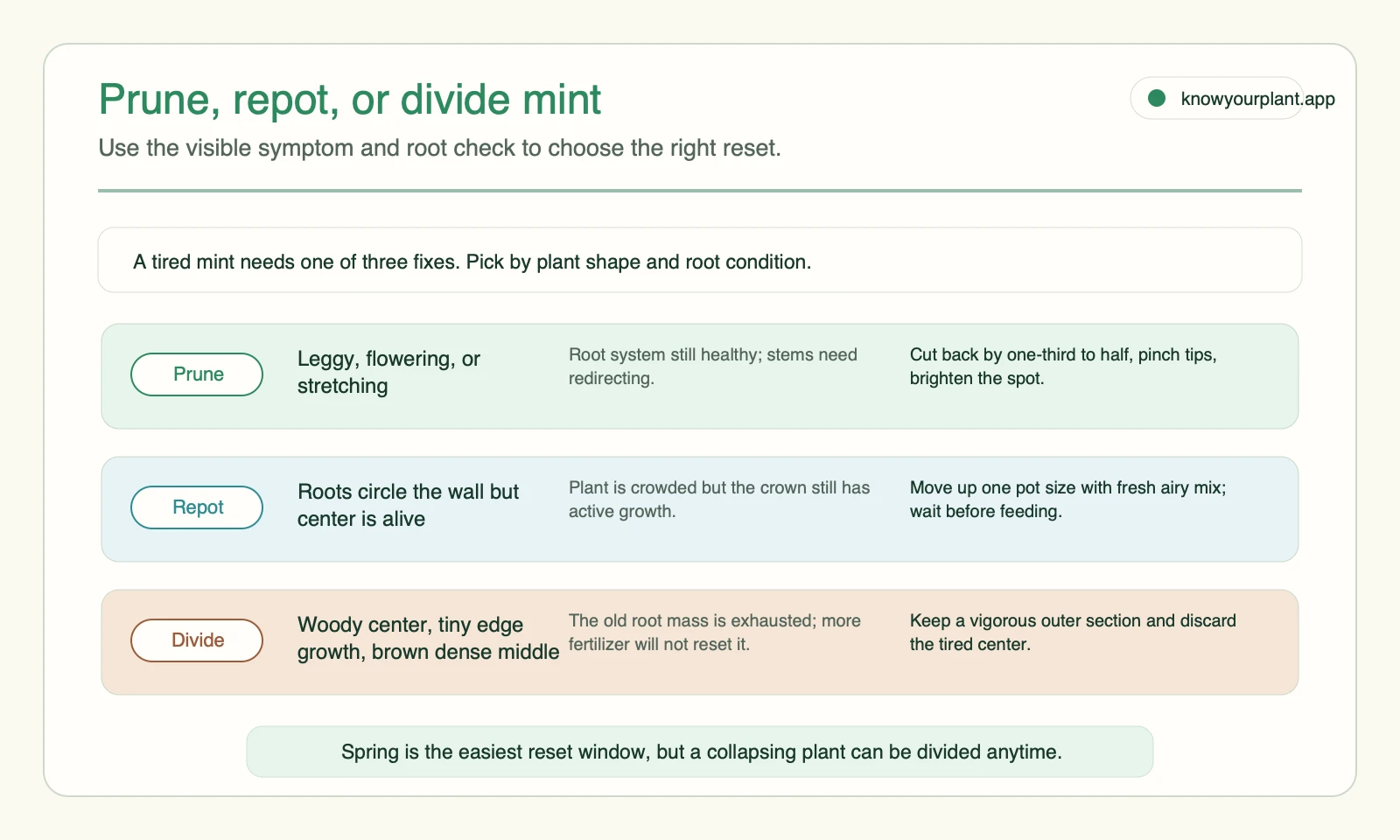
Use the router to pick the reset that matches plant shape and root condition.
When Mint Starts Looking Tired
If your mint was thriving and then started producing small leaves, weak new growth, or a woody bare center, the problem is usually not watering or light – it’s space. As mint fills a container, the center of the root mass gets exhausted and starts dying back while the outer edges keep pushing. Adding more fertilizer will not revive an overcrowded root system.
Bonnie Plants recommends periodic lifting and replanting every few years as standard mint maintenance – treating it as a reset, not a rescue.
The fix is division: tip the root clump out, pull it apart, discard the woody exhausted center, and repot a healthy outer section in fresh potting mix. Done every one to two years, this resets the plant back to its productive phase. If you haven’t repotted a plant before, our guide to repotting plants walks through the process step by step.
Common Problems
- Leggy, pale growth: usually a light problem first, especially if the plant sits more than a short distance back from the window. Pinching helps, but brighter light is the real fix.
- Wet soil and yellowing leaves: dense potting mix or weak drainage is keeping the lower root zone too cold and wet. Let the pot dry more between waterings and improve drainage.
- Woody center with weak outer growth: the plant is telling you it has outgrown the container. Divide it instead of feeding it harder.
- Rust or spotted leaves: mint can develop fungal issues such as rust or leaf spot, especially when airflow is poor. Remove affected leaves and avoid wetting the foliage late in the day.
- Weak fragrance or bland flavor: low light and overly rich feeding both soften flavor. Harvest young tips and keep the plant bright rather than pushing lush, soft growth.
Pet Safety
If you share your home with pets, do not rely on a vague “mint” label alone. Culinary mint is usually kept as a kitchen herb, but mixed nursery labels, fertilizer residue, and any pesticides used on the pot can all change the risk profile for a chewing cat or dog. The safest move is to verify the exact species on the label, keep treated pots out of reach, and supervise pets that treat herb planters like a snack bar.
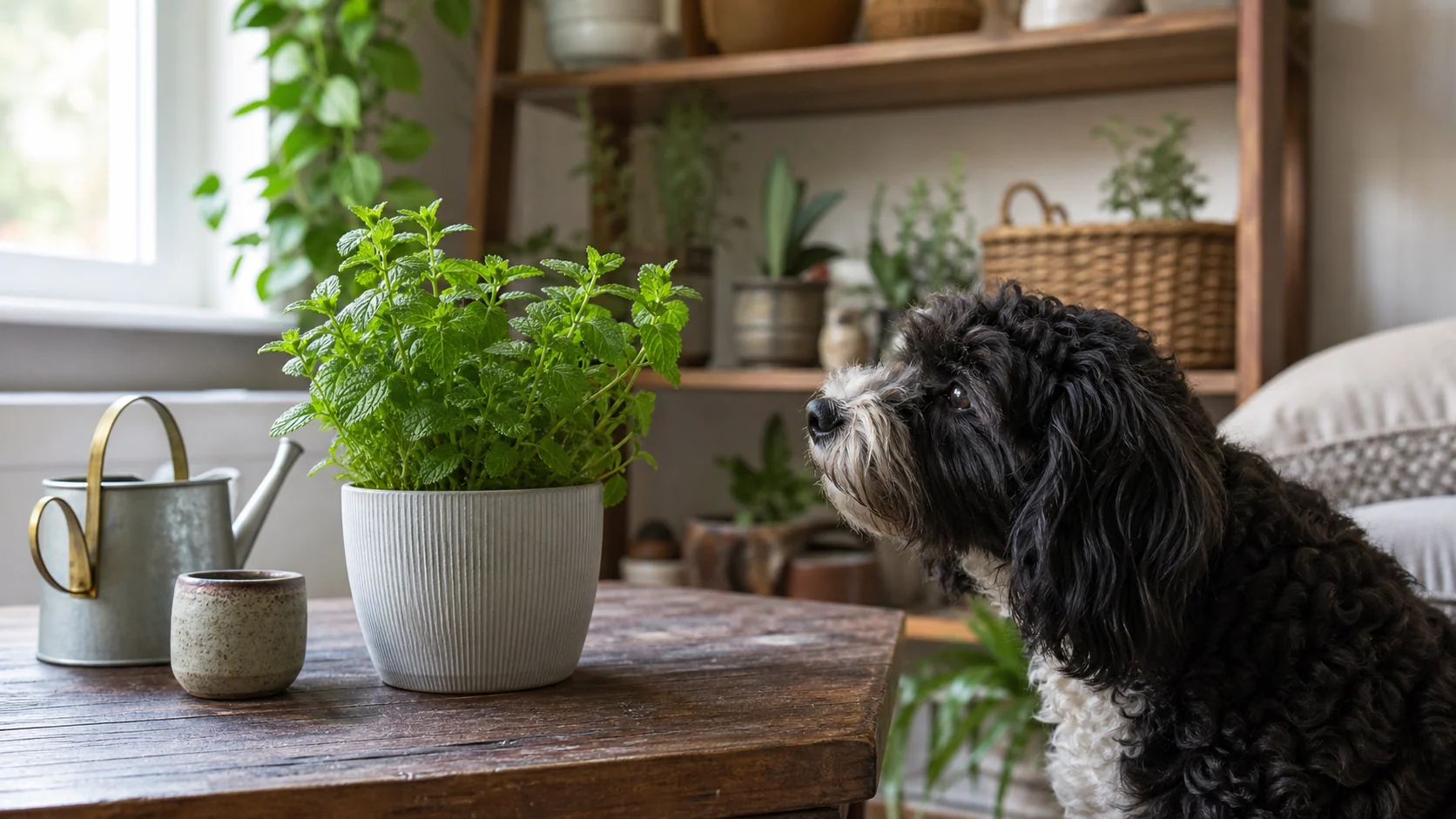
Keep mint pots controlled and supervise curious pets so treated herbs do not become an unattended snack.
Methodology Note
This guide was refreshed on June 15, 2026 using the Royal Horticultural Society, Bonnie Plants, Savvy Gardening, and NC State Extension for core care guidance. Public grower discussions were used only as qualitative signal for recurring indoor problems such as crowded roots, unclear window placement, and potting mixes that stay wet too long.
Freshness Note
Mint advice does not change as fast as trend-driven houseplant content, but indoor results still shift with season, window strength, and pot crowding. Recheck light, drainage, and root space first whenever a once-healthy mint suddenly goes leggy or woody.
Real User FAQ
How often should I water indoor mint? There’s no schedule that works for every setup. Use the soil as your guide: push your finger about an inch into the pot. Still damp? Wait. Dry at that depth? Water thoroughly. Most indoor mint in well-draining mix needs water every two to three days in warm months and less frequently in winter, but pot size, light levels, and humidity all affect drying time. A heavy pot that feels cold at the base is still holding moisture even if the surface looks dry.
Why is my mint leggy and stretching toward the light? Leggy mint is almost always a light problem. Mint wants bright, direct or near-direct light for most of the day. A spot that seems bright to you – a few feet back from a window, or in indirect light – is often not enough for mint to bush out into a full plant. Move the pot as close to a south or west-facing window as possible. If that still isn’t enough in winter, a basic grow light placed close to the plant usually solves it quickly.
Why does my mint keep dying back in a pot? If the center of the plant is going woody and bare while the edges are still pushing, the root mass is exhausted and crowded. This is normal for mint in containers after one to two years. More water and fertilizer will not revive an overcrowded root system. The fix is division: tip the plant out, pull the root clump apart, discard the woody center, and repot a healthy outer section in fresh potting mix.
Can mint grow in low light indoors? It can survive in low light, but it won’t produce much, and the leaves will have less flavor. Low-light mint typically goes leggy, and the slow-drying soil in dim conditions increases the risk of root rot. If you only have a north-facing window, a grow light is a more reliable path than trying to coax kitchen mint from ambient indoor light alone.
Why does my indoor mint smell less strong than store-bought? Essential oil concentration in mint increases with strong light, slightly stressed growing conditions, and harvesting from young tips. Indoor mint in lower light or consistently rich, moist soil often produces less intensely scented leaves than outdoor or greenhouse-grown mint. Regular harvesting from the growing tips and avoiding overly rich feeding tends to improve fragrance and flavor intensity over time.
Should I fertilize indoor mint? Yes, but lightly. A balanced liquid fertilizer at half strength, once a month from spring through late summer, supports consistent leaf production. Stop fertilizing from October through February. Heavy feeding doesn’t improve mint – it pushes growth faster than the plant can develop properly, and flavor suffers as a result.
Can I grow mint from seed? Spearmint and Moroccan mint can be grown from seed, though germination is sometimes slow and inconsistent. Peppermint is a sterile hybrid and does not reliably come true from seed – it needs to be propagated from cuttings or division. For most indoor growers, starting with a nursery plant or a division from an established mint is faster and more predictable than seed-starting.
Sources: Royal Horticultural Society, How to Grow Mint (rhs.org.uk); Bonnie Plants, Growing Mint (bonnieplants.com); NC State Extension Gardener Plant Toolbox, Mentha spicata (plants.ces.ncsu.edu); Savvy Gardening, How to grow mint indoors (savvygardening.com).