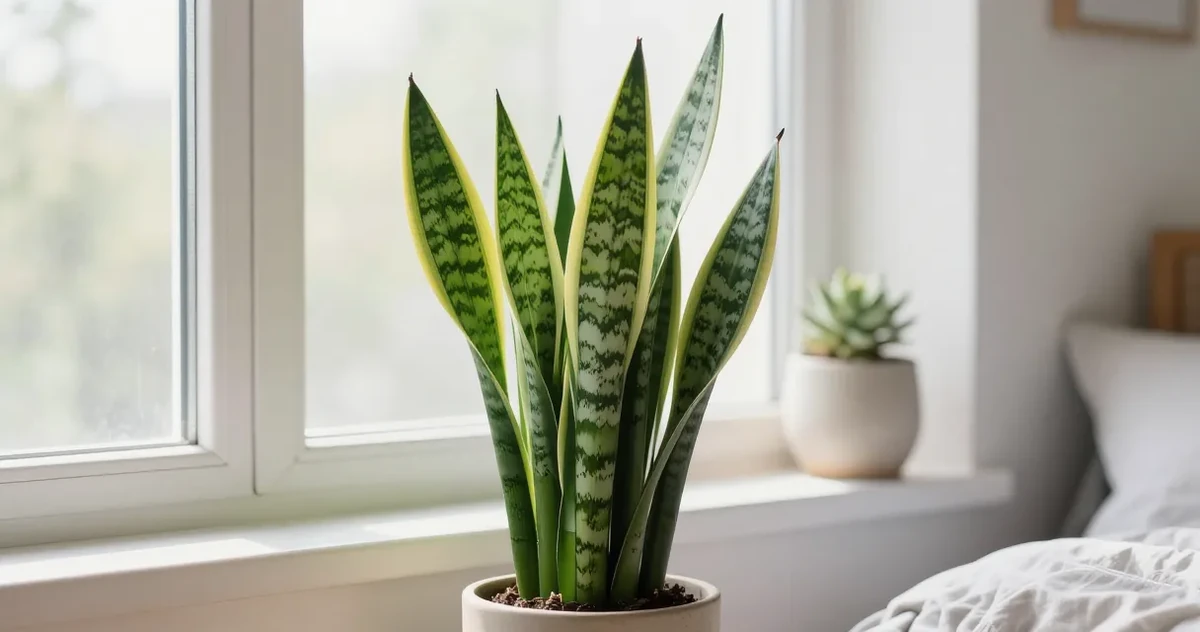
Snake plant propagation is one of those things that sounds simple – divide an offset or root a leaf – and yet still trips people up in the same ways every time. A division already has roots; a leaf section must grow them. Treat those starts alike and the cutting may turn mushy, or a water-rooted piece may struggle when moved to soil. A leaf cutting from a yellow-edged parent can also produce a plain-green plant.
The good news: snake plants really do propagate well. The complication: most guides describe all the methods in the same breath without telling you why you’d choose one over another, or where exactly things go wrong. If you need to stabilize the parent plant before taking cuttings, start with the snake plant care guide. This is the version that actually explains the tradeoffs.
One definition worth holding onto before we start: snake plant propagation is the process of creating a new plant from a piece of the original – either by splitting the root system (division) or by rooting a leaf section in soil or water. The method you choose determines your timeline, your success rate, and whether the new plant will look like its parent.
Dividing and Rooting a Snake Plant in Soil
First identify what is in your hand. A division is a young leaf cluster that already has part of the rhizome and its own roots. A leaf cutting is only a section of leaf: it has no roots yet and must form them after the cut end calluses. Do not pot and water them as though they are the same thing.
| Starting piece | Prepare it | Planting depth | First water | Progress vs. failure |
|---|---|---|---|---|
| Rooted division | Separate an offset with roots and a firm piece of rhizome; let any fresh cut air-dry until its surface is no longer moist | Set roots downward and keep the crown at roughly its previous soil line | Once the wound surface is dry, water the retained root zone and drain fully. If the mix is already damp, wait and check it rather than adding more water. | Brief wobbling or mild wilt can be transplant stress. A soft rhizome, sour smell, or a cluster loosening while the mix stays wet points to rot. |
| Callused leaf cutting | Cut a healthy leaf into sections, mark the original bottom, and let each cut surface dry for 24 to 48 hours | Insert the original bottom about 1 inch into gritty, fast-draining mix | Start in barely moist mix; do not add a heavy settling soak. Water again only after the mix has nearly dried. | No visible growth for several weeks is normal. A firm cutting or gentle tug resistance is progress; a black, translucent, or mushy base is failure. |
Use a small pot with a drainage hole so the mix cannot stay wet around the cut. Division is the faster path and preserves variegation. Soil-rooted leaf sections are slower and may produce plain-green plants even when the parent has yellow margins.
Identification Snapshot
Before you take a cutting, make sure you’re working with a true snake plant and not just another stiff-leaved succulent in a nursery pot.
- Leaves are thick, upright, and sword-shaped rather than soft or easily bendable.
- Most common forms have horizontal banding or mottling across the leaf surface.
- New offsets emerge from underground rhizomes at the base of the mother plant, which is why division works so well.
- Variegated forms may have yellow or pale margins, but those margins usually do not carry forward through leaf-cutting propagation.
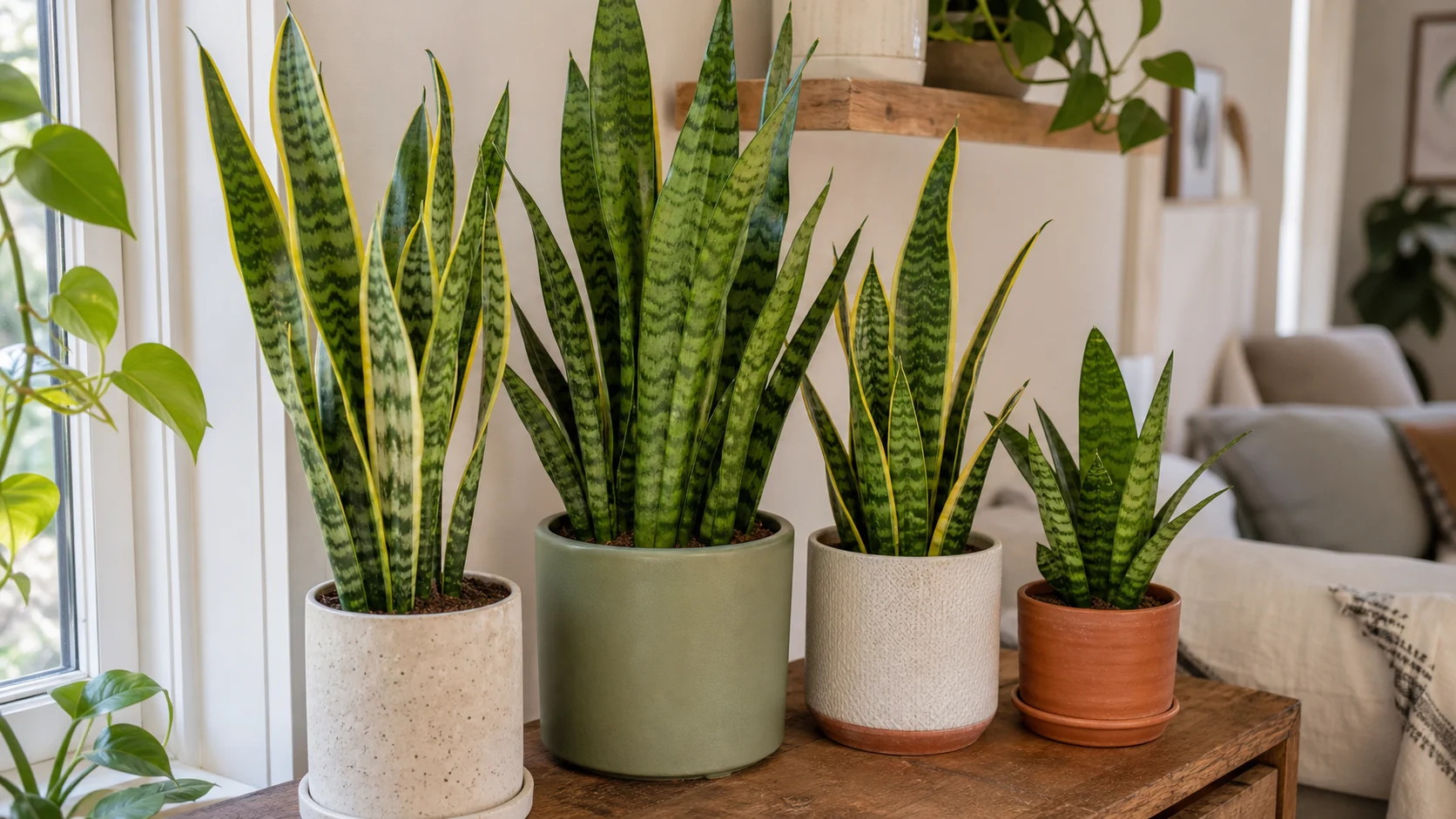
Upright sword-shaped leaves, horizontal banding, and yellow margins distinguish common snake plant forms before propagation begins.
Lookalikes and Confused With
| Plant or form | Why people confuse it with snake plant | What matters for propagation |
|---|---|---|
| Bird’s nest snake plant | It has the same thick succulent leaves, but they stay shorter in a rosette | Division still works well, but leaf sections are smaller and slower |
| Cylindrical snake plant | It shares the same genus but has round spear-like leaves instead of flat blades | The same callus-first, low-moisture logic applies, but cutting orientation is even easier to lose track of |
| Aloe and similar spiky succulents | Nursery labels and mixed succulent displays often group them together | Aloe offsets are handled differently, so do not assume every upright succulent can be propagated like a snake plant leaf section |
What Most Propagation Guides Miss
Most step-by-step guides treat division, soil cuttings, and water rooting as roughly equivalent choices and let you pick whichever sounds easiest. They skip the part where your goal changes which method actually makes sense.
The common misdiagnosis: beginners often choose water propagation because it feels the most transparent – you can see what’s happening. But water-rooted cuttings develop structurally different roots than soil-rooted ones: roots adapted to a low-resistance, oxygen-rich liquid environment. When moved into potting mix, they sometimes fail to adapt and the plant stalls or declines. Iowa State University Extension specifically notes this transition risk and recommends transplanting water-rooted snake plant cuttings when roots reach about one inch – before they become too specialized to make the switch.
The practical first check: before you pick a method, look at the base of your snake plant. If you see offsets – small clusters of leaves pushing up from the soil near the main plant – division is almost always the faster and more reliable path. Leaf cuttings make sense when there are no offsets, or when you want to multiply quickly and variegation doesn’t matter.
Social Listening: What Real Growers Keep Running Into
The same confusion patterns show up again and again in grower forums and search-visible Reddit discussions. People stick fresh leaf pieces straight into damp mix and end up with rot. They lose track of which end of the cutting points down. They choose water because it feels easier, then get stalled cuttings when those water roots have to adapt to potting soil. And variegated snake plant owners are often caught off guard when leaf-cutting babies come back plain green.
Those patterns are useful because they point to the failure states basic tutorials gloss over. They are not controlled tests, but they line up closely with the extension guidance behind the recommendations in this article.
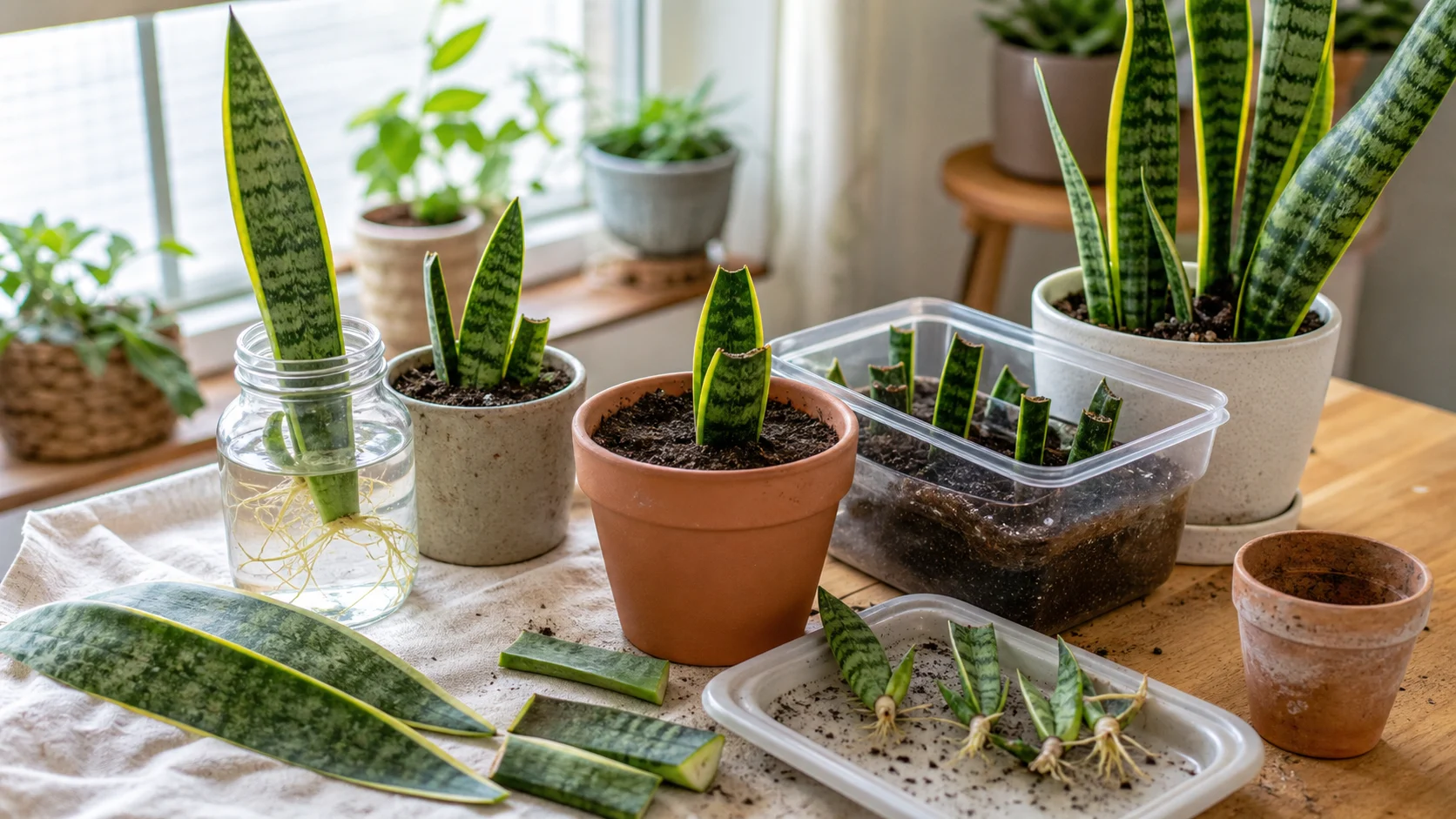
Mixed water and soil starts show why cutting orientation, moisture, rooting method, and variegation repeatedly confuse home growers.
Three Ways to Propagate a Snake Plant
Each method works. The difference is in what you’re starting with, how long you’re willing to wait, and whether the new plant needs to look like the parent.
Division: The Fastest, Most Reliable Method
If your snake plant has been in its pot for a while, it may have produced offsets – small new plants that sprout from the rhizome beneath the soil. Division means separating those offsets from the mother plant and potting them individually.
Penn State Extension identifies division as the easiest propagation method for snake plants, and it makes sense once you try it: you’re not waiting for roots to form from nothing. The offsets already have roots. You’re just untangling them from the parent.
How to do it:
- Tip the plant out of its pot when the soil is dry. Dry soil shakes loose more easily and puts less stress on the roots.
- Look for offsets that have their own cluster of leaves and their own root mass attached at the base.
- Use clean scissors or a knife to sever the rhizome connecting them to the mother plant. If roots are tightly intertwined, trace them gently with your fingers before cutting.
- Let the cut surface air-dry until it no longer looks or feels moist before potting. A small, clean cut may be ready within a few hours; a thicker cut or humid room can take longer, so use the wound surface rather than a fixed timer.
- Set the division at its previous soil line in fresh, well-draining mix. Once the wound surface is dry, water around the retained roots and let excess drain; do not keep the mix continuously moist.
Timeline: The offset can go straight into a pot and should establish within a few weeks – far quicker than any cutting-based method.
One thing division does that no other method can: it preserves variegation. If your snake plant has yellow-edged leaves, division is the only reliable way to guarantee the new plant keeps that coloring. More on why in the variegation section below.
Leaf Cuttings in Soil
This is what most people try first because it seems intuitive – cut a leaf, put it in soil, wait for roots. It does work. It’s just slower than division and has one failure mode that catches a lot of beginners off guard.
Virginia Cooperative Extension emphasizes that clean, porous, low-fertility rooting medium is important for asexual propagation success – and this is especially true for snake plant leaf sections, which sit in moist growing media for weeks before roots appear.
How to do it:
- Cut a healthy, mature leaf close to the base of the plant using clean scissors or a sharp knife.
- Let the cut end sit out for 24 to 48 hours before doing anything with it. This allows the wound to callus slightly. Skipping this step is the most common reason fresh cuttings rot in soil – the open, moist cut meets damp growing medium and the cutting deteriorates before roots form.
- If you want multiple cuttings from one leaf, cut it into 3-to-4-inch sections. Keep track of which end was originally facing down. Snake plants only root from the bottom of each section. Plant a section upside-down and nothing will happen – the cutting just sits there and eventually rots.
- Press the bottom ends an inch or so into a well-draining, gritty mix. Keep the medium barely moist.
Timeline: Considerably slower than division. Expect several weeks before roots form, and the cutting won’t show outward signs of progress for most of that time. New growth from the base signals the cutting has established.
Water Propagation
Water propagation is popular because it lets you watch roots form in real time – you can see exactly what’s happening, which makes the process feel less like guessing.
It works for snake plants, with two honest caveats.
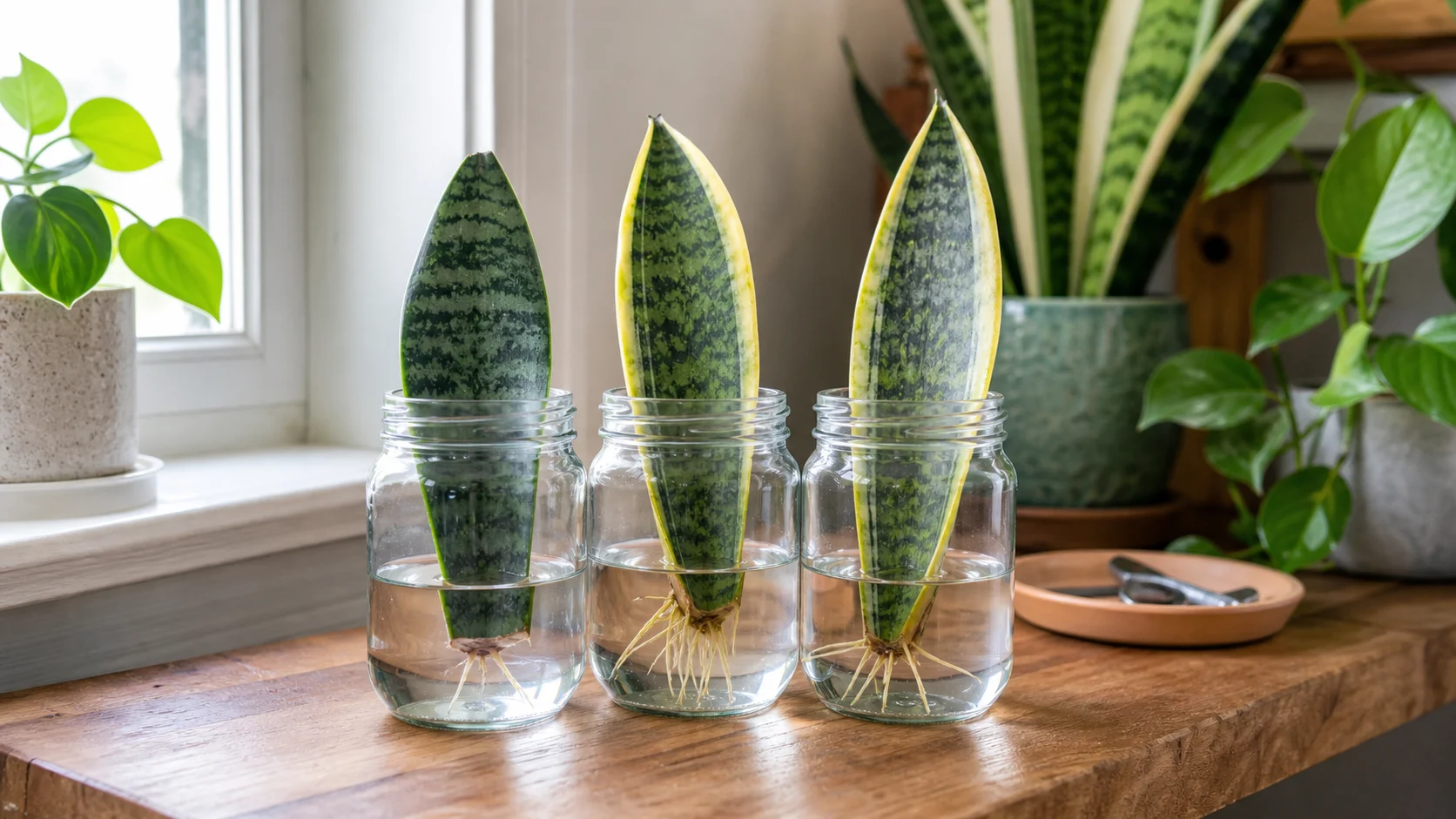
Clear jars make pale new roots easy to monitor so cuttings can move to soil near the one-inch mark.
How to do it:
- Prepare your cutting the same way as the soil method: let it callus for 24 to 48 hours first.
- Place the cut end in a clean jar with an inch or two of water. Keep the leaf itself out of the water – only the bottom of the cutting should be submerged.
- Change the water every few days to keep it fresh and prevent bacterial buildup.
- Once roots reach about one inch long, move the cutting into soil. Iowa State University Extension specifically recommends transplanting at this stage – before water roots grow longer and become harder to transition.
The move from water to soil is where many water-rooted cuttings struggle. Transplant too late and the cutting may sulk, lose leaves, or fail to establish. Transplant at the one-inch mark, keep humidity slightly higher for the first week or two after potting, and the success rate improves noticeably.
Water propagation also carries a slightly higher rot risk than soil propagation overall, since the cutting is in contact with moisture continuously. The callusing step before placing in water matters more here, not less.
Which Method Should You Choose?
| Your goal | Best method |
|---|---|
| Fastest new plant with the least setup | Division (if offsets are present) |
| Preserve yellow or white variegation | Division only |
| Multiply a plain green snake plant quickly | Leaf cuttings in soil |
| Watch roots develop in real time | Water propagation – transplant at 1 inch |
| No offsets available, no water container | Leaf cuttings in soil |
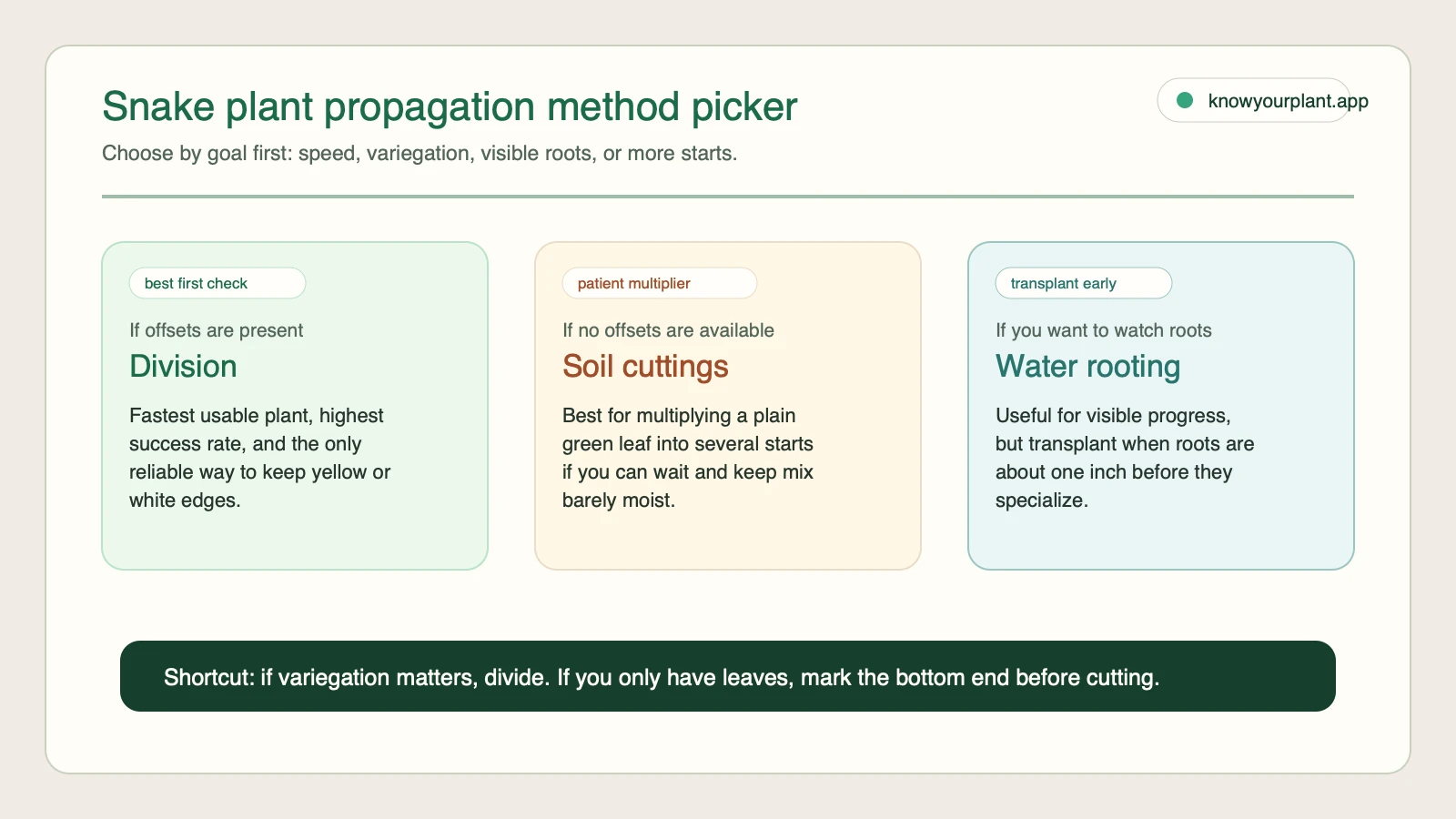
Use this method picker before cutting anything: division is the reliability path, soil cuttings are the patient multiplier, and water rooting works best when you transplant before roots get too long.
Care Cards
| Method | Best when | Main watchout | Readiness sign |
|---|---|---|---|
| Division | You already have offsets or want the fastest result | Root disturbance right after separation | Offset stands up on its own and settles into fresh mix |
| Leaf cuttings in soil | You want more plants from one leaf and color reversion is acceptable | Rot from planting before the cut end calluses | Gentle tug meets resistance and new growth appears at the base |
| Water propagation | You want visible rooting and do not mind an extra transplant step | Waiting too long to move water roots into soil | Roots are about 1 inch long and still firm and pale |
The Variegation Problem
If your snake plant has yellow or white edges – the variety commonly called Sansevieria trifasciata ‘Laurentii’ – you may be hoping to propagate more of those patterned plants from leaf cuttings. Here’s the thing most guides bury in a footnote: leaf cuttings from variegated snake plants almost always produce solid green offspring.
The yellow or white edge coloration in these varieties is produced by specialized tissue in the outermost part of the leaf – tissue that doesn’t carry the variegation pattern into newly formed roots and plantlets. The cutting itself is variegated, but the baby plants it produces revert to plain green.
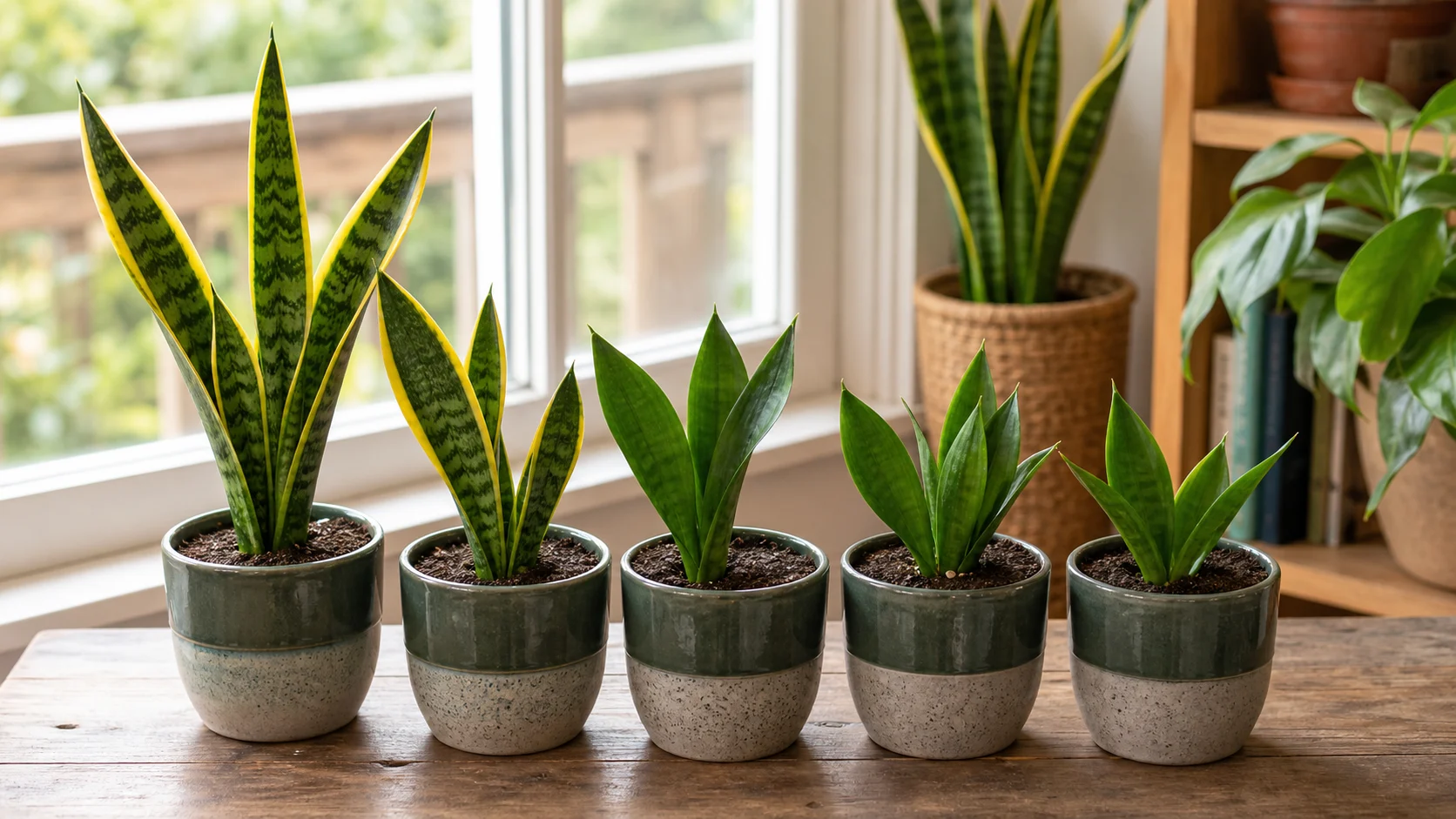
Yellow-edged parent forms contrast with solid-green offspring, the common result of propagating variegated snake plants from leaf cuttings.
Division is the only method that reliably carries variegation forward, because you’re separating a piece of the original root system with its own established growing points. The offset was already growing with variegated genetics intact.
If the patterned look matters to you: divide, don’t cut.
Common Problems
Use this quick diagnosis card when the process looks wrong before you assume the cutting is a total loss.
If something goes wrong, the cause is almost always one of these five situations:
| What you’re seeing | Most likely cause | What to do next |
|---|---|---|
| Cutting is mushy at the base | No callus before potting; rot started quickly | Trim to firm tissue, let dry 48 hrs, retry in dry gritty mix |
| Cutting sits for weeks with no roots | Planted upside-down; polarity lost | Mark cuttings before cutting; discard reversed sections |
| Water roots formed but plant stalled in soil | Water roots too long before transplant | Keep humidity high, wait – may still recover; next time transplant at 1 inch |
| New plant is solid green despite yellow-edged parent | Variegation reversion from leaf cutting | Divide offsets from the parent instead |
| Division looks wilted for 1 to 2 weeks | Normal root stress during establishment | No intervention needed; give it time in a stable spot |
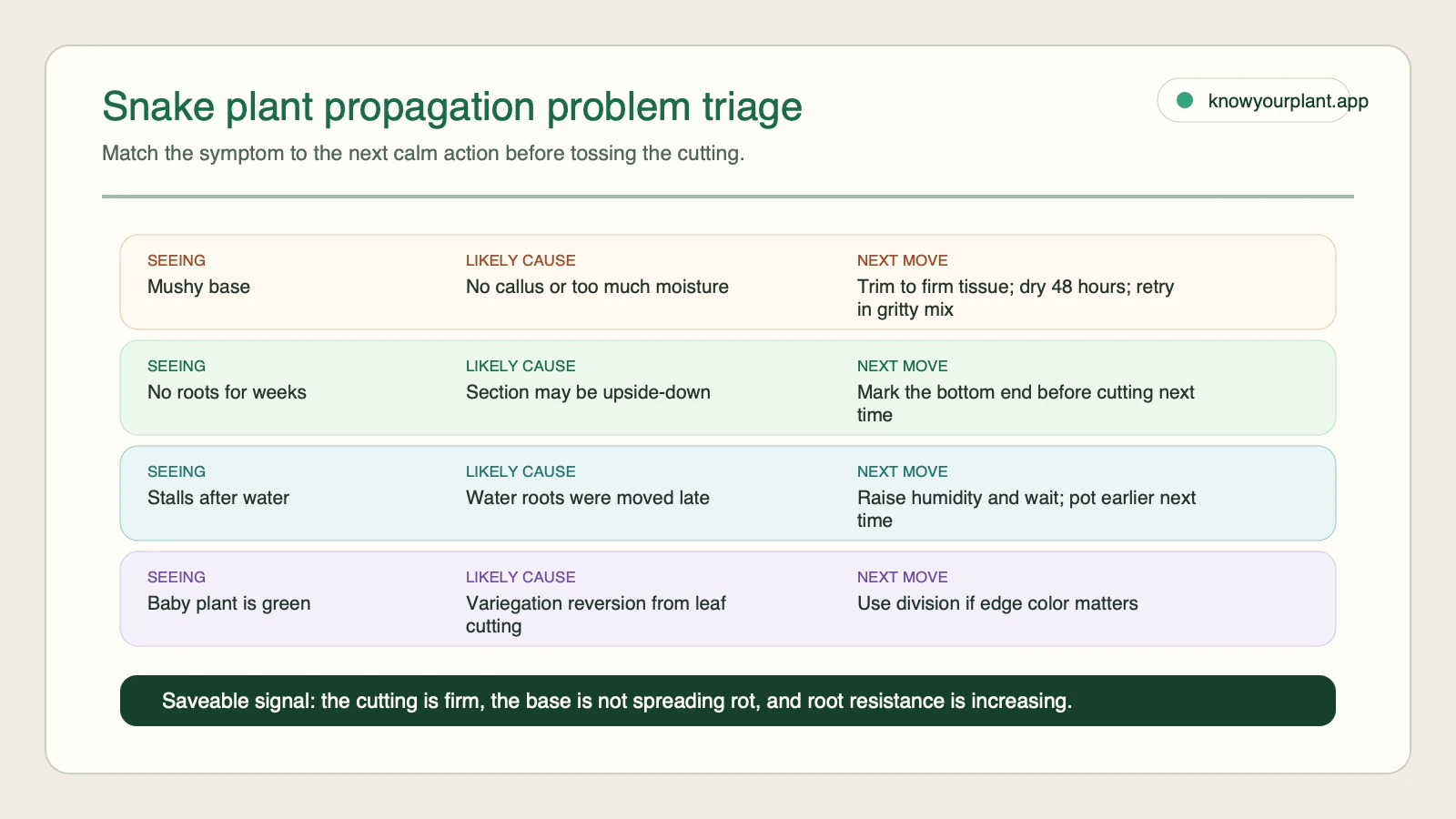
The triage card keeps the fix tied to the visible symptom, so you do not overwater, repot, or discard a cutting that only needs more time.
Expert note: Penn State Extension’s preference for division and Iowa State’s warning about water-root stress both point to the same practical rule. When you care most about reliability, use offsets. When you care most about multiplying one leaf into several starts, accept the slower path and manage moisture carefully.
Seasonal Propagation Calendar
Snake plants are forgiving enough to propagate year-round in most indoor conditions, but timing affects speed and stress.
Spring (March to May) The best window. Snake plants are entering active growth, stored energy is building, and ambient temperatures support faster rooting. Division and leaf cuttings both root more quickly in spring than at any other time of year.
Summer (June to August) Still an excellent window. Warm temperatures and longer days help cuttings establish fast. The main risk in summer is forgetting to water new cuttings and offsets – warmer conditions dry out small propagation pots faster than you might expect.
Autumn (September to November) Workable, but slower. Growth is winding down. Cuttings root more slowly and new offsets may not push growth until spring. If you propagate in autumn, expect a longer wait before seeing new leaves.
Winter (December to February) Not ideal, but not impossible. In a warm, stable home above 60°F, cuttings can still root – just on a longer timeline. Avoid propagating in winter if your indoor temperatures drop significantly or if the plant is near a cold window. Cold soil temperatures slow rooting and raise the risk of rot.
When Is a Cutting Actually Ready to Pot Up?
Most guides tell you how to start a cutting but not how to know when it’s done.
For water-rooted cuttings:
- Roots are visible and approximately 1 inch long
- Root tips look white or pale yellow and firm, not brown or mushy
- Transplant before roots grow longer than 2 inches
For soil-rooted cuttings:
- Give the cutting a very gentle tug. If there’s resistance, roots have formed. If it pulls free easily, wait longer.
- New growth at the base of the cutting is the clearest sign it has established.
- Don’t rush repotting – let the cutting settle in its propagation container for at least a month after you feel root resistance.
For divisions:
- The offset can go directly into a pot after the cut surface dries.
- Expect some leaf wobble for the first week or two as new roots anchor in fresh medium.
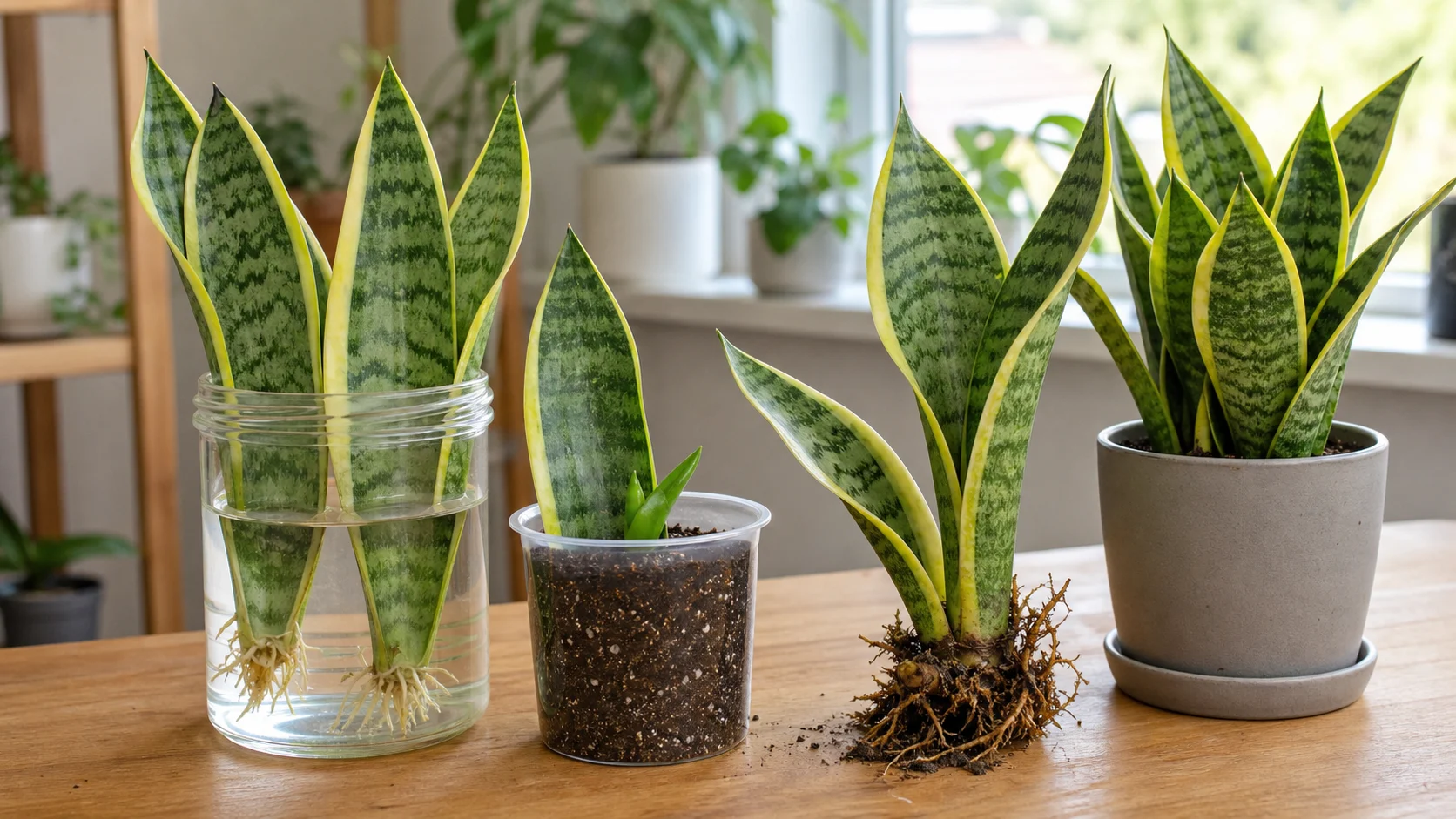
Short pale water roots, fresh basal growth in soil, and an intact divided root mass are practical signs that a start is ready to pot.
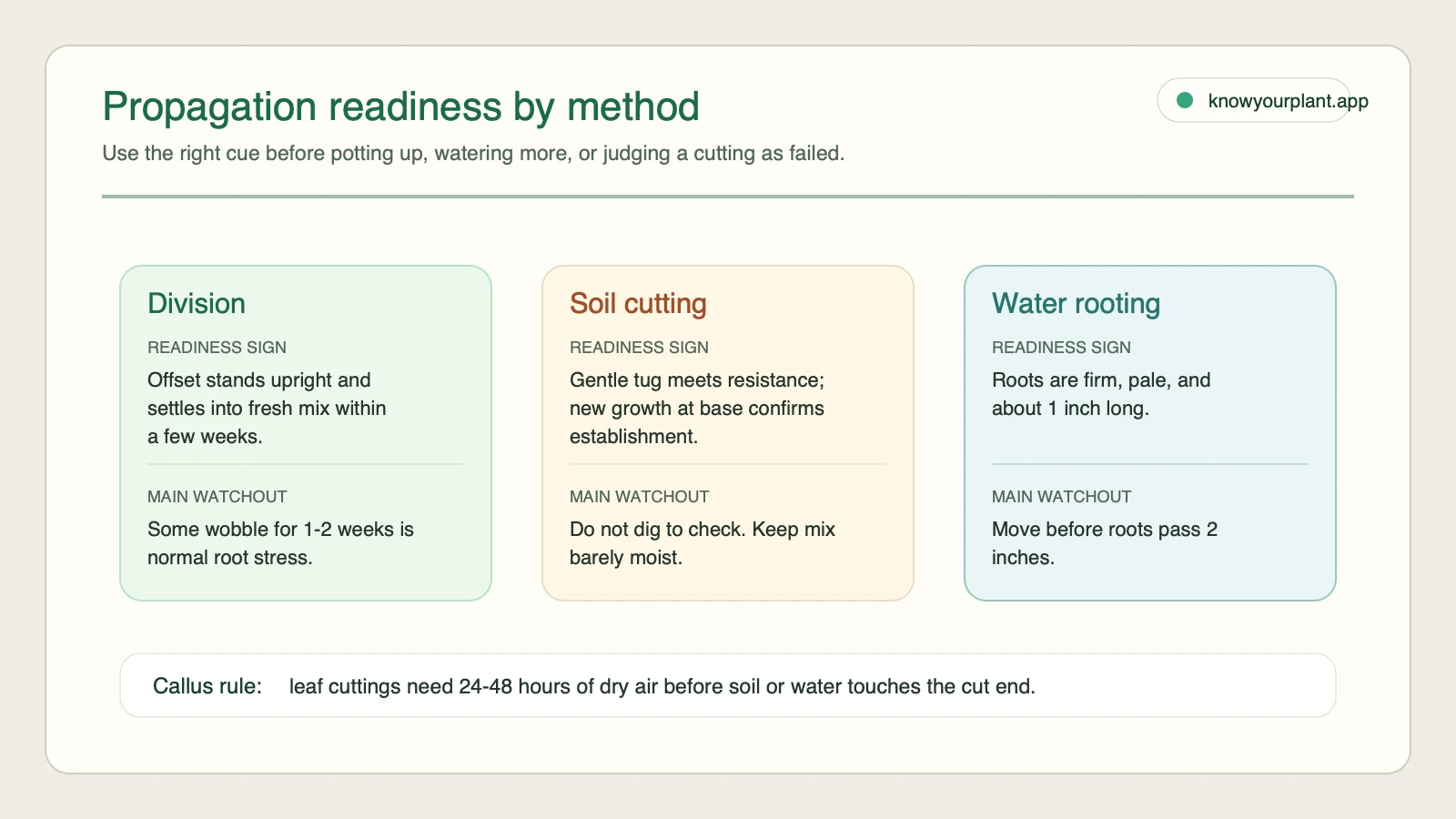
Use readiness signs instead of the calendar alone: firm one-inch water roots, tug resistance in soil, and a settled division are stronger cues than a fixed number of days.
If you’re unsure whether your plant is ready to move up in pot size after propagating, the guide to repotting plants covers timing and soil mix selection in detail.
The Mistakes That Cause Most Failures
1. Skipping the callus step on a leaf cutting Fresh leaf sections are vulnerable to rot. Let their cut surfaces dry for 24 to 48 hours before placing them in soil or water. A rooted division is different: its rhizome wound only needs to air-dry until the surface is no longer moist before it is potted and watered around the retained roots.
2. Planting sections upside-down Snake plant leaf sections root from the bottom end only – the end that was originally closer to the base of the plant. Mark the bottom of each section with a small notch or a dot before cutting, so you don’t lose track.
3. Overwatering the propagation container The soil around a new cutting should be barely moist, not wet. Wet soil plus a freshly cut surface is the fastest route to rot. A gritty, well-draining mix helps; so does a terracotta propagation pot that dries faster than plastic.
4. Moving water-rooted cuttings too late The longer water roots grow, the harder the transition to soil becomes. Aim for the one-inch mark as your transplant cue.
5. Expecting fast results from leaf cuttings Leaf cuttings in soil are slow. Several weeks with no visible progress is normal. Digging up the cutting to check is the easiest way to damage fragile young roots. Trust the process and check for resistance with a gentle tug instead.
If your snake plant is also showing yellowing on the original plant while you’re trying to propagate, it’s worth ruling out overwatering or root stress first – yellow leaves on snake plants are almost always a watering or drainage problem.
A Note on Pet Safety
Snake plants contain saponins – compounds that are toxic to dogs and cats. According to the ASPCA, ingestion can cause nausea, vomiting, and diarrhea in pets. Propagation tends to create more access points temporarily: cuttings sitting on a counter, small new plants on the floor during potting. Keep all of it out of reach until the new plant is established somewhere safe.
If you have pets at home and want to expand your collection without the worry, the guide to cat-safe indoor plants is a good place to start.
For another practical pet-safety check, see Is Snake Plant Toxic to Cats? Signs, Risk, and Prevention for the risk level and the next steps.
Real User FAQ
How long does snake plant propagation take?
It depends on the method. Division is fastest: an offset with existing roots can establish in a few weeks. Leaf cuttings in soil take longer – many weeks before roots form, and new growth may not appear above soil for two to three months. Water propagation produces visible roots faster than soil, but the transition to potting mix adds extra time and a stress period. For most home growers, division gives the fastest usable result.
Can I propagate a snake plant in just water forever?
Not successfully. Snake plants can root and even push small new growth in water for a while, but they don’t thrive long-term without the support structure, nutrients, and drainage that soil provides. Water propagation is a rooting technique, not a permanent growing method. Once roots reach about one inch, move the cutting into a well-draining potting mix.
Why is my snake plant cutting going mushy?
The most likely cause is rot from excess moisture before the leaf section had a chance to callus. Fresh leaf cuts are vulnerable because open tissue meets moisture before roots form. For a leaf cutting, trim back to firm tissue, let the new cut surface air-dry for 24 to 48 hours, and try again. For a rooted division, follow the shorter readiness cue above: pot only after the rhizome wound surface is no longer moist, then avoid keeping the mix continuously wet.
Will a propagated snake plant look like the original?
That depends on the variety and the method. Plain green snake plants reproduce true from leaf cuttings – the offspring will look like the parent. Variegated snake plants (yellow or white edges) do not reproduce true from leaf cuttings; the new plants almost always revert to solid green. Division is the only method that reliably carries variegation forward, because you’re separating a piece of the original plant with its genetic patterns intact.
How many cuttings can I take from one leaf?
As many as the leaf length allows, at 3-to-4-inch intervals. A mature snake plant leaf that is 24 inches long could theoretically yield five or six cuttings. The main constraint is keeping track of which end was originally at the bottom of each section – that end needs to face down in the growing medium. Mark each section before you cut to avoid mix-ups.
My cutting grew roots but isn’t producing new leaves. What’s wrong?
This is normal and not a sign of failure. Once a leaf section roots, it takes additional time for the energy reserves in the cutting to support new growth above soil. It can take two to three months from rooting before you see the first new leaf tip emerge. As long as the cutting is firm, not rotting, and shows resistance when gently tugged, it’s doing what it’s supposed to do.
Is it better to propagate snake plants in spring or can I do it year-round?
Spring and early summer are the most forgiving times – the plant is actively growing, has more stored energy, and warmer temperatures support faster rooting. That said, snake plants propagate successfully year-round in stable indoor conditions. If your home stays warm (above 60°F) in winter, there’s no reason to wait. Avoid propagating immediately after repotting or during any period when the parent plant is already stressed.
Freshness Note
Last updated: 2026-09-09. The answer-first soil comparison was added using the article’s existing extension-reviewed propagation guidance; the source set was last reviewed on 2026-05-26.
Methodology
This guide combines direct extension guidance with qualitative practitioner signal. Factual recommendations about division, rooting media, transplant timing, and pet safety were checked against Penn State Extension, Iowa State Extension, Virginia Cooperative Extension, Missouri Extension, and ASPCA. Grower discussion threads were used only to surface the mistakes and questions people repeat most often, such as callusing failures, upside-down cuttings, water-to-soil transition stress, and variegation loss from leaf sections.
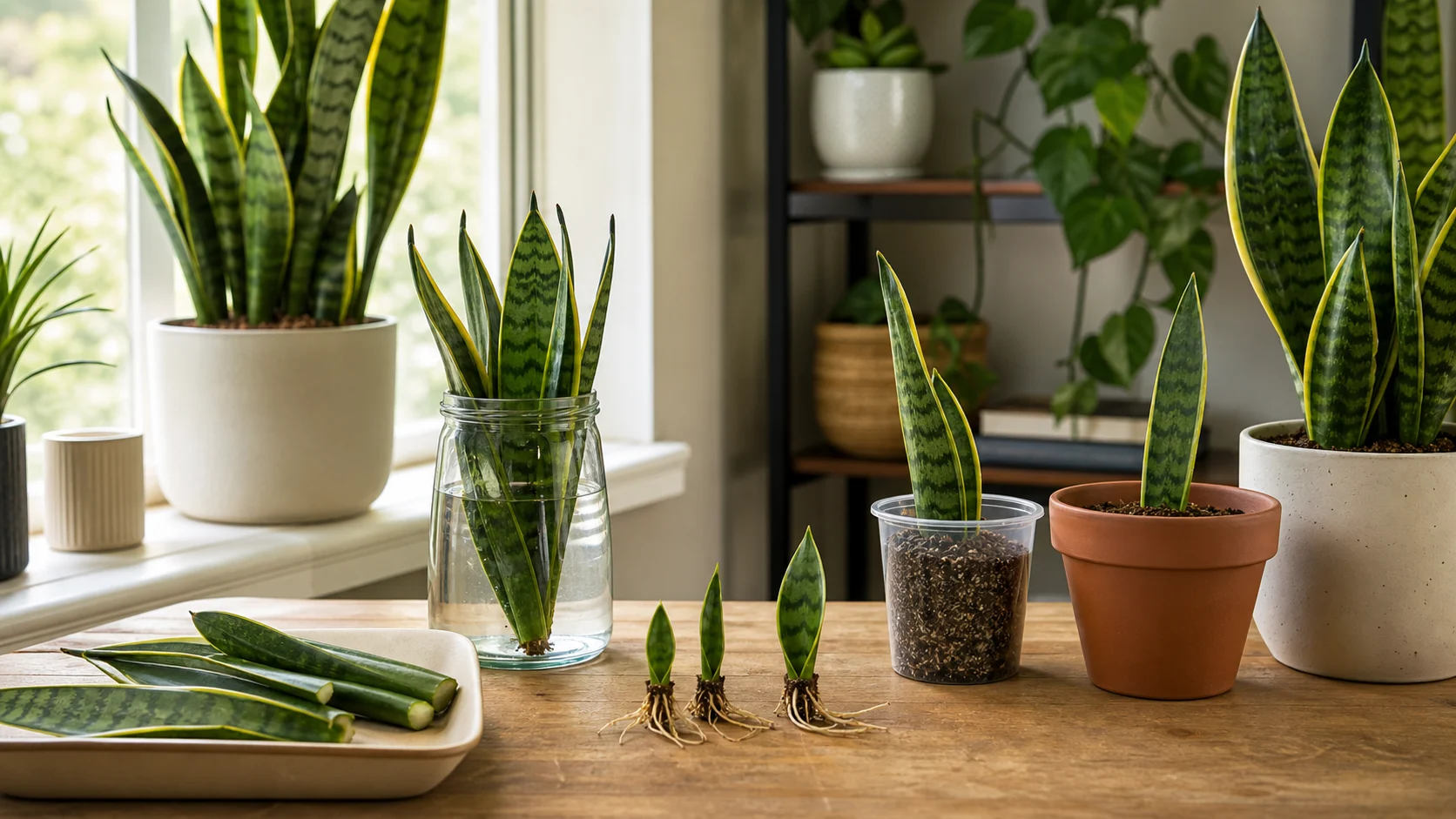
Side-by-side leaf sections, water starts, soil starts, rooted plantlets, and parent plants mirror the propagation methods checked for this guide.
Download KnowYourPlant for personalized plant care reminders – including propagation timing, watering nudges for new cuttings, and alerts when your plants need attention: https://knowyourplant.app
Sources
- Penn State Extension. Snake Plant: A Forgiving, Low-maintenance Houseplant. extension.psu.edu
- Iowa State University Extension and Outreach. How to Propagate Houseplants by Leaf Section Cuttings. yardandgarden.extension.iastate.edu
- Virginia Cooperative Extension. Propagation by Cuttings, Layering and Division. pubs.ext.vt.edu
- Missouri Extension. Home Propagation of Houseplants. extension.missouri.edu
- ASPCA Animal Poison Control. Snake Plant (Sansevieria trifasciata). aspca.org