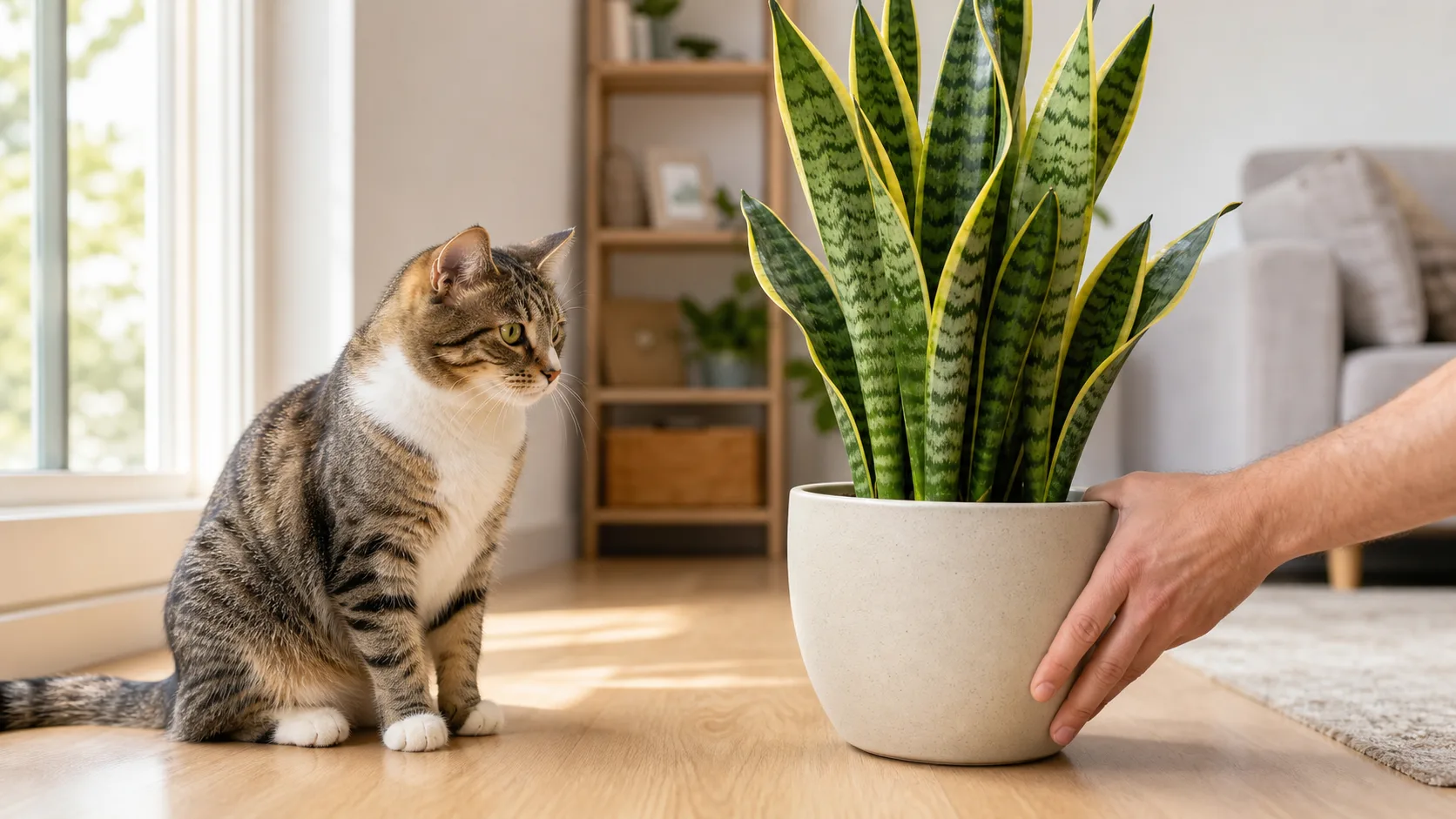
Is Snake Plant Toxic to Cats? Signs, Risk, and Prevention
If your cat just chewed a leaf and now you are panic-searching is snake plant toxic to cats, the short answer is yes. Snake plant, also sold as sansevieria, mother-in-law’s tongue, or Dracaena trifasciata, contains saponins that can irritate a cat’s mouth and stomach.
The part most articles skip is the part you actually need in the moment: this is usually treated as an irritation and GI-upset problem, not the same kind of no-delay emergency people associate with lilies. That does not mean ignore it. It means stay calm, look at your cat first, and respond based on symptoms rather than just the torn leaf.
What most cat-toxicity guides get wrong
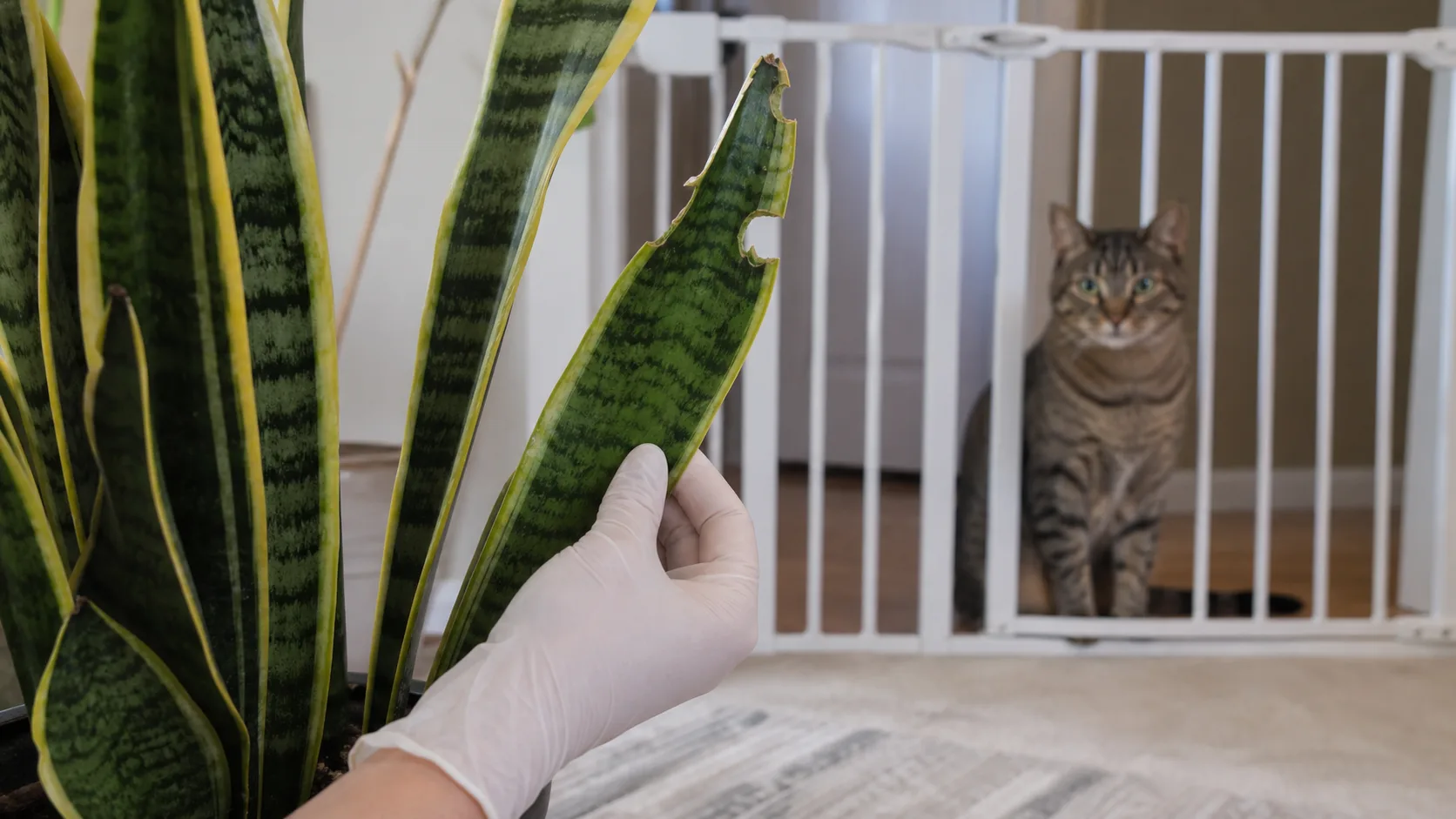
Fresh leaf damage plus confirmed access is stronger evidence than treating one vague symptom as proof of poisoning.
The word “toxic” does a lot of heavy lifting in plant safety content, and it almost always leaves cat owners worse off. Most guides hand you a yes-or-no answer and a short symptom list, then say “contact your vet.” That is technically correct and practically useless when you are standing in your living room at 11 pm staring at a chewed leaf.
The common misdiagnosis here is treating snake plant exposure the same as lily exposure. Lily toxicity in cats is a true emergency with kidney failure risk, where even a small amount demands immediate emergency care. Snake plant toxicity is in a different category: the ASPCA lists it as primarily a GI irritant and saponin-exposure problem. That does not make it safe to ignore, but it does mean your response should be calibrated to what your cat is actually doing, not to the worst-case framing of the word “toxic.”
The practical first check is this: look at the cat before you study the plant. A shredded leaf edge tells you exposure happened. Your cat’s behavior in the next 30 to 60 minutes tells you what to do about it. Drooling, pawing at the mouth, vomiting, hiding, refusing food, stumbling, or looking visibly distressed are the signals that move you from “monitor” to “call now.”
The quick answer on snake plant toxicity
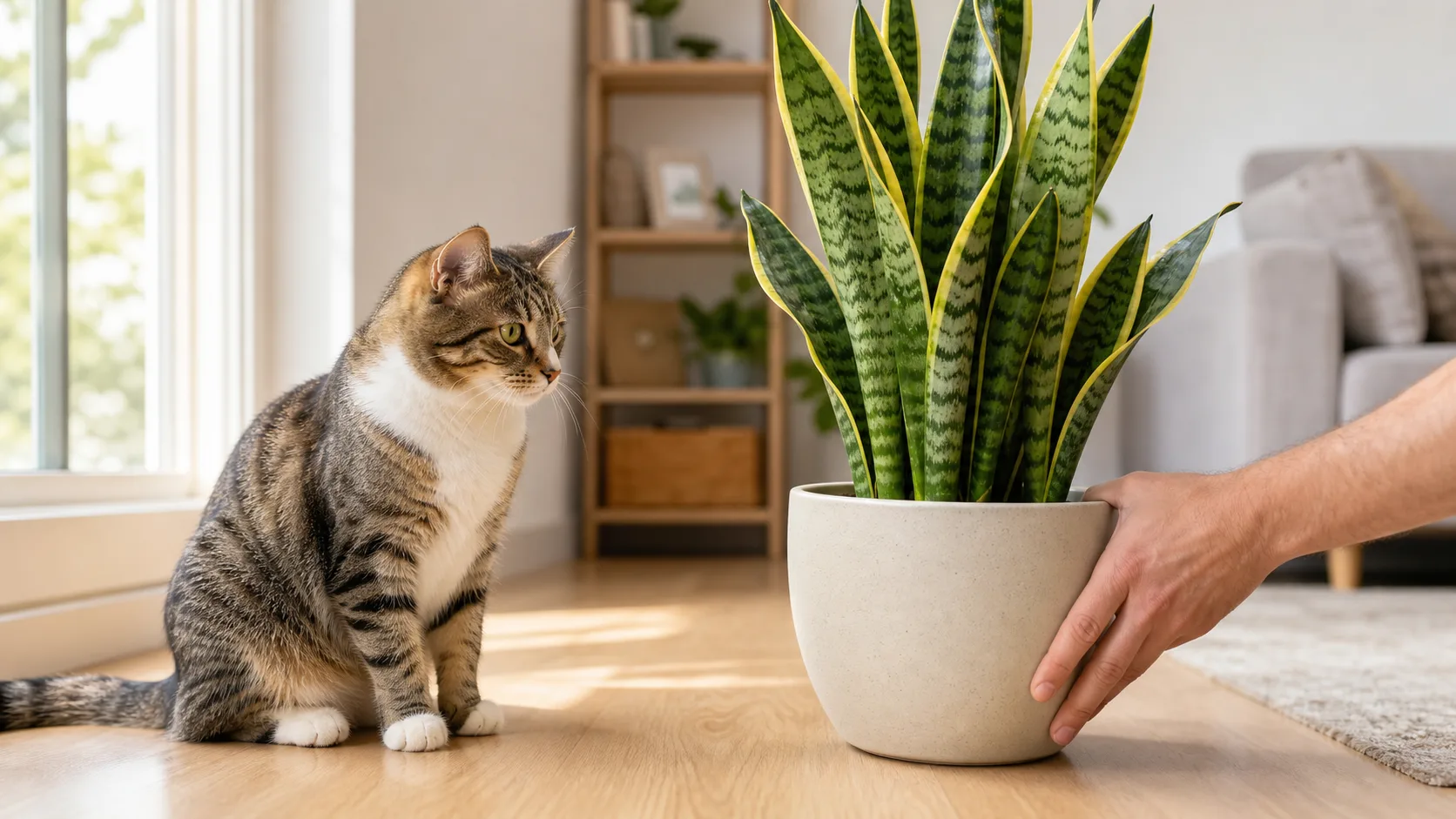
Snake plant is toxic to cats, so remove access first while you confirm what was chewed and how the cat is acting.
Yes, snake plant is toxic to cats.
The ASPCA lists snake plant as toxic to cats and identifies saponins as the toxic principle, with nausea, vomiting, and diarrhea as the main expected signs. Pet Poison Helpline adds that in cats, dilated pupils and a wobbly gait have also been reported after ingestion.
“Snake plant” is listed by ASPCA poison control as toxic to cats because of saponins, with nausea, vomiting, and diarrhea as the key clinical signs. Source: ASPCA.
Pet Poison Helpline notes that after sansevieria ingestion, “clinical signs of dilated pupils and wobbly gait” have been reported specifically in cats. Source: Pet Poison Helpline.
NC State Extension classifies snake plant as a low-severity poison and separately confirms the same saponin mechanism and overlapping symptom list: hypersalivation, vomiting, diarrhea, anorexia, depression, and dilated pupils are all possible after ingestion.
Symptom diagnosis card
Likely mild-to-moderate signs
These are the symptoms most often tied to snake plant saponin exposure:
- drooling
- lip smacking or pawing at the mouth
- vomiting
- diarrhea
- nausea or stomach cramping
- temporary drop in appetite
Red-flag signs: call or go now
These symptoms warrant prompt veterinary contact rather than continued home monitoring:
- repeated vomiting, not just one episode
- marked lethargy or hiding
- dilated pupils
- wobbliness or unsteady walking
- obvious distress that is not resolving
- exposure in a kitten, senior cat, or cat with another health condition
- unknown amount eaten
Cat ate snake plant: what to do right now
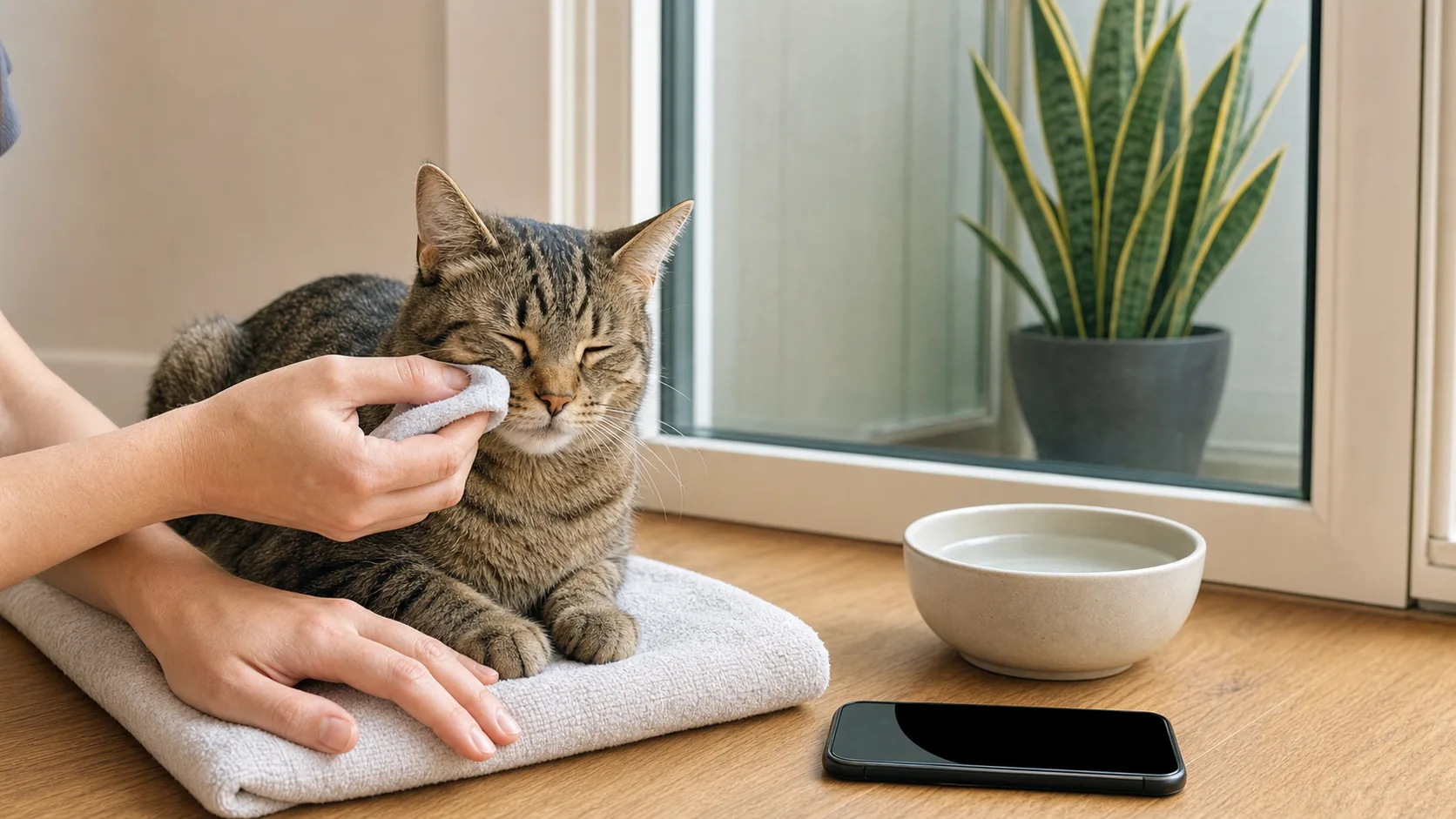
Calm first steps are to isolate the plant, wipe reachable residue, offer water if wanted, and call for case-specific guidance.
Walk through this in order before doing anything else:
- Gently remove any loose plant material from the mouth if you can do so safely.
- Move the plant and any fallen leaf pieces well out of reach.
- Offer fresh water.
- Watch your cat for drooling, vomiting, diarrhea, pupil changes, or unusual behavior over the next hour.
- Call your veterinarian or a pet poison service for guidance specific to your cat’s size, health history, and the estimated amount eaten.
- Do not induce vomiting unless a veterinary professional tells you to.
That last point matters. Trying a home remedy when the better move is getting a real triage answer wastes time and can create a second problem. A poison helpline call takes a few minutes and gives you actual guidance for your specific cat.
Decision tree: monitor, call, or go now

Symptoms and uncertainty determine whether to monitor, call promptly, or leave with the carrier for veterinary care.
Scenario 1: Small nibble, no symptoms
You found a bite mark on a leaf and your cat seems fully normal. Call your vet or a pet poison line for guidance and monitor closely for delayed GI upset over the next several hours. Many cats stay symptom-free after minor nibbling, but you want professional input in case symptoms appear later.
Scenario 2: Clear chewing plus drooling or one episode of vomiting
This is no longer a “maybe.” Contact your vet promptly. Many cases stay limited to mouth irritation and stomach upset, but active symptoms mean your cat has reacted to the plant.
Scenario 3: Repeated vomiting, dilated pupils, wobbliness, heavy drooling, or obvious lethargy
Treat this as urgent. Contact a veterinarian right away. The same applies if a kitten chewed the plant, if your cat has another health issue, or if you cannot estimate how much was eaten.
The name confusion that trips people up
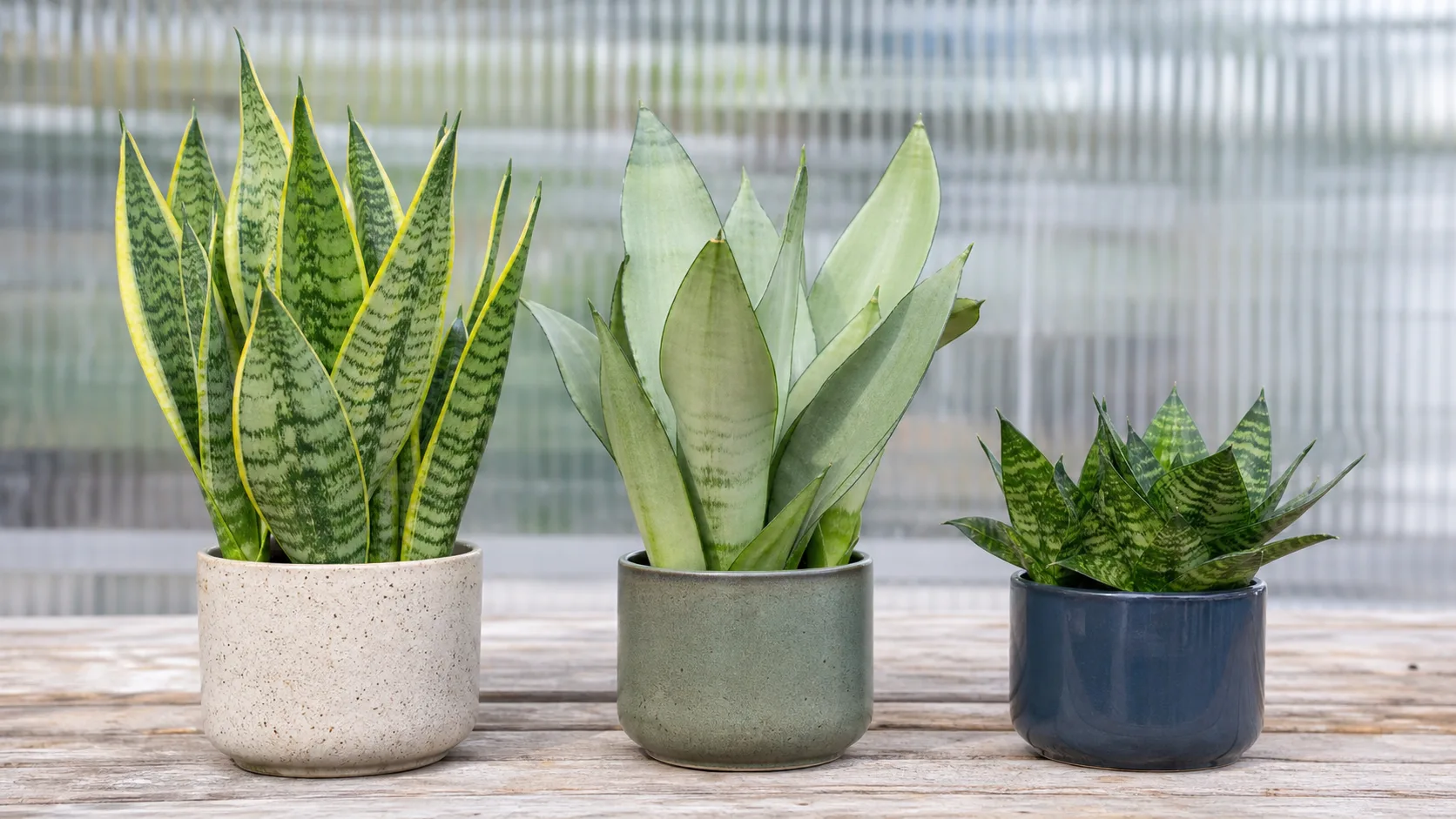
Laurentii, Moonshine, and compact bird’s-nest forms may look different, but the cat-safety advice does not change.
One reason this topic feels confusing is plant labeling. The same plant shows up under multiple names in nurseries, old apps, and different care guides.
If your label says any of the following, treat the pet-safety answer the same way:
| Label you might see | What it means |
|---|---|
| Snake plant | Common name, all forms |
| Mother-in-law’s tongue | Common name, same plant |
| Sansevieria | Former genus name |
| Sansevieria trifasciata | Old scientific name |
| Dracaena trifasciata | Current scientific name |
| Bird’s nest snake plant | Compact rosette form |
Penn State Extension explains the taxonomy shift: snake plant was historically placed in Sansevieria and later reclassified into Dracaena, which is why older labels, apps, and care guides often disagree. All of these names refer to plants with the same saponin toxin profile.
By the numbers
A few grounded figures help explain why this question comes up so often in real homes:
- 95 million U.S. households own a pet, according to the APPA’s 2025 National Pet Owners Survey. Plant safety questions are everyday household decisions, not niche concerns.
- Penn State Extension notes there are more than 70 species of snake plant, which helps explain why owners keep running into different names and forms of the same pet-safety issue.
- Missouri Botanical Garden says indoor snake plants often grow 2 to 4 feet tall, which means leaves can grow into reach zones owners did not anticipate when they first placed the pot.
- NC State notes that snake plant tolerates 2 to 6 hours of direct sun and can go as long as every 1 to 2 months without water in winter, which is exactly why so many people keep one. It is easy, forgiving, and visually striking.
Should you keep a snake plant if you have cats?
This depends less on the plant and more on your specific cat and home layout.
Lower-risk household
You may be able to keep it with confidence if all of these are true:
- your cat ignores houseplants consistently
- the pot lives in a spot your cat genuinely cannot access
- fallen leaf pieces get cleaned up quickly
- the plant is not in a room your cat patrols when bored or restless
Higher-risk household
Strongly consider relocating or replacing it if any of these apply:
- your cat chews leaves for entertainment
- your cat regularly knocks over pots
- the plant is at floor level or on a low shelf
- you have found bite marks more than once
- “out of reach” in your home means shelf-edge access rather than a closed room
If you decide the stress is not worth it, swapping for a non-toxic option is genuinely the easier fix. Our guide to cat-safe indoor plants covers alternatives that give you a similar upright or tropical look without the toxicity question. If you are weighing a common lookalike-safe option, is spider plant toxic to cats? walks through why that answer is different.
What to check before you make any big changes
A lot of cat owners see one torn leaf and immediately throw the plant out that night. Sometimes that is the right call. But it is worth separating two different problems before you act.
If your cat has symptoms, act on the symptoms first. That is a medical question, not a household-arrangement question.
If your cat has no symptoms, act on the pattern of access. That means asking: Does my cat regularly interact with upright strap-leaf plants? Has this happened more than once? Is the placement actually reliable, or does it only hold up when I am home and watching?
Cats that go back to the same plant repeatedly are telling you something about their chewing behavior in general. Snake plant may not be the only future problem. If your cat is a committed leaf-chewer, the most durable fix is reconsidering which plants live in accessible spots throughout the home, not just removing one.
If you want to understand more about snake plant care, growth habits, and what makes it so durable, the snake plant care guide covers the full picture, including why the leaves are so tempting to cats that mouth firm, textured foliage. For the bigger picture on why owners keep choosing this plant despite the tradeoff, see snake plant benefits.
Common mistakes after exposure
These are the ones that turn a stressful moment into a harder one:
- assuming “toxic” always means fatal
- assuming “mild” means there is no reason to call anyone
- waiting through repeated vomiting to “see what happens”
- trying to induce vomiting at home without professional guidance
- focusing on how much the plant was damaged instead of watching the cat’s behavior
- forgetting that sansevieria and Dracaena trifasciata refer to the same plant, so older and newer resources may seem to disagree
Prevention that holds up in real homes
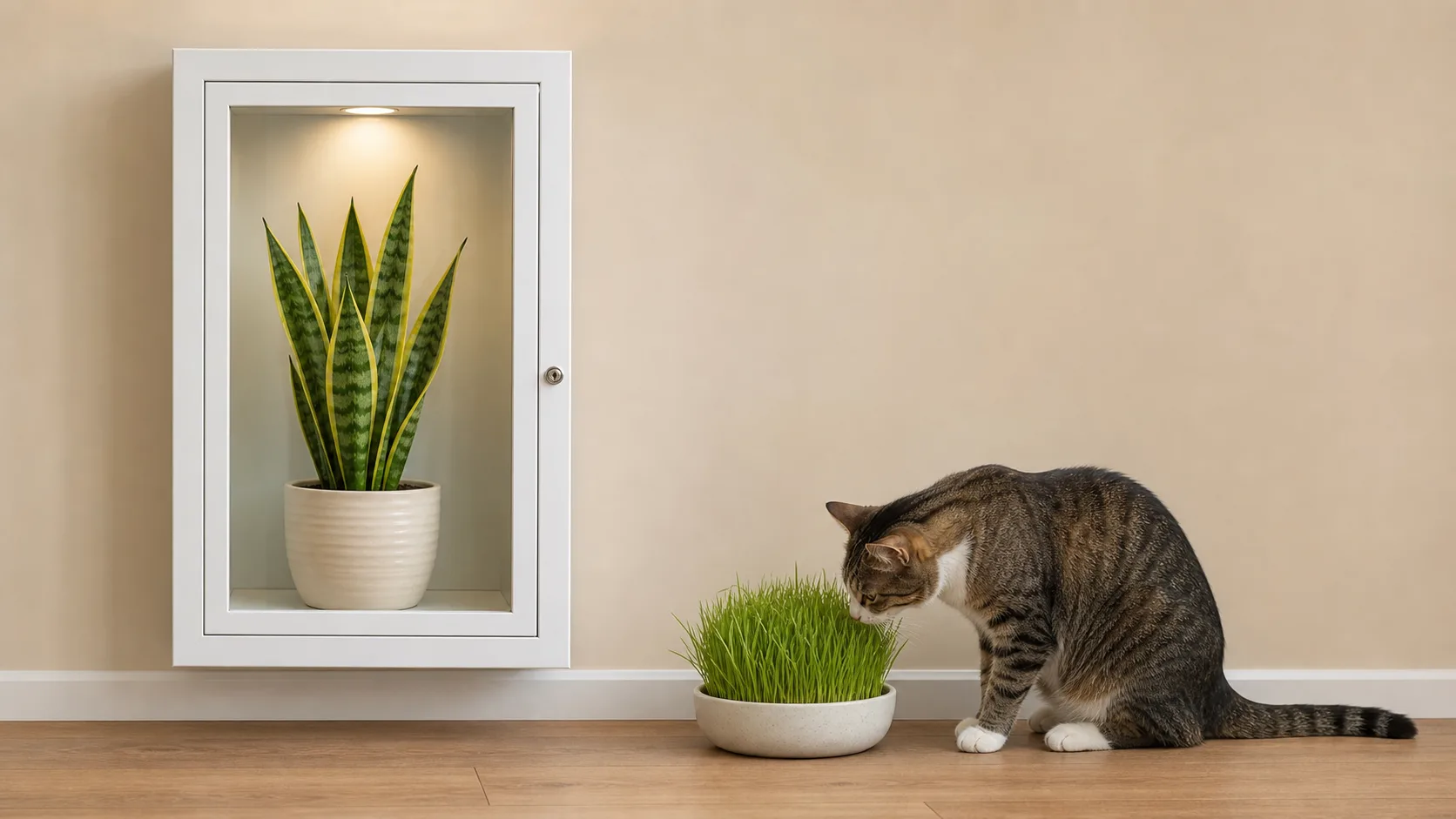
A genuinely closed, locked cabinet is safer than relying on height alone, while cat grass offers an accessible alternative.
If your cat is a chewer, “I’ll keep an eye on it” is not a prevention strategy.
Try these instead:
- Place risky plants behind closed doors or in rooms your cat cannot enter reliably.
- Clean up any snapped leaf pieces right away. A dropped leaf on the floor is the same risk as the plant itself.
- Use heavier pots so the plant is harder to tip and scatter.
- Provide your cat with approved chew options like cat grass or catnip plants. Cats that chew houseplants often do so out of boredom or because they lack appropriate alternatives.
- Rotate enrichment and toys regularly to reduce boredom-driven plant exploration.
- If the plant is on a shelf, make sure fallen leaves cannot drop into a space your cat patrols.
If you want a similar architectural look without the worry, a quick comparison between snake plant and dracaena varieties is worth reading. Some dracaena cultivars carry a similar toxicity classification, which is worth knowing before you swap one for another.
Seasonal note
Indoor plant curiosity tends to spike when cats spend more time inside.
In winter months, during apartment moves, or any time your cat’s routine shrinks and outdoor time drops, boredom turns into plant sampling more often. That is a good moment to reassess placement: check whether leaves have grown into new reach zones since you last moved the pot, whether fallen pieces accumulate in spots you do not check daily, and whether your cat has enough enrichment to redirect that energy somewhere else.
Snake plant grows slowly, but even slow growth over a season can mean leaves that were safely above reach in spring are now at paw level by autumn.
Expert note and source layer
This article is built on veterinary and horticultural extension references, not forum reassurance.
- ASPCA identifies snake plant as toxic to cats via saponins and lists nausea, vomiting, and diarrhea as the key signs.
- Pet Poison Helpline adds cat-specific signs: dilated pupils and wobbliness after ingestion.
- NC State Extension classifies snake plant as a low-severity poison and confirms the full symptom range: hypersalivation, vomiting, diarrhea, anorexia, depression, and dilated pupils.
- Penn State Extension explains the taxonomy shift from Sansevieria to Dracaena and confirms that all snake plant species contain saponin toxins.
- Missouri Botanical Garden documents the plant’s common indoor height range, which helps explain how “out of reach” placements can fail as a plant grows into new zones over time.
The combination matters because it answers the real question more completely: yes, the plant is toxic, but the useful response comes from symptom severity, not from the label alone.
FAQ
Is snake plant toxic to cats if they only lick it?
A quick lick is less concerning than chewing and swallowing, but it does not guarantee no reaction. If your cat only mouthed the plant and seems completely normal, monitor closely and call your vet if anything changes over the next few hours.
Is snake plant as dangerous as lilies for cats?
No. Snake plant is generally discussed as a GI irritant and saponin-exposure problem. Lilies carry a much higher severity classification in cats because of kidney failure risk. That said, do not minimize snake plant exposure if your cat is showing symptoms.
What symptoms show up first after a cat eats snake plant?
Early signs are typically drooling, lip smacking, mouth irritation, nausea, or vomiting. Some cats develop diarrhea. Pet Poison Helpline specifically notes that dilated pupils and wobbliness can also occur in cats.
Should I make my cat throw up after eating snake plant?
No, not unless a veterinary professional specifically tells you to. Attempting home vomiting induction can create a second problem and delay proper care.
How long should I watch my cat after chewing a snake plant?
Monitor closely for several hours if your cat seems normal. Follow the advice of your vet or poison service. If symptoms start, especially repeated vomiting or unusual behavior, escalate right away rather than waiting it out.
Can I keep a snake plant in one room and still have a cat?
Sometimes, but only if the separation is reliable every single day. Closed-door setups can work, but they fail fast if the cat gains access even occasionally or if leaf pieces fall into shared areas. Evaluate your actual home layout honestly rather than the setup you intend to have.
My cat chewed a snake plant two weeks ago with no problems. Is it safe now?
Past symptom-free exposure does not mean future exposures will be the same. The amount eaten, the cat’s health at the time, and individual sensitivity all vary. Continued access is still a risk worth addressing.
Bottom line
So, is snake plant toxic to cats? Yes. But the next question is the one that actually drives your decision: how is your cat acting right now?
If there are symptoms, call promptly. If there are no symptoms, monitor carefully and get case-specific advice from a vet or poison line. And if your cat keeps going back to that plant, the most useful thing you can do is change the setup, not just watch more carefully.