
If your cat just chewed a philodendron leaf, you probably do not need a vague warning. You need to know whether this is a watch-closely moment, a call-the-vet moment, or a drop-everything-and-go moment.
The short answer is yes, philodendron is toxic to cats. But the usual problem is not the kind of poisoning people imagine when they hear the word toxic. In most cases, philodendron causes immediate burning and irritation in the mouth and throat because the plant contains insoluble calcium oxalate crystals. That difference matters, because it changes what you should check first.
The first practical question is not, “Will this damage organs later?” It is, “Is my cat dealing with mouth irritation only, or are symptoms moving into repeated vomiting, trouble swallowing, or breathing changes?”
That is the line this guide is built around.
Quick answer: yes, philodendron is toxic to cats

A closed physical barrier prevents repeat exposure while you assess what the cat chewed and how symptoms are changing.
According to the ASPCA, heartleaf philodendron is toxic to cats and can cause oral irritation, intense burning of the mouth, tongue and lips, excessive drooling, vomiting, and difficulty swallowing. Iowa State University Extension describes the same basic pattern and ties it to calcium oxalate crystals in the plant tissue.
So if you are searching is philodendron toxic to cats, the answer is clearly yes. That includes common indoor forms sold under names like heartleaf philodendron, sweetheart plant, cordatum, and many plants labeled simply as philodendron.
What most care guides miss
A lot of articles flatten this into one generic warning, and that is where readers get stuck.
The common misdiagnosis is treating every philodendron exposure like a mysterious delayed poisoning, then either panicking or dismissing the advice because it sounds too dramatic. Philodendron usually causes a sharp contact-style irritation reaction right away. That means the smartest first check is not waiting around for tomorrow’s symptoms. It is looking at the pattern in front of you now.
First check: Is your cat mainly drooling, pawing at the mouth, and acting uncomfortable right after chewing? Or are you seeing repeated vomiting, obvious swelling, hard swallowing, or any breathing change?
Generic advice is incomplete because it often says only “monitor closely” without telling you what would make this more urgent. For most cat owners, that missing decision rule is the whole problem.
Symptom diagnosis card
If your cat ate philodendron or chewed even a small piece, these are the first symptoms to watch for:
- sudden drooling
- pawing at the mouth
- lip licking
- repeated swallowing
- refusing food right after chewing
- vocalizing or pulling away when the mouth is touched
- mild vomiting
- swelling of the lips or tongue
That symptom cluster fits the expected calcium oxalate irritation pattern.
Red-flag symptoms
Call your vet promptly, or seek urgent care, if you notice:
- repeated vomiting
- difficulty swallowing water
- marked swelling of the lips, tongue, or mouth
- open-mouth breathing
- noisy breathing
- severe lethargy
- inability to keep water down
Here is the simplest way to think about it: mouth pain alone can fit the usual pattern; breathing trouble does not belong in the wait-and-see category.
Which philodendrons are a problem?
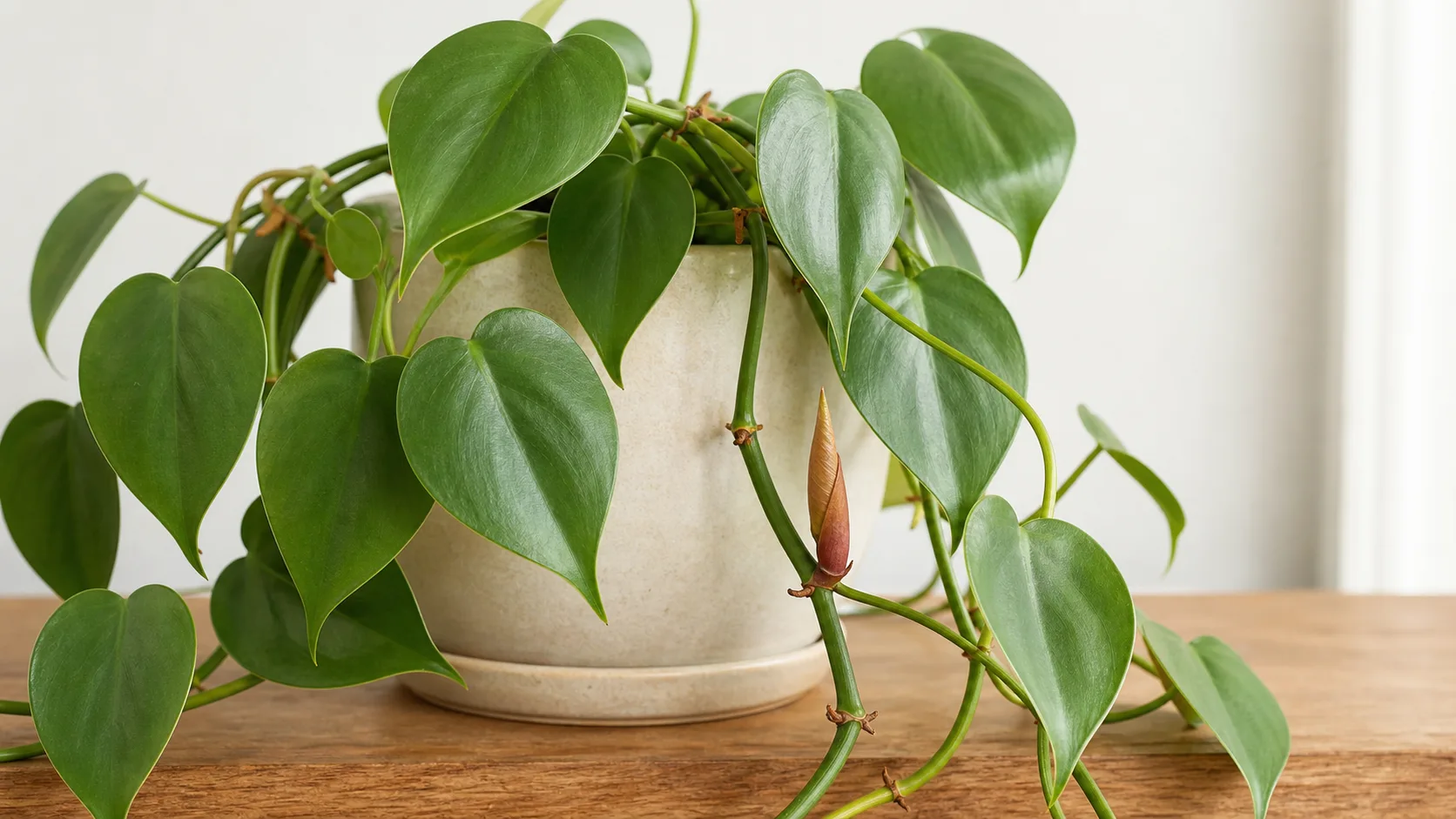
Smooth heart-shaped leaves, round vines, nodes, aerial-root nubs, and papery cataphylls identify heartleaf philodendron.
This is where online advice often gets fuzzy, because “philodendron” is not one single tidy houseplant label.
NC State notes that Philodendron is a large genus with more than 600 species. On top of that, garden-center tags are often casual, incomplete, or inconsistent. That is why readers end up comparing one article about heartleaf philodendron with another article about split-leaf philodendron and wondering whether the rule changed.
For cat safety, the safest assumption is simple: if it is being sold as a philodendron, treat it as unsafe unless you have reliable identification that proves otherwise.
Name-matching snapshot
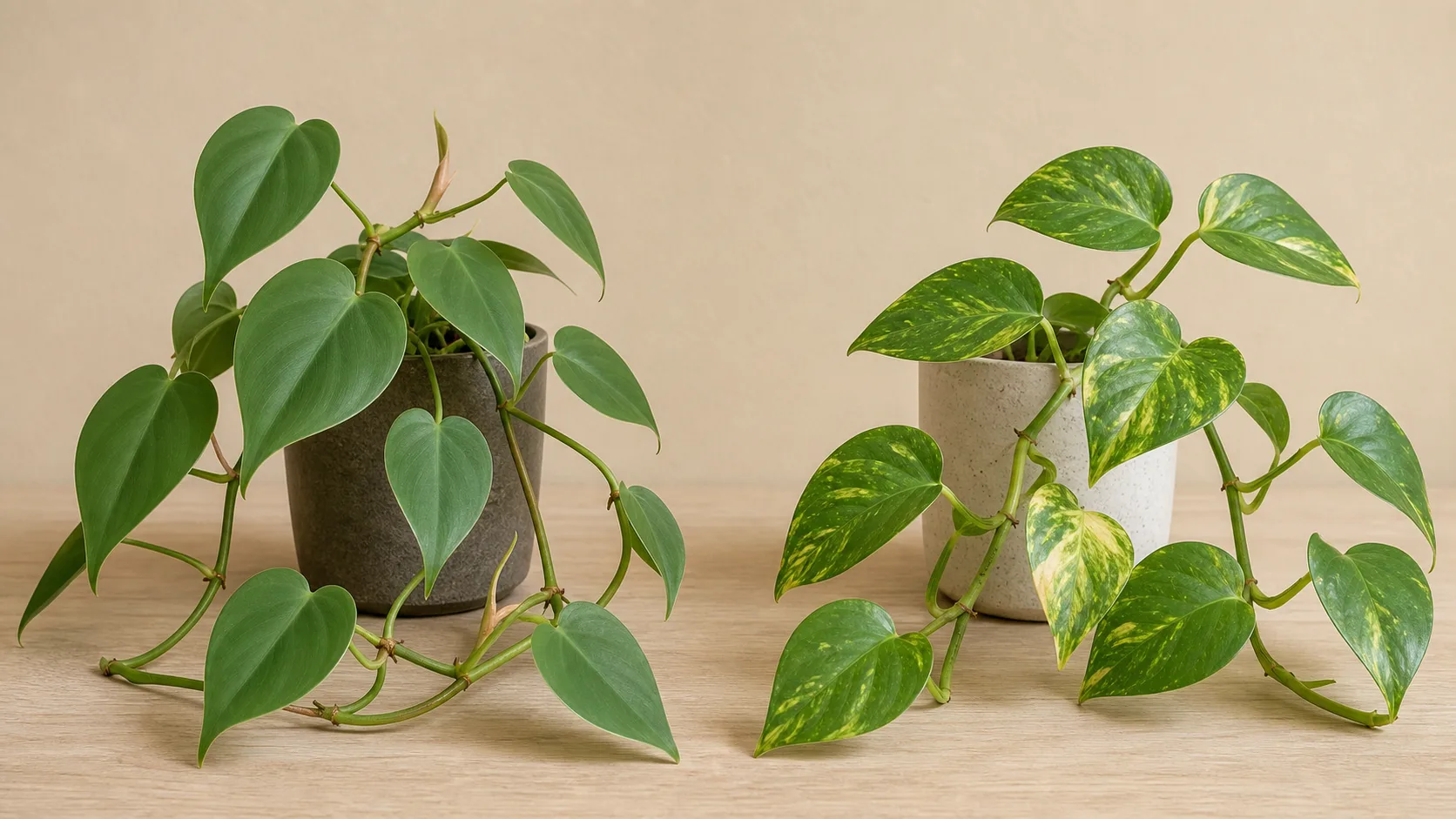
Heartleaf philodendron is symmetrical and cataphyll-bearing; golden pothos is more asymmetrical and often yellow-marbled, though both are unsafe for cats.
| Label you may see | What it often refers to | Cat safety takeaway |
|---|---|---|
| Heartleaf philodendron | Philodendron hederaceum | Toxic to cats |
| Sweetheart plant | Often heartleaf philodendron | Toxic to cats |
| Cordatum | Often used loosely for heartleaf philodendron | Treat as toxic |
| Split-leaf philodendron | A separate toxic philodendron listing in ASPCA references | Treat as toxic |
| Plain “philodendron” | Any of many climbing or upright types | Treat as toxic |
If your plant tag is vague, do not use that vagueness as reassurance. If anything, it is a reason to be more cautious.
For lookalike confusion, our pothos vs philodendron guide can help you separate two plants people mix up constantly.
What to do right away if your cat chewed philodendron
When you are stressed, it helps to have the steps in order.
1. Remove the plant and any fallen pieces
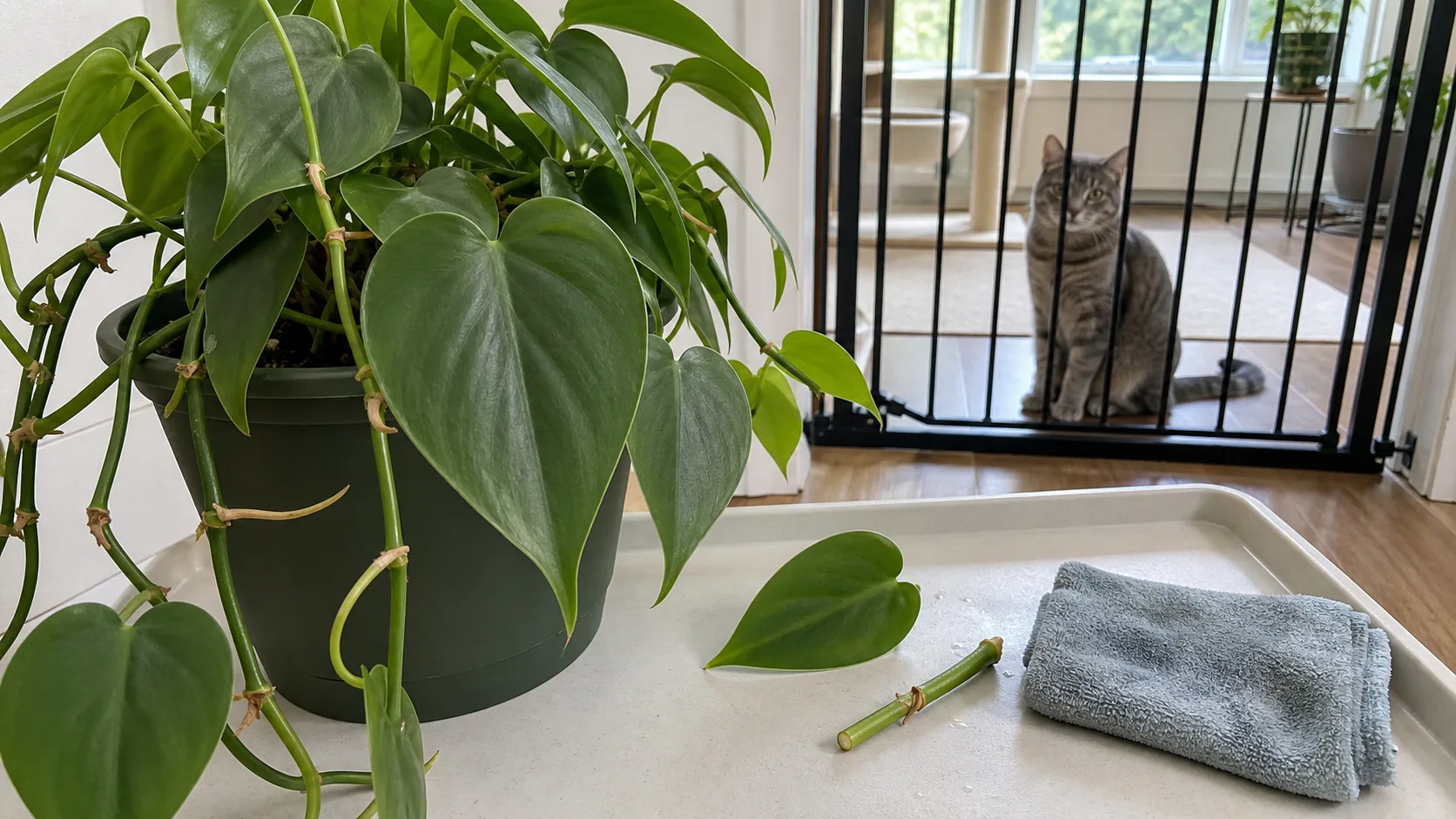
Isolate broken leaves and vines, then remove sap residue before a cat can contact or lick it again.
Pick up chewed leaves, dropped vines, and stem bits from the floor. A fallen leaf still counts as exposure.
2. Check the mouth-irritation pattern first
Look for drooling, pawing at the mouth, lip licking, and repeated swallowing. Those fit the expected pattern.
Then look for escalation: repeated vomiting, worsening swelling, trouble swallowing, or breathing changes.
3. Offer plain water
A few laps of water may help rinse the mouth a little. Do not force food, milk, oil, butter, or home remedies.
4. Call your vet or pet poison support
Even if symptoms seem mild, a quick call is reasonable because throat swelling and pain can be harder to judge at home than people expect.
5. Keep the plant label or take a photo
If you need to call, clear plant identification helps. If the tag only says philodendron, tell the clinic that too. It is still useful.
Decision tree: monitor, call, or go now?
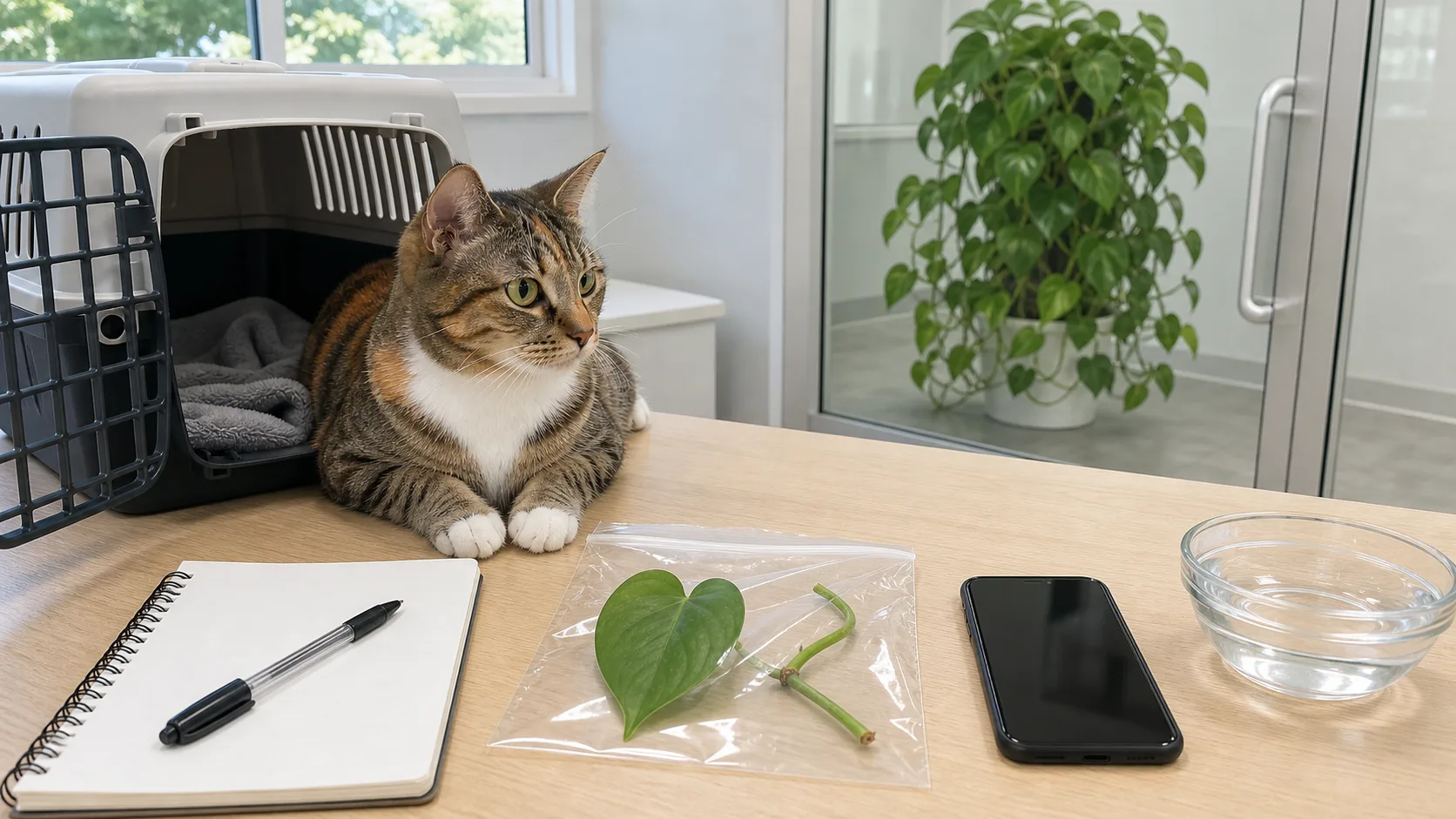
Save a sample, record timing and symptoms, and keep the carrier ready if mouth or throat irritation escalates.
This is the practical triage that many articles skip.
If your cat only took a small nibble
If you saw a tiny bite and your cat has mild drooling but normal breathing, call your vet for guidance and monitor closely.
If your cat swallowed plant material
Be more cautious. Swallowing a chunk or torn piece makes painful swallowing and vomiting more likely. Contact your vet sooner rather than later.
If your cat is drooling and vomiting more than once
That is no longer a casual monitor-at-home situation. Call promptly.
If your cat cannot swallow comfortably
If water seems hard to get down, or your cat keeps trying to swallow and looks distressed, contact a vet right away.
If your cat has swelling or breathing changes
Go urgently.
A good decision rule to hold onto: the farther symptoms move from the mouth into swallowing, hydration, and breathing, the less appropriate home monitoring becomes.
Why severity advice online feels so inconsistent
You will see everything from “minor irritation” to full panic. That mismatch is exactly why so many owners feel paralyzed after one chewed leaf.
The missing context is that severity depends on:
- how much was chewed
- whether plant tissue was swallowed
- how much swelling develops
- whether symptoms stay localized to the mouth
- your cat’s size, age, and overall health
So yes, some cats recover after a small nibble with supportive care and monitoring. But that is not the same thing as calling philodendron harmless. It means the typical injury pattern is often immediate irritation, not silent internal poisoning.
That distinction is calming in the useful way, not the false-reassurance way.
Expert note: what the trusted sources actually say
ASPCA lists heartleaf philodendron as toxic to cats and describes the classic signs as oral irritation, intense burning of the mouth, tongue and lips, excessive drooling, vomiting, and difficulty swallowing.
Iowa State University Extension explains the cause clearly: the plant contains calcium oxalate crystals that trigger pain and swelling in the lips, mouth, tongue, and throat.
UF/IFAS also notes that all parts of philodendrons are poisonous to pets and can cause intense burning and irritation.
These sources are more helpful than generic roundup blogs because they give you both pieces you need at once:
- what is causing the reaction
- what the reaction usually looks like
Keep, move, or rehome? A realistic household checklist
A lot of readers are not only asking whether philodendron is toxic. They are trying to decide whether it can stay in the house.
That answer depends less on your intentions and more on your cat’s actual behavior.
Lower-risk setups
- a truly closed room your cat cannot access
- a plant cabinet that stays shut
- an office with a solid door
- a room your cat never enters, consistently and not just usually
Higher-risk setups
- floor pots
- coffee tables and side tables
- low shelves
- hanging baskets with trailing vines
- tall shelves that connect to a jump path
- freshly pruned vines left on a counter for “just a minute”
The honesty test
If your cat already chews bouquet greens, spider plant leaves, ribbon-like foliage, or anything dangling, I would not rely on “she normally ignores plants.” Cats change their minds at the worst possible time.
If that sounds like your home, the practical choices are usually:
- move the plant to a truly cat-free space
- rehome it
- switch to a safer look and care style
For safer swaps, start with our cat-safe plants indoor guide. If you want an easy, forgiving plant with a softer look, our spider plant care guide can help you decide whether that fits your space and routine.
The one practical check most owners skip
Here is a small but useful real-world check that generic advice often misses: trace your cat’s route, not just the plant’s location.
Owners look at a philodendron on a high shelf and think it is safe because the plant itself is high. Cats do not evaluate risk that way. They use routes.
Look for:
- a chair beside the shelf
- a radiator cover below it
- curtain access
- a nearby bookcase that turns the shelf into a landing spot
- trailing vines that hang lower than the pot
If your cat can reach the route, your cat can reach the plant.
That one check is often more useful than buying another hook or moving the pot six inches to the left.
Common mistakes cat owners make
Mistake 1: asking only whether it is deadly
That question makes sense emotionally, but it is not the most useful first filter. The better first question is whether your cat can reach the plant again today.
Mistake 2: trusting a vague nursery label
A pot labeled only “philodendron” is not enough detail to make a safety call. Treat unknown philodendrons as unsafe.
Mistake 3: assuming a hanging basket solves the problem
For a climbing or curious cat, a dangling vine is not protection. It is a toy with bonus leaves.
Mistake 4: waiting for symptoms to become dramatic
Early symptoms can look messy, not dramatic. Drooling, lip licking, and repeated swallowing are still real symptoms.
Mistake 5: focusing on the plant more than the cat
Some cats investigate once and never again. Others chew every trailing leaf in reach. Your cat’s pattern matters just as much as the plant species.
Seasonal note: when the risk quietly goes up
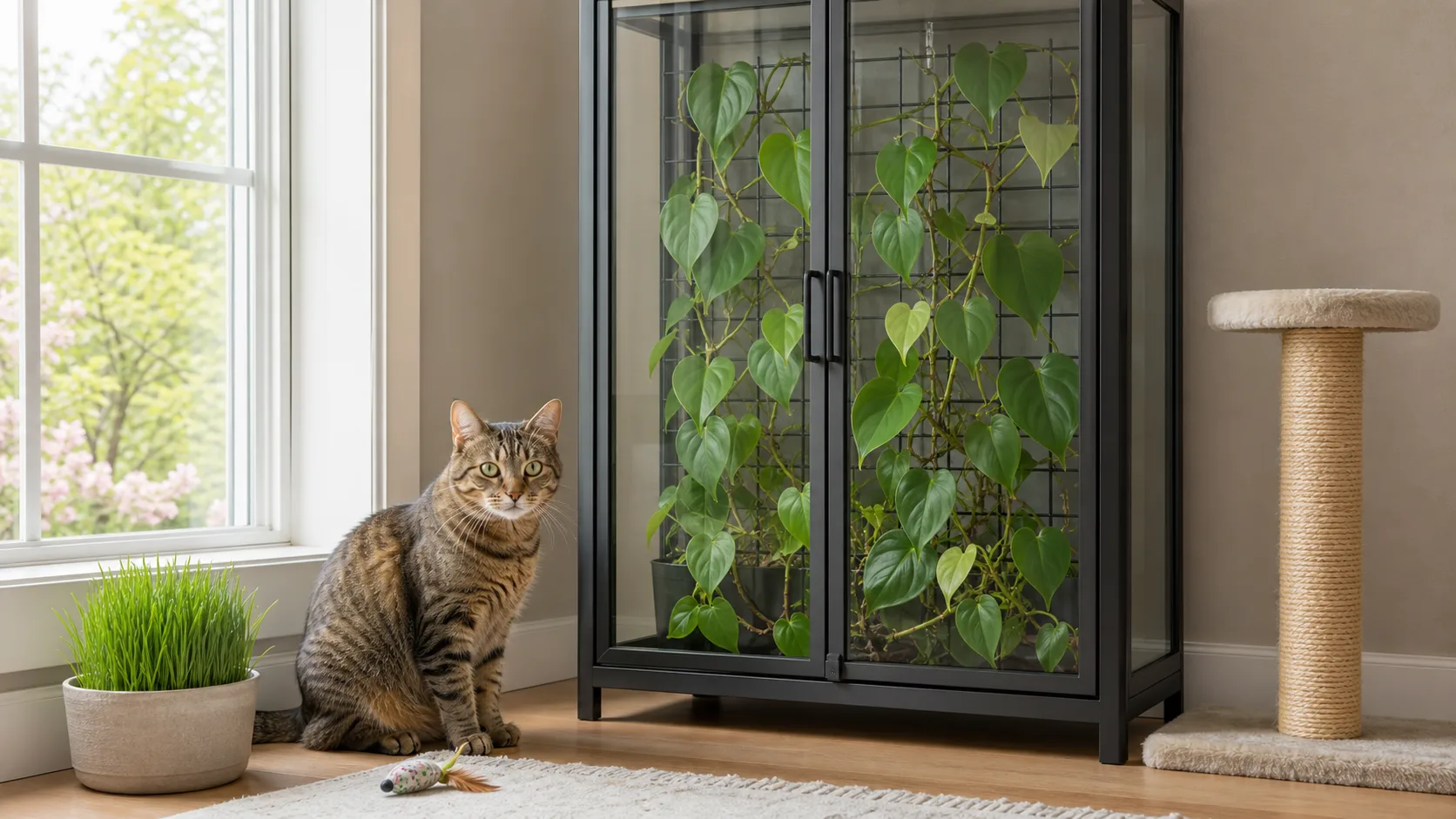
Fresh seasonal vines can change an old reach calculation, so keep all growth contained behind a closed barrier.
Philodendron does not become more toxic in one season than another, but exposure risk often rises in spring and summer.
Why? Because that is when many philodendrons push fresh growth, send vines farther, and get pruned more often. New leaves hang lower. Cuttings sit out on counters. Windows open, furniture shifts, and cats explore new routes.
A good seasonal habit is to do a quick reach-check every few weeks during active growth. Sit where your cat sits. Look up from that angle. You will notice hanging tips and jump paths much faster than when you are standing like a human doing a room scan.
Safer alternatives if you love the look of philodendron
If what you love is the relaxed, leafy, trailing look, you do not have to give up on having greenery at home. You just may need to stop chasing the exact philodendron shape.
Look for cat-friendlier plants that match the feel you want instead of trying to outsmart a risky setup.
A few owners also confuse philodendron with pothos and assume one must be safer than the other because the leaves look a little different. Do not lean on appearance alone. Use proper plant ID first with our pothos vs philodendron guide, then make the safety decision.
FAQ
How toxic is philodendron to cats?
Philodendron is clearly toxic to cats, but the usual reaction is immediate mouth and throat irritation from insoluble calcium oxalate crystals rather than a delayed organ-damage pattern. That still matters because swelling, drooling, vomiting, and painful swallowing can become serious.
What happens if my cat eats a philodendron leaf?
The most common pattern is sudden drooling, pawing at the mouth, lip licking, repeated swallowing, and mouth pain. Some cats also vomit. If swallowing becomes difficult, vomiting repeats, or breathing changes, contact a vet right away.
Is heartleaf philodendron toxic to cats too?
Yes. ASPCA specifically lists heartleaf philodendron as toxic to cats. If your plant is labeled heartleaf philodendron, sweetheart plant, or cordatum, treat it as unsafe.
Are all philodendrons toxic to cats?
For practical home safety, assume yes unless you have a highly reliable identification source telling you otherwise. The genus is large, naming is messy, and casual plant tags are not a safe basis for risk decisions.
Should I make my cat throw up after eating philodendron?
No. Do not try home vomiting remedies unless a veterinarian specifically instructs you to do that. Safer first steps are removing access, offering water, monitoring symptoms, and calling your vet.
Can my cat recover after chewing philodendron?
Many cats do recover, especially after smaller exposures, but recovery depends on how much was chewed, whether swelling develops, and how quickly you respond if symptoms escalate.
Can I keep philodendron if my cat usually ignores plants?
Maybe, but only if the plant is in a truly cat-free area. “Usually ignores plants” is not a strong safety system. If your cat has access and the plant is reachable, the risk is still real.
Methodology and source layer
This article was built from current search intent and primary toxicity references reviewed on 2026-07-19, including ASPCA, Iowa State University Extension, UF/IFAS Extension, and NC State Extension. Community search snippets were used only to understand owner confusion, especially around plant naming and how serious a single chewed leaf might be. They were not used as proof of safety outcomes.
The bottom line
So, is philodendron toxic to cats? Yes.
The most useful thing to remember is that philodendron usually causes immediate irritation from calcium oxalate crystals, which means your first job is to read the symptom pattern well. Mild mouth irritation is one kind of situation. Repeated vomiting, trouble swallowing, and breathing changes are a different kind entirely.
Remove the plant, offer water, watch closely, and call your vet when symptoms move beyond mild exposure. And if your cat is a known leaf-chewer, the safest long-term fix is usually not better luck. It is better placement, or a safer plant altogether.