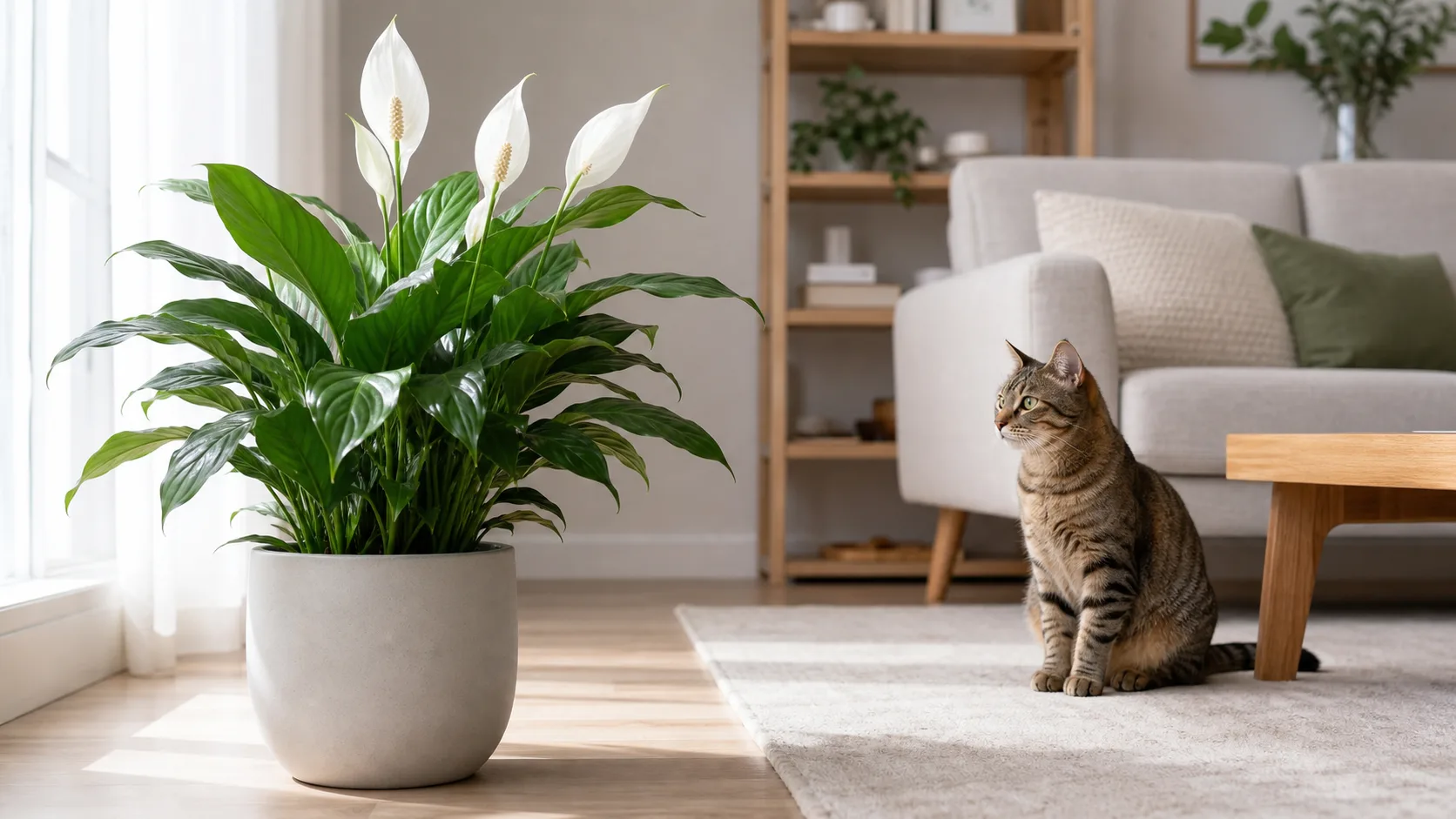
If your cat has been near a peace lily and you are now searching “is peace lily toxic to cats” at midnight, here is what you need first: peace lily is not in the same category as the lilies that cause fatal kidney failure in cats. That distinction matters enormously, and most of the content you will find online does not explain it clearly enough to actually help you decide what to do right now.
The short answer is yes, peace lily is listed as toxic to cats by ASPCA Poison Control. But “toxic” covers a wide spectrum, and where peace lily falls on that spectrum is very different from where Easter lily or tiger lily sits. Getting those two things confused leads to unnecessary panic in one direction, or occasionally, to dismissing a real concern in the other.
Emergency Action Box: The First 10 Minutes
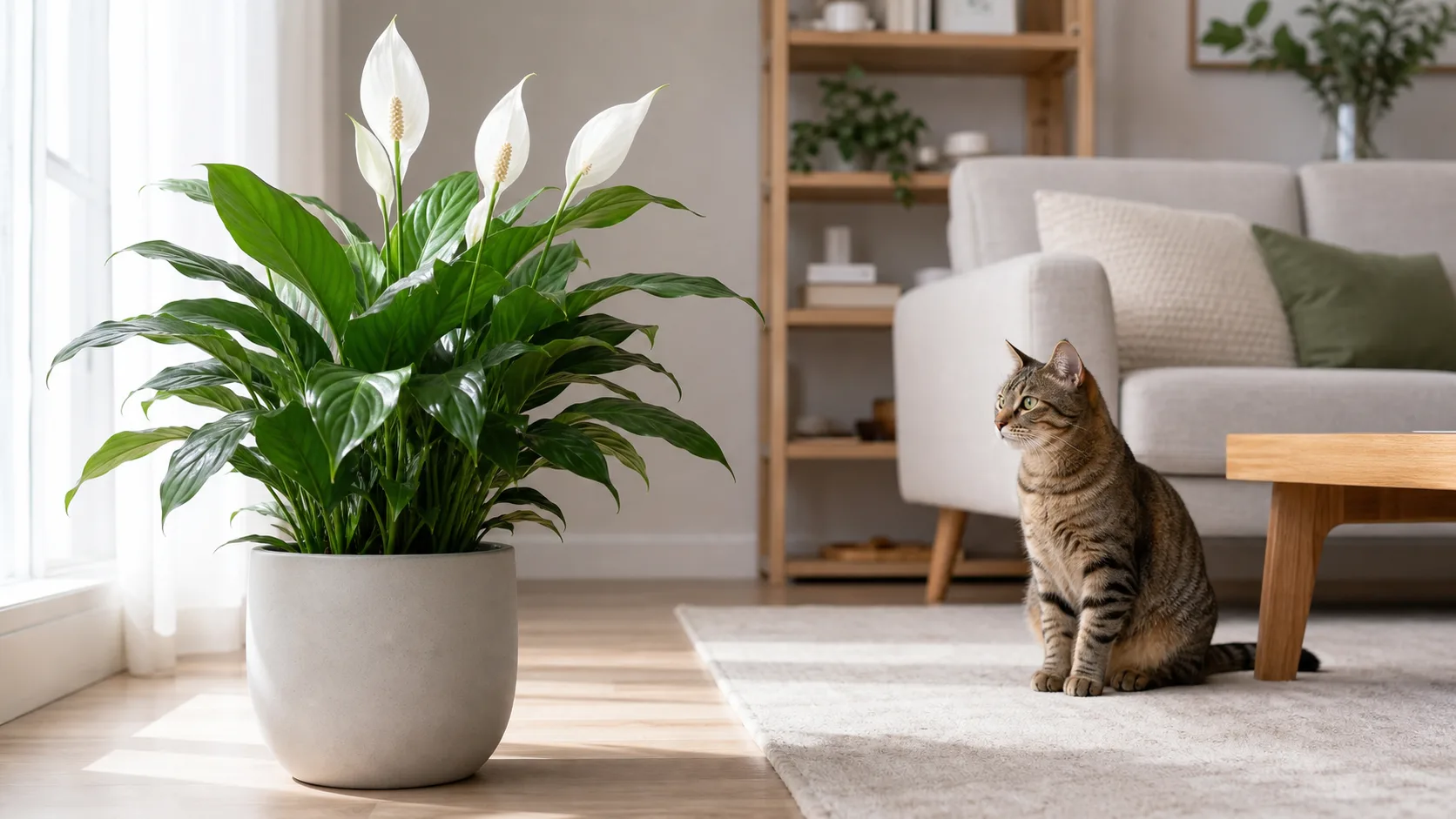
Separate cat and plant first while you confirm whether the plant is a peace lily, a true lily, or something else.
Use this triage sequence before reading the rest of the guide:
- Remove access and save evidence. Move the plant away, photograph it, and keep a leaf or label for identification.
- Confirm the plant. A verified Spathiphyllum peace lily usually causes immediate mouth irritation. A true Lilium lily, a daylily, or an unidentified lily-like plant is an emergency: call a veterinarian or animal poison control now, even if your cat appears normal.
- Do not induce vomiting. If your cat will tolerate it without stress or aspiration risk, gently offer water or wet food; do not force liquid into the mouth.
- Record the exposure. Note the time, the amount possibly chewed, and whether drooling, mouth pawing, vomiting, swallowing trouble, or lethargy appears.
- Escalate when the pattern does not stay mild. Repeated vomiting, difficulty swallowing or breathing, marked lethargy, an uncertain plant identity, or a medically vulnerable cat warrants immediate professional advice.
Expert-source note: This triage framework is an editorial synthesis of the ASPCA Animal Poison Control plant listings, North Carolina State University Extension’s Spathiphyllum entry, and veterinary guidance cited below. It is not a diagnosis or a substitute for advice from a veterinarian who can assess your cat.
What Most Lily-Safety Guides Miss
Most articles answer the yes-or-no toxicity question, maybe list a few symptoms, and stop there. That is the gap this article is here to close.
The common misdiagnosis: treating all plants with “lily” in the common name as a single risk level. They are not. The botanical difference is significant enough to change every downstream decision you make about your home, your cat, and whether you call a vet tonight or just watch for symptoms.
The word “lily” appears in the common names of plants from at least four different botanical families. Those plants have different toxic mechanisms, different target organs, and different urgency levels when a cat encounters them. Peace lily, true lily, daylily, calla lily, lily of the valley. Same word. Completely different chemistry.
The practical first check before doing anything else: confirm the scientific name of the plant in your home. A peace lily is a Spathiphyllum. A true lily is a Lilium. That one word changes the entire conversation.
The Name Is the Problem
Peace lily is not a true lily. That sounds like a botanical footnote, but it has direct consequences for how serious the risk is.
True lilies belong to the genus Lilium. Easter lilies, tiger lilies, Asiatic lilies, and stargazer lilies are all true lilies. Daylilies belong to the related genus Hemerocallis. Both groups are the plants associated with acute kidney failure in cats, sometimes from a very small exposure, including contact with pollen or water from a vase of cut flowers. ASPCA Poison Control lists Easter lily (Lilium longiflorum) as toxic to cats with potential for vomiting, lethargy, kidney failure, and death.
Peace lily is a Spathiphyllum, which belongs to the arum family, Araceae, the same broad plant group as pothos and philodendron. It shares the word “lily” in its common name because of its white hood-shaped flower, not because of any botanical relationship to Lilium. The toxic mechanism is completely different.
Peace Lily vs. True Lily: The Differences That Matter
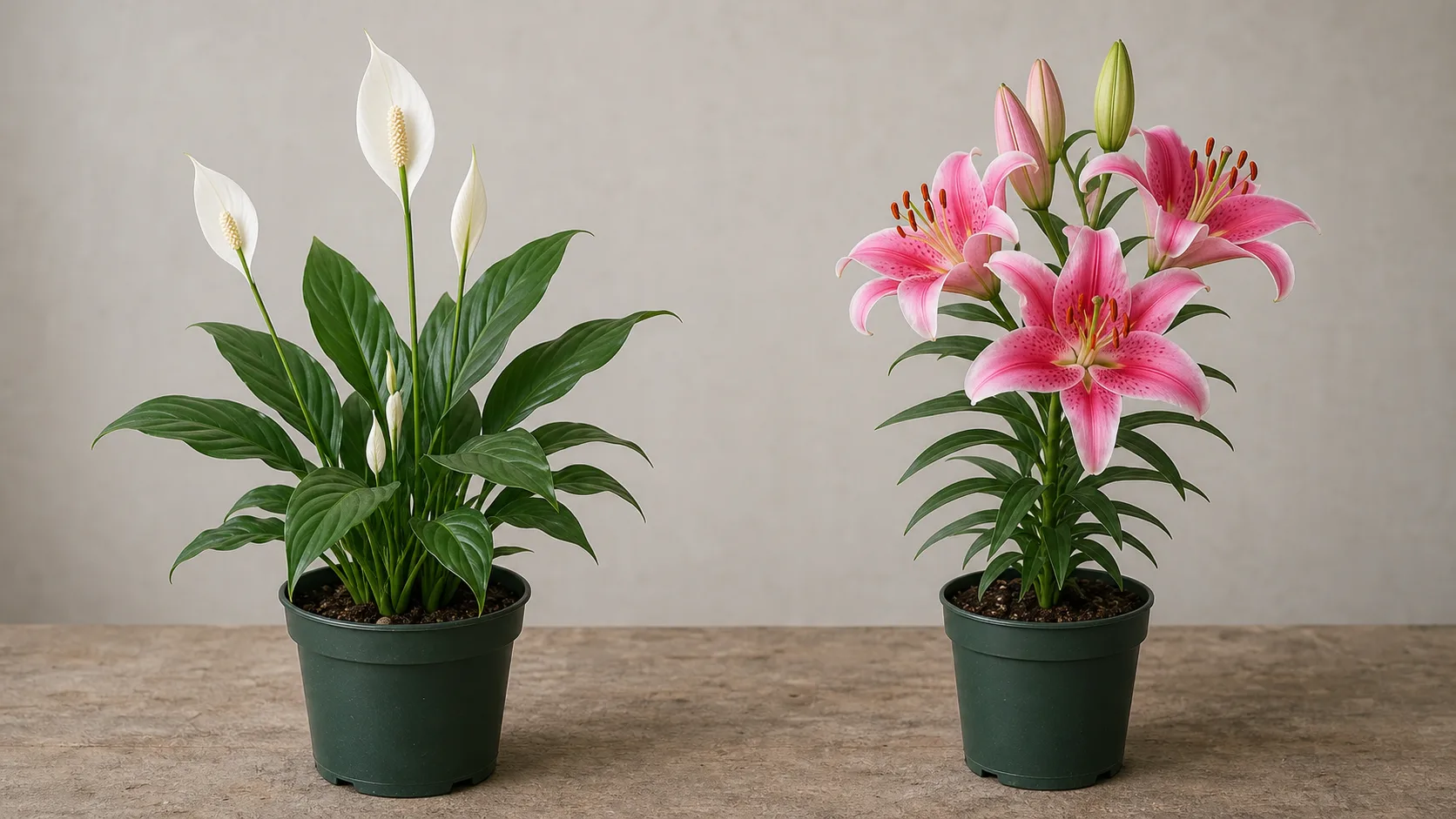
Peace lily has glossy basal leaves and a white spathe; a true lily has a six-part flower and a very different cat-safety risk profile.
Before you do anything else, find your plant in this table:
| Peace Lily | True Lily (Easter, Tiger, Asiatic) | Daylily | |
|---|---|---|---|
| Scientific group | Spathiphyllum (Araceae) | Lilium (Liliaceae) | Hemerocallis (Asphodelaceae) |
| Toxic principle | Insoluble calcium oxalate crystals | Unknown nephrotoxic compound | Unknown nephrotoxic compound |
| Primary target | Mouth, throat, GI irritation | Kidney tubules | Kidney tubules |
| Typical signs in cats | Drooling, mouth pawing, vomiting | Vomiting, lethargy, kidney failure | Vomiting, lethargy, kidney failure |
| Onset | Immediate, within minutes of chewing | Delayed by hours, then acute | Delayed by hours, then acute |
| Urgency level | Monitor closely; call vet if unsure | Emergency: call vet immediately | Emergency: call vet immediately |
Sources: ASPCA Poison Control toxic plant listings; PetMD lily poisoning in cats veterinary explainer.
Calla lily also causes confusion because of its name. ASPCA Poison Control lists calla lily (Zantedeschia) as toxic to cats through the same calcium oxalate mechanism as peace lily, producing similar oral irritation rather than kidney failure. Worth knowing if you have multiple plants and need to sort out risk levels across all of them.
What Peace Lily Actually Contains
The reason peace lily is still considered toxic to cats comes down to insoluble calcium oxalate crystals. These are microscopic needle-shaped structures present throughout the plant in the leaves, stems, and flowers. When a cat chews any part of a peace lily, those crystals embed in the soft tissue of the mouth, tongue, and throat.
ASPCA Poison Control identifies these as the core clinical signs from peace lily exposure: oral irritation, burning sensation of the mouth, tongue, and lips, excessive drooling, vomiting, and difficulty swallowing. North Carolina State University Extension also identifies peace lily as a medium-severity poison plant, with calcium oxalate crystals as the toxic principle and the leaves as the primary problem part.
Think of it this way: the plant defends itself at the point of contact. The crystals cause immediate local irritation rather than a slow-building systemic toxin working its way to the kidneys. As PetMD’s veterinary explainer on lily poisoning in cats makes clear, peace lily and calla lily do not cause the kidney-failure pattern seen with Lilium and Hemerocallis species. A cat that nibbles a true lily petal needs emergency intervention even if it seems fine an hour later. A cat that chews a peace lily leaf is dealing with mouth pain and a strong instinct to stop chewing.
What Happens If a Cat Chews a Peace Lily
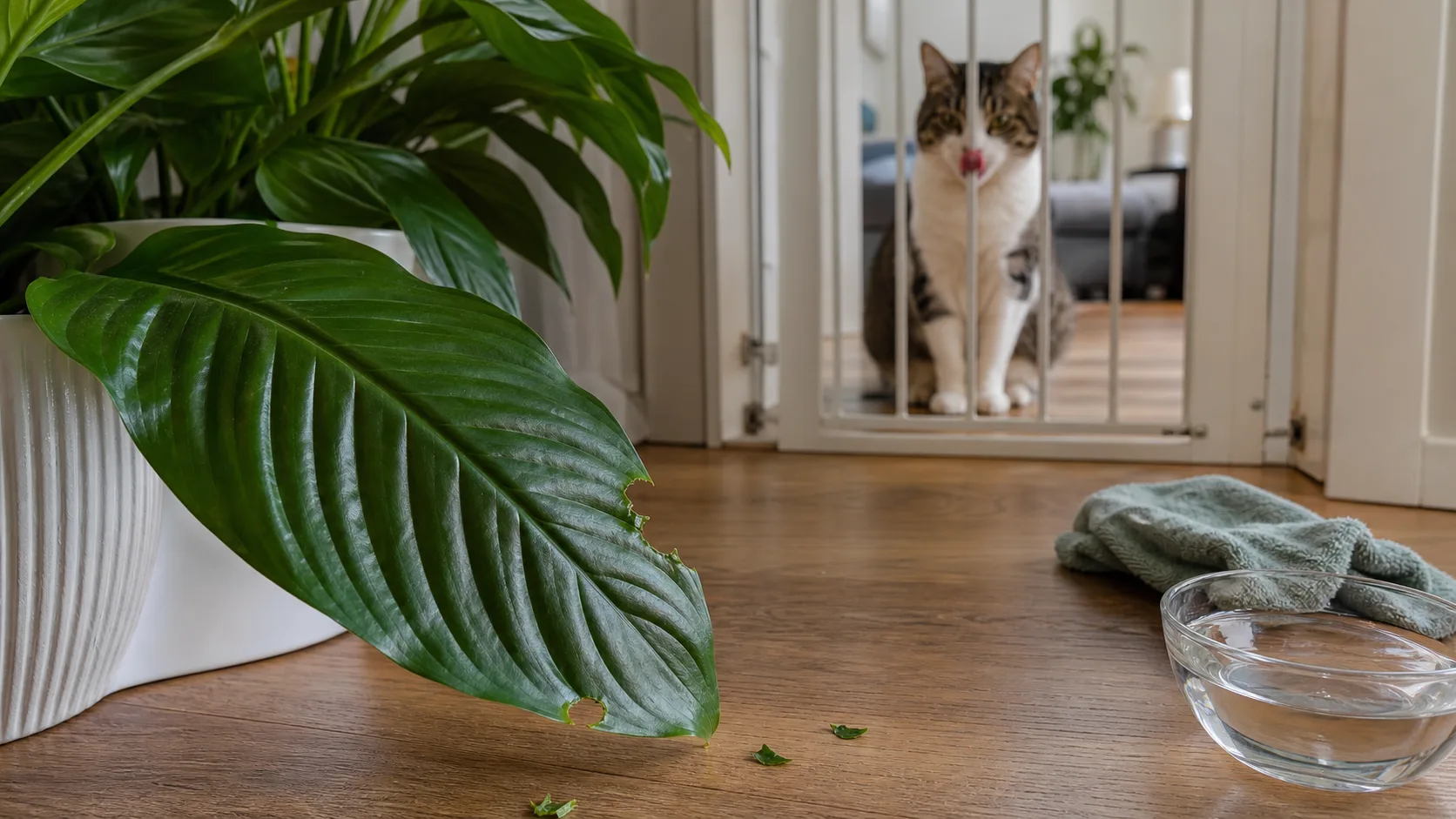
Fresh edge damage and leaf fragments are stronger evidence of a chew than proximity to the plant alone.
The signs of peace lily exposure tend to come on within minutes and affect the mouth first:
- Heavy drooling, sometimes more than you have seen before
- Pawing at the face or mouth repeatedly
- Reluctance to eat or drink, or recoiling from the water bowl
- Vomiting, which can happen quickly after exposure
- Visible irritation or swelling around the lips
Most cats stop chewing almost immediately because the sensation is intensely unpleasant. That natural aversion works in their favor. The calcium oxalate irritation is self-limiting in the sense that the plant actively discourages continued ingestion.
In most cases, a cat that chews a peace lily leaf and shows the above symptoms will recover with supportive care: rinsing the mouth with water to flush out crystals, offering something to eat or drink to soothe the tissue, and monitoring for a few hours.
The word “most” is doing real work in that sentence. Individual cats respond differently. A small cat that ate more than a nibble, a cat that is already unwell, or a cat showing signs beyond typical mouth irritation all warrant a call to a vet or to animal poison control rather than a wait-and-see approach.
Symptom Check: Peace Lily Irritation vs. True Lily Emergency
This is the confusion that sends cat owners in the wrong direction. Peace lily symptoms appear fast and center on the mouth. True lily symptoms can look mild at first, then become serious over hours.
Signs that fit peace lily oxalate irritation:
- Drooling starting within minutes of possible chewing
- Pawing at the mouth or face
- Vomiting shortly after exposure, then settling
- Cat remains alert and responsive between episodes
Signs that suggest something more serious:
- Vomiting that continues or worsens over several hours
- Lethargy or unusual quietness hours after the exposure
- Loss of appetite that persists well past the initial hour
- Any symptom timeline that looks delayed rather than immediate
If you are not certain which plant your cat contacted, treat the situation as potentially more serious until you can confirm the plant identity. The cost of misidentifying a true lily as a peace lily is far higher than the cost of overreacting to a confirmed peace lily exposure.
Visual Symptom Matrix: Monitor, Call, or Go Now
| What you see | Timing or context | Best next step |
|---|---|---|
| Brief drooling or mouth pawing after a confirmed peace lily chew | Starts within minutes and begins settling | Remove the plant, offer water or wet food if safe, and monitor closely |
| Repeated vomiting, painful swallowing, swelling, or symptoms that are getting worse | Persists beyond the first mild irritation period | Call your veterinarian or animal poison control now |
| Any contact with a true Lilium lily or daylily | Symptoms may be absent or nonspecific early | Treat as an emergency; do not wait for kidney-related signs |
| The plant cannot be identified confidently | Any symptom pattern | Use the higher-risk path and call immediately |
This matrix is deliberately based on both plant identity and symptom timing. Symptoms alone cannot reliably rule out a true-lily exposure.
Real Example: Two Similar Searches, Two Different Decisions
Consider two hypothetical cases. In the first, a cat is seen biting a labeled Spathiphyllum leaf and starts drooling and pawing at its mouth within minutes. The owner removes the plant, saves a photo, offers water without forcing it, and calls when the cat vomits repeatedly. That pattern fits local oxalate irritation, while the repeated vomiting supplies a clear escalation threshold.
In the second, a cat is found beside a florist’s bouquet containing an unidentified six-petaled lily. The cat looks normal and there is no obvious chewing. Waiting for drooling would be the wrong decision: because pollen, petals, leaves, and vase water from a true lily can all matter, the unknown exposure itself triggers an emergency call. The useful rule is not “symptoms versus no symptoms.” It is confirmed plant identity plus symptom timing plus an escalation threshold.
Cat-Exposure Decision Tree
Not sure what to do right now? Work through this step by step.
1. Did your cat chew the plant or just brush against it?
- Brushed against it only: watch for any mouth irritation if they groomed afterward, but casual contact carries much lower risk than chewing.
- Chewed it: move to step 2.
2. Are you certain the plant is a Spathiphyllum peace lily and not a true lily or daylily?
- Not certain: call your vet or ASPCA Animal Poison Control (888-426-4435) now. Do not wait.
- Certain it is a Spathiphyllum: move to step 3.
3. What symptoms is your cat showing right now?
- Drooling, pawing at face, one or two vomiting episodes, then settling: rinse mouth with water if you can do so safely, offer food or water to soothe the tissue, monitor for 2 to 3 hours.
- Vomiting repeatedly over more than an hour, difficulty swallowing, or lethargy: call your vet.
- No symptoms at all: still monitor for 1 to 2 hours.
4. Is your cat small, young, elderly, or managing a health condition?
- Yes: call your vet even if symptoms seem mild so far.
- No: continue monitoring and call if anything escalates.
Ingestion vs. Contact: A Common Source of Worry
Some cat owners become concerned after their cat brushes against a peace lily without chewing it, worried that casual contact might cause skin irritation or worse. This comes up often enough to address directly.
The calcium oxalate crystals in peace lily cause their strongest reaction when plant tissue is damaged by chewing, which releases the crystals into the mouth. Casual contact such as walking past the plant or rubbing a cheek against a leaf is unlikely to produce the same response. Skin offers far more protection than the soft mucous membranes of the mouth and throat.
That does not mean casual contact is proven completely harmless for every cat. But the primary documented risk pathway is ingestion. If your cat is a plant chewer rather than a plant ignorer, that is the behavior that matters most here, not proximity alone.
When to Call a Vet
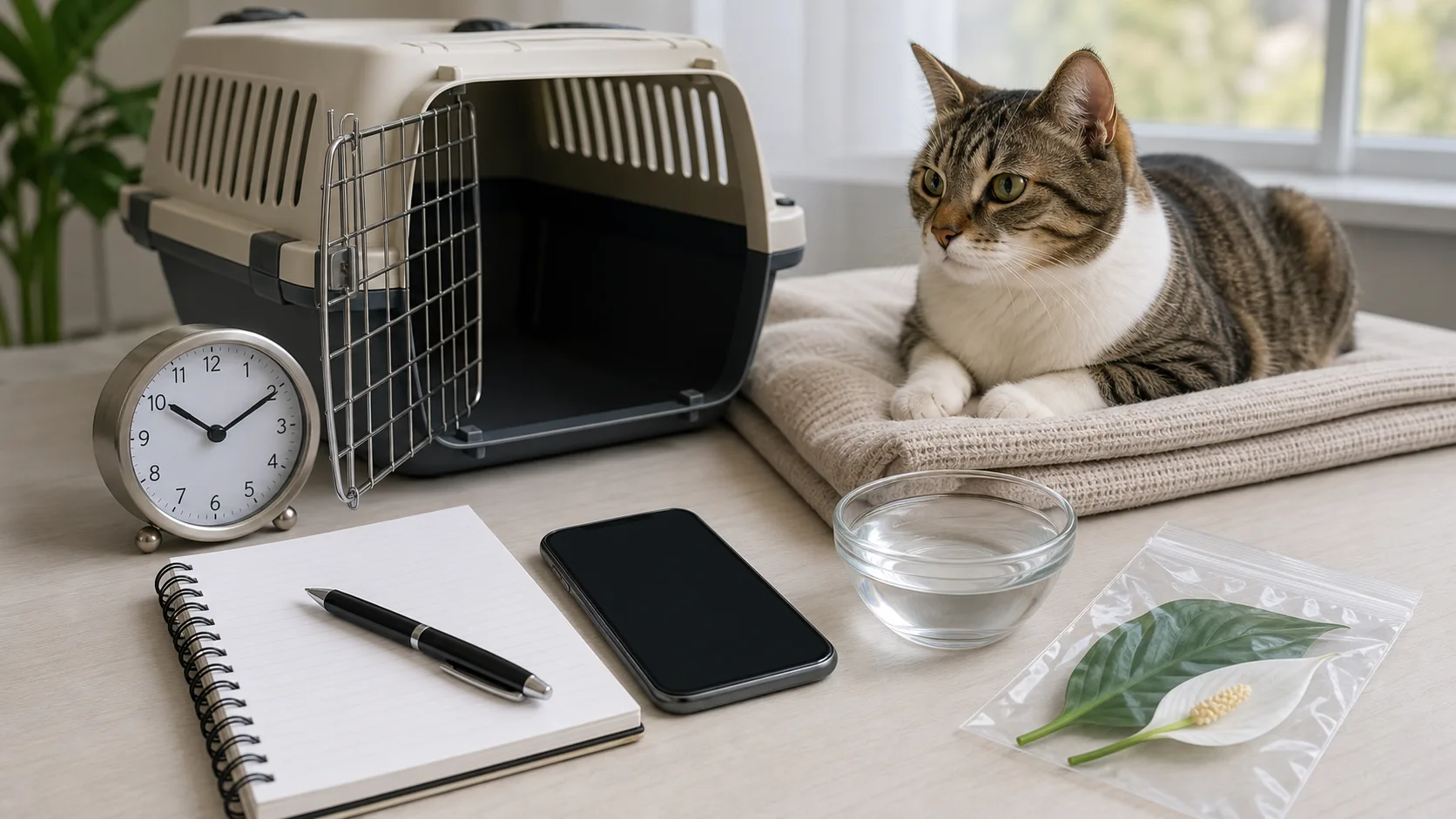
Record timing, save a plant sample, and keep the carrier ready when symptoms persist or plant identity is uncertain.
There is no threshold of peace lily ingestion that is safe to simply wait out without professional input if you are unsure what plant your cat actually chewed. Before acting on any risk assessment, confirm that the plant is a Spathiphyllum and not a true lily.
Contact a vet or animal poison control if any of these apply:
- Your cat is vomiting repeatedly over more than an hour or two
- Swallowing looks difficult or painful
- Your cat is lethargic or unresponsive beyond normal avoidance behavior
- You are not certain the plant is a peace lily and not a true lily or daylily
- The cat is small, young, old, or managing a known health condition
The ASPCA Animal Poison Control Center operates a 24-hour hotline (888-426-4435). They can help you assess how much your cat likely ingested and whether you need to go beyond monitoring at home.
Keep It or Remove It? A Practical Household Scorecard
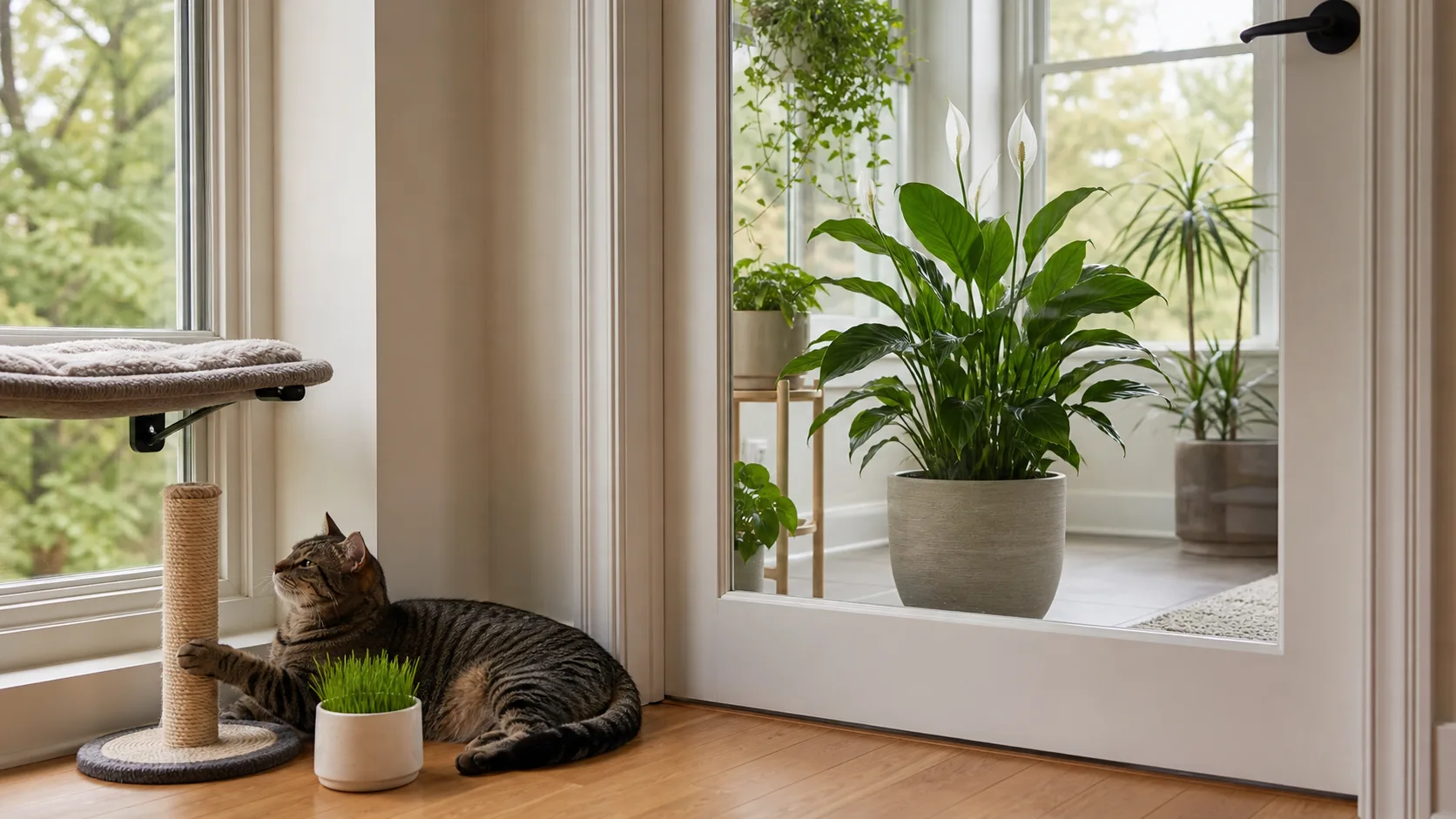
A genuinely closed door provides a reliable barrier, while cat grass and a scratcher offer safer enrichment.
Most guides leave you with a vague “consult your vet” and nothing more useful. Here is a more practical way to think through your specific situation:
| Placement | Cat Access | Repeat Exposure Risk | Practical Verdict |
|---|---|---|---|
| High shelf in low-traffic room | Low | Low | Manageable with basic precautions |
| Bathroom with door usually closed | Low to medium | Low | Reasonable if the door stays closed reliably |
| Shared living area, floor level | High | High | Relocate or rehome the plant |
| Open hallway or busy stairwell | High | Very high | Remove or relocate |
| Behind a closed door, cat no access | Minimal | Minimal | Fine while access stays controlled |
A cat that shows no interest in plants is a different situation from one that treats every leaf as a target. If your cat has already chewed the plant once, that tells you what will happen the next time they have access.
Good peace lily care often places the plant in lower-light spots like bathrooms or shelves away from windows, locations that may naturally limit cat access without requiring the plant to leave entirely. If you want alternatives that carry no toxicity risk at all, the guide to cat-safe indoor plants covers plants that are genuinely non-toxic rather than just lower-risk. Many of them thrive in the same indirect-light conditions as a peace lily. The low-light indoor plants guide is a useful starting point if you are looking for a replacement that fits the same corner of your home.
A Quick Plant Identity Check
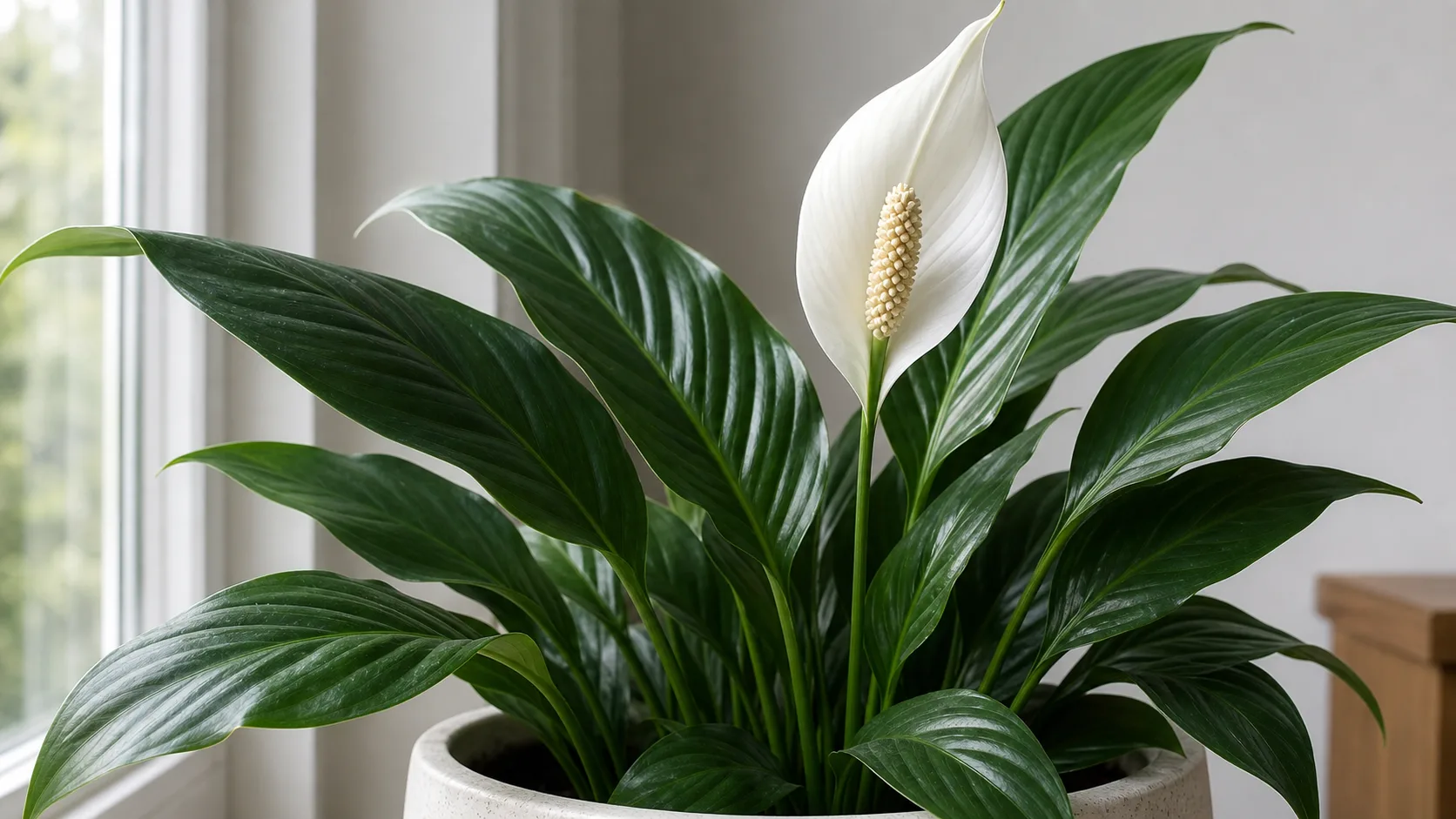
Glossy leaves rising from the base plus a hood-shaped white spathe around a pale spadix are key Spathiphyllum identifiers.
Before settling on any risk level, confirm you actually have a Spathiphyllum peace lily in your home.
Peace lily identification points:
- Glossy oval leaves growing directly from the base of the plant, no tall central stem
- Flowers that are white and hood-shaped, each on a single stem rising above the foliage
- No strong fragrance
- Compact tropical houseplant form, not a cut-flower arrangement shape
If the plant has multiple distinct petals arranged around a central stamen, a noticeable floral scent, or looks more like what you would find in a florist’s vase, it may not be a Spathiphyllum. True lilies look quite different up close, but if there is any doubt, photograph the plant and verify with a plant identification app or ask a local nursery before making a risk call.
This matters because a true lily in a home with cats is an active emergency risk. A confirmed peace lily is something that warrants careful placement and monitoring, not the same urgency. If you are also deciding whether the plant should stay in your home, the full peace lily care guide covers the lower-light setup, drainage, and placement patterns that make repeat exposure less likely.
For another practical pet-safety check, see Is ZZ Plant Toxic to Cats? Symptoms, Sap, and Safer Placement for the risk level and the next steps.
For another practical pet-safety check, see Is Philodendron Toxic to Cats? Symptoms and Safer Alternatives for the risk level and the next steps.
Frequently Asked Questions
Is peace lily toxic to cats?
Yes. ASPCA Poison Control lists peace lily (Spathiphyllum) as toxic to cats because of insoluble calcium oxalate crystals. The typical signs are oral irritation, drooling, pawing at the mouth, and vomiting. These usually appear quickly after chewing and are uncomfortable but not the life-threatening emergency associated with true lilies.
What is the difference between peace lily and true lily toxicity in cats?
True lilies (Lilium species) and daylilies (Hemerocallis) cause kidney tubule damage in cats and can lead to fatal kidney failure, sometimes from a very small amount of plant material. Peace lily causes immediate oral irritation from calcium oxalate crystals, which is painful but follows a different and generally less severe clinical path. The urgency level is meaningfully different.
My cat chewed a peace lily leaf. What should I do right now?
Rinse your cat’s mouth with water if you can do so safely. Offer something to drink or a small amount of food to help soothe the irritated tissue. Monitor for repeated vomiting, difficulty swallowing, or lethargy. If your cat is small, young, elderly, or managing a health condition, call your vet or ASPCA Animal Poison Control (888-426-4435) rather than waiting to see what develops.
Can a cat die from eating a peace lily?
Peace lily is not in the category of plants typically associated with fatal outcomes in cats, unlike true lilies and daylilies. That said, every exposure is different. A cat that ate a large amount, a very small or unwell cat, or any cat showing signs beyond normal mouth discomfort should be evaluated by a vet rather than managed at home with monitoring alone.
Can my cat brush against a peace lily without danger?
Casual contact such as walking past the plant or lying near it is unlikely to cause the same reaction as chewing, because the crystals cause the most harm when plant tissue is damaged and they make contact with mucous membranes in the mouth. The main documented risk is ingestion. If your cat is a plant chewer, that is the behavior to watch, not proximity.
Do I have to remove my peace lily if I have a cat?
Not necessarily, though removing it entirely is the most straightforward way to eliminate the risk. Many cat owners keep peace lilies on high shelves, in closed rooms, or in bathrooms where cat access is limited. The right call depends on your cat’s behavior and your home layout. A determined chewer with floor access to the plant is a different situation from a cat that ignores plants entirely.
How do I know if my plant is actually a peace lily or a true lily?
Peace lily (Spathiphyllum) has glossy oval leaves growing from the base and a white hood-shaped flower on a single stem. It does not have multiple separate petals or a strong fragrance. True lilies have multiple petals, often a distinct scent, and usually look more like a cut-flower arrangement. If you are not certain, photograph the plant and verify with a plant identification app or ask a nursery.
Are there non-toxic plants that work in the same conditions as peace lily?
Yes. Several plants offer a similar low-light tropical look without the calcium oxalate risk. The cat-safe indoor plants guide covers verified non-toxic options, and many of them work well in the same indirect-light conditions that peace lily prefers.
Sources: ASPCA Poison Control toxic plant listings for Spathiphyllum, Easter lily (Lilium longiflorum), calla lily (Zantedeschia), and lily of the valley. PetMD veterinary explainer on lily poisoning in cats. North Carolina State University Extension Gardener Plant Toolbox entry for Spathiphyllum. All sources accessed 2026-07-18.