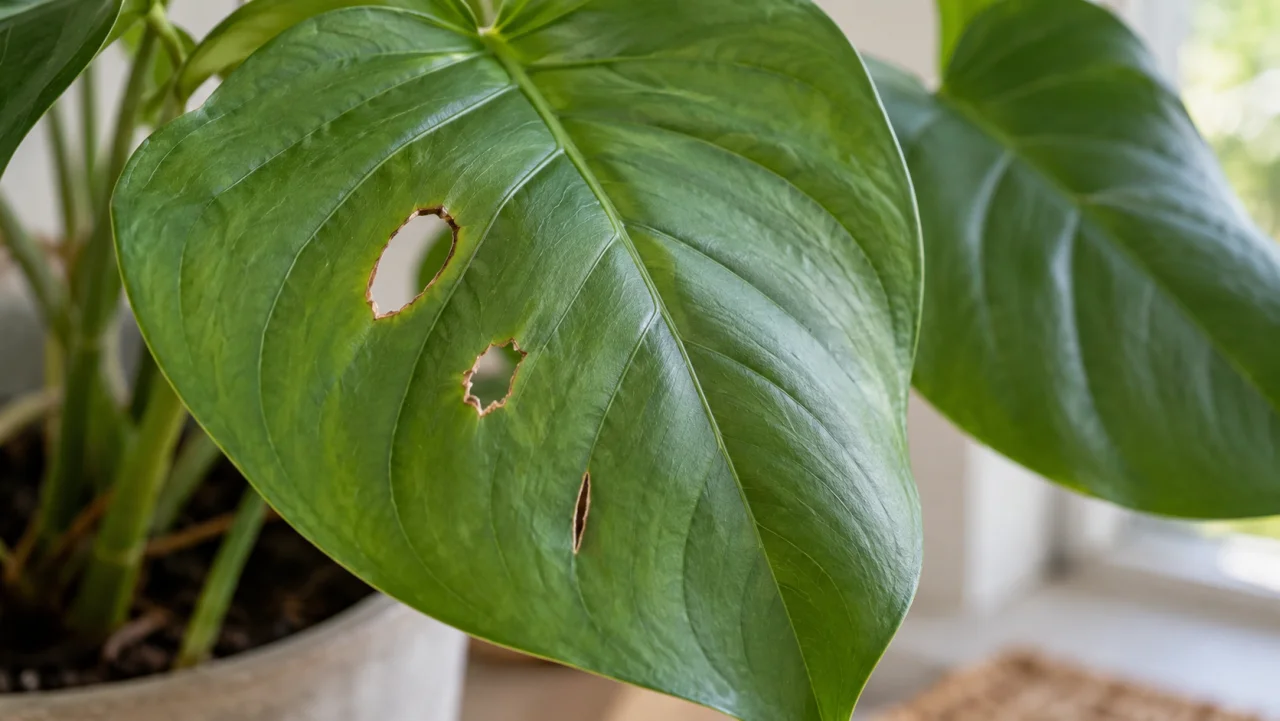
You walk over to your plant and notice it: a hole in a leaf that wasn’t there before. Or maybe you just brought this one home and are only now seeing it in better light. Your first instinct might be to panic, assume something is eating it alive, and reach for a pesticide. Before you do anything, slow down – because a plant with holes in its leaves is not automatically a plant under attack.
Holes in plant leaves fall into four very different categories, and the right response depends entirely on which one you’re dealing with.
What Most Pest Guides Miss
Most articles about holes in plant leaves jump straight to a pest list – caterpillars, beetles, slugs, fungus gnats – without asking the more important first question: is this hole actually new?
That matters because not every hole means something is eating your plant right now. Leaf tissue can be missing because of a chewing pest, yes, but also because a disease spot dried out and fell away, because the plant was handled roughly during shipping, because a pet chewed on it once and you didn’t notice, or because your plant is a species that naturally develops openings in its leaves as it matures.
Texas A&M AgriLife’s Landscape IPM guidance notes that spots caused by disease or physical injury can dry and drop out of leaf tissue, creating a shot-hole pattern that can resemble chewing. That means even a round, clean-edged hole may have nothing to do with a pest currently on your plant.
Treating an old scar as an active infestation can stress the plant without solving anything. The first check isn’t what kind of pest you have. It’s whether you have an active pest at all.
Symptom Diagnosis Card
Use this quick read before you spray, prune, or isolate the plant:
| If the holes look like this | Most likely explanation | Best next step |
|---|---|---|
| Smooth openings repeated in similar spots on a Monstera or similar plant | Natural fenestration | Confirm plant ID and leave the leaf alone |
| Ragged fresh tears with frass, sticky residue, webbing, or visible insects | Active pest damage | Isolate the plant and inspect leaf undersides before treating |
| Small round holes with a brown or yellow halo where a spot dried out | Shot-hole from disease or prior injury | Isolate if damage is spreading, keep leaves dry, and verify the cause before treating |
| Dry calloused holes limited to older leaves | Old shipping, handling, or past pest scar | Watch new growth for a week before doing anything aggressive |
| New damage across several plants or one leaf chewed overnight near floor level | Pet damage, physical abrasion, or a mobile feeder | Check the room setup, nearby pets, and nighttime activity first |
Why So Many Owners Misread Leaf Holes
Recent plant-owner threads tend to cluster around the same confusion points: panic over a hole that may be old, spider-mite aftermath that still scars leaves after treatment, and Monstera-style openings that look dramatic but are normal for the species. Those discussions are useful because they match how owners actually describe the problem, but they are not proof of prevalence. Treat them as reader-language signals, then verify the cause on your own plant.
Is It a New Hole or an Old Scar?
Run your finger along the edge of the hole. Fresh damage tends to feel soft, sometimes with green tissue that still looks moist or slightly torn. Older damage dries out – the edge becomes papery, brown, or calloused. You might see a thin dry border around the perimeter where the tissue died back after the original injury.
Check the surrounding leaf surface too. If you see frass (tiny dark specks that look like black pepper or crumbled soil), sticky residue, fine webbing, or visible insects, that’s evidence of current activity. If the leaf is otherwise clean and healthy-looking, and the rest of the plant is putting out new growth without holes, the damage may be old.
A useful rule: compare the newest leaf on the plant to the oldest. If only older leaves have holes and emerging leaves look clean, whatever caused the damage may already be gone – or it was a one-time physical event.
Leaf-Hole Triage at a Glance
Before deciding on a response, match what you see to these five patterns:
| What you see | Most likely cause | First action |
|---|---|---|
| Clean symmetrical openings, same position leaf to leaf | Natural fenestration (species-typical) | Confirm plant ID, no treatment needed |
| Fresh ragged missing tissue, frass or visible insects | Active chewing pest | Isolate, inspect undersides, identify before treating |
| Small round or oval holes that began as spots | Shot-hole from disease or prior injury | Isolate if damage is spreading, keep foliage dry, and verify the cause |
| Dry calloused holes only on older leaves, new growth clean | Old scar (shipping, handling, past pest) | Watch new growth for seven days before treating |
| Multiple plants damaged simultaneously, overnight | Pets, air draft, mechanical abrasion, or mobile outdoor pest | Check physical causes before assuming infestation |
University of Florida IFAS recommends using the feeding pattern – such as chewing, piercing-sucking, or rasping – to narrow the pest category because those feeding types leave different marks. A clean shot-hole can look different from caterpillar damage, and neither resembles spider mite stippling. Pattern is your first clue, not a final identification.
Decision Tree: What to Check First
- Does the plant naturally fenestrate? If it’s a Monstera or another species known for natural openings, compare the hole pattern to other mature leaves before assuming damage.
- Are the holes smooth and repeated, or ragged and random? Smooth repeated openings lean natural. Ragged or uneven missing tissue leans toward chewing or physical injury.
- Do you see live evidence like frass, webbing, sticky residue, eggs, or insects? If yes, treat it as active pest damage and inspect the whole plant.
- Did the hole start as a spot with a brown or yellow edge? That points toward shot-hole style damage from disease or prior injury rather than chewing.
- Are only older leaves affected while new growth looks clean? That usually means an old scar, shipping damage, or a past problem that has already stopped.
- Did the damage appear overnight on several plants or along easy-to-reach edges? Check pets, physical abrasion, or outdoor night feeders before blaming a persistent indoor infestation.
Natural Fenestration: When Holes Are Supposed to Be There
Some plants develop holes as part of normal leaf development. Monstera deliciosa is the most familiar example, and other aroids can develop their own characteristic splits or openings. Natural fenestrations normally have smooth, healed edges and recur in a species-typical pattern as leaves mature.
If your plant produces these kinds of openings, you’ll notice they appear in similar positions on similarly sized leaves. The edges are clean – no ragged tissue, no discoloration, no sign of anything being removed. This is different from pest or disease damage, which tends to be random in placement and irregular in shape.
If you’re unsure whether your plant is a naturally fenestrating species, that’s worth confirming before you assume something went wrong. The article Why Your Monstera Has No Holes covers the specific conditions that trigger fenestration in Monstera – useful if that’s what you’re working with.
Reading Hole Shape and Pattern
Damage pattern gives you real information about likely cause. Here’s how to read it:
Small, round, shot-like holes scattered across a leaf – these often started as disease spots. When a fungal or bacterial lesion dries out, the dead tissue can fall away or crack out, leaving a clean-edged round hole. The surrounding leaf may show faint yellow or brown halos where the spot used to be. This shot-hole pattern belongs in a houseplant disease check, not an automatic insect diagnosis – treating it with pesticide addresses nothing.
Ragged missing tissue along leaf edges or in irregular patches – this is more consistent with chewing. Michigan State University Extension notes that flea beetles can leave small, round holes while caterpillars and larger chewing insects create irregular missing areas. Those are different patterns, but you still need to find the pest or fresh evidence before choosing a treatment.
Large irregular tears, especially on big-leafed tropical plants – often mechanical. Monstera, bird of paradise, and similar plants with large flat leaves are prone to tearing from wind, contact with walls or other objects, or rough handling. A single large ragged opening with no secondary damage usually points here.
Tiny pale dots that only look like holes – check for spider mites. Mites pierce cells and cause stippling rather than chewing out pieces of leaf. Hold the leaf up to the light, then look for fine webbing and moving specks on the underside, especially near veins. If tissue is visibly missing, keep looking for another cause. The guide to getting rid of spider mites covers how to distinguish active mite damage from old scarring.
The Indoor vs. Outdoor Difference
This distinction is worth naming directly: most pest advice about holes in leaves was written with garden plants in mind. If your plant lives indoors, the range of likely causes is different.
For a plant that has stayed indoors, first check handling damage, nearby objects, pets, and common indoor pests before applying advice written for outdoor slugs, snails, or beetles. A plant that recently spent time outdoors has a wider range of possible feeders.
If your plant recently came home from a nursery, check for holes that look like they happened before you bought it – irregular, already-calloused, sometimes with a slightly crinkled edge where the tissue dried. Watch the new growth. If it stays clean and the old holes do not change, the damage may predate the purchase and no longer be active.
What to Do Before You Treat Anything
Before spraying or cutting, work through these checks in order:
- Are any new leaves emerging with non-natural holes? If yes, damage is continuing. If no, you may be looking at an old injury.
- Check leaf undersides – turn every affected leaf over and look for insects, eggs, webbing, or stippling.
- Look at night – some feeders, including caterpillars and slugs on outdoor plants, are most active after dark.
- Check the pot, soil surface, and saucer for hiding caterpillars, slugs on outdoor plants, or other moving pests.
- Inspect nearby plants for the same fresh pattern, then isolate any plant with confirmed active feeding while you identify the cause.
Only treat once you have a reasonable idea of what you’re treating. Spraying a plant with no active pest does not help it, and some treatments can injure already-damaged tissue. If you identify an active pest and are considering neem oil, first check that the product label lists both the pest and the plant, then follow its application and safety directions exactly.
How to Know If Pests Are Still Active
If you find evidence of past pest activity but aren’t sure the problem is ongoing, a seven-day evidence check is more useful than immediate treatment:
- Photograph the affected leaves and note the exact position and size of each hole.
- Check the plant again in 48 hours – if holes are expanding or new ones appear, something is still feeding.
- Inspect at night and early morning, when many chewing pests are most active.
- Check the undersides of every leaf, the stem joints, and the soil surface.
- Compare emerging leaves to older ones – new growth that comes in clean is strong evidence the pest is gone or was never present.
If you reach day seven with no new damage and clean new growth, the holes are more likely to be old scars than an active infestation. Continue checking during normal care instead of spraying automatically. If you confirm an active infestation, use the houseplant pests guide to match the pest and choose a targeted response. If the leaf also has spots, yellowing, scorch, or distortion, route the whole symptom pattern through the leaf-damage identification guide before treating.
Common Mistakes When Treating Holed Leaves
Spraying before identifying the cause. If the holes came from a disease spot that dried and fell out, no pesticide will help – and some may stress the plant further. Identify first, treat second.
Cutting every damaged leaf immediately. A leaf with one or two old holes is still photosynthesizing. Removing many functioning leaves at once adds stress without fixing the cause. Prioritize tissue that is dead, badly damaged, or part of a confirmed spreading disease, and keep healthy tissue whenever possible.
Assuming the same pest because the holes look similar. Round holes can come from flea beetles, disease shot-hole, or mechanical puncture. Ragged edges can mean caterpillars, slugs, or a pet. Shape is a starting clue, not a confirmed ID.
Treating once and assuming it worked. Pest life cycles differ, and eggs or protected life stages can survive an application. Follow the product label or pest-specific extension guidance for repeat timing, then keep inspecting new growth.
Ignoring the new growth. The condition of your newest emerging leaf is a useful indicator of whether damage is continuing. Watch it during the label-directed treatment and follow-up period.
Expert Note
For damage-pattern claims in this guide, the primary anchors are extension references rather than photo-thread guesses. University of Florida IFAS separates chewing damage from other feeding patterns, Texas A&M AgriLife explains how disease or injury can create shot-hole patterns, and Michigan State Extension shows how different chewing pests leave different kinds of missing tissue.
Freshness Note
This article was updated September 9, 2026 and checked against University of Florida IFAS, Texas A&M AgriLife Landscape IPM, and Michigan State Extension. Plant-owner discussions were used only as qualitative signals for the kinds of confusion people describe when holes appear, not as evidence that any cause is most common.
Methodology Note
The diagnosis guidance here was built from extension references on chewing damage, shot-hole injury, and hole-pattern recognition, then compared against current plant-owner discussions to surface the confusion patterns owners repeat most often. The expert sources support the care and diagnosis claims directly. Forum threads were used only to capture reader language and common misreads, not to prove that one cause is most common.
Frequently Asked Questions
Why does my plant have holes but I can’t find any bugs?
Several causes leave holes without a visible insect. A disease lesion or physical injury can dry and drop out, leaving a round clean hole after the original event. Shipping or handling can leave tears with no pest involved, and some plants fenestrate naturally. Before assuming pests, check edge texture (fresh versus calloused), look at new growth, and inspect undersides for webbing or stippling – mites are often too small to see without a hand lens.
Are holes in leaves serious enough to worry about?
The key question is whether the damage is old or ongoing. A few scarred holes on older leaves, with new growth coming in cleanly, rarely affect plant health. New or expanding damage is worth investigating because a physical cause, pest, or disease may still be active; confirmed pests or pathogens may also threaten nearby plants. The size and number of holes matter less than whether the damage is still progressing.
My Monstera has holes – is that normal?
Yes, for mature Monstera deliciosa and several related species, symmetrical openings that develop predictably on large leaves are fenestration – a normal feature, not damage. If the holes are irregular, ragged, or appear on smaller younger leaves, that’s less typical and worth inspecting more closely. Why Your Monstera Has No Holes explains the conditions that trigger natural splitting in more detail.
What pest most commonly causes holes in indoor houseplants?
There is no single culprit you can name from a hole alone. Caterpillars or other chewing insects are more plausible when an indoor plant recently spent time outside; slugs and snails are mainly outdoor suspects. Thrips and spider mites usually leave scarring or stippling rather than clean missing pieces. Use the edge pattern, inspect after dark, and look for frass, eggs, webbing, or the pest itself before treating.
Can I cut off leaves with holes in them?
You can, but you do not have to. If a leaf is mostly intact, dry, and stable, it is still photosynthesizing. Remove tissue that is dead, badly damaged, or part of a confirmed spreading disease, using clean tools. Avoid stripping many functioning leaves at once merely for appearance.
Could my pet be causing the holes?
Yes. Dogs and cats can chew houseplants, and the damage may resemble insect feeding at first glance – irregular missing tissue, often along leaf edges or tips. Tooth marks, fraying, and recent pet access make physical damage plausible, but keep inspecting if new damage continues. Check whether the plant is toxic before the question becomes urgent: cat-safe indoor plants is a useful reference.
Should I treat the soil when I find holes in the leaves?
Only if there’s evidence of soil-dwelling pests. Fungus gnat larvae live in moist soil and chew roots, but they don’t cause leaf holes – adult gnats don’t feed on leaves either. If you find larvae or increased gnat activity alongside leaf damage, the two problems are likely separate. Treat the one you’ve confirmed, not both at once.
The holes appeared overnight – what should I check first?
Sudden overnight damage is a useful clue. Many chewing pests – caterpillars especially – feed primarily at night and hide during the day. Check the undersides of leaves, in the soil, and around the pot base after dark with a flashlight. If your plant spends time outdoors or near an open window, a slug or snail is also possible. If you find nothing alive and the damage doesn’t spread over the following days, the cause may have been a one-time event – rough handling, a pet, or a single insect that didn’t stay.
Sources
- University of Florida IFAS. Different Pests, Different Damage. Accessed 2026-09-09.
- Texas A&M AgriLife Landscape IPM. Diagnosing Insect and Mite Damage on Ornamentals. Accessed 2026-09-09.
- Michigan State University Extension. What Bug Chewed on My Plants Last Night?. Accessed 2026-09-09.