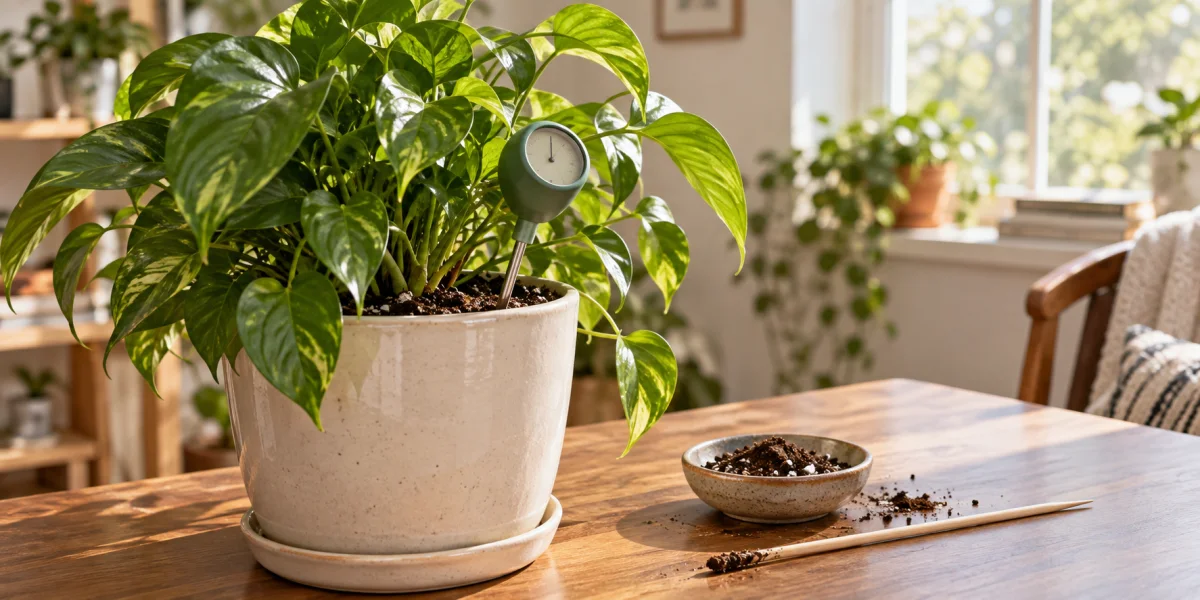
You buy a moisture meter expecting it to take the guesswork out of watering. Then something strange happens: the meter reads dry right after you have watered, or it stays stubbornly in the “moist” zone while your plant starts looking unhappy. The device may be faulty, but placement, potting media, salts, or the sensing method can also explain the mismatch.
This guide covers what a soil moisture meter for indoor plants is genuinely measuring, when that number is useful, when it needs a second check, and how to combine it with low-tech methods that fill in the gaps the meter misses.
What Most Moisture Meter Guides Miss
Most care guides treat the meter reading like a straightforward answer. Check the number, compare it to a species-specific range, water or do not water. Done.
That framing skips the core issue: many inexpensive analog meters infer moisture from electrical behavior rather than directly measuring the amount of water in the pot. Other sensor types use different methods. Readings can shift with salts, potting-media texture, temperature, probe condition, placement, and calibration.
The common misdiagnosis is assuming either that the meter is broken or that its number must be correct. Treat disagreement as a prompt to check the device, placement, potting mix, pot weight, and plant symptoms.
The practical first check before you trust any reading: follow the meter’s instructions, sample the active root zone without forcing the probe through roots, and compare more than one safe location. A surface-only check can miss moisture deeper in the pot.
What a Moisture Meter Is Actually Measuring
Many low-cost, battery-free plant meters use metal electrodes and translate the electrical response of the growing medium into a wet-to-dry scale. Capacitive and dielectric sensors work differently, so check the product manual before interpreting its numbers. In every case, the display is an estimate that depends on the medium and placement, not a direct view of the entire root ball.
University of Minnesota Extension’s sensor guide explains that different sensor types estimate soil water through different physical properties and that readings can be affected by soil conditions, salinity, temperature, and installation. Its examples are field-irrigation sensors, but the underlying caution applies here: know what your device measures and cross-check it before acting.
- Chunky aroid mixes with bark, perlite, and pumice have air gaps that break contact between the probes and soil particles. Readings can trend lower than actual moisture levels.
- Fertilizer salt buildup increases electrical conductivity in the soil independently of water content. Salt-laden soil conducts more easily, which can push a reading toward “moist” even when the plant is ready to drink.
- Small nursery pots are hard to read reliably because the probe is close to the pot wall, and the outer ring of soil dries faster than the center.
- Freshly repotted plants give inconsistent readings until the mix settles and the probe makes reliable contact. If you just repotted, pot weight is a better guide for the first few weeks.
None of this makes meters useless. It means a single reading from a single location is the beginning of your check, not the conclusion.
How to Get a Reading Worth Trusting
The difference between a useful meter reading and a confusing one is usually technique, not the device.
Sample the root zone carefully. Use the depth recommended by the manufacturer and avoid forcing the probe where it could puncture thick roots. Surface soil often dries before the lower root zone, so a shallow reading alone may not answer the watering question.
Check two or three spots. Insert the probe near the center, then near one edge. If readings differ noticeably, water has moved unevenly through the mix. That uneven distribution is itself useful information – it may mean the soil has developed dry pockets, or that water is channeling along the pot wall.
Wipe the probe before each use. Residue from the previous pot shifts readings. A damp cloth before inserting takes ten seconds and keeps things honest.
Remove it after the reading unless it is designed for continuous monitoring. Wipe the probe and store it according to the manufacturer’s directions. A handheld meter and an in-pot sensor are not interchangeable.
When the Reading Needs a Second Check
Some readings are not just about moisture levels – they are signals to investigate something else.
| What the meter shows | What might be happening | What to check next |
|---|---|---|
| Dry reading right after watering | Water channeled along the sides and out the drain hole without wetting the root ball | Lift the pot; if very light, try bottom watering |
| Wet reading for 10+ days | Large pot, dense soil, low light, or plant slowing seasonally | Check drainage, assess light, watch for root rot symptoms |
| Reading jumps when probe shifts | Poor soil contact, bark blocking the probes, or a worn probe | Cross-check with a chopstick or finger test |
| Surface reads dry, meter reads moist | Water still present lower in the pot | Wait and use plant-specific drying preference before watering |
| Meter reads moist but plant wilts | Root damage, compaction, or overwatering – not thirst | Inspect roots before adding any more water |
If you are unsure whether root damage is involved, the root rot treatment guide covers what to look for before you make any watering change.
The Moisture Meter Trust Scorecard
Before acting on a reading, run through these quickly:
- Probe at root depth? A surface reading reflects the fastest-drying zone, not where the roots are.
- Two or more spots checked? One reading is weak evidence. Two or three that agree are meaningful.
- Probe clean before inserting? Residue or mineral deposits can interfere with some sensor designs.
- Potting media type? Dense, fine soil gives more reliable readings than chunky bark or cactus grit.
- Cross-check agreement? When pot weight, finger feel, and the meter reading all point the same direction, confidence is higher. When they disagree, trust the plant’s appearance and a root-zone check over the number.
- Plant risk? For plants vulnerable to prolonged saturation, including pothos and snake plants, conservative interpretation is safer than acting on a reading you are not sure about.
A reading you trust has earned that trust because the surrounding context supports it.
Moisture Meter Scoring Rubric
If you are deciding whether a moisture meter belongs in your routine, score the setup instead of asking for one magic number.
| Evaluation point | What earns a strong score | Points |
|---|---|---|
| Probe contact and depth | The probe reaches the active root zone and makes firm contact with the mix instead of skimming the surface or hitting bark gaps | 0-2 |
| Pot and media fit | Dense potting mix in a medium or deep pot scores higher than tiny nursery pots, gritty cactus mixes, or chunky aroid blends | 0-2 |
| Repeatability | Readings stay reasonably close when you test the same pot twice and compare two nearby spots | 0-2 |
| Cross-check agreement | Pot weight, finger or chopstick feel, drainage behavior, and plant symptoms point in the same direction as the meter | 0-2 |
| Care-risk control | The meter helps you avoid overwatering rot-prone plants instead of pushing you to water blindly | 0-2 |
8 to 10 points: the meter is giving decision-useful information. 5 to 7 points: use it only as a rough signal. 0 to 4 points: trust pot weight, root-zone checks, and plant symptoms more than the dial.
Meter vs. Other Methods
Illinois Extension recommends checking soil about two inches deep, lists the environmental and container factors that change water use, and says a water-meter probe can be useful but may not always be reliable. A meter gives you one data point. These other methods give you different ones.
| Method | Best for | Weakness | Best cross-check |
|---|---|---|---|
| Moisture meter | Deep pots, learning a new plant’s rhythm | Affected by salt, chunky media, probe wear | Pot weight + visual check |
| Finger test | Pots you can reach 2–3 cm into | Tells you only about the surface zone | Chopstick for depth |
| Chopstick or skewer | Deep pots, aroid mixes | Needs interpretation (clean = dry, residue = wet) | Meter to confirm |
| Pot weight | Medium to large pots once you know the range | Requires learning full/empty weight over several cycles | Finger or chopstick |
| Drainage behavior | Spotting uneven wetting after watering | Does not tell you current root-zone moisture | Meter at root depth |
| Root inspection | When symptoms conflict with readings | Disruptive; not a routine check | Necessary when other signals disagree |
For a deeper look at how environment affects watering frequency, the guide on how often to water indoor plants walks through the full picture: light levels, pot size, season, and plant type all shift the rhythm more than any meter reading can on its own.
Best For and Not For
A moisture meter earns its place when:
- Your pots are too deep to reach the root zone with a finger.
- You are still learning how a new plant drinks – the meter helps you track how fast a specific pot actually dries.
- You want a second check when a plant looks off and you cannot tell whether the issue is too much water or too little.
- You have plants in very similar-looking pots and need a faster triage than lifting each one.
A moisture meter is less useful when:
- Your potting mix is chunky, bark-heavy, or arid – probe contact is inconsistent and readings fluctuate without meaning much.
- The pot is very small; the probe ends up near the wall, measuring the fastest-drying soil rather than the root zone.
- You just repotted – the mix has not settled and contact is unreliable.
- A plant is already showing wilting or yellowing; at that point you need a root inspection, not another reading.
Pros and Cons of Using a Moisture Meter
Pros
- Helpful in deep pots. A probe reaches moisture zones your finger cannot.
- Good for learning plant rhythm. Repeated readings help you notice how quickly a specific pot actually dries in your space.
- Useful as a conflict-breaker. When a plant looks off, the meter can help you decide whether to inspect roots or hold off on watering.
Cons
- Easy to overtrust. One reading from one spot can be wrong for reasons that have nothing to do with thirst.
- Weak in chunky or gritty media. Bark gaps, pumice, and cactus mix reduce probe contact and make the reading noisier.
- Not a substitute for root checks. A meter cannot tell you whether roots are healthy, compacted, or already rotting.
- Cheap probes drift over time. Residue, corrosion, and leaving the meter in soil all make future readings less useful.
What to Look for When Buying
For most indoor plant collections, choose a probe that can reach the root zone of your usual pots without hitting the base. A readable scale, repeatable results, a clear manual, and a design intended for your potting medium matter more than extra modes.
The most important quality is consistency: insert the probe firmly, note the reading, pull it out, wipe it, and reinsert in the same spot. A meter that gives the same number twice is behaving reliably. One that varies by two or three points between identical insertions is not giving you usable information, and no amount of careful technique fixes an inconsistent device.
Multi-function meters can be convenient, but treat every mode as a separate measurement with its own instructions and limitations. Do not make a pH correction or fertilizer decision from an unverified budget probe reading alone.
If you are choosing a potting mix for your indoor plants that is chunky and well-draining, keep in mind that airy, bark-heavy media makes meter readings less stable. Plan to lean more on pot weight and chopstick checks with those mixes, and treat the meter as a rough first pass rather than a final call.
How We Evaluated Moisture Meter Advice
This guide is not a lab shootout of branded meters. Our evaluation method looks at the same failure points owners run into in real pots: probe contact, pot depth, media type, repeatability, and whether the reading agrees with pot weight, finger or chopstick checks, drainage behavior, and plant symptoms.
The recommendations here combine university extension watering guidance with institutional sensor guidance. Community discussions were used only to surface recurring questions, such as dry readings after watering; they were not treated as performance evidence. Because the University of Minnesota and Arizona sources discuss field sensors rather than consumer houseplant probes, we use them only for general principles about calibration, placement, and environmental interference. In plain terms: trust a meter only when its reading is repeatable and agrees with root-zone checks, plant symptoms, and the way water moved through the pot.
Common Mistakes That Make Readings Less Useful
Testing only at the surface. This is the most common one. Surface soil dries fastest and tells you the least about what the roots are experiencing. A reading from the top layer of a deep pot is often just measuring how recently you misted or how warm the room is.
Leaving a handheld probe in the soil. If the meter is not designed for continuous monitoring, insert it, read it, remove it, and follow the cleaning and storage directions in its manual.
Acting on one reading without a cross-check. Especially in small pots or chunky mixes where probe contact is unreliable, one number is not enough to make a confident decision. Two readings from different spots that agree are a much stronger signal.
Using the same target number for every plant. A tropical aroid and a succulent do not share a watering threshold, and scales are not standardized across every device. Start with species needs and your meter’s instructions, then learn a repeatable range for that plant, pot, and mix.
Treating the meter number as the whole answer. University of Maryland Extension advises against watering on a fixed schedule because plant needs shift with conditions and season. The same logic applies to a fixed meter target: the number is a starting point, not a calendar substitute.
Ignoring pot weight as a parallel check. Pot weight is one of the most reliable moisture signals once you know what a fully watered pot and a bone-dry pot feel like for a given plant. The meter confirms what you already suspect; pot weight often tells you something the meter missed.
Keeping the Probe Accurate Over Time
Clean and store the probe exactly as its manual directs. Soil residue or mineral buildup can interfere with readings, but cleaning materials that are safe for one probe may damage another.
To check repeatability, take two readings in the same safe location, removing and reinserting the probe as directed. Then compare readings in the same potting mix when you know it is freshly watered and later when it has dried to the plant’s normal watering point. Do not submerge a probe unless its manufacturer explicitly says that is a valid test.
If repeated readings vary widely under the same conditions, or the meter no longer responds across a known wet-to-dry cycle, troubleshoot and recalibrate it according to the manual or replace it. Arizona Cooperative Extension’s calibration guide describes how drift, fouling, temperature, salinity, and soil variability can affect field sensors; consumer devices differ, but the need for repeatable checks is the same.
Frequently Asked Questions
Do moisture meters for plants actually work?
Yes, with caveats. Consumer devices use different sensing methods, so follow the manual and test for repeatability in your own potting mix. Used as one input alongside pot weight, a root-zone check, drainage behavior, and plant symptoms, a meter can be useful – especially for deep pots and plants you are still learning.
Why does my moisture meter read dry right after I water?
First confirm the reading in another safe location. If the pot is still light, water may have traveled down the sides without evenly wetting the root ball. Bottom watering can help some mixes rehydrate; remove the pot once the mix is evenly moist and let it drain fully, then recheck according to the meter instructions.
Can I leave the moisture meter probe in the soil all the time?
Only if the device is designed for continuous monitoring. Remove a handheld probe after each reading and follow its cleaning and storage instructions.
What number should I water at on a moisture meter?
It depends on the plant, potting mix, and device; scales are not universal. Use the manufacturer’s range only as a starting point, then cross-check against the plant’s drying preference, pot weight, and root-zone moisture. Record the readings that correspond to a healthy wet-to-dry cycle in your own setup.
Is a moisture meter better than the finger test?
They answer slightly different questions. The finger test gives you texture and temperature at the top 2–3 cm of soil. The meter gives you an electrical signal from wherever the probe reaches. For deep pots or plants you cannot easily finger-test, the meter covers ground the finger misses. For shallow pots with dense, consistent soil, a finger check is often faster and just as informative.
My meter says moist but the plant is wilting. What is happening?
This is a sign to check the roots, not add water. Wilting despite moist soil usually points to root damage: rot, compaction, or roots that can no longer take up water effectively. Adding more water makes it worse. Remove the plant from its pot, inspect the roots for dark or mushy tissue, and treat accordingly. The root rot treatment guide covers what to look for and what to do next.
How do I know if my moisture meter is accurate?
Follow the manufacturer’s test or calibration procedure. For an everyday repeatability check, compare two readings in the same safe location and track whether the device responds consistently across a known wet-to-dry cycle in the same potting mix. Do not use a glass-of-water test unless the manual explicitly permits immersion.
Do moisture meters work for succulents?
Sometimes, but gritty mixes can make probe contact inconsistent, and different sensor designs behave differently. Because most succulents need a substantial dry interval, use the meter only as a cross-check alongside pot weight, the condition of the mix, and species-specific guidance.
Sources reviewed 2026-09-09: University of Minnesota Extension, University of Maryland Extension, Illinois Extension, and Arizona Cooperative Extension.
The best moisture meter for plants earns its place when you treat its reading as one input rather than the final answer. It is most useful for pots too deep to finger-test, for plants you are still learning, and as a cross-check when a plant looks off but you cannot tell whether it is thirsty or sitting in soil that is too wet. The number gives you a starting point. Pot weight, plant appearance, and drainage behavior fill in the rest.