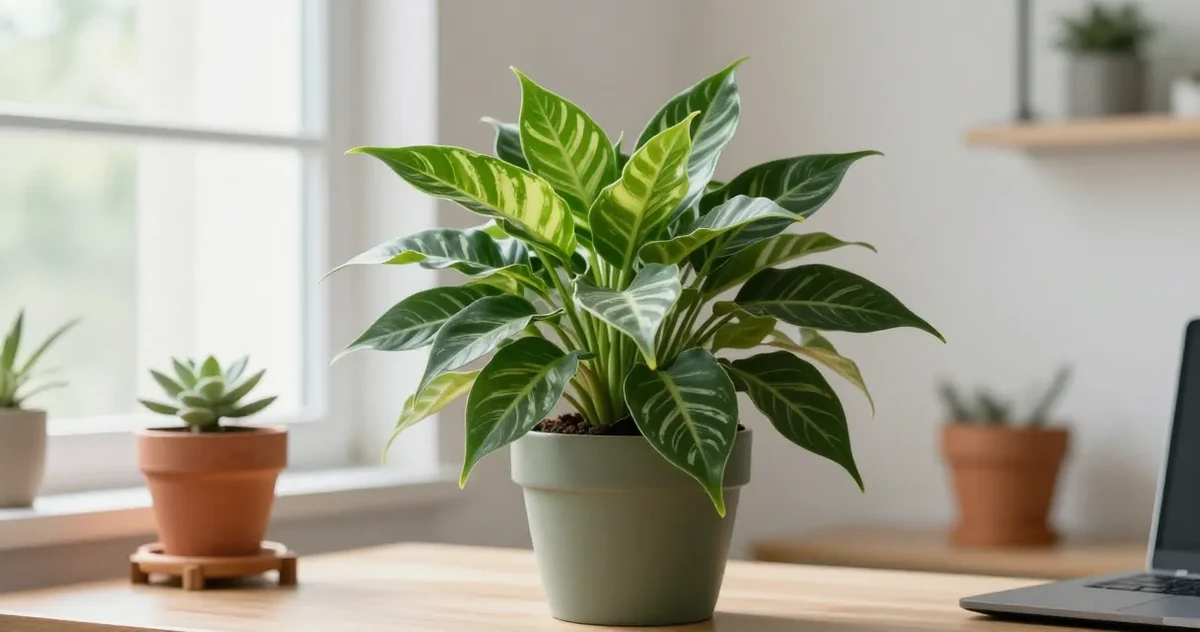
If you’ve ever stood in a garden center unsure whether to bring home the silvery-green Chinese evergreen or the one with hot pink leaves, wondering which one will still look that good six months later, this guide is for you.
Chinese evergreens, sold under the botanical name Aglaonema, come in a wider range of colors than most people expect. The green and silver forms will hold their appearance in a dim corner with minimal intervention. The pink and red ones need noticeably more light, and when they don’t get it, the color drains away quietly, without any other warning sign.
That one difference is what most people don’t know when they’re choosing, and it’s what this guide is built around.
By KnowYourPlant editorial team. Last updated June 2026 after reviewing NCSU Extension guidance, Costa Farms’ cultivar list, ASPCA pet-safety data, and recurring owner questions about fading color, pale new leaves, and inconsistent variety labels.
What Most Chinese Evergreen Variety Guides Miss
Most roundups hand you a list of cultivar names and move on. What they rarely explain is the thing that matters most when you’re standing in front of the display or troubleshooting a plant that has changed since you brought it home: color saturation in Chinese evergreens is a light response, not a fixed trait.
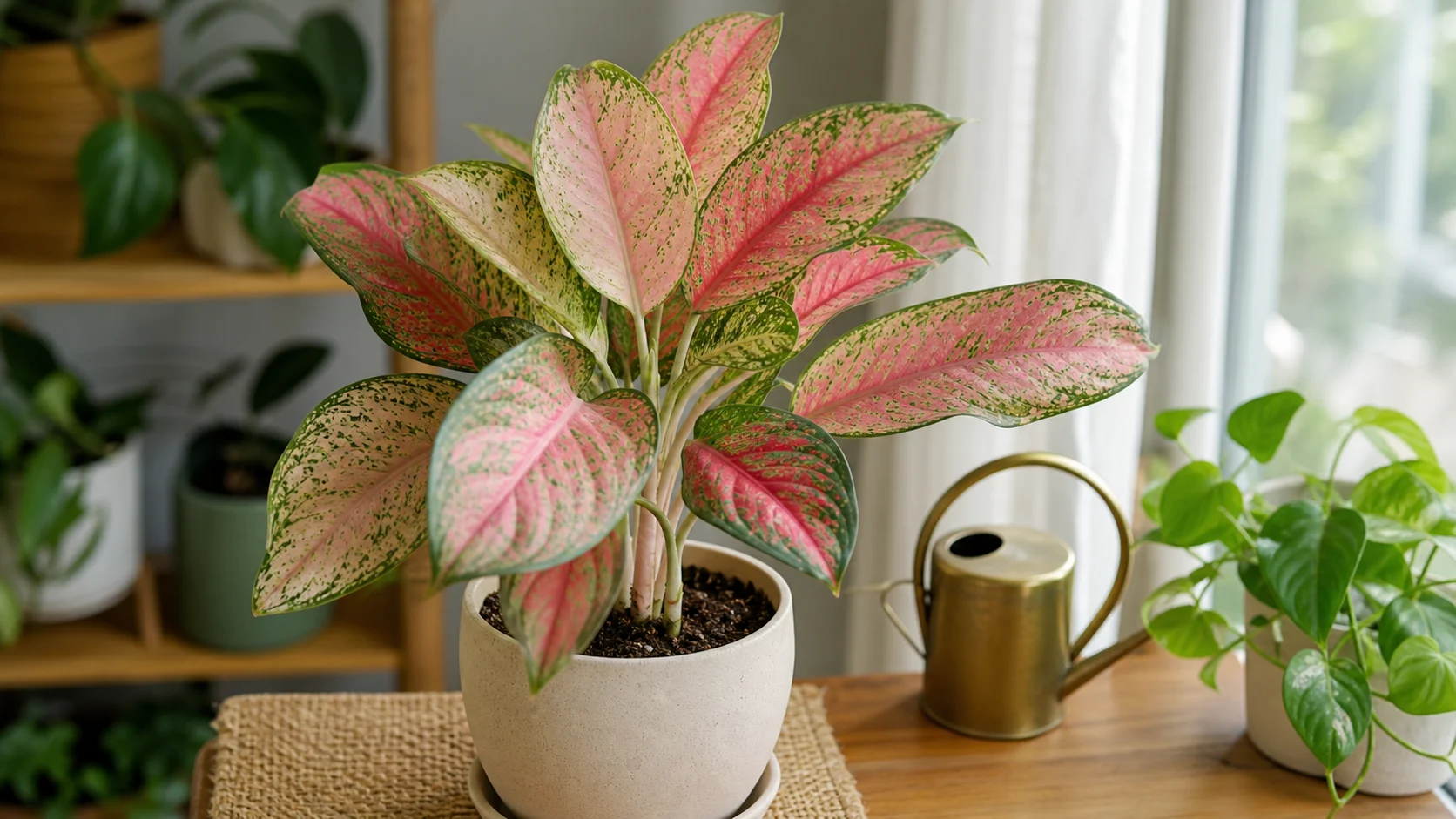
A pink Aglaonema beside a bright filtered window shows why light placement is the first thing to test when new color fades.
The most common misdiagnosis is treating pale or fading new leaves as a nutrient deficiency or root problem. In pink and red aglaonemas especially, this sends owners toward fertilizing, repotting, or worrying about disease, when the real issue is simpler.
The first check before changing anything: move the plant to brighter indirect light and watch the next two or three new leaves over four to six weeks. If they come in with more saturation, light was the issue. If the leaves stay pale and you’re also seeing soft stems, waterlogged soil, or yellowing spreading upward from older foliage, then it’s worth looking at watering.
This single test resolves most of the confusion people have with pink and red varieties. Generic care articles skip it because they don’t connect variety choice to light requirements in a practical way. The rest of this guide does.
What owners keep getting stuck on
- Pink and red aglaonemas turning paler or greener in ordinary room light
- Store tags that say only “pink aglaonema” or “red aglaonema,” which makes cultivar ID fuzzy
- Not knowing whether very pale new leaves are normal immature color, a light issue, or a watering problem
- Paying extra for a pink form, then realizing a green or silver variety would have been easier for the room
The Two Worlds of Chinese Evergreen Varieties
The North Carolina State Extension Gardener Plant Toolbox notes that the Aglaonema genus includes 26 species plus a wide range of cultivars, with leaves variegated in white, silver, pink, and red. In practice, the retail varieties you’ll encounter break into two camps that behave quite differently in a home setting.
Green and Silver Varieties: The Reliable Core
These are the Chinese evergreens that earned the plant its reputation for resilience. Cultivars like Silver Queen, Silver Bay, Maria, and Emerald Beauty lean on silver-green patterning, deep green leaves with pale centers, or silvery streaking that reads well even in lower-light rooms.
Costa Farms, one of the largest houseplant producers in the US, lists Silver Queen, Silver Bay, Maria, Emerald Beauty, and Cecilia among their core Chinese evergreen range, describing them as tolerant of both low and medium light, conditions that would stress many other tropical foliage plants.
What makes these varieties genuinely useful is that the color is stable. Silver and green don’t depend on strong light to develop, so the plant you bring home looks like the plant you have a year later, assuming the basics are solid.
Silver Bay is the one most people reach for when they want something forgiving. It handles inconsistent care, low humidity, and a less-than-ideal window without much protest. Maria is more compact and does well on a table or shelf in a north-facing room. Silver Queen has longer, narrower leaves with heavy silver patterning and is a good choice if you want visual contrast in a spot that doesn’t get much direct sky exposure. If you’re choosing for a cubicle or shaded desk, the roundup of best plants for office helps you compare aglaonema against the other realistic office survivors.
These forms are good fits if:
- Your home gets mostly indirect light or you’re working with a window a few feet away
- You want a plant that holds its appearance through the seasons without needing placement adjustments
- This is your first or second houseplant and you want something that tolerates a few care mistakes
If you’re building a collection for lower-light rooms, the guide to low-light indoor plants covers several companion picks that share similar tolerance.
Pink and Red Varieties: The Statement Forms
Pink and red aglaonemas are what make people stop mid-aisle. Cultivars like Pink Valentine, Lady Valentine, Red Siam, and various unnamed pink hybrids carry saturated pink midribs, flushed red leaves, or deep rose patterning across the full leaf surface.
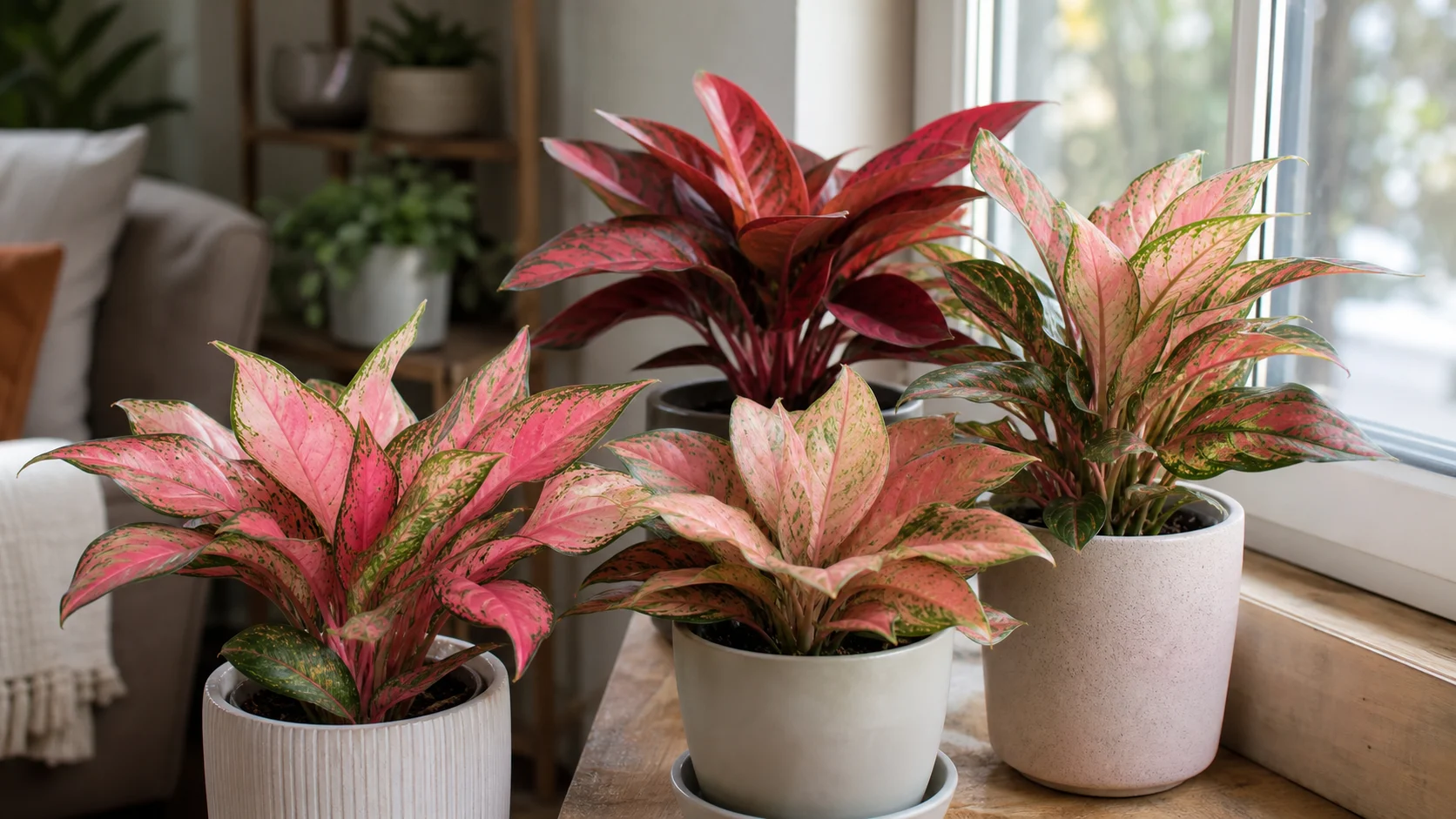
Several pink and red Aglaonema forms beside a bright window show the range of color patterns that stronger indirect light helps maintain.
The color is real. But it takes more energy to maintain, which means more light than most homes provide by default.
Bright indirect light, a few feet from an east- or west-facing window, is where these forms hold their color best. In lower light, new leaves come in with less saturation, sometimes noticeably greener than the existing foliage. This is one of the most common points of confusion for owners of pink cultivars: they assume something is wrong with the plant when the plant is actually just adapting to what the room offers.
The reassuring part is that these are still aglaonemas. They tolerate lower light far better than most colorful tropical foliage plants. They just don’t hold color in it the same way a Silver Bay does. Knowing that going in prevents a lot of disappointment.
If your room doesn’t have a strong window but you’re set on a pink form, a grow light running a few extra hours each day fills the gap reliably. The guide to grow lights for indoor plants walks through how to choose and position one without making it complicated.
Color-Family Comparison
Here’s a practical reference for the cultivar groups you’re most likely to encounter at retail:
| Color Family | Common Cultivars | Light Tolerance | Color Stability | Beginner Fit |
|---|---|---|---|---|
| Green and Silver | Silver Queen, Silver Bay, Maria, Emerald Beauty, Cecilia | Low to medium indirect | High: stable in dim rooms | Best |
| White and Cream | Golden Bay, Harlequin, lighter Siam Aurora forms | Medium indirect | Moderate: may shift greener in low light | Good |
| Pink and Red | Pink Valentine, Lady Valentine, Red Siam, Prestige, Wishes | Medium to bright indirect | Lower in dim rooms, stronger near a good window | Better for intermediate owners |
This covers most of what you’ll encounter at garden centers and online retailers. It doesn’t capture every cultivar in the genus, but it reflects the groupings that actually drive practical decisions.
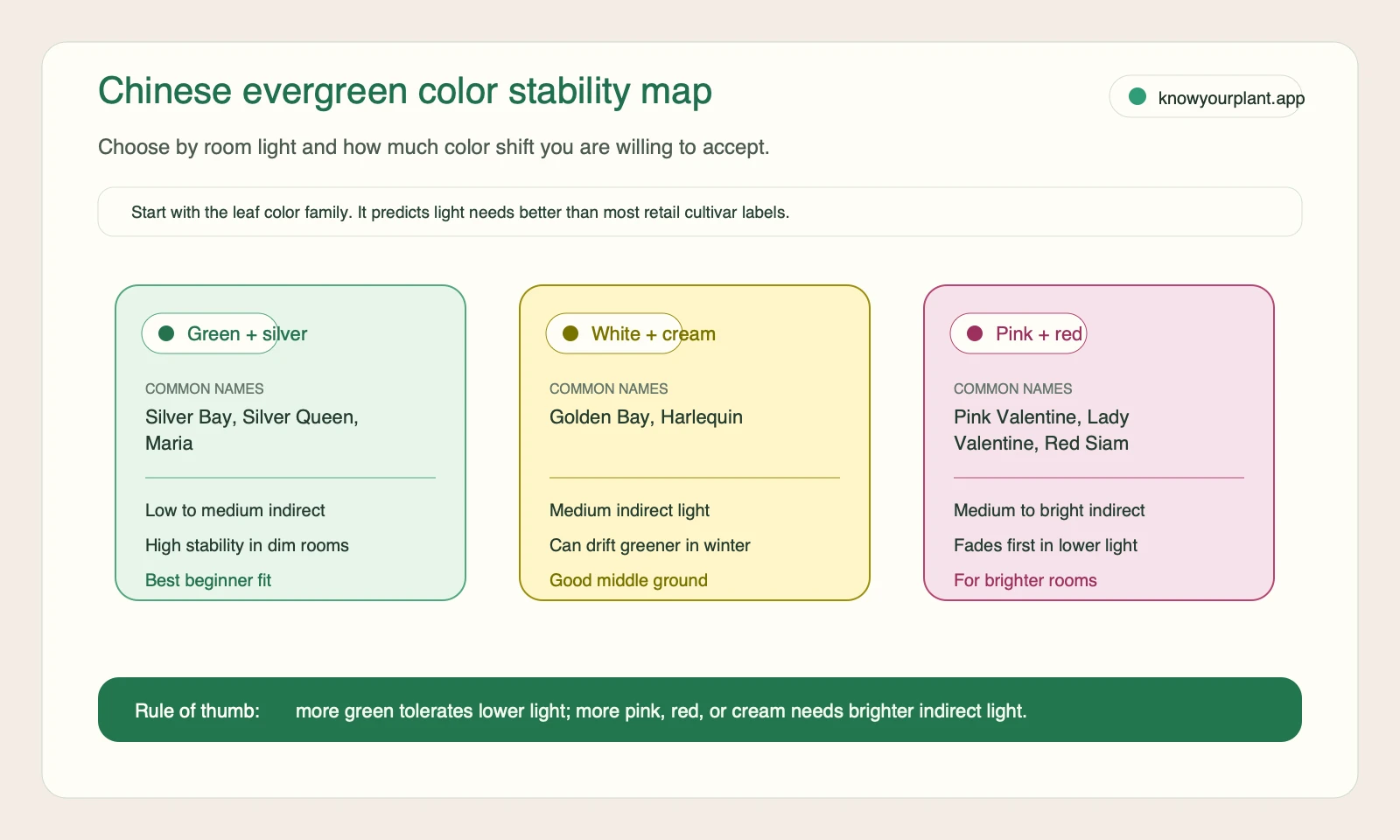
Use the color stability map before choosing a cultivar. Green and silver types tolerate dimmer rooms, while pink, red, and cream forms need brighter indirect light to keep their color.
Identification Snapshot
Use this quick snapshot before you buy, relabel, or troubleshoot a plant at home.
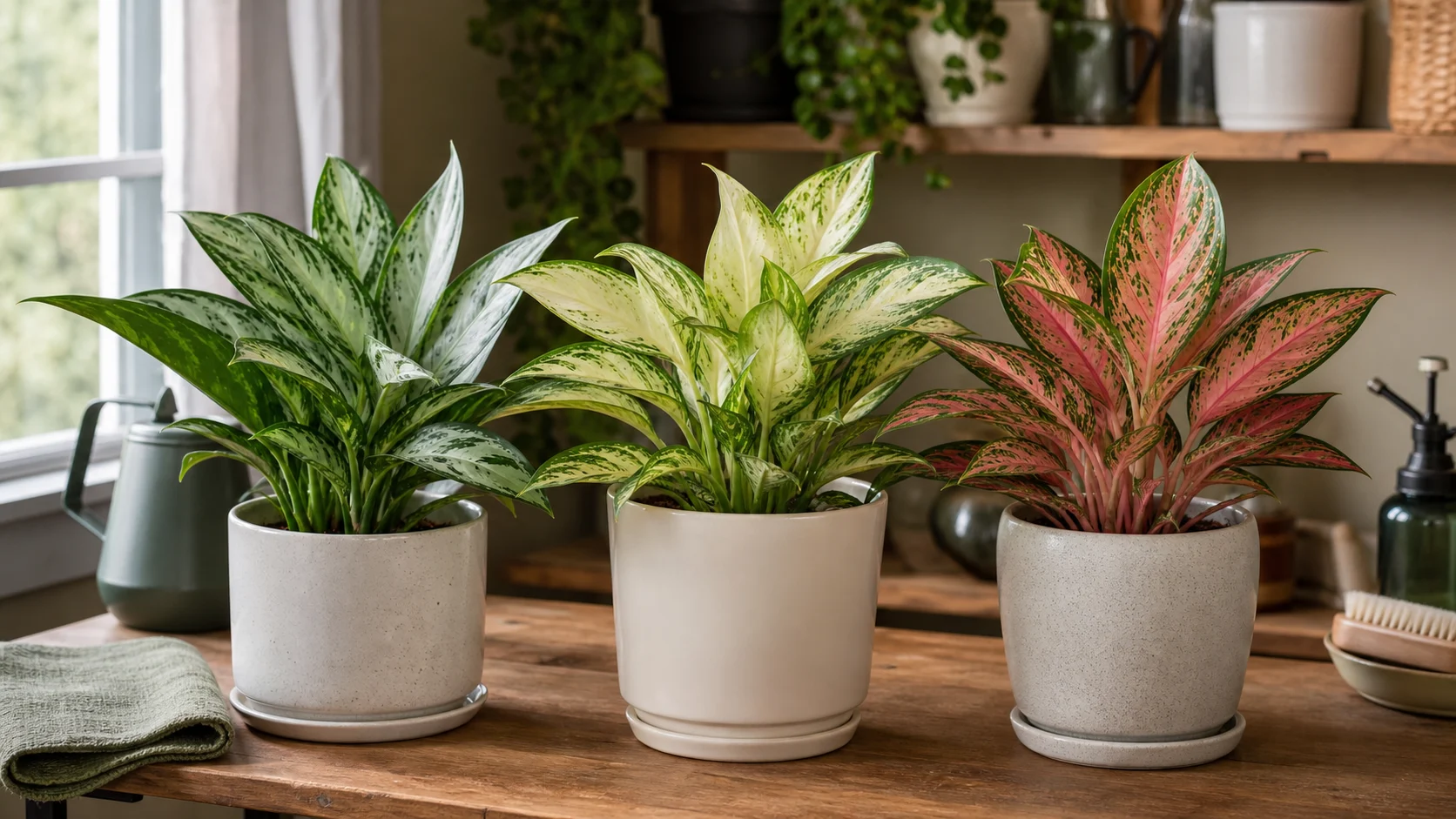
Silver-green, cream-variegated, and pink Aglaonema side by side make color placement easier to compare before relying on a cultivar name.
| If the plant looks like… | You are probably looking at… | Best fit | First thing to check |
|---|---|---|---|
| Mostly green with silver splashes or a silvery center | A green or silver cultivar such as Silver Bay, Silver Queen, or Maria | Dimmer rooms, offices, newer plant owners | Watering rhythm and root health, not color loss |
| Creamier centers with softer green edges | A white-cream cultivar such as Golden Bay or a lightly variegated hybrid | Medium indirect light and shoppers who want more contrast without going fully pink | Whether the room is bright enough to stop the plant drifting greener |
| Pink midribs or rose flushing with clear green edges | A pink cultivar such as Pink Valentine | Bright indirect light with some patience | New leaves that start greener in lower light |
| Strong pink or red across much of the leaf surface | A pink-red hybrid such as Lady Valentine or Red Siam | Bright rooms, collectors, people willing to tweak placement | Color fade or slower growth in darker corners |
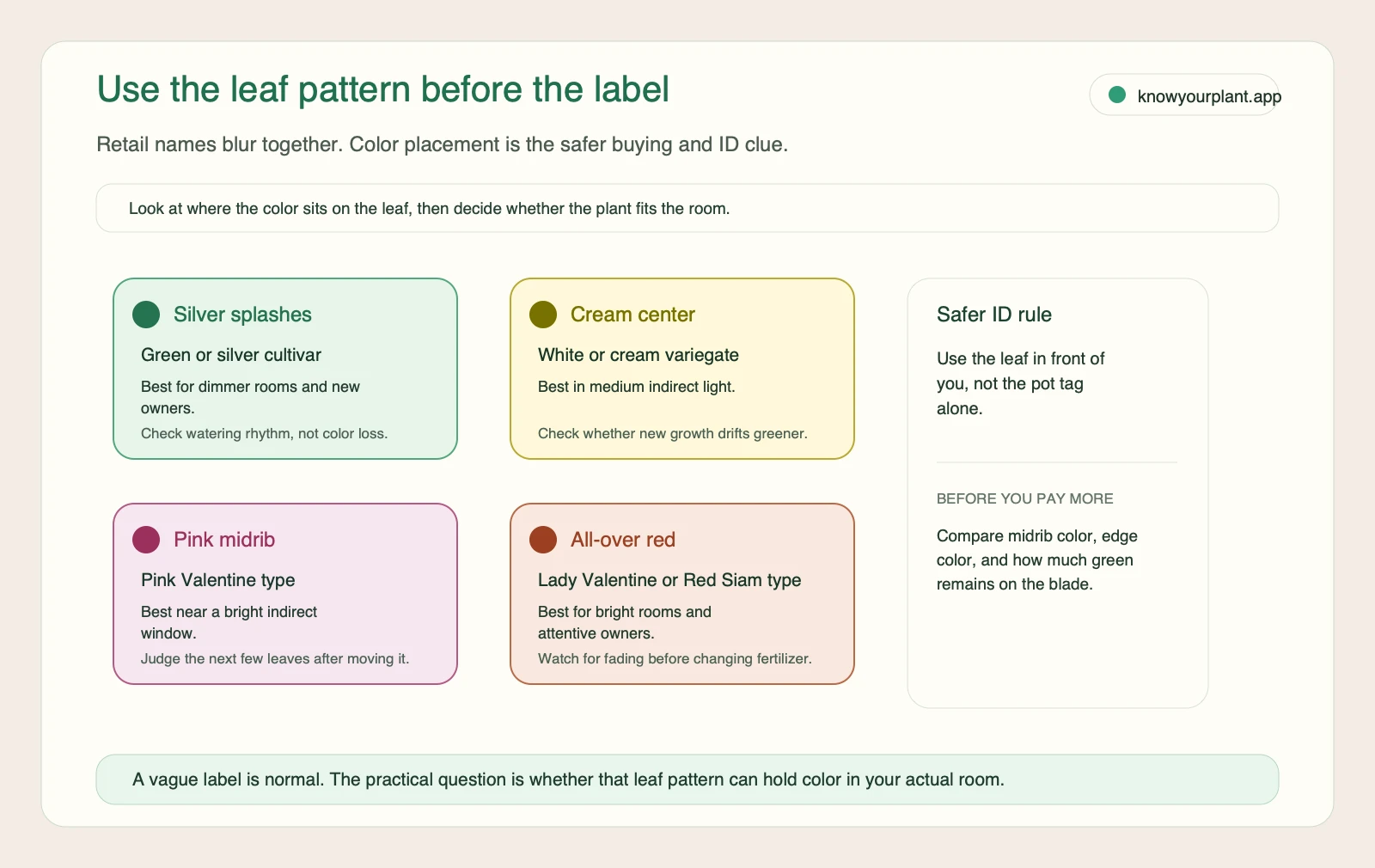
Use leaf pattern before the pot tag when labels are vague. Where the color sits on the blade is usually more useful than a generic pink or red aglaonema label.
Care Cards
| Variety group | Light | Water | Seasonal note | Best for |
|---|---|---|---|---|
| Green and silver basics | Low to medium indirect light | Let the top layer dry slightly, then water thoroughly | Winter growth often slows, but the color usually stays stable | Beginners, offices, dimmer rooms |
| White and cream variegates | Medium indirect light | Keep evenly moist but never soggy | Short winter days can make new growth greener | People who want more contrast without chasing pink color |
| Pink and red statement plants | Medium to bright indirect light | Water only after the top layer starts drying, then watch the next few leaves | Color usually softens first in autumn and winter unless the plant gets a better window or a grow light | Collectors, bright rooms, owners willing to adjust placement |
A Decision Guide for Your Home
If you’re not sure which type to get, here’s a straightforward routing based on your two most important constraints:
You have a bright-ish room (east or west window, or within a few feet of a south-facing window): Almost any Chinese evergreen variety will work well here. Pink and red forms hold color. Green and silver forms grow at a reasonable pace. Pick based on what appeals to you visually.
You have a medium-light room (bright indirect but no direct sun, or a north-facing window with decent daylight): Green and silver varieties are comfortable here. A cream-variegated form like Golden Bay can also work. Pink and red forms survive but gradually lose saturation. If you want pink, add supplemental light.
You have a low-light room (dim corners, spaces lit mainly by artificial light, rooms far from windows): Stay with green and silver cultivars. Silver Bay and Maria are the safest starting points. Pink and red forms will survive for a while in these conditions but won’t hold color or produce much new growth. If you’re still calibrating what “low light” really looks like in a home, compare the room against the examples in low-light indoor plants.
You have pets with access to your plants: All Chinese evergreens are toxic regardless of variety. This is a placement question, not a cultivar question. More on that below.
Lookalikes and Confused-With Labels
Here’s something that genuinely trips up a lot of buyers: cultivar names for Chinese evergreens are not consistent across sellers. A plant labeled “Pink Aglaonema” at one garden center may look quite different from the one with the same label at another shop down the road. Trade names like Lady Valentine and Pink Valentine describe distinct cultivars, but they’re sometimes used interchangeably in retail. Unnamed “red aglaonema” hybrids span a wide range of color patterns depending on the grower.
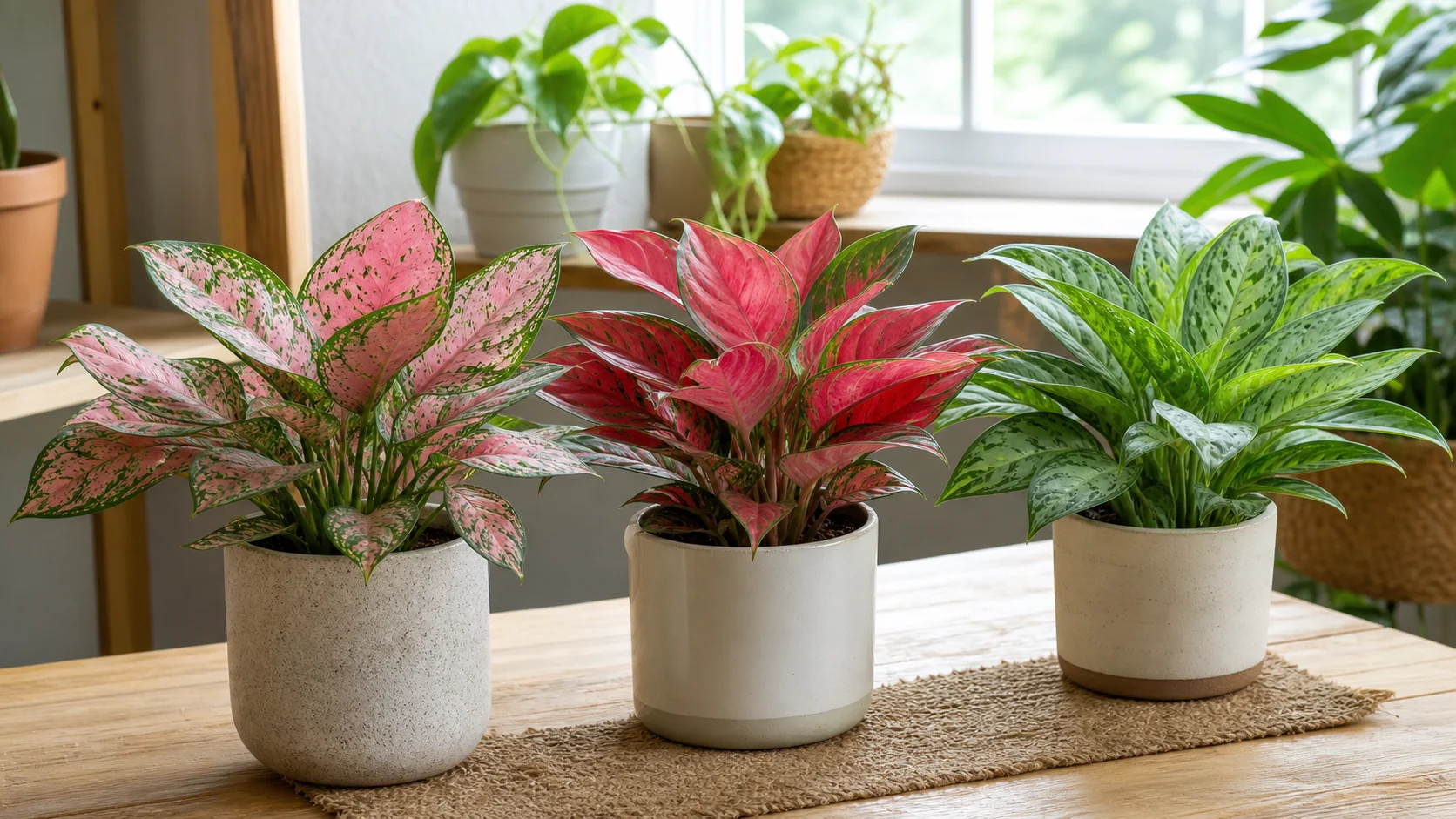
Comparing pink, red, and silver-green leaf coverage directly is often more reliable than trusting an inconsistent retail cultivar label.
The NCSU Extension notes that there are many cultivars within the genus, but formal naming conventions don’t always follow through to consumer packaging. This gap is especially pronounced with pink and red hybrids, which have proliferated through the trade in recent years under inconsistent labels.
The practical takeaway: buy based on what you see in front of you, not just the label. If you’re trying to match a plant you already have at home, focus on where the color appears on the leaf. Is the pink concentrated in the midrib, spread across the full leaf surface, or patchy and irregular? That pattern is a more reliable ID clue than anything on the tag.
| Common label or lookalike issue | What it usually means | Safer way to buy or ID it |
|---|---|---|
| “Pink aglaonema” with no cultivar name | A trade label, not a precise ID | Buy from the actual leaf pattern, not the tag alone |
| Lady Valentine vs Pink Valentine | Retailers sometimes blur the names | Use leaf coverage: all-over pink usually signals a Lady Valentine type, while a greener edge with a pink center is often sold as Pink Valentine |
| “Red aglaonema” used for multiple hybrids | Several distinct plants get grouped together | Compare the midrib color, edge color, and how much of the blade stays green before paying collector pricing |
| Silver Bay vs Maria | Both are forgiving silver-green forms | Silver Bay is broader and fuller, while Maria usually stays darker and more compact |
If the pink appears as small freckles on thin leaves rather than broad blocks on glossy leaves, you may have Hypoestes instead; use the polka dot plant care guide for that plant.
Common Problems by Variety Type
Most variety frustration shows up as the same few symptoms. The right first check depends on which color family you own and whether the plant is reacting to seasonal light changes or a true care issue.
| Symptom | Most likely variety context | First check | When to worry |
|---|---|---|---|
| Pink leaves fading or new growth coming in greener | Pink or red forms in medium or low light | Increase bright indirect light and judge the next two or three leaves, not the current one | Worry if fading comes with mushy stems, sour soil, or rapid yellowing |
| Very pale new leaves on a pink form | Fresh new growth or a high-color hybrid | Wait two to three weeks for the leaf to harden off, then reassess light | Worry if the leaf stays bleached and the plant is also floppy or stalled |
| Lower leaves yellowing from the base | Any variety, often after the mix stayed wet too long | Check soil moisture and drainage before feeding | Worry if several leaves drop fast and the pot stays soggy |
| You cannot tell which cultivar you own | Mixed retail labels and overlapping trade names | Use color placement and overall leaf pattern, not the pot tag | Worry only if you need an exact collector ID before paying collector prices |
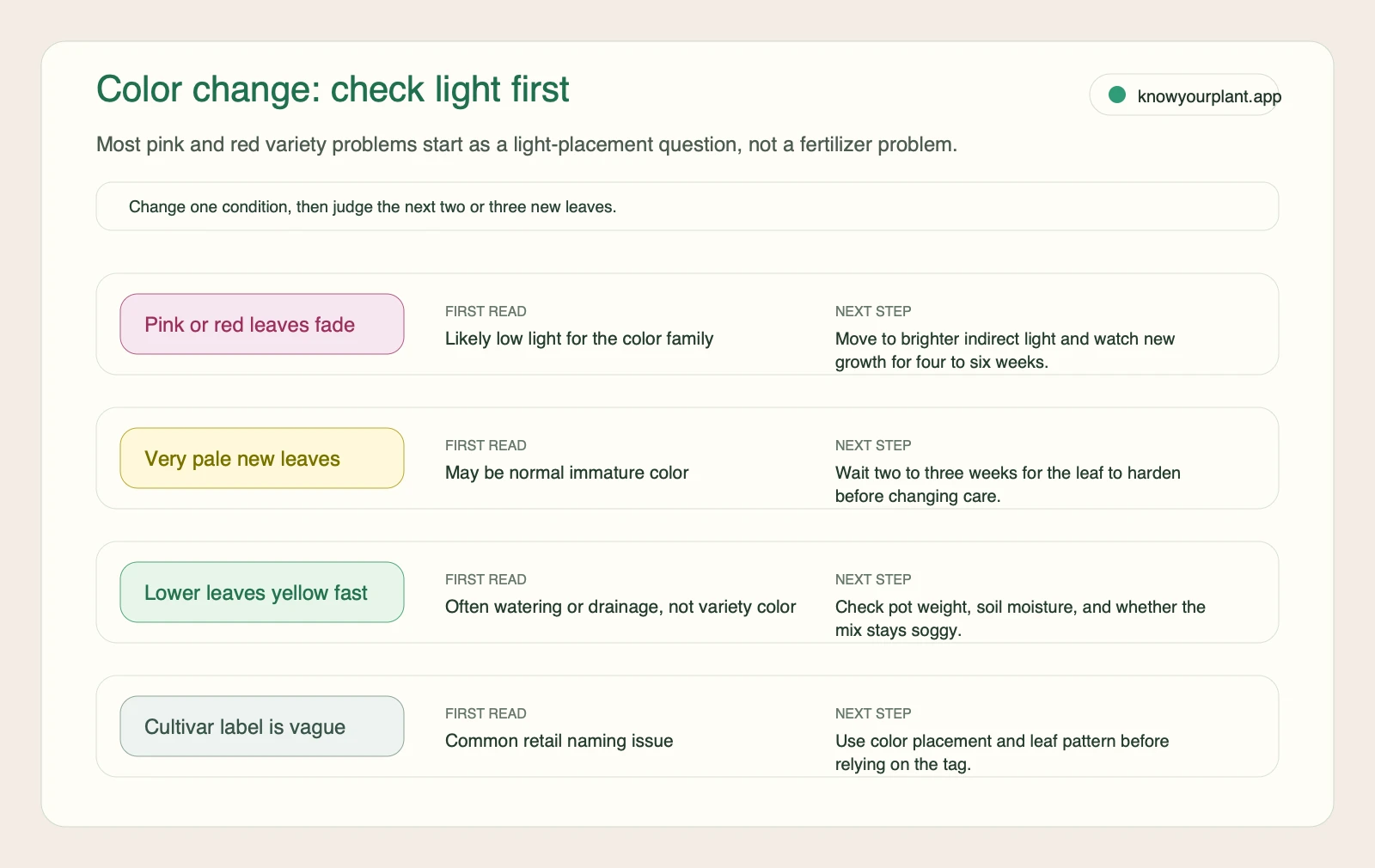
Use the triage table before changing fertilizer or repotting. For colorful aglaonemas, light placement is usually the first check, and the next few leaves tell you whether the change worked.
One of the more common worries with colorful aglaonemas is when new growth looks different from the rest of the plant. Here’s what’s usually happening:
New leaves coming in greener than the older ones: Almost always a light response in pink and red cultivars. Move the plant closer to a brighter indirect light source and watch the next two or three leaves. If color returns, you have your answer.
Color fading gradually across the whole plant over months: Usually a slow-build lighting issue. The plant is getting less light than it needs to maintain pigmentation over time. Check whether the plant has been moved, whether a curtain now blocks more light than before, or whether daylight hours have dropped significantly since the last growing season.
New leaves coming in very pale or almost white before opening: Some pink hybrids naturally produce pale new growth that deepens as the leaf matures and hardens off. Give a new leaf two to three weeks before deciding something is wrong. If it stays pale after fully opening while the rest of the plant looks healthy, consider light.
Lower leaves yellowing and dropping from the base: Normal over time as the plant grows and sheds older foliage. If it’s happening quickly across several leaves at once, check watering first. Consistently wet soil is the most common cause of accelerated lower-leaf loss in aglaonemas.
For watering thresholds, soil choices, and seasonal care across all varieties, the Chinese evergreen care guide covers those in full.
A Note on Pet Safety
All Chinese evergreens, regardless of variety, contain insoluble calcium oxalates. The ASPCA lists Chinese evergreen as toxic to cats, dogs, and horses, with clinical signs including oral irritation, drooling, vomiting, and difficulty swallowing. The pink and red forms are no more or less toxic than the green and silver ones. This applies to the whole category.
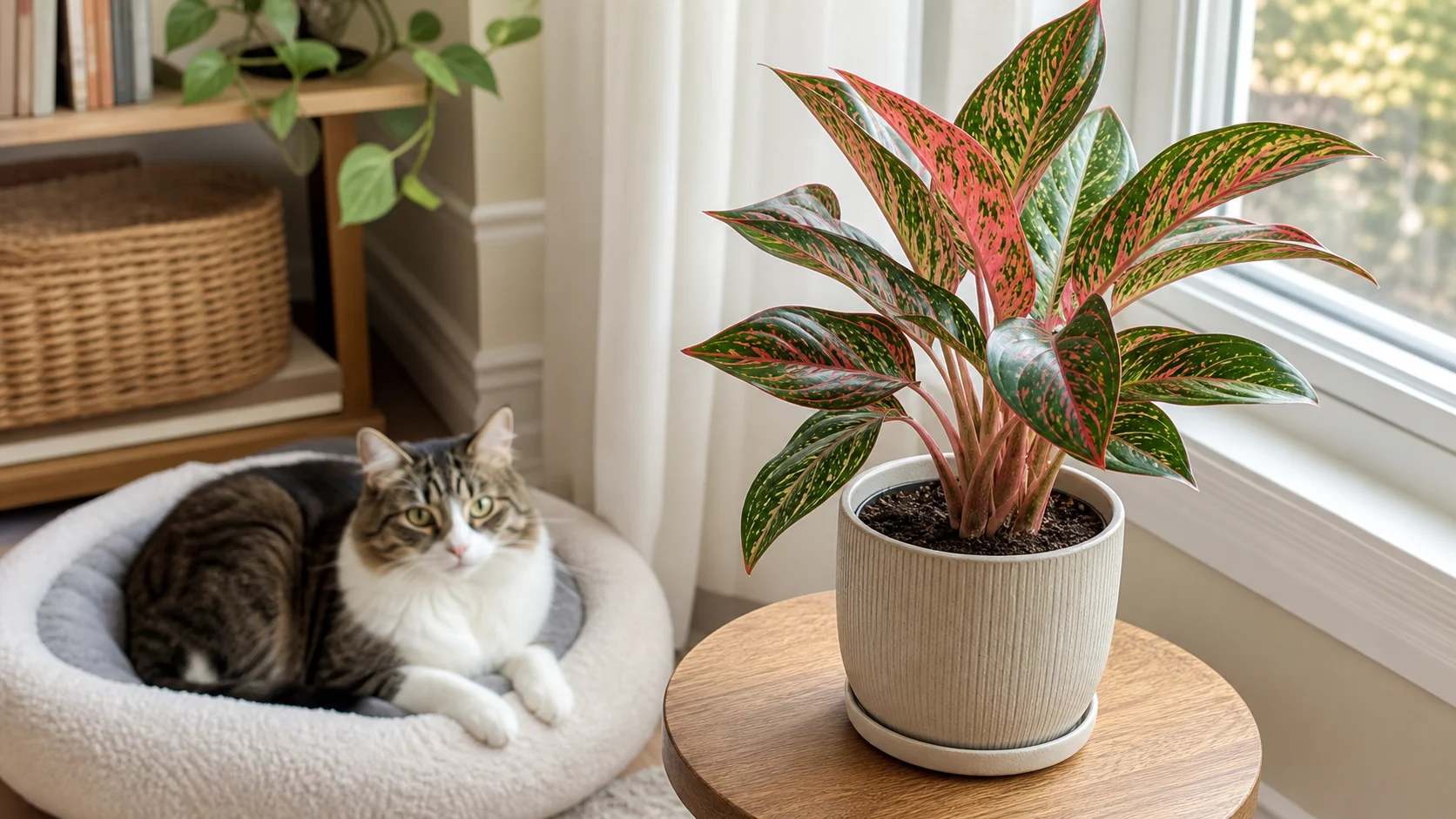
A low side table leaves Chinese evergreen foliage within a cat’s reach, making this a placement to avoid for pets that investigate plants.
If you have pets that chew on plants, the question isn’t which variety to choose, it’s where to place the plant or whether to choose a different species entirely. The guide to cat-safe indoor plants has alternatives that carry no toxic risk.
What to Sort Out Before You Choose
Light, first. This is more important than any other factor. Decide which spot the plant will actually live in, not the best spot in your home in theory. If that spot is dim, choose a green or silver variety. If it’s near a decent window, almost any cultivar works.
Pets and kids. All varieties are toxic. Placement is the solution, not cultivar selection.
How hands-on you want to be. Green and silver forms need less intervention. Pink and red forms reward some attention to placement and seasonal light shifts, especially in autumn and winter when daylight hours drop. Neither type is high-maintenance by houseplant standards, but there is a real difference in how forgiving each one is.
Your experience level. If this is one of your first few houseplants, the guide to easy houseplants for beginners is worth reading before committing to a pink or red cultivar. A green or silver aglaonema is a more comfortable starting point while you’re still building confidence with plants.
Choosing the Right Variety for Your Home
Green and silver forms are the smarter default for most homes. They handle the conditions that actually exist in average apartments and offices, hold their appearance through the seasons, and don’t require much from you to stay presentable.
Pink and red forms are a different kind of plant relationship. When the light is right, they’re among the more striking foliage plants you can keep indoors. When it isn’t, they tell you slowly by producing paler new leaves. You can fix that by adjusting placement or adding supplemental light, but you do need to notice it and respond.
If you want something in between, look at lightly variegated cream forms like Golden Bay. They offer more visual variation than a straight green cultivar without the stricter light demands of fully pink forms.
Chinese evergreens as a group remain one of the more adaptable plant families for indoor growing. The variety choice is really just about knowing which version of that adaptability fits your space and your habits.
Methodology
This guide was updated after reviewing NCSU Extension guidance on Aglaonema, Costa Farms’ consumer variety list, ASPCA pet-safety data, and recurring owner questions on Houzz and Reddit about fading pink color, pale new leaves, and inconsistent cultivar labels. Extension, retailer, and safety sources were used for direct care and toxicity claims. Forum and discussion threads were used only as qualitative signal for the questions owners keep asking.
A blank research workspace beside a pink Aglaonema reflects the source review and practical owner-question analysis behind this guide.
Real User FAQ
What is the easiest Chinese evergreen variety for beginners? Silver Bay and Maria are the most consistently recommended starting points. Both handle lower indirect light without complaint, stay compact enough for a shelf or table, and don’t need humidity levels above what most homes already have. If you want something that stays healthy with minimal adjustment, either of those is a solid first aglaonema.
Do pink Chinese evergreens need more light than green ones? Yes, noticeably more. The pink and red pigmentation in cultivars like Pink Valentine or Lady Valentine requires more light energy to develop and hold over time. In lower-light rooms, new leaves often emerge greener or paler than the existing foliage on the plant. Bright indirect light, a few feet from an east- or west-facing window, is where these forms hold color best.
Why are my pink aglaonema’s new leaves coming in lighter than the older ones? This is almost always a lighting response, not a disease or nutrient problem. When a pink or red cultivar doesn’t receive enough light, new growth develops with less pigmentation. Move the plant to a brighter spot and watch the next two or three leaves. If they come in with more color, light was the issue. If the plant also has soft stems near the base, mushy soil, or yellowing spreading up from older leaves, check your watering routine.
Are all Chinese evergreen varieties equally toxic to pets? Yes. The ASPCA lists Chinese evergreen as toxic to cats, dogs, and horses regardless of variety. The toxic compounds are insoluble calcium oxalates, which cause oral irritation, drooling, and vomiting. No cultivar is safer than another for pets that chew on plants.
Can I identify my Chinese evergreen variety from the leaf pattern? You can often get close. Cultivar naming at retail is inconsistent, so the label alone isn’t reliable. Look at where the color appears on the leaf: a pink midrib with green edges differs from an evenly flushed pink or red surface. The pattern and color distribution together are more useful for identification than any name tag.
How do I stop my red or pink Chinese evergreen’s color from fading? Consistent bright indirect light is the main lever. Moving the plant closer to an east- or west-facing window usually helps. If your room doesn’t have great natural light, a grow light running for a few extra hours each day compensates well. Fertilizing in spring and summer with a balanced houseplant fertilizer supports healthy leaf development, but it won’t restore color that’s fading due to insufficient light. Start with light before adjusting anything else.
What is the difference between Lady Valentine and Pink Valentine aglaonema? Both are pink-heavy cultivars but distinct hybrids. Lady Valentine typically shows more intensely saturated pink across the full leaf surface. Pink Valentine tends to concentrate pink in the midrib and center with greener edges. Sellers sometimes use the names interchangeably, so the leaf you’re looking at matters more than the tag. If you want deep, all-over pink, look at the leaf surface directly rather than relying on the name.
Will a Chinese evergreen lose its color if I move it to a lower-light room? Green and silver varieties hold their appearance well in lower light. Pink and red varieties will gradually produce paler, greener new leaves if the light isn’t sufficient. The older leaves don’t change, but over time the plant’s overall look shifts as new growth comes in with less saturation. Moving it back to better light, or adding a grow light, reverses the trend.