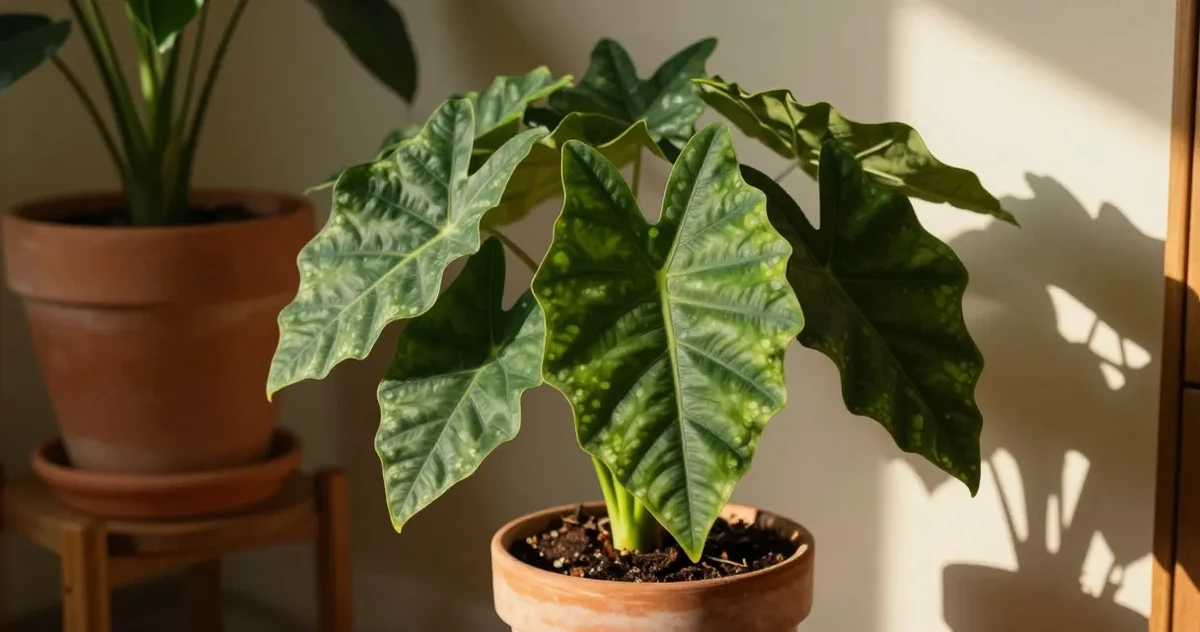
By the KnowYourPlant editorial team. The care thresholds in this guide are based on university extension sources, horticulture references, and indoor-growing observations cross-checked in May 2026.
Alocasia drops leaves, grows brown tips, and sulks indoors. Almost always, it comes down to three fixable problems: not enough light, too little humidity, or inconsistent watering.
Quick reference: 6+ hours of bright indirect light / Water when the top 1-2 inches of soil feel dry / Aim for 60%+ humidity
Alocasia is a genus of tropical aroids native to the rainforests of Southeast Asia, grown indoors for their large, arrow-shaped leaves and striking pale-veined markings. Most popular varieties stay manageable indoors, though they have a reputation for being demanding. That reputation is partly deserved: alocasia care requires attention to light, humidity, and watering. But the rules are consistent, and once you understand what this plant is asking for, it stops feeling mysterious.
What Most Alocasia Guides Miss
Most care guides treat alocasia symptoms as single-cause problems: water more if it droops, water less if it yellows. The problem is that with alocasia, the same symptom often has two opposite causes, and the fix depends entirely on what the soil and roots tell you, not just the leaves.
The most common misdiagnosis: a drooping, sad-looking plant gets more water when the real problem is soggy roots. In bright summer conditions, drooping usually is thirst. In lower light or cooler conditions, a drooping plant often already has wet, oxygen-starved roots, and adding more water makes things significantly worse.
The first check is always the soil, not the leaves. Before you adjust watering, fertilizing, or move the plant, press your finger into the soil to the second knuckle. If it’s wet and hasn’t dried out, the problem isn’t light, nutrients, or humidity. It’s that the roots need air. If the soil is bone dry, water it first and then reassess.
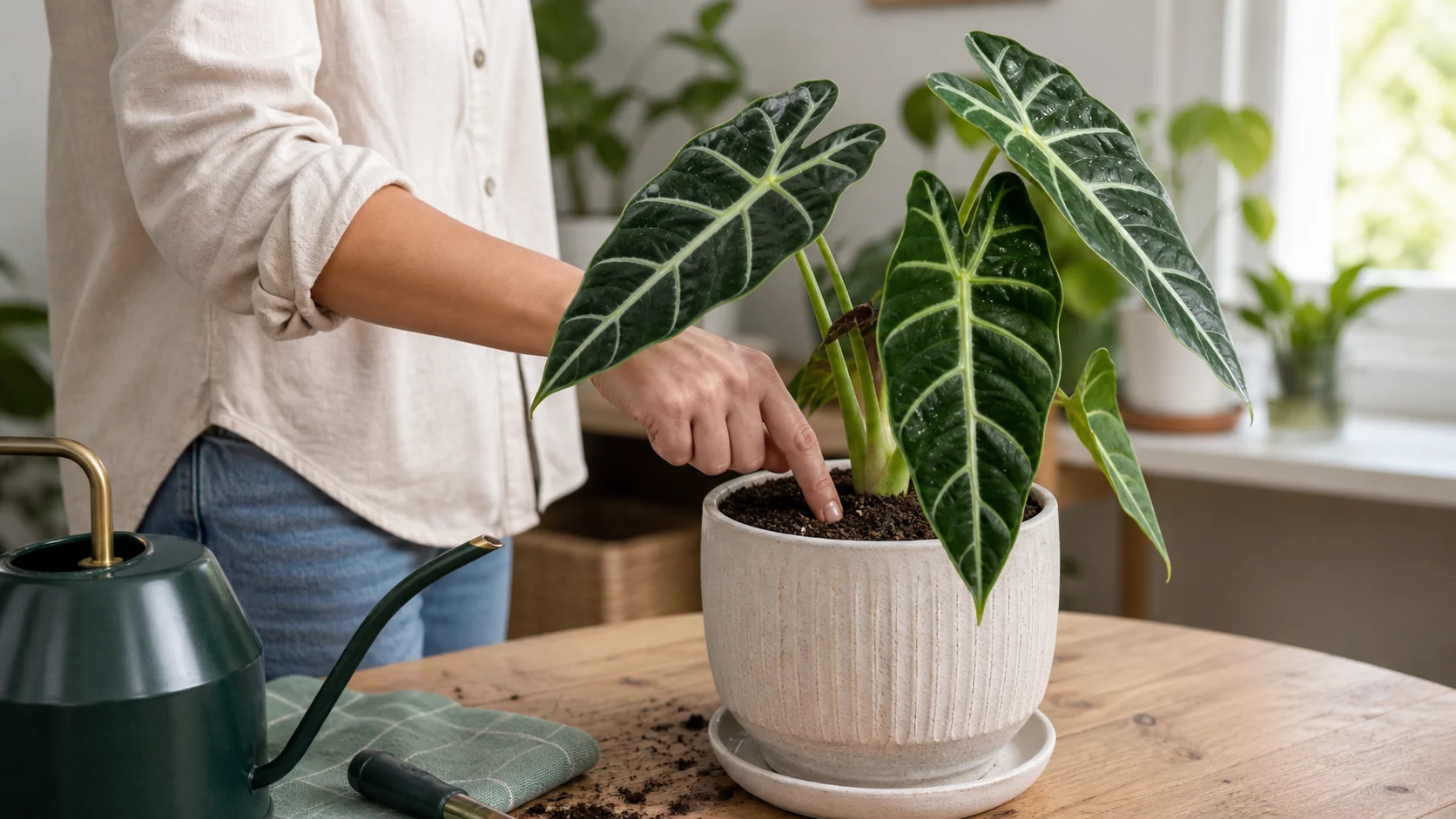
Check the soil before reacting to drooping leaves, because wet and dry roots call for opposite fixes.
That one habit, checking soil before acting, resolves the majority of alocasia problems owners deal with indoors.
Community Signal: The Symptoms Owners Misread Most
In plant-help threads and grower discussions reviewed in May 2026, the same four confusion points kept repeating:
- Drooping right after watering: often a soggy-root problem in lower light or cooler rooms, not a sign to water again.
- Sudden collapse after bringing the plant home: usually worth treating as drainage, root stress, or environment shock before assuming the schedule is simply too dry.
- Winter leaf loss: commonly triggers panic, but a firm corm with cooler, dimmer conditions points more toward dormancy than death.
- Yellow leaves with brown edges: should push you to check moisture and root condition first, before blaming fungus or light burn.
Use these patterns as a diagnosis order, not a verdict. They are recurring owner reports, so they help you choose the first inspection, but the plant in front of you still gets the final say.
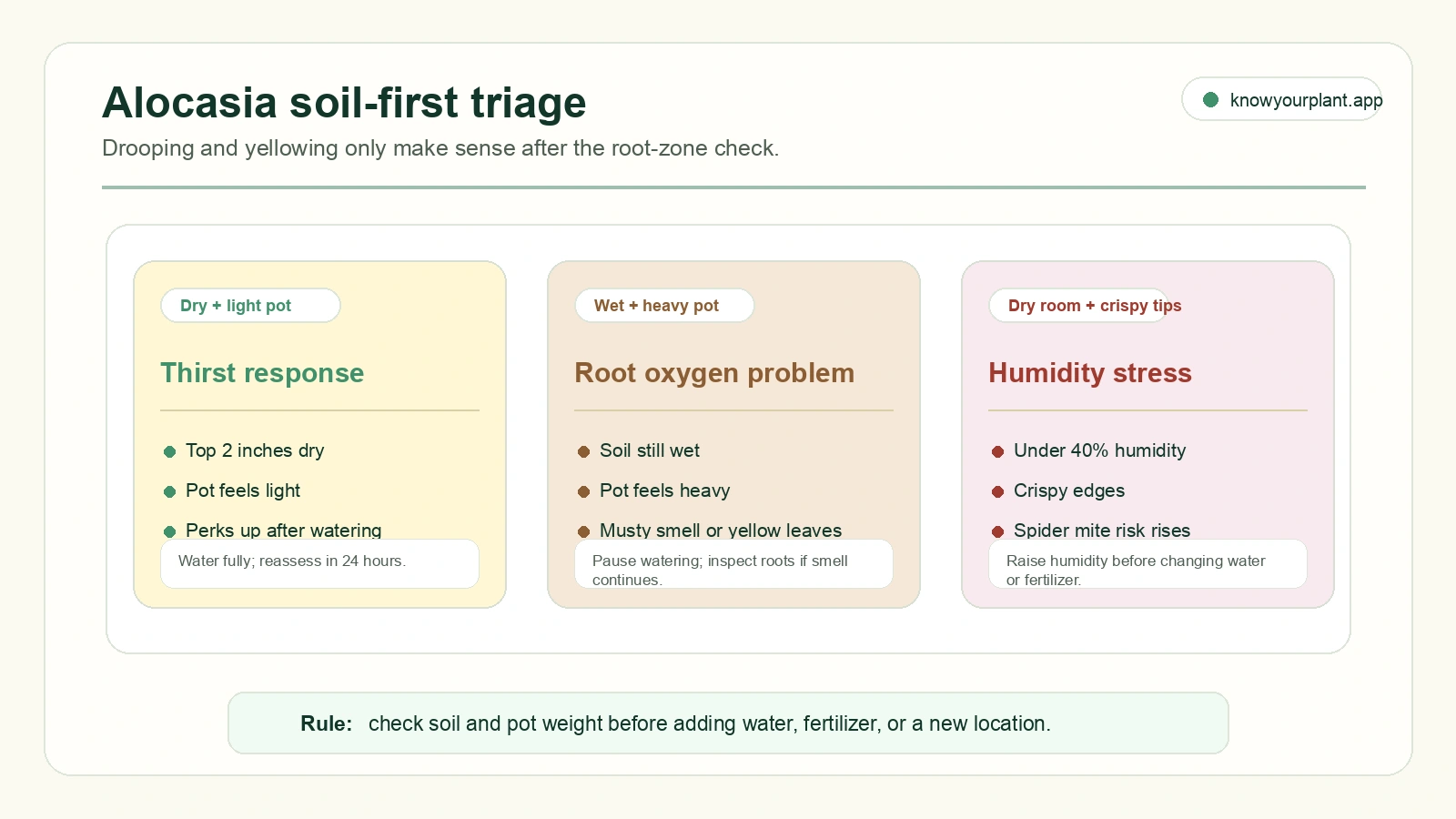
Use the triage before changing care: dry soil, wet soil, and dry air can all make alocasia look stressed, but they need different fixes.
Identification Snapshot
Before you fine-tune care, make sure you really have an alocasia and not one of her lookalikes.
- Leaf posture: Alocasia leaves usually sit more upright.
- Leaf shape: Most indoor types have arrow-shaped leaves with strong pale veins.
- Growth habit: She grows from a corm at the base and often holds fewer, bigger leaves rather than lots of small ones.
- Most common mix-up: Colocasia. Colocasia leaves often hang more downward and attach closer to the center underside of the leaf.
Why this matters: colocasia generally tolerates wetter soil than alocasia. If you confuse the two, it’s easy to keep alocasia too wet and blame the wrong problem when she starts to droop. Our elephant ear plant care guide explains the difference in more detail if you are still not sure which type you have.
Care Cards
| Care card | What to do | What usually goes wrong |
|---|---|---|
| Light care card | Give alocasia 6+ hours of bright indirect light, or add a grow light in dim rooms. | Owners hear “indirect light” and put it in a dark corner where the soil stays wet too long. |
| Water care card | Water when the top 1 to 2 inches are dry, then let excess drain fully. | Fixed weekly watering ignores seasonal slowdown and causes root stress. |
| Humidity care card | Aim for 60%+ humidity, especially in winter. | Brown tips get blamed on fertilizer when the real issue is dry air. |
| Soil care card | Use an airy mix with drainage and root oxygen. | Dense nursery mix stays soggy after purchase, especially in low light. |
| Winter care card | Reduce watering and stop fertilizer when growth stalls. | Dormancy gets mistaken for death, so people keep watering and rot the corm. |
| Pet safety care card | Keep alocasia out of reach of pets and children. | The plant looks decorative, but it is not pet-safe if chewed. |
These care cards reflect the same pattern seen in the research pack: light, moisture, humidity, and dormancy interact, so the right fix depends on checking the whole setup instead of chasing one symptom.
Light: Where Alocasia Feels at Home
Alocasia wants bright, indirect light. The placement relative to your window matters more than compass direction alone.
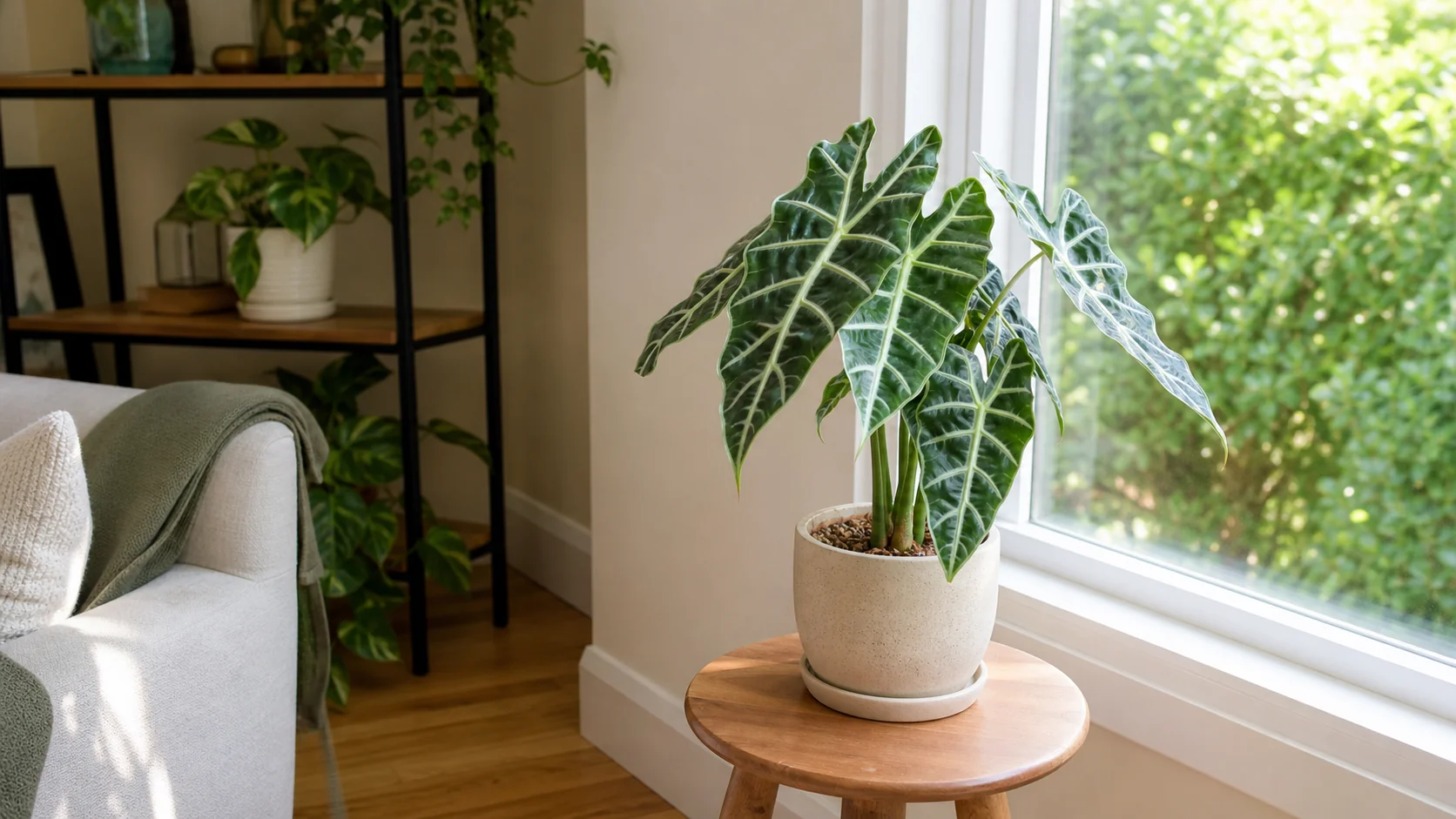
Place alocasia where bright window light reaches the leaves without hours of harsh direct sun.
Window placement guide:
| Window type | Distance from glass | Estimated lux | Expected outcome |
|---|---|---|---|
| South or west-facing, unobstructed | 2-4 ft back or behind sheer curtain | 1,500-3,000 lux | Active growth, new leaf every 2-3 weeks in season |
| East-facing, unobstructed | Right at the window | 1,000-2,000 lux | Steady growth, slightly slower in winter |
| North-facing or obstructed south | Any distance | Under 500 lux | Growth stops, leaf drop likely within 6-8 weeks |
| Any window + grow light overhead | Per grow light specs | Supplement to 2,000+ lux | Can compensate for limited natural light in winter |
Direct sun will scorch the leaves, often leaving pale or brown patches that don’t recover. At the same time, low light isn’t a safe fallback. According to the University of Florida IFAS Extension, tropical aroids like alocasia need a minimum of 6 hours of bright indirect light daily to sustain active growth. In dim conditions, alocasia slows to a crawl, eventually stops producing new leaves, and may start dropping older ones as she conserves energy. If your space is genuinely low-light, this plant will struggle there.
If natural light is limited, a grow light positioned close overhead can fill the gap through the darker months. Our guide to grow lights for indoor plants covers what actually works.
Watering: Consistent, Not Soggy
Water when the top 1 to 2 inches of soil have dried out, then water thoroughly until it drains from the bottom. Tip the saucer after watering so the pot doesn’t sit in water.
This is where most people go wrong in both directions. Alocasia doesn’t like to dry out completely between waterings the way a pothos or snake plant does. But she also punishes soggy roots quickly.
How long does the top 2 inches take to dry out? It depends on the season:
- Spring: 6-9 days as light and warmth return. Begin increasing your check frequency.
- Summer: 5-7 days in bright, warm conditions. This is peak watering season.
- Autumn: 9-12 days as light fades. Begin stretching the interval between waterings.
- Winter: 10-14 days or longer. In low light and cool rooms, soil stays wet much longer than most people expect.
A drooping plant is often thirsty, but not always. If the soil feels wet and the plant is drooping, that’s a root problem, not a dry spell. Lift the pot: if it feels heavy and the soil smells musty, ease back on watering and check the roots at your next repot. If the soil feels dry and the pot is light, water it.
A useful way to think about watering, echoed by House Plant Journal, is to let light drive the schedule. In lower light, the same pot stays wet much longer, and that is where overwatering usually starts.
Yellow leaves at the base of the plant are usually a sign of overwatering over time. Brown, crispy tips are more often a humidity issue than a watering one.
Seasonal Care: What Changes Through the Year
Alocasia doesn’t stay static, and neither should your care routine. Find your season below to orient your full care plan before adjusting individual parameters.
Spring: This is when alocasia wakes up. As days lengthen and light returns, growth resumes and the plant can push out a new leaf every two to three weeks under good conditions. Resume or increase watering frequency as the soil starts drying out faster, expect the top 2 inches to dry in 6-9 days. Start fertilizing again with a diluted balanced fertilizer every two to four weeks.
Summer: Peak growing season. Keep up with watering, maintain high humidity, and give the plant your brightest indirect spot. Soil dries fast in summer, often within 5-7 days, so check it more frequently than you think you need to. If you move the plant outside, wait until overnight temperatures are reliably above 55 degrees Fahrenheit. Watch for spider mites in hot, dry stretches, as they thrive when humidity drops.
Autumn: Growth slows as light fades. Begin tapering fertilizer in early autumn and stop entirely by October. Soil drying slows to 9-12 days, so stretch the watering interval accordingly. NC State Extension recommends stopping fertilizer for tropical houseplants between October and February when growth stalls.
Winter: Alocasia may go partially or fully dormant, dropping lower leaves as she conserves energy. This is normal, not a death spiral. Soil can take 10-14 days or longer to dry in low light and cool rooms. Keep the soil barely moist rather than consistently wet. Avoid cold drafts from windows and keep her away from heating vents that blast dry air. If the corm underground survives with no signs of rot, new growth will return in spring.
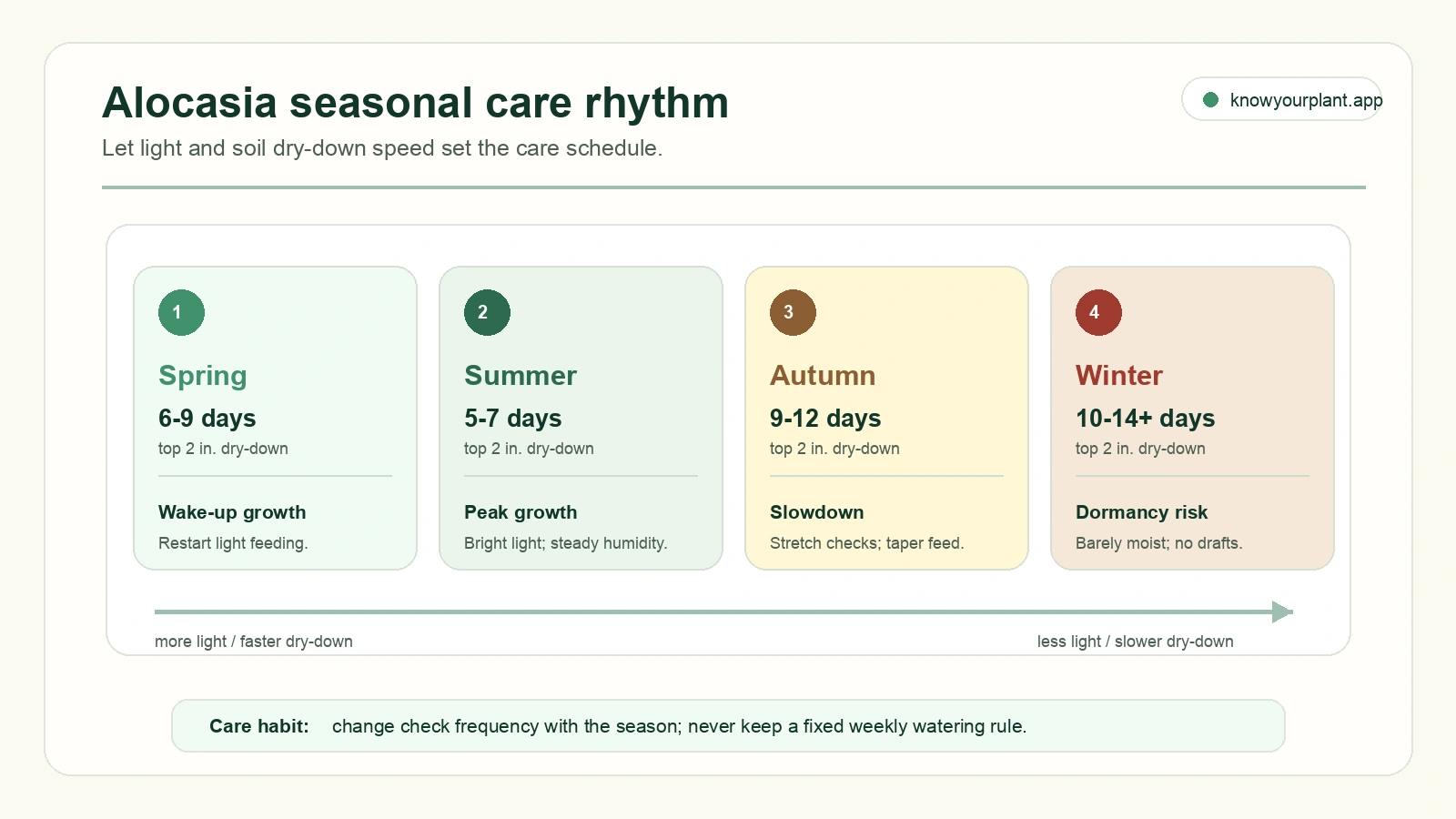
Use the season map to change your checking rhythm as light changes. Alocasia care breaks down when a summer watering habit carries into winter.
Humidity: The One Thing Most People Underestimate
Aim for 60% humidity or higher. Low humidity is the most common reason alocasia underperforms indoors, and it is behind three of the most frustrating symptoms: crispy leaf edges, persistent brown tips, and spider mite outbreaks.
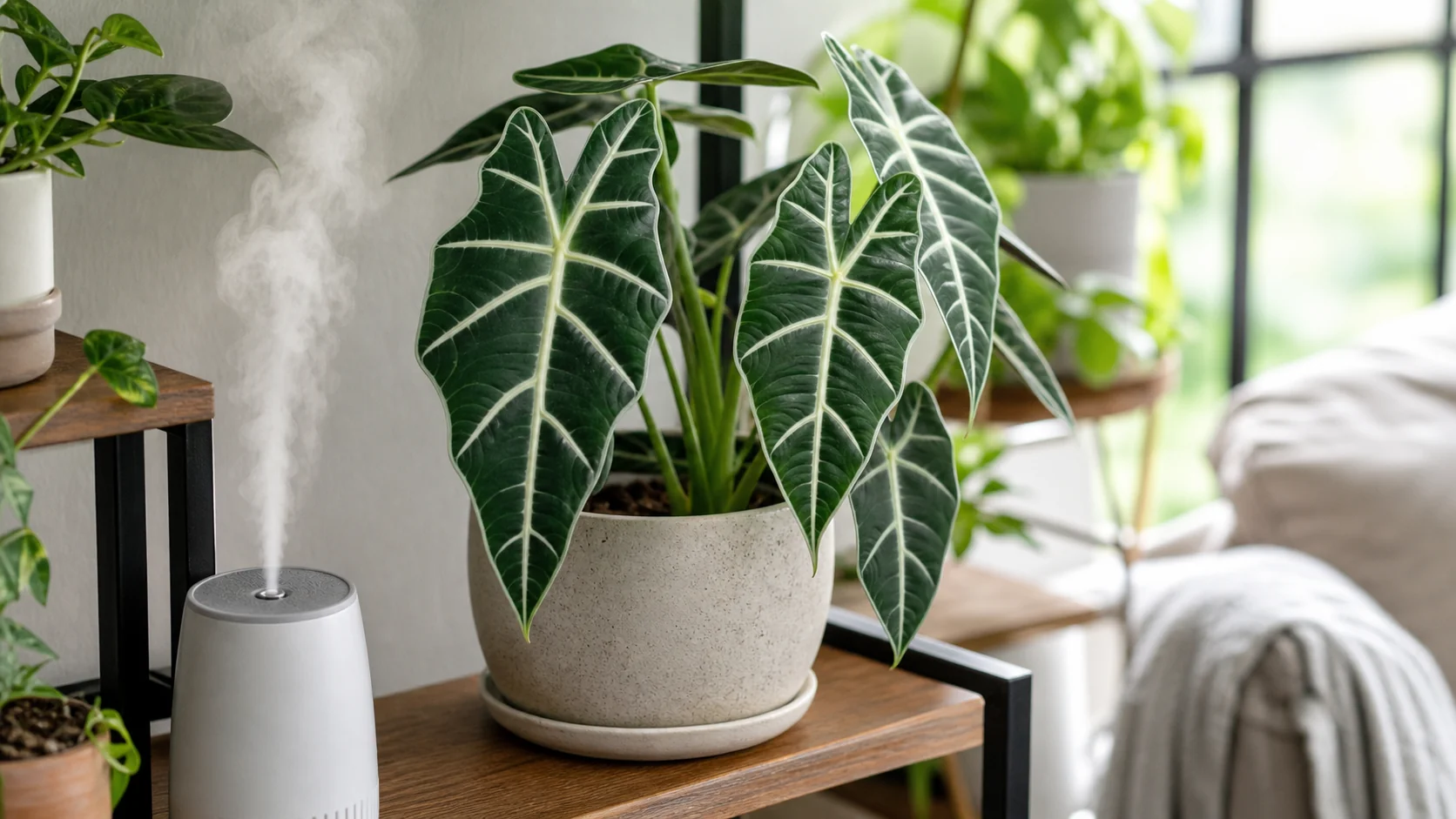
A nearby humidifier and grouped plants create a more stable humid zone around sensitive alocasia leaves.
The University of Minnesota Extension notes that average indoor humidity during winter heating season often drops to 30% or below, far short of what tropical aroids need to stay healthy. That gap between what your home offers and what alocasia expects is where most problems begin.
Hygrometer reference points – a basic hygrometer costs $10-15 and removes the guesswork:
- Below 40%: Spider mite risk zone. Alocasia shows stress through brown tips and crispy edges at this level.
- 40-55%: Acceptable short-term. Most varieties survive here, but Frydek will show stress first.
- 60%+: Target zone. Active growth, healthy leaf edges, and reduced pest pressure.
Practical approaches, and one to skip:
- Pebble tray: Works. Fill a tray with pebbles, add water to just below the pot base, set the pot on top. Evaporation raises local humidity around the plant.
- Grouping plants: Works. Plants share transpired moisture when clustered together, nudging local humidity up without any hardware.
- Small humidifier: Works best. Running one nearby, especially in winter, is the most reliable way to hit 60%+ consistently.
- Misting the leaves: Skip it. Misting offers minimal lasting humidity benefit and can invite fungal spots if the leaves stay damp.
What to buy before you bring alocasia home, ranked by impact:
- Small humidifier – the single highest-impact purchase for winter survival and leaf quality
- Perlite and orchid bark – to amend potting mix for the drainage and aeration alocasia needs
- Well-draining pot with a drainage hole – terracotta works well in humid rooms; plastic in dry or heated spaces
- Basic hygrometer – cheap and gives you actual data rather than guesswork on humidity levels
Soil and Pot
Alocasia roots want to stay moist but need oxygen too.
Recommended mix ratio: 1 part standard potting mix : 1 part perlite : 1 part orchid bark. This holds just enough moisture between waterings without staying waterlogged and gives roots the air pockets they need to stay healthy.
A pot with a drainage hole is not optional. If the pot you love has no drainage, use a nursery pot inside it and empty the outer pot after watering.
Terracotta dries out faster than plastic or ceramic, which can work well for alocasia in high-humidity rooms. In dry climates or heated indoor spaces, plastic keeps moisture more consistent.
When to repot – move up a size when you see:
- Roots circling the drainage hole or pushing out the bottom
- Water running straight through the pot without being absorbed by the soil
- The plant tipping over because the root ball has outgrown the pot’s base
When your alocasia is ready for a new pot, move up just one size, about 1 to 2 inches wider in diameter. Too large a pot holds excess moisture that roots can’t absorb quickly, raising the risk of rot. Our guide to how to repot plants covers timing and technique in full.
Soil Mix Scorecard
| Mix type | Drainage | Root-air access | Forgiveness indoors | Best use |
|---|---|---|---|---|
| Dense nursery mix | Low | Low | Low | Short-term holding mix only, especially risky in dim rooms |
| Standard potting mix | Medium | Medium | Medium | Works if your light is strong and you water carefully |
| Chunky aroid mix | High | High | High | Best default for indoor alocasia, especially if you are still learning the plant |
If your plant is declining in a pot that stays wet for a long time, upgrade the mix before you assume the answer is more humidity or a stricter watering schedule.
Temperature and Placement
Alocasia is comfortable in the same temperature range most people keep their homes: 65 to 85 degrees Fahrenheit. According to the University of Florida IFAS Extension, temperatures below 60°F slow growth noticeably, and sustained temperatures below 50°F can push the plant into dormancy or trigger significant leaf drop, even if the corm underground survives.
The real risks are cold drafts and sudden temperature swings. Keep her away from air conditioning vents, exterior doors that open frequently in cold weather, and radiators that blast dry heat.
Feeding Through the Growing Season
In spring and summer, a diluted balanced fertilizer every two to four weeks gives alocasia what she needs to push out new leaves. Reduce feeding in autumn and stop entirely through winter when growth slows.
One rule worth keeping: don’t fertilize a plant that is stressed, newly repotted, or showing signs of root trouble. Feed healthy plants; let struggling ones recover first. Our plant fertilizer guide covers timing, dilution ratios, and what to do when leaves aren’t responding to feeding.
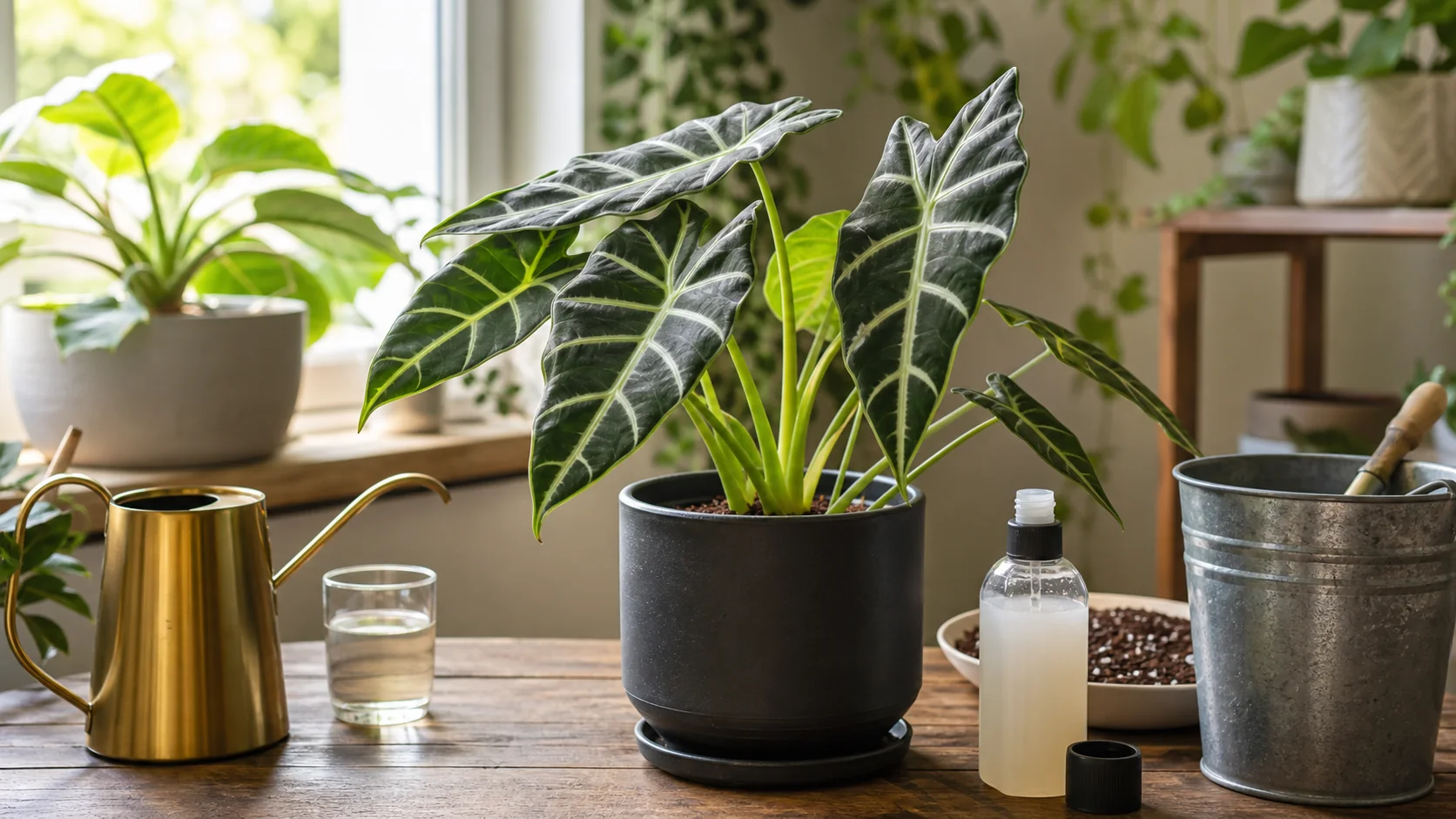
Dilute balanced fertilizer before feeding a healthy, actively growing alocasia in spring or summer.
Diagnosing What’s Going Wrong
One thing alocasia owners quickly learn: the same symptom can have two opposite causes. Reading the whole plant, not just one leaf, gets you to the right answer faster.
| Symptom | Check first | Most likely next move |
|---|---|---|
| Drooping leaves + wet soil | Root oxygen and smell | Pause watering and inspect drainage |
| Drooping leaves + dry soil | Moisture level through the pot | Water thoroughly, then reassess in 24 hours |
| Yellow lower leaves + heavy pot | Overwatering over time | Stretch the watering interval and improve light |
| Brown crispy tips + dry room | Humidity reading | Raise humidity before changing fertilizer |
| Winter leaf loss + firm corm | Dormancy, not death | Water less and wait for spring growth |
| Fine webbing or dusty leaves | Leaf undersides | Treat for spider mites early |
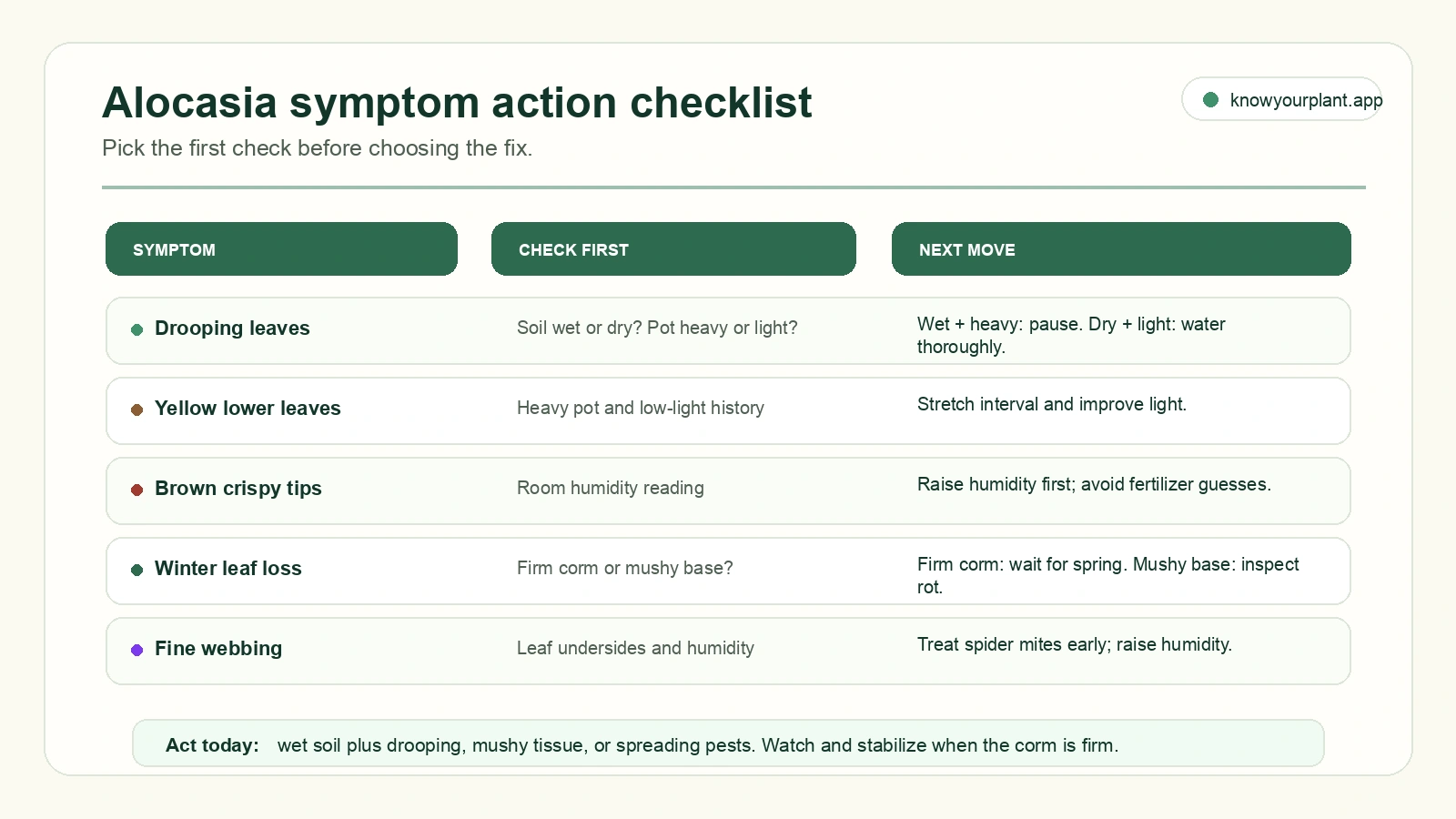
Use the checklist to separate same-day fixes from watchful waiting. The first check prevents the common mistake of watering a plant whose roots need air.
Yellow leaves (watchful waiting, unless paired with wet soil, which needs action today)
Most often overwatering, or a plant sitting in low light longer than it can handle. Check the soil first. If it’s wet and hasn’t dried out properly, ease back on watering. If the soil is dry and light has been poor, improve both before assuming something worse.
Drooping (check today: wet soil plus drooping means root rot, not thirst)
Wet soil plus drooping leaves points to a root problem, not drought. Dry soil plus a light pot means it needs water. These are opposite problems with opposite fixes, so the soil check matters before you do anything else. If the pot has stayed wet and the base smells sour, follow our step-by-step root rot treatment guide before watering again.
Brown leaf tips (watchful waiting; soft or mushy tips need same-day attention)
Dry, crispy tips almost always point to low humidity. Occasionally tap water minerals, especially in hard-water areas, play a role. Letting tap water sit overnight or switching to filtered water can help. Brown tips that are soft or mushy rather than crispy usually indicate overwatering or the early stages of root rot.
Leaf drop in winter (watchful waiting, normal dormancy behavior)
Alocasia can go partially or fully dormant in low light and cold temperatures. Losing leaves in winter, particularly lower ones, is normal. The corm underground is usually fine. Keep the soil barely moist and wait for spring.
Dormancy recovery protocol: If the plant drops all leaves and goes fully dormant, don’t discard it. Month 1: Stop watering almost entirely, just enough to keep the corm from shriveling, roughly a small amount once a month. Months 2-3: Move to brighter light as days lengthen and watch the corm’s base for a green nub emerging from the soil. Once a shoot appears, resume normal watering and begin fertilizing lightly. Most dormant corms with no visible rot will produce new growth by late spring.
Spider mites (act today; treat before they spread)
These appear when humidity drops below 40%. NC State Extension identifies low ambient humidity as a primary trigger for spider mite trouble on tropical foliage plants indoors. Check under the leaves for fine webbing and a dusty, stippled look to the leaf surface. Treat early with a diluted neem oil solution. Our guide to how to get rid of spider mites walks through the full removal process.
Mistakes Alocasia Owners Make in the First Month
Most alocasia losses happen in the first four to six weeks. These are the five patterns that show up most consistently:
-
Watering on a fixed schedule instead of checking the soil. The most common mistake and the one that causes the most root rot. A week-one routine that worked can destroy the plant by week three if light or temperature has changed and the soil is staying wet much longer than before.
-
Placing it in indirect light that is actually just low light. “Not in direct sun” is not the same as “bright indirect light.” A corner 8 feet from the nearest window won’t sustain this plant. If you can comfortably read a book there without a lamp, the light is probably sufficient. If you need the lamp, it isn’t.
-
Misting in response to brown tips. Brown tips are almost always a humidity problem, but misting is not the solution. It raises local humidity for a few minutes and leaves water sitting on the leaf surface, which can encourage fungal spots. A humidifier or pebble tray addresses the cause; misting doesn’t.
-
Repotting immediately after purchase. Repotting a recently bought alocasia into fresh soil is well-intentioned but adds a second stress on top of the relocation. Give the plant 3-4 weeks to acclimate before disturbing her roots, unless the pot has no drainage hole at all.
-
Interpreting normal leaf drop as failure. Most alocasias shed one to three leaves when moved to a new environment. This is an adjustment response, not a sign the plant is dying. Stable conditions for 3-4 weeks almost always result in a new leaf emerging from the center, confirming the plant is settling in rather than declining.
Toxicity
All parts of alocasia contain insoluble calcium oxalate crystals. According to the ASPCA, ingestion causes immediate oral irritation, excessive drooling, difficulty swallowing, and vomiting in cats and dogs. The same crystals cause a burning sensation and mouth swelling in humans.
Keep the plant out of reach of pets and small children, and wash your hands after handling it, particularly when repotting. For a list of plants that are safe to keep around cats, see our guide to cat-safe indoor plants.
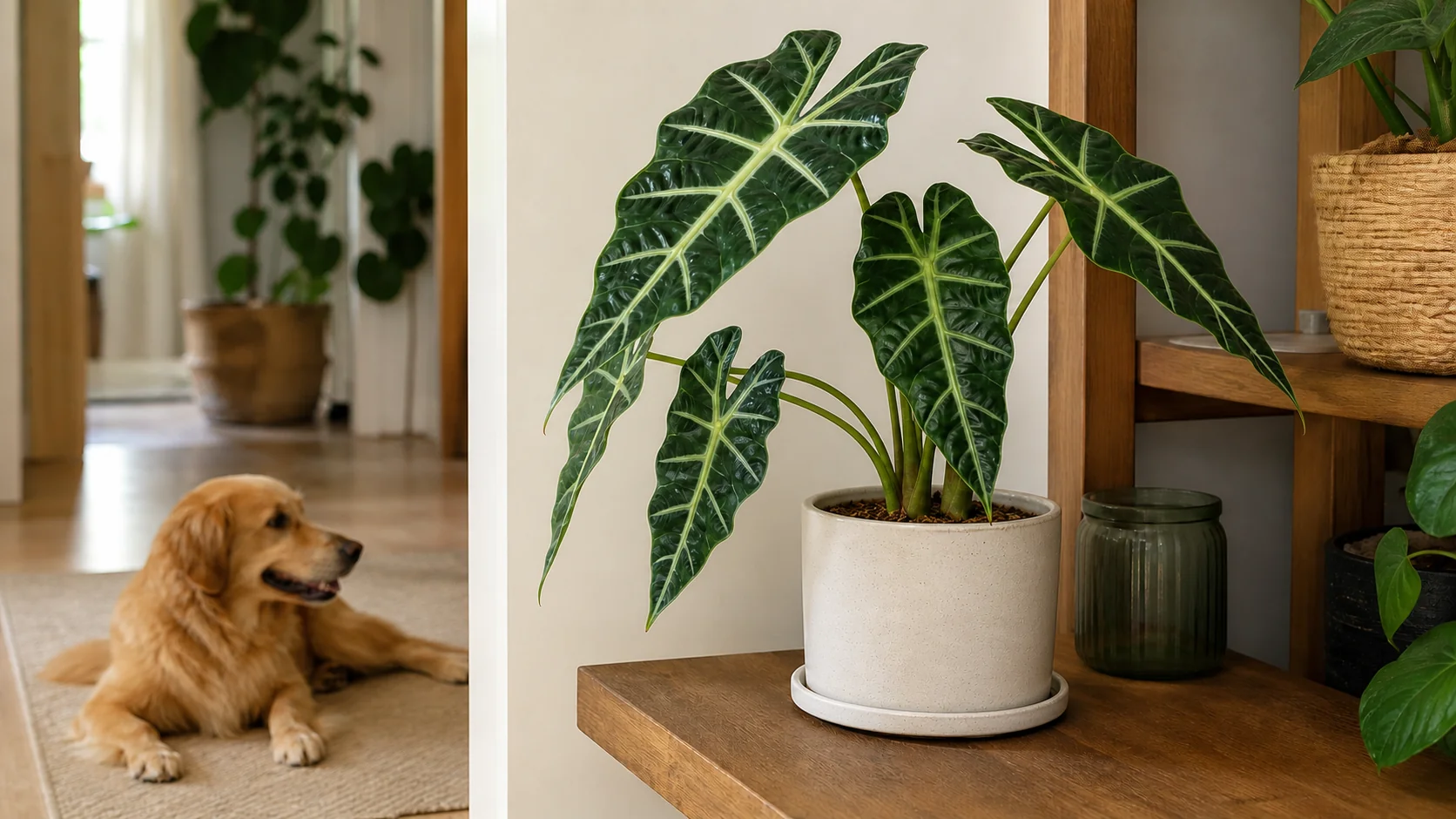
Keep toxic alocasia foliage elevated and separated from curious pets and small children.
Frydek, Amazonica, and Polly: What Actually Changes Between Varieties
Most care articles treat all indoor alocasia varieties as identical. For watering and feeding, they mostly are. But humidity tolerance and forgiveness differ enough to matter when you’re choosing which variety to buy or troubleshooting why yours isn’t thriving.
| Amazonica / Polly | Frydek (Green Velvet) | Odora | |
|---|---|---|---|
| Leaf look | Very dark green, bright white/cream veins | Matte, suede-like surface, silver-green veins | Larger, upright, glossy |
| Size indoors | Compact (30-60 cm) | Medium (45-75 cm) | Larger (60-90 cm+) |
| Humidity floor before visible stress | ~50% | ~60% | ~45% |
| Winter minimum temp before dormancy | 55°F (13°C) | 60°F (16°C) | 50°F (10°C) |
| Humidity sensitivity | Moderate | High | Lower |
| Forgiveness for lapses | Moderate | Less forgiving | Most forgiving |
| Best for | Most indoor setups | Growers who can hold 60%+ consistently | Beginners or larger spaces |
Amazonica (Polly) is what you’ll find at most garden centers. Compact, dramatic, and the most widely available. It’s the right starting point for most people.
Frydek has a softer, matte leaf texture that feels almost like velvet, with silver-green veining rather than stark white. She’s more humidity-sensitive than Amazonica and appreciates even more consistent moisture, making her noticeably less forgiving if your home runs dry in winter.
Odora grows taller and more upright than the compact varieties and is generally more relaxed about conditions, tolerating a wider range of environments before showing visible stress. If that is the plant you have, use the dedicated Alocasia odora care guide for its larger-space setup and variety-specific watering checks.
The core routine, light, watering, humidity, and pot choice, applies to all three. The table above shows where it’s worth paying closer attention based on which variety you have.
Is Alocasia Right for Your Home?
Before you buy, or before you give up on the one you already have, run through these five checks. A “no” on any of them doesn’t mean you can’t grow alocasia, but it tells you where the effort is going to go.
Light window: Can you give it 6+ hours of bright indirect light daily, or are you willing to add a grow light? Yes / No
Humidity floor: Is your home above 50% humidity during winter, or are you willing to run a small humidifier nearby? Yes / No
Temperature stability: Does your plant’s spot stay above 60°F consistently, away from drafts and heating vents? Yes / No
Pet and child access: Can you place it somewhere a curious cat, dog, or small child can’t reach it? Alocasia is toxic if chewed. Yes / No
Watering attention: Are you comfortable checking the soil every 5 to 7 days in summer and adjusting the schedule seasonally? Yes / No
Three or more yeses means alocasia is a realistic choice for your setup. Four or five and you’re genuinely set up to succeed.
Two or fewer yeses: A lower-maintenance tropical is a better fit right now. If light is the limiting factor, a dracaena tolerates the dim conditions that would stall alocasia within weeks. If your routine is irregular, a pothos handles inconsistent watering far better and still delivers lush tropical foliage without the strict care window alocasia requires.
Real User FAQ
How often should I water alocasia?
Water when the top 1 to 2 inches of soil feel dry, roughly every 5 to 7 days in summer, every 10 to 14 days in winter. There’s no fixed schedule that works for every home. In bright light and warm conditions, the soil dries faster. In lower light, it dries much more slowly. The soil, not the calendar, is your guide.
Why are my alocasia leaves turning yellow?
Most likely overwatering, especially if the lower leaves are going first and the soil feels consistently wet. Less commonly, yellow leaves can indicate too little light or a nitrogen deficiency. Check the soil: if it’s wet and hasn’t dried out properly between waterings, ease back and let it drain before watering again.
Why does my alocasia keep dropping leaves?
In autumn and winter, leaf drop is normal as the plant goes semi-dormant in response to shorter days and lower light. Outside that window, look for cold drafts, inconsistent watering, or a recent location change. Moving the plant from a bright spot to a darker one often triggers a round of leaf drop as she adjusts.
Can alocasia survive in low light?
No, not well. She will stop producing new leaves, drop older ones, and become more vulnerable to root rot since the soil dries much more slowly in dim conditions. Alocasia needs at least 6 hours of bright indirect light. If your light is genuinely dim, a grow light is a better investment than hoping she adapts.
Why does my alocasia have brown tips on the leaves?
Dry, crispy brown tips almost always mean low humidity, the most common cosmetic complaint with alocasia indoors, especially in winter. A pebble tray or small humidifier nearby will help. If the tips are soft or mushy rather than crispy, that points to overwatering or root rot instead.
Is alocasia safe for cats and dogs?
No. If a pet chews on it, they’ll experience immediate oral burning, drooling, and potentially vomiting. Alocasia contains calcium oxalate crystals throughout the plant. Keep her on a high shelf or in a room pets don’t access. If you want striking foliage that’s safer around animals, see our list of cat-safe indoor plants.
How do I know if my alocasia is dormant or dying?
Check the corm. If the bulb-like base feels firm and shows no rot, the plant is most likely dormant. Keep the soil barely moist, leave her in indirect light, and new shoots usually emerge in spring as days lengthen. If the corm feels mushy or smells off, that’s root rot rather than dormancy.
How fast does alocasia grow?
In the right conditions, expect one new leaf every two to three weeks during the growing season. In bright indirect light, humidity above 60%, and warm temperatures, growth can be quick. Each new leaf unfurls from the center and often takes a week or more to fully open and harden off. Growth slows noticeably in winter.
What is the easiest alocasia variety for beginners?
Odora is the most forgiving of the common indoor varieties: she handles lower humidity, down to around 45%, tolerates a wider temperature range before going dormant, and is less likely to sulk after a care lapse. Amazonica (Polly) is a close second and far easier to find at garden centers, making her the practical first pick for most beginners. Frydek is the least beginner-friendly due to her stricter humidity requirements, so save her for once you’ve grown comfortable with the basic care routine.
Expert and Source Layer
This guide is built from extension and horticulture references first, then shaped around the recurring indoor problems alocasia owners actually run into: drooping in wet soil, winter dormancy panic, and brown tips from dry air.
Core sources used for thresholds and safety:
- North Carolina Extension Gardener Plant Toolbox on alocasia growth conditions, watering reduction in winter, and common problems
- Illinois Extension on warm, humid conditions and overwintering context
- Wisconsin Horticulture on elephant-ear lookalikes and calcium oxalate toxicity context
- ASPCA on pet toxicity and what chewing symptoms look like
These sources are useful because they help separate “alocasia is dramatic” from “here is what to check first.”
Observe the plant and record what you find before choosing a care adjustment.
Sources and methodology: Care thresholds in this guide draw on NC State Extension Plant Toolbox, University of Florida IFAS Extension, Illinois Extension, Wisconsin Horticulture Division, University of Minnesota Extension, and the ASPCA Toxic and Non-Toxic Plants database. Extension publications were prioritized because they are peer-reviewed, regionally calibrated, and updated on a regular review cycle rather than written once and left static. House Plant Journal is included as a practitioner reference for watering philosophy because the advice is grounded in long-term documented observation rather than generic schedules. Research and cross-referencing for this guide were completed in May 2026.
What to expect in the first 90 days: Most alocasias drop one to three leaves and stall for two to four weeks after moving to a new home. That’s a normal adjustment response, not a sign of failure. Once conditions stabilize, the first new leaf typically unfurls by weeks four to eight, with steady growth resuming from there if light, humidity, and watering stay consistent.