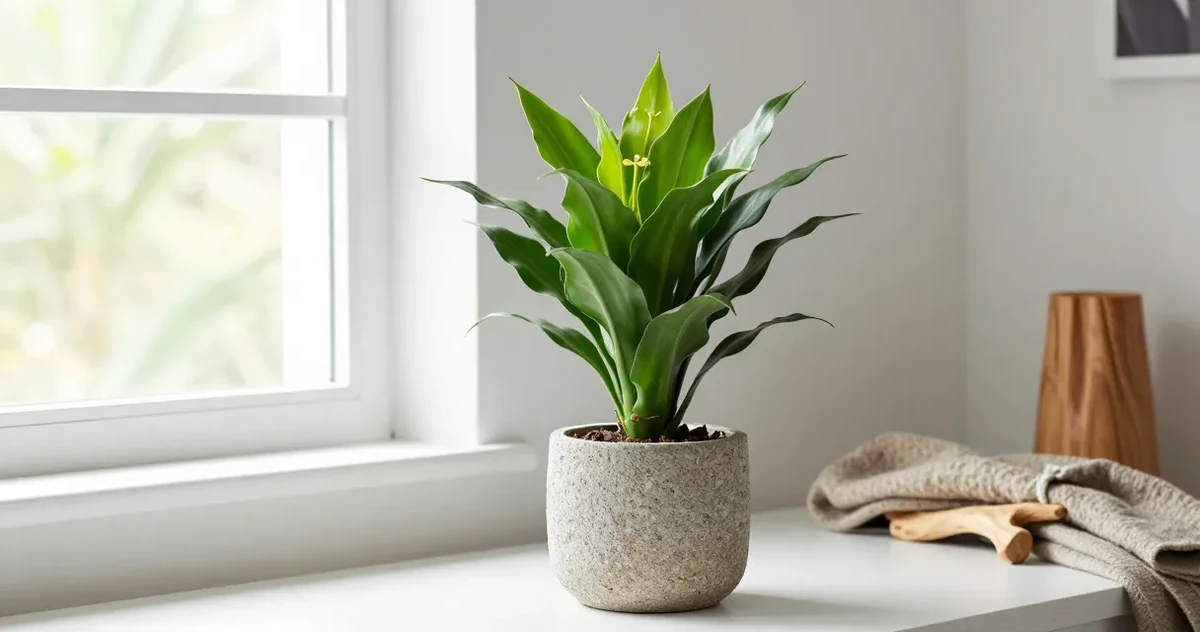
ZZ plant flower meaning: a bloom usually indicates that the plant is mature enough to reproduce and has stored enough resources to flower. It is not, by itself, proof of perfect care or a sign that the plant is dying. If the leaves and roots otherwise look healthy, keep the routine stable rather than watering, feeding, or repotting just because a flower appeared.
The pale, finger-shaped structure sits low near the soil and is easy to mistake for a new shoot. This guide shows how to identify a real ZZ plant bloom, what it can and cannot tell you about plant health, and which conditions may support future flowering.
What Most Care Guides Miss About ZZ Plant Blooms
Most guides call the ZZ flower “rare” and leave it there. That word does not help you understand why your plant bloomed when it did, or what it says about your care.
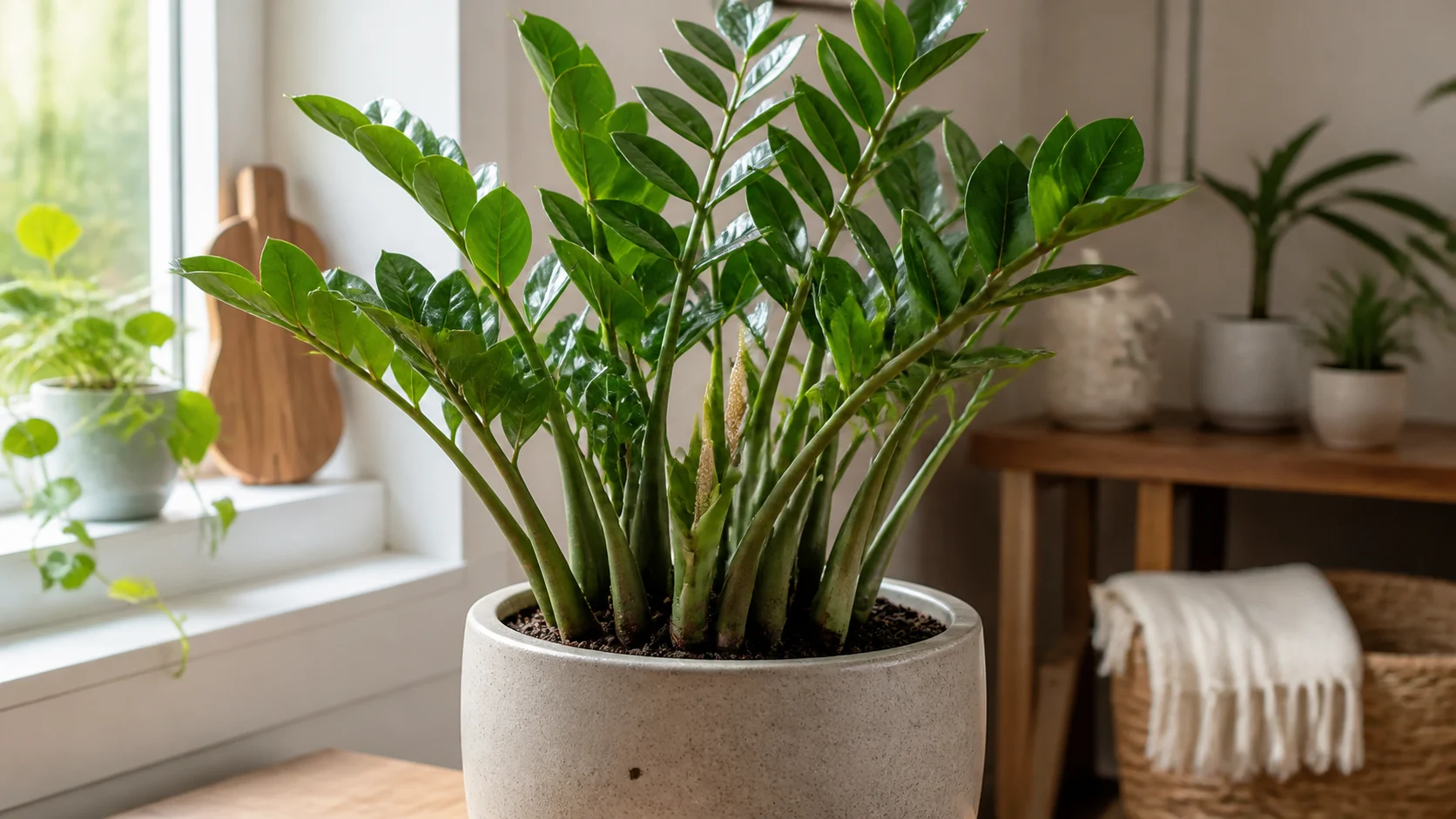
A mature ZZ plant can bloom from stored rhizome energy without showing signs of distress.
The more useful framing: ZZ plants flower when they are mature enough and their rhizomes have built up sufficient energy reserves. The bloom is not a random event, and it is not primarily a stress signal. It is a maturity milestone that also requires a reasonable care baseline sustained over time.
The common misdiagnosis is the “rootbound stress” explanation that circulates in plant communities. The idea is that a pot-bound ZZ panics and tries to reproduce. This sometimes gets conflated with maturity because old plants and rootbound plants are often the same plant. But rootboundness is a correlation, not the cause. The actual driver is accumulated rhizome energy, which takes years to build.
The practical check: Before assuming your plant is stressed, look at how long you have had it. If it is three or more years old and has been getting reasonable light, the bloom is most likely a sign of maturity and stored reserves, not distress. If it is under two years old and something flower-like is appearing, double-check that it is not new growth instead.
Not sure what plant you are caring for?
Open KnowYourPlant, snap a photo, and get the plant name plus care notes matched to the species in front of you.
Identify your plantIdentification Snapshot
A real ZZ plant flower is easy to miss because it hides at the base of the plant instead of rising above the foliage.
- The bloom sits low near the soil line, often tucked under the leaf stalks
- The visible flower is a spadix wrapped in a spathe, not a petaled bloom
- Mature ZZ plants have glossy paired leaflets and thick underground rhizomes that store water and energy
- New shoots stretch upward and unfurl, while a flower stays short and compact near the potting mix
North Carolina State describes the flower as a spadix surrounded by a sheath-like spathe, which is the cleanest way to separate a true bloom from ordinary new growth.
Want a care schedule you do not have to remember?
KnowYourPlant sends watering, feeding, repotting, and seasonal reminders based on the plants you actually own.
Get care remindersLookalikes and Confused-With Cases
| What you see | What it usually is | Why it gets confused with a flower |
|---|---|---|
| Pale structure staying low at the soil line | Actual ZZ bloom | It looks odd and understated, so people assume something is wrong |
| Thick spear pushing upward between stems | New shoot | Early shoots are pale and compact before the leaflets spread |
| Bent or damaged stalk near the base | Mechanical damage | A broken stem can look like a strange emerging structure for a day or two |
| Brown, drying bloom sheath after flowering | Spent flower | Owners sometimes think a fading bloom is disease instead of a normal end stage |
Save this plant plan before you forget the details.
Keep the plant, diagnosis notes, reminders, and care changes in KnowYourPlant so the next decision is based on your actual plant history.
Open KnowYourPlantWhat a ZZ Plant Flower Actually Looks Like
The ZZ plant (Zamioculcas zamiifolia) belongs to the Araceae family, the same botanical family as peace lilies, anthuriums, and pothos. Illinois Extension explains that members of this family do not produce showy petaled blooms. Instead, they produce a two-part flower structure:
- A spadix: a narrow, finger-like spike where the tiny true flowers are packed together along its surface
- A spathe: a leaf-like sheath that wraps loosely around the base of the spadix
Missouri Botanical Garden describes the ZZ plant bloom as a white to cream-colored spadix with a greenish spathe. The whole structure sits close to the soil, partially tucked beneath the stems. It does not rise up tall. It does not open dramatically. If you are not looking for it, you can easily miss it for weeks.
That low, understated position is why so many owners do not recognize it the first time. The ZZ plant flower is not announcing itself. It is just quietly doing its thing at soil level while the rest of the plant carries on exactly as usual.
Is It a Flower or New Growth? How to Tell
Before you get excited or worried, make sure what you are looking at is actually a bloom and not ordinary new growth. This is one of the most common points of confusion for ZZ owners, because the plant’s emerging stems are also pale and compact before they unfurl.
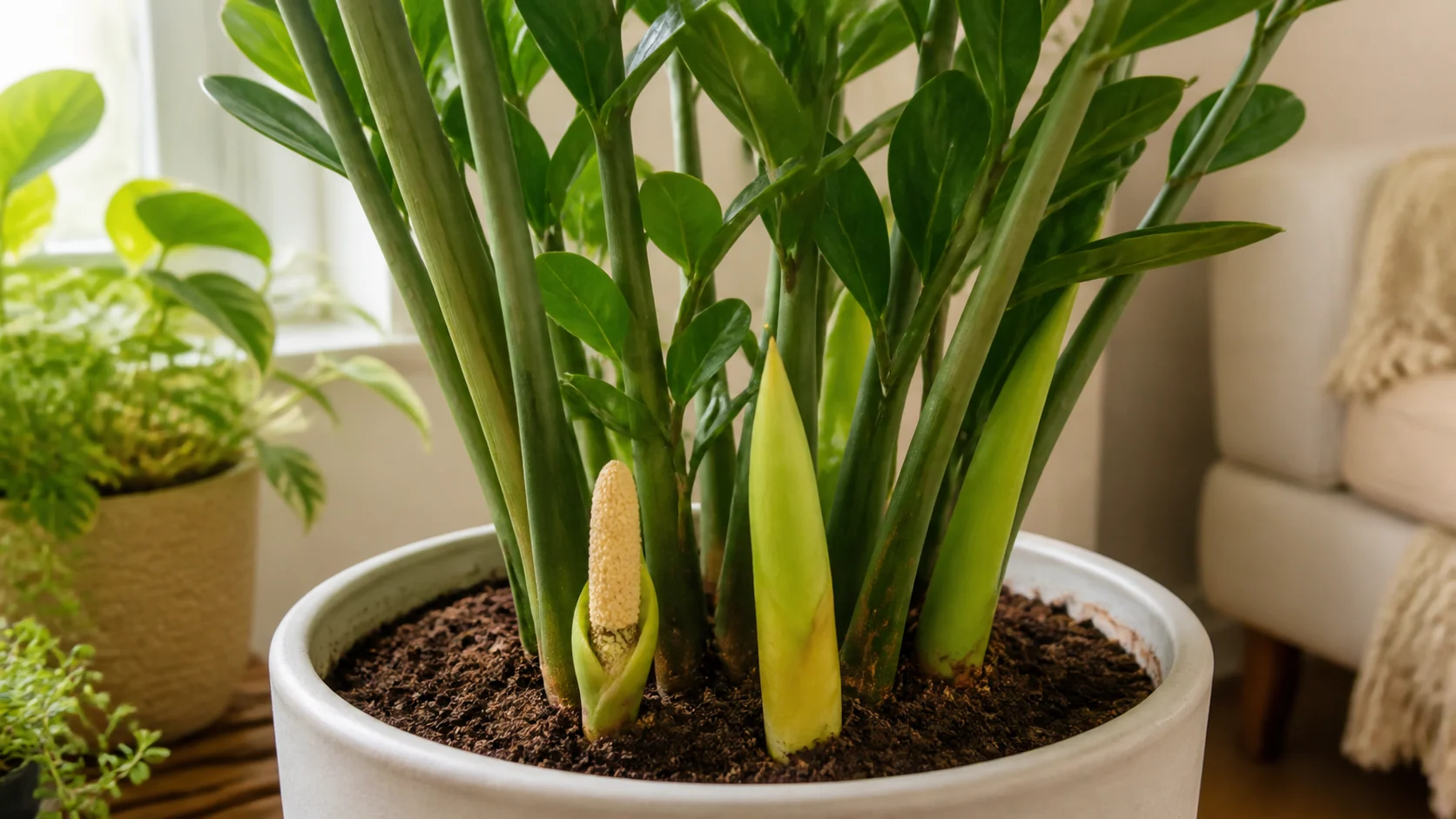
A compact spadix stays low while new ZZ shoots rise as pale, tightly folded spears.
It is probably a flower if:
- The structure is sitting at or near the soil surface, tucked under stems
- It has a pale, finger-like shape with a soft wrapper around the base
- It does not unfurl into a stem with leaflets
- It stays compact and does not extend upward over several days
It is probably new growth if:
- The structure is pushing upward from between the stems
- It is tightly coiled or spear-shaped and starting to extend
- You can see small leaflet bumps forming along it as it lengthens
- It has grown noticeably taller over a few days
New stems on a ZZ plant are enthusiastic growers. They push up quickly and unfurl into the familiar waxy leaflet arrangement within a week or two. A flower stays near the base and does not climb. If it is low, pale, spathe-wrapped, and not extending, it is a bloom.
What Does It Mean When a ZZ Plant Flowers?
Plant community discussions about ZZ blooms tend to split into competing explanations. Here is a more grounded reading of each, based on what the botanical evidence actually supports:
| Explanation | Supported? | What it means in practice |
|---|---|---|
| Plant has matured | Yes, well-supported | Most reliable interpretation for plants 3+ years old |
| Good overall energy reserves | Yes, supported | Rhizomes have had time and good conditions to build up resources |
| Rootbound correlation | Plausible, but indirect | Old plants are often rootbound; rootboundness itself is not the driver |
| Stress or last-ditch reproduction | Weak for ZZ | More applicable to annuals than to rhizome-storing perennials |
North Carolina State University Extension notes that ZZ plant rhizomes function as storage organs for both water and energy, which is why the plant tolerates drought so well and why those reserves ultimately power a bloom. Building that kind of rhizome density takes years of steady growth.
UConn Extension reports that ZZ plant flowers tend to appear in late summer, which aligns with the plant drawing on energy built over a full growing season. Seeing a bloom in July or August fits that pattern. A bloom in February is less typical, though not impossible if indoor conditions have been favorable.
What it probably does not mean: that you have unlocked some secret care formula, or that something is terribly wrong. Overreading a ZZ plant bloom in either direction leads owners to change things that were working fine.
How Light Affects Your Odds of Ever Seeing a Bloom
ZZ plants are famously marketed as low-light survivors, and they are. But there is a meaningful difference between surviving dim conditions and building up enough energy to eventually flower. The table below shows how light level affects the factors that matter most for long-term bloom potential.
| Light condition | Growth rate | Flowering odds | Legginess risk | Overwatering risk |
|---|---|---|---|---|
| Very low (dim room, far from windows) | Slow | Low – plant runs an energy deficit | High – stems stretch toward light | Higher – soil stays wet too long |
| Medium indirect (near a north or east window) | Moderate | Moderate – plant maintains reserves over time | Low | Moderate |
| Bright indirect (close to a filtered south or west window) | Faster | Best – rhizomes build reserves more quickly | Low | Lower – faster evaporation |
NCSU Extension recommends bright indirect light for ZZ plants, noting that while the plant tolerates very low-light conditions, it does best with filtered light from a bright window. UConn Extension confirms that growth rate increases noticeably with more light, which directly supports rhizome development over time.
A spot near a north or east window, or set back from a brighter south or west window, gives the plant what it needs without the risk of afternoon sun scorching the leaves. If your ZZ has been sitting in a truly dim room for years and still managed to bloom, consider it a bonus – and a brighter spot going forward would give it more to work with.
If you are not sure whether your current setup is working, our guide to grow lights for indoor plants explains how to assess your natural light and when a supplemental light actually helps.
Care Cards
- Light: ZZ tolerates low light, but bright indirect light gives it the best chance to build bloom-ready energy reserves.
- Watering: Let the mix dry down properly between waterings. Chronically wet soil works against flowering.
- Potting mix: Fast-draining soil protects the rhizomes from rot and keeps growth steady.
- Timing: Late summer is the most believable indoor bloom window, so do not overreact if nothing happens in spring.
- Patience: Maturity matters. A younger plant usually needs more time, not more intervention.
What Conditions Make Blooming More Likely
Light is the biggest lever, but three other factors work alongside it.
Age and Rhizome Size
Plants under two or three years old are unlikely to bloom indoors regardless of how well you care for them. The rhizomes need time to develop into full, chunky, energy-dense structures. A plant with a well-established root mass has more in reserve. This is why blooms tend to happen on plants that have been undisturbed in the same pot for several years without being divided.
If you have only had your ZZ for a year or two and it has not bloomed, that is not a care failure. The plant simply has not had enough time yet.
Watering and Drainage
The rhizomes store water precisely so the plant can weather dry spells. Chronic overwatering does the opposite of helping: it keeps the roots under stress and risks rot long before a bloom ever forms. Water when the top several centimetres of soil are dry, and make sure the pot drains freely.
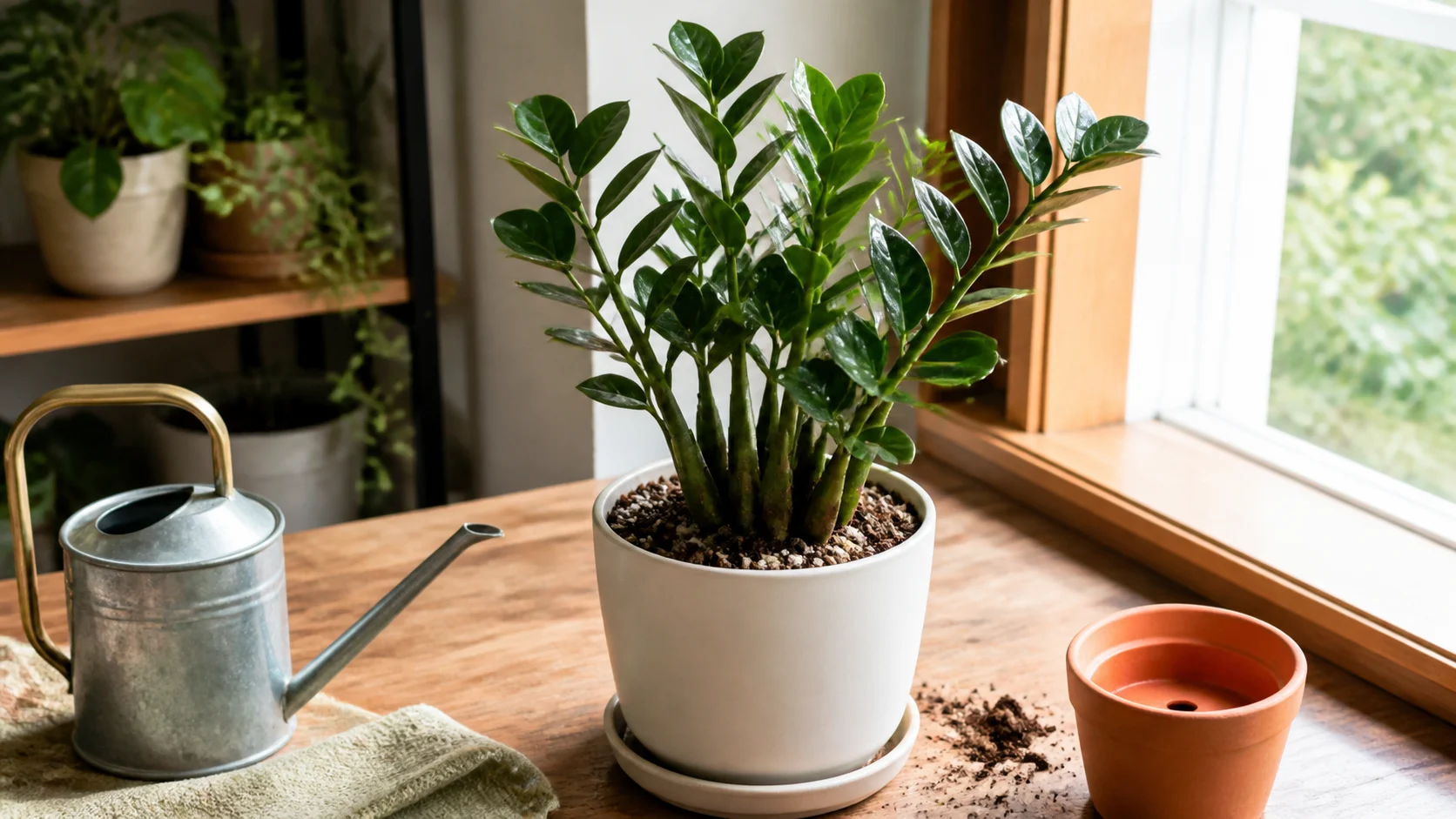
A coarse, dry potting mix and a freely draining container support the steady rhythm mature ZZ plants need.
A steady rhythm with a genuine dry-down period between waterings tends to produce a healthier plant overall, and a healthier plant over several years is a better candidate for eventually blooming. For a full breakdown of ZZ watering, soil, and container needs, the ZZ plant care guide covers all of it.
Seasonal Patience
ZZ blooms are most often observed in late summer. If you have a plant that is old enough and well-lit enough, that window is when conditions are most likely to align. This is not a hard rule, but it is a useful pattern to keep in mind rather than expecting flowers year-round. Do not assume that because nothing appeared by spring, nothing will come.
Common Mistakes After a Bloom Appears
Seeing the flower for the first time tends to trigger one of two responses: panic or overenthusiasm. Both lead to the same problem, which is making unnecessary changes to care that was already working.
Repotting immediately. The bloom is often interpreted as a sign of rootboundness, which prompts owners to repot right away. Unless the plant is actively showing signs of root stress, such as roots pushing out of drainage holes or very rapid soil drying, hold off. The plant just used energy to flower. Repotting adds more stress on top of that.
Adding heavy fertiliser to “reward” the bloom. The flower does not need feeding. ZZ plants are light feeders in general, and dosing after a bloom does not make it happen again faster.
Cutting the bloom off immediately. There is no reason to rush. The flower does not drain the plant, and it will dry and drop on its own once it fades. If you prefer a tidy look, snip it at the base with clean scissors once it starts to brown. Either approach is fine.
Moving the plant to a dramatically different spot. If the plant bloomed in its current location, that location was working. The most useful adjustment, if any, is a gradual move toward more light, not a dramatic relocation to full sun.
The most reliable approach after a bloom: keep doing what you were doing. If light was on the dim side, a slight improvement is worthwhile. Otherwise, let the plant settle back into its routine.
Plant ID + Plant Doctor
Not sure what your plant needs?
Snap a photo in KnowYourPlant to identify the plant, check yellow leaves, spots, wilting, or pests, and get a calm next step before the problem spreads.
Common Problems
| Problem pattern | What it usually means | Best next step |
|---|---|---|
| “Flower” grows taller every day and starts showing leaflet bumps | It is new growth, not a bloom | Keep normal care and let the shoot unfurl |
| Plant bloomed, then leaves started yellowing | Separate watering or drainage issue | Check the soil and roots before blaming the bloom |
| Mature plant never blooms in a dim room | Energy reserves never fully build | Move it to brighter indirect light and give it another season or two |
| Bloom appears on a crowded old plant | Maturity may overlap with root restriction | Do not rush to repot unless you also see root-stress signs |
| Owner waters more often to “support” flowering | Overwatering risk | Keep the normal dry-down rhythm instead of forcing growth |
Pet Safety
ZZ plant is not a pet-safe houseplant. NC State lists it as having medium toxicity to cats and dogs, so keep it out of reach if pets chew foliage or dig in pots. A bloom does not change that risk, because the same irritating plant tissue is present in the leaves, stems, and underground rhizomes.
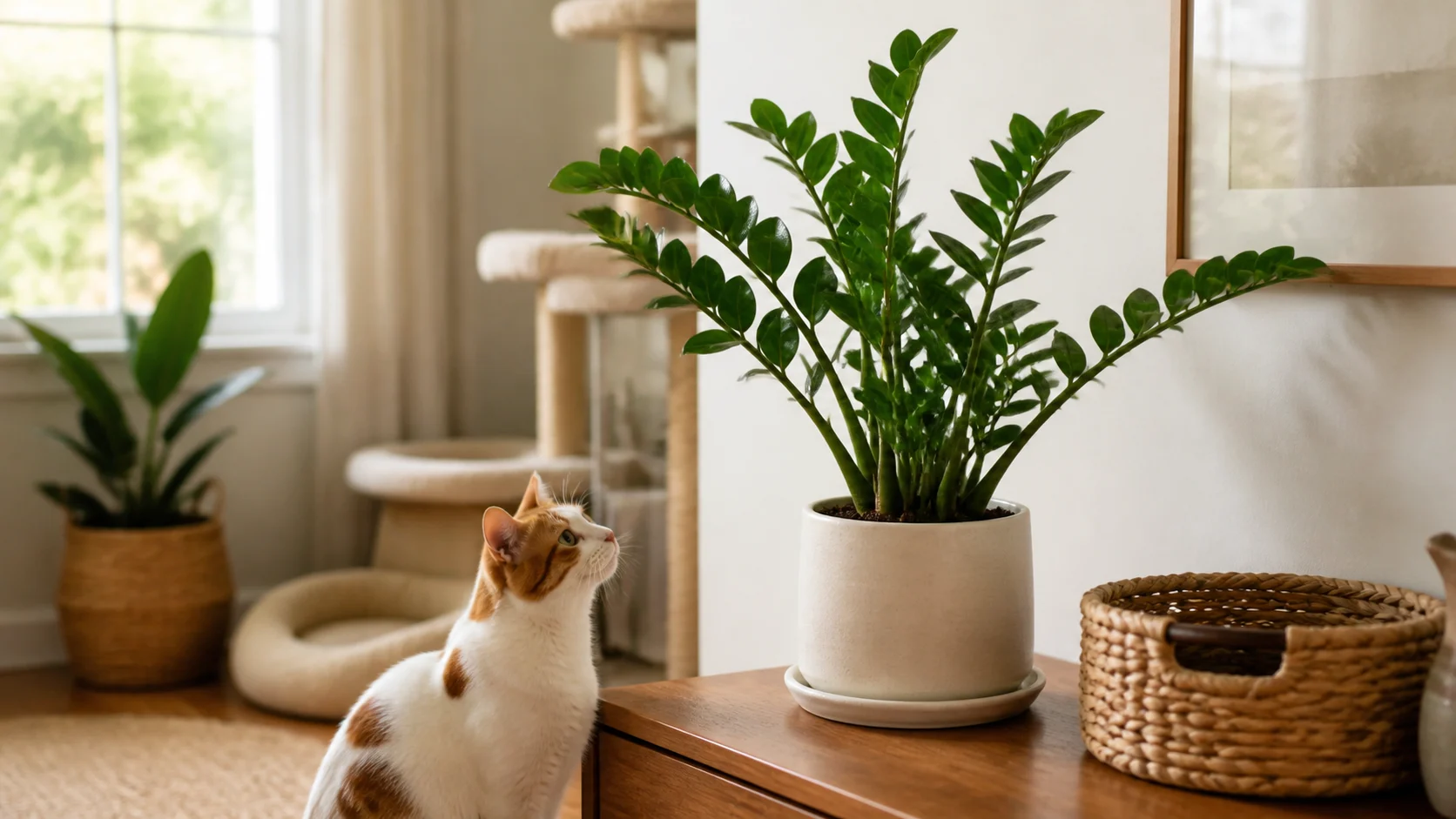
Keep a ZZ plant elevated and separated from curious pets that may chew leaves or dig in the pot.
Methodology
This article was refreshed on 2026-06-20 against the current research file for this topic. Flower-structure and care claims were checked against NC State, Illinois Extension, Missouri Botanical Garden, and UConn. Community threads were only used to surface real owner confusion, especially around “flower or new shoot?” and what blooming means, not as proof of horticultural causation.
Real User FAQ
How rare is a ZZ plant flower indoors?
Uncommon is a more accurate word than rare. ZZ plants do bloom indoors, but they need to reach maturity first, typically three or more years, and they need conditions good enough to build up rhizome energy reserves. Plants in very dim light or those that have been consistently overwatered are less likely to reach that threshold. Well-lit, well-established plants with stable care routines are the ones that tend to show blooms, usually in late summer.
Does a ZZ plant flower mean the plant is dying?
No. This is one of the more persistent misconceptions in ZZ plant communities. The bloom is most reliably a maturity signal, not a distress signal. ZZ plants flower when they have accumulated enough energy in their rhizomes to support reproduction. That is the opposite of a plant running low on resources. If the rest of the plant looks healthy, the flower is a good sign, not a warning.
Should I cut off the ZZ plant flower?
You do not have to. The flower does not drain the plant in any meaningful way, and it will dry and fall off on its own once it fades. If you prefer a tidier look, snip it at the base with clean scissors once it starts to brown. Either approach is fine.
How do I encourage my ZZ plant to bloom?
You cannot force it, but you can create the right conditions. Move the plant to a spot with bright indirect light if it has been in a dim corner. Keep a steady watering rhythm with proper dry-down periods between waterings. And give it time: plants under three years old are unlikely to bloom regardless of care. Light is the biggest lever. Everything else is consistent maintenance over a long stretch.
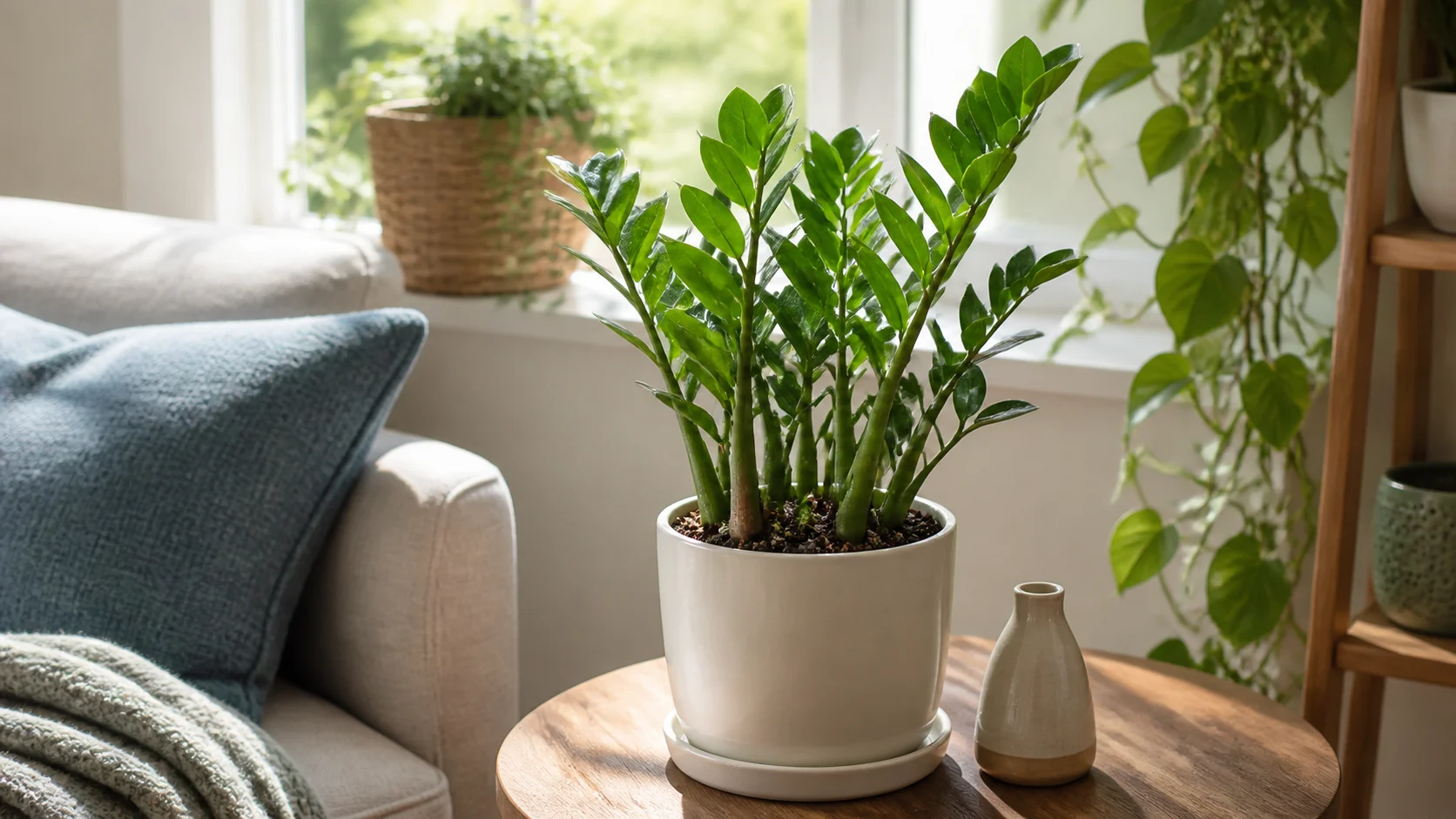
Bright indirect light and steady care give a mature ZZ plant the best chance to build bloom-ready reserves.
Can I propagate from a ZZ plant flower?
Technically yes, but it is not practical for most indoor growers. ZZ plants can produce seeds if the flower is pollinated, but pollination indoors is unlikely without manual help, and growing from seed is very slow. The practical propagation methods for ZZ plants, stem cuttings and leaf cuttings rooted into the rhizome, are much more straightforward. The ZZ plant propagation guide covers those methods for this species, while how to propagate plants indoors explains the broader approach.
My ZZ plant flowered and now leaves are yellowing. Are they connected?
Probably not directly. Yellowing leaves on a ZZ plant are almost always a watering issue, most often overwatering or poor drainage, rather than a bloom-related problem. The two events can coincide simply because an older plant in a too-small pot is both mature enough to bloom and starting to show some root stress. Check the soil and drainage first. ZZ plant yellow leaves walks through the most common causes and how to tell them apart.
How often does a ZZ plant flower?
There is no fixed interval. Reports from plant owners suggest mature plants may flower every few years rather than annually, but this varies considerably with care and conditions. The best approach is not to expect flowers on a schedule, but to maintain the conditions that made it happen: good light, steady watering, and enough time undisturbed.
My ZZ plant is in a low-light room. Will it ever bloom?
It is unlikely in very low light, but not impossible. The plant needs to accumulate rhizome energy over time, and dim conditions slow that process significantly. Even a move to a brighter spot, a north-facing window or a few feet back from a south-facing one, can make a real difference over the next few growing seasons. Very low light also increases the risk of waterlogged soil, which is the main thing that prevents a ZZ from ever reaching bloom-capable maturity indoors.
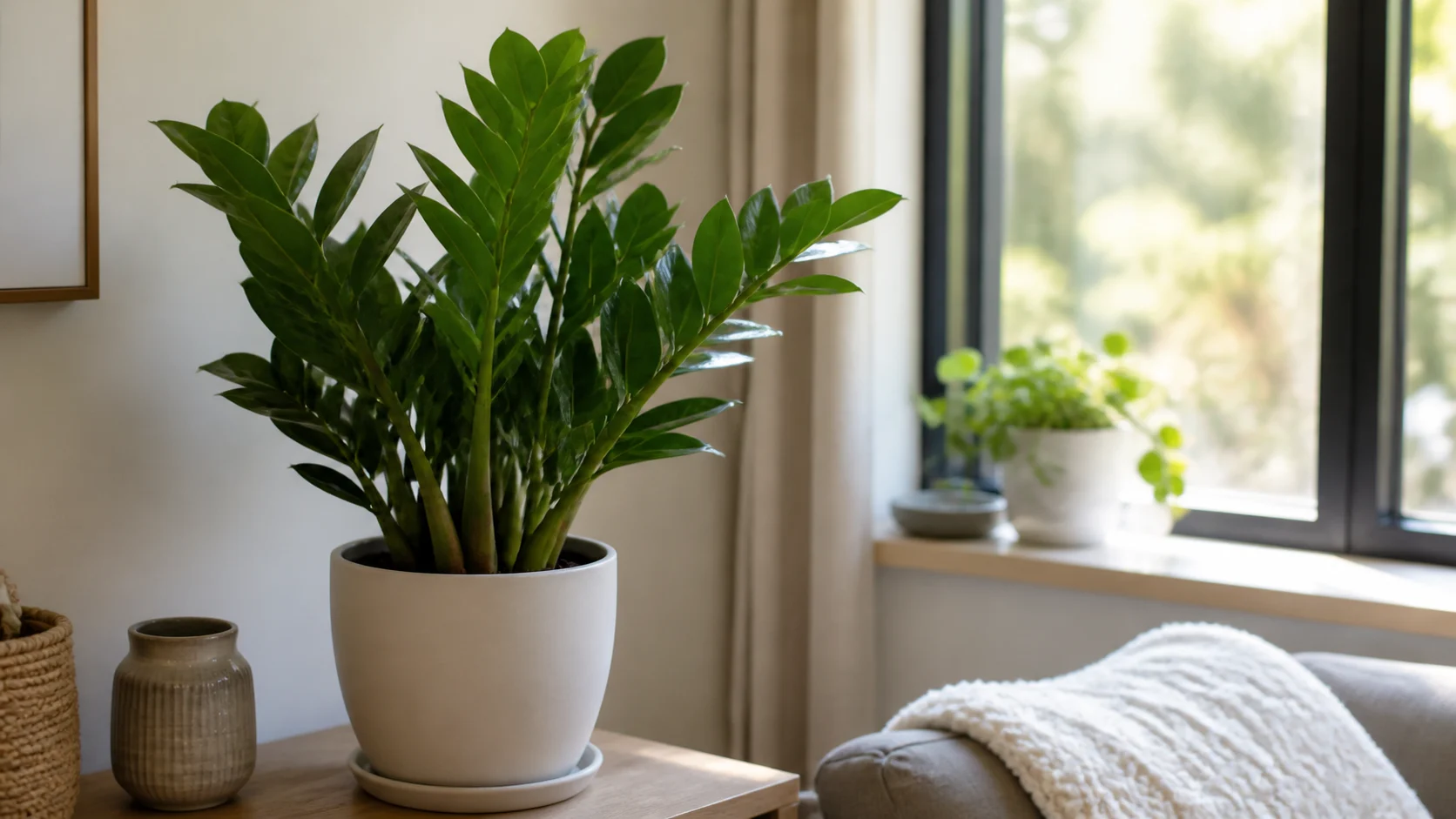
Moving a ZZ plant from a dim corner to soft light several feet from a window can improve long-term energy reserves.
For general ZZ plant care, watering schedules, soil type, and light requirements, see the ZZ plant care guide. If you are seeing yellow leaves alongside the bloom, ZZ plant yellow leaves walks through the most common causes. If your home does not get much natural light, low light indoor plants covers which plants handle dim conditions best and what “low light” actually means in practice.
Sources: North Carolina State Extension Gardener Plant Toolbox (Zamioculcas zamiifolia); Illinois Extension, Houseplant Spotlight: the ZZ Plant (January 2026); Missouri Botanical Garden Plant Finder (Zamioculcas zamiifolia); University of Connecticut Home Garden Education Office, ZZ Plant. SERP reviewed June 2026.