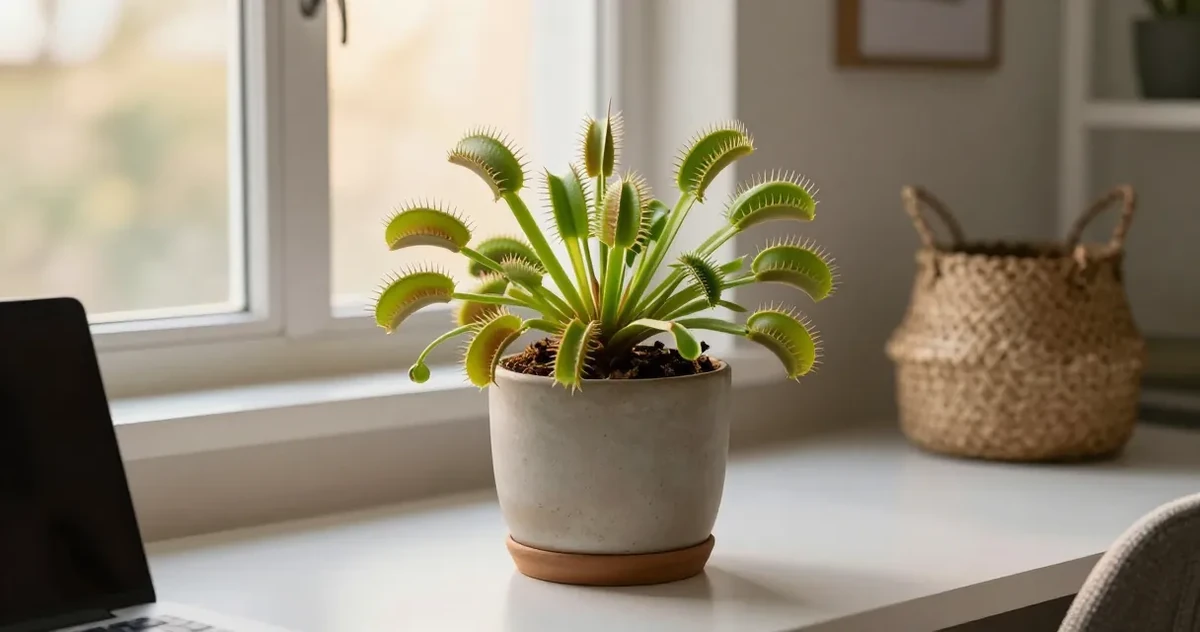
Most houseplants want roughly the same things: some light, regular watering, decent soil, maybe a little fertilizer once in a while. Venus flytrap care runs on almost the opposite set of rules, and that is exactly where most new owners get into trouble.
A Venus flytrap is a carnivorous bog plant native to a narrow stretch of coastal wetland in North and South Carolina. NC State Extension notes that it evolved in nutrient-poor, mineral-light conditions that would stress many ordinary houseplants. That is why tap water, standard potting mix, weak indoor light, and routine fertilizer are not small mistakes here. They are the main reasons a new plant declines.
Once you understand the habitat logic, the care stops feeling weird and starts feeling specific.
What Most Care Guides Miss
Most care pages explain water, light, soil, feeding, and dormancy as separate topics. The real problem for indoor growers is that all five collide in one setup.
The common first-week scenario looks like this: the plant comes home in a clear dome or gift-shop sleeve, goes onto a windowsill or desk, gets watered like a normal houseplant, and is fed too early because the traps look like they should be used. A few weeks later, the traps blacken, growth stalls, and the owner assumes the plant is sick.
Usually it is not sick. It is mismatched to its environment.
The enclosure cuts useful light. The windowsill often looks brighter than it really is. The water source is frequently tap water or filtered pitcher water, which still carries dissolved minerals. Then feeding adds more stress to a plant that is already struggling.
The first fix is usually not medicine. It is setup correction. Check the light and the water source before you troubleshoot anything else.
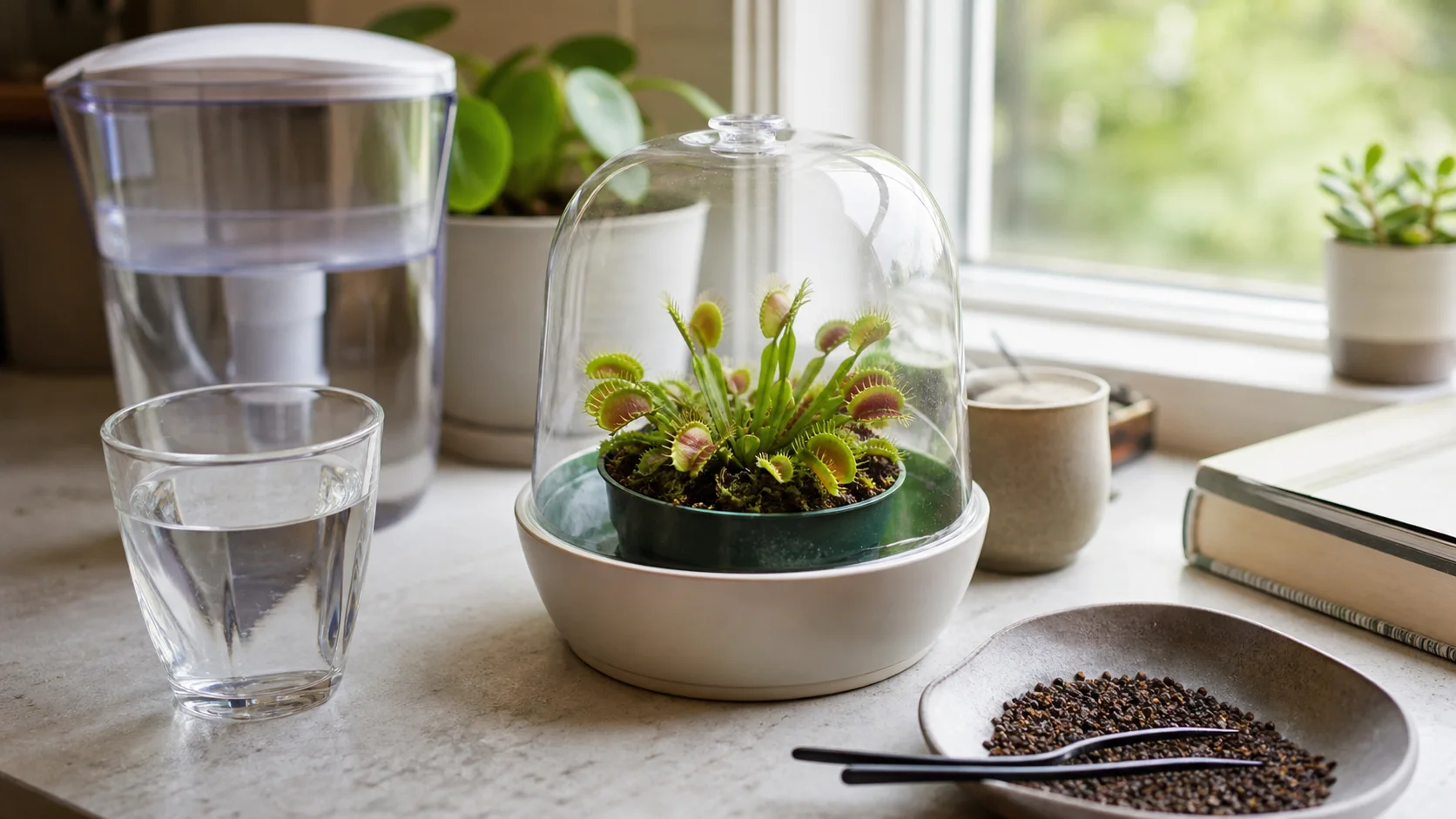
A display dome, uncertain water, and a weak windowsill can combine into one mismatched Venus flytrap setup.
Identification Snapshot
| Snapshot | What to know |
|---|---|
| Plant type | Carnivorous bog plant |
| Native range | Coastal bog habitat in North and South Carolina |
| Best indoor light | Direct sun if truly strong, or a dedicated grow light |
| Water rule | Distilled, rain, reverse osmosis, or similarly mineral-free water |
| Soil rule | Nutrient-free carnivorous mix only |
| Feeding rule | Optional indoors, light and occasional, never human food |
| Winter behavior | Depends on whether the plant is outdoors, on a weak windowsill, or under strong supplemental light |
| Main beginner risk | Treating it like a normal houseplant or terrarium novelty |
Expert Note: Treat It Like a Bog Plant, Not a Houseplant
The strongest sources reviewed for this article, including Iowa State Extension, NC State, University of Alaska Fairbanks, New York Botanical Garden, and the International Carnivorous Plant Society, agree on the same core idea: the plant succeeds when the setup copies its bog conditions, not when it copies ordinary houseplant care.
That means pure water, nutrient-free media, strong light, and restraint. New owners often try to help with fertilizer, rich soil, bottled water, frequent trap triggering, or decorative enclosures. Those are the exact interventions that usually make the plant decline faster.
Original Data: First-Week Rescue Checklist
If you bought the plant recently and it already looks stressed, use this checklist before changing anything more complicated.
- Remove any sealed plastic sleeve, glass cloche, or display dome.
- Confirm the pot has a drainage hole.
- Switch immediately to distilled or rainwater.
- Flush the medium with distilled water if tap or mineral water was used.
- Move the plant to the brightest spot you have, or put it under a grow light.
- Do not feed it during the first week in the new setup.
- Ignore one or two black traps if new growth still looks firm and green.
This reset catches the beginner mistakes that show up most often in community discussions about failing new Venus flytraps.
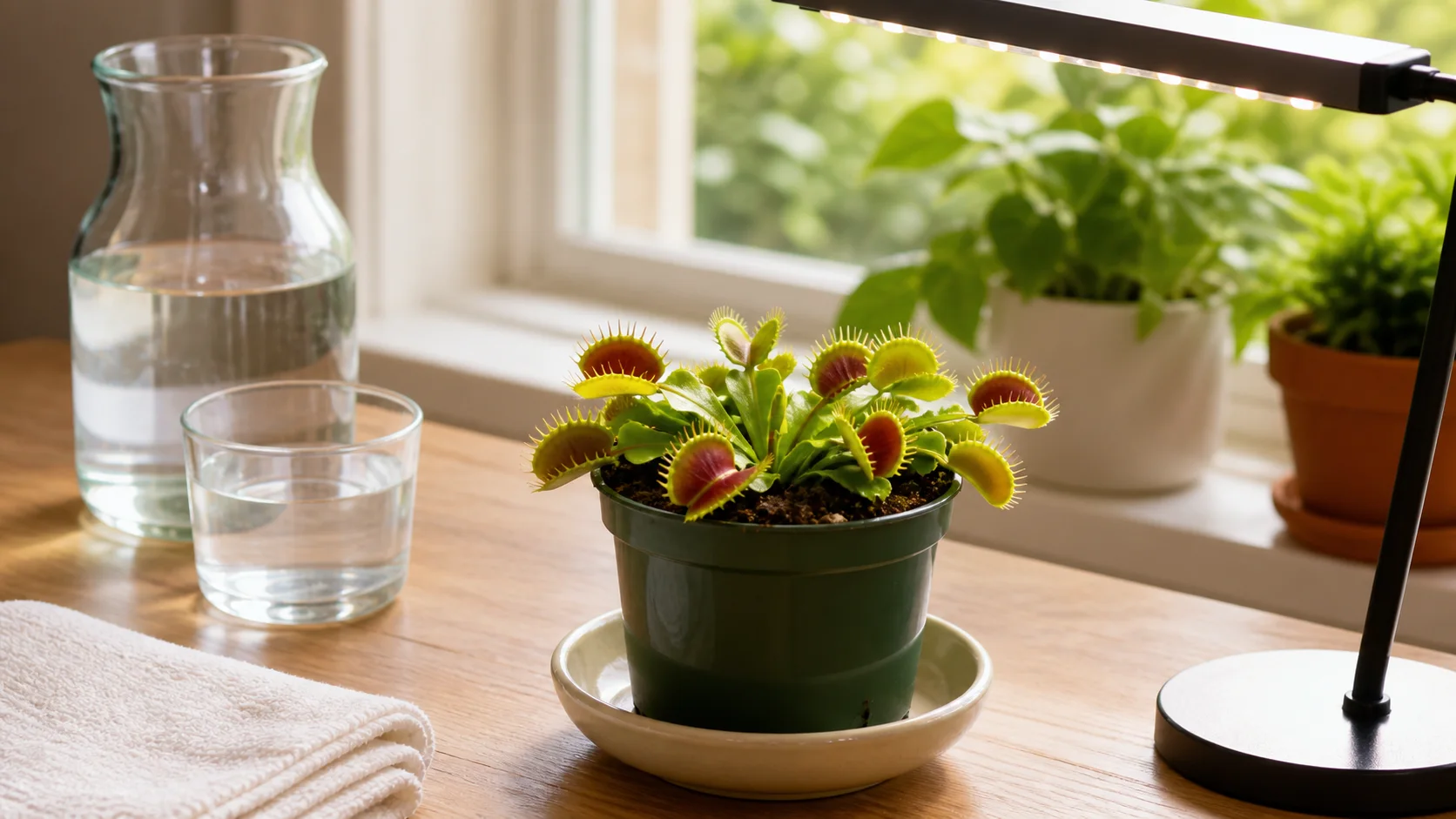
A clean-water tray, bright window, and dedicated grow light address the most common first-week setup problems.
Care Cards
Light
Aim for the strongest light in your home. The International Carnivorous Plant Society notes that indoor Venus flytraps usually need much more light than a typical windowsill provides. A dedicated grow light often solves problems faster than any other change.
Water
Use distilled, rain, reverse osmosis, or another low-mineral source. Keep the soil moist, usually with the pot sitting in a shallow tray of water.
Soil
Use pure sphagnum moss, or a nutrient-free carnivorous mix such as peat and perlite. Standard potting soil is a bad fit.
Feeding
If the plant catches insects on its own, leave it alone. If it lives indoors with no access to prey, occasional small insects during active growth are enough.
Winter
Do not force one dormancy script onto every setup. Outdoor plants, bright grow-light plants, and weak-light windowsill plants behave differently.
Water: The Most Common Point of Failure
Tap water, filtered pitcher water, and most bottled mineral water all contain dissolved salts that build up in the soil and slowly damage the plant. The University of Alaska Fairbanks Greenhouse recommends rain, distilled, deionized water, or clean melted snow. Treated tap water and mineral-labeled bottled water are not safe long-term substitutes.
| Water type | Safe? | Notes |
|---|---|---|
| Distilled water | Yes | Consistent and easy to find |
| Reverse osmosis water | Yes | Good option if your home system is reliable |
| Collected rainwater | Yes | Use clean collection containers |
| Clean melted snow | Yes | Useful where available |
| Filtered pitcher water | No | Removes some contaminants, not enough dissolved minerals |
| Bottled spring or mineral water | No | The minerals on the label are the problem |
| Tap water | No | Mineral salts and treatment chemicals build up over time |
The simplest method is tray watering. Sit the pot in a shallow tray and let it pull water from below, then refresh the tray regularly so the water does not sit stagnant for too long.
If you used tap water by accident, switch immediately and flush the medium with distilled water. One mistake is usually recoverable. Repetition is what causes the slow collapse.
Light: Much More Than Most Windowsills Offer
A Venus flytrap that is not getting enough light often stays alive for a while, which is why weak-light care can fool people into thinking the setup is acceptable. It is not thriving, just hanging on.
Signs that light is the bottleneck include small traps, long pale leaves, flat green growth, and weak new development. In those cases, move the plant to the brightest position you have or use a full-spectrum grow light for indoor plants placed 15 to 30 centimetres above the plant for 12 to 14 hours a day.
Avoid assuming a closed terrarium solves the problem. Most decorative enclosures trap heat and humidity but still fail the light test.
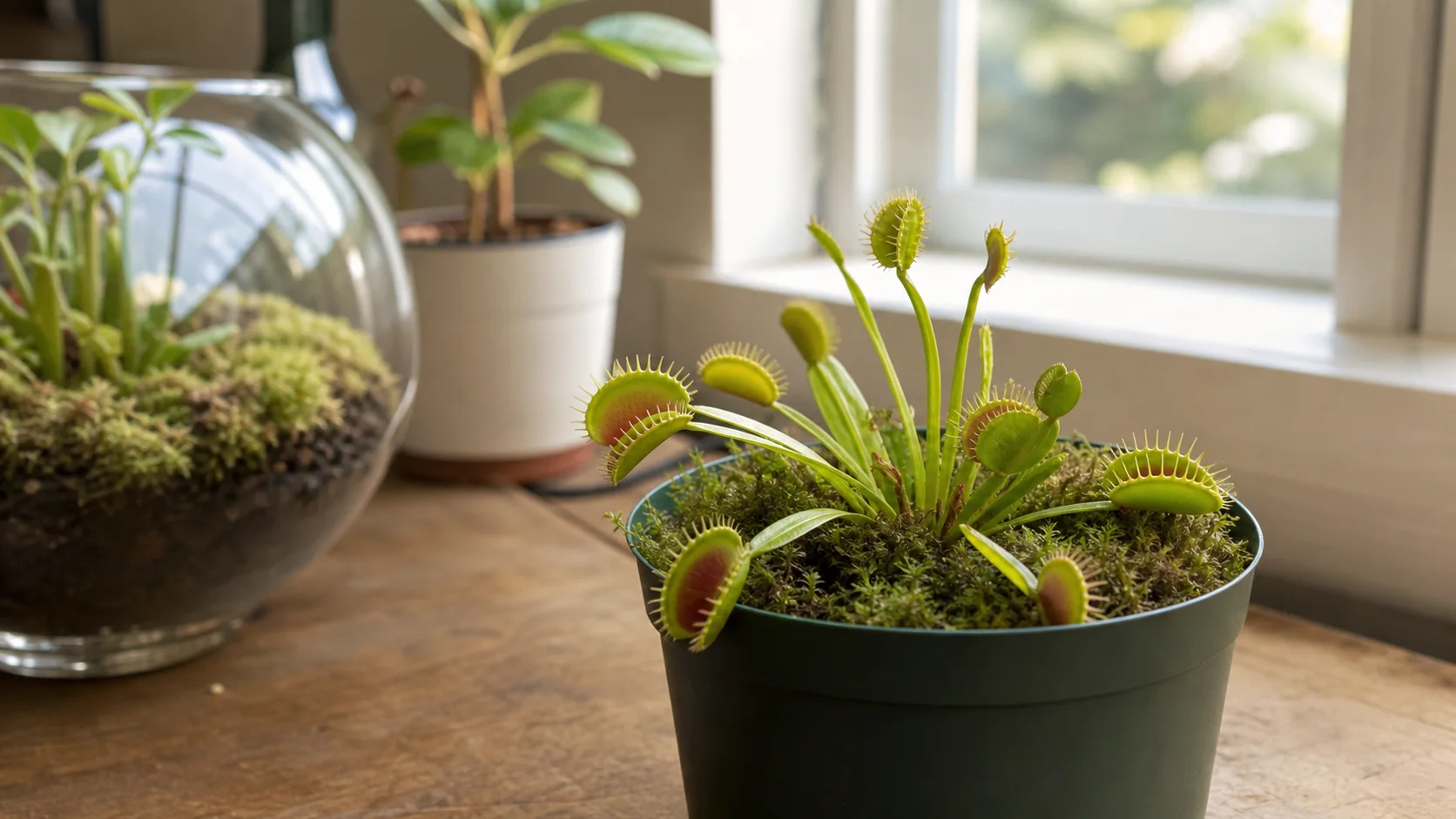
Long pale leaves and sparse traps can reveal that a bright-looking windowsill still provides too little usable light.
Soil: No Nutrients Allowed
Standard potting mix, garden soil, and any blend with added fertilizer are wrong for a Venus flytrap. The plant gets nutrients from prey, not from rich soil.
Use pure sphagnum moss, a simple peat-and-perlite carnivorous mix, or a ready-made carnivorous plant medium with no added fertilizer. If you are used to shopping for potting soil for indoor plants, the selection logic flips here. Cheap and plain is often better than enriched and premium.
Do not fertilize the soil.
Feeding: Less Often Than You Think
If the plant has access to insects, it can usually feed itself. Indoors, supplemental feeding is optional, not mandatory.
Iowa State Extension is blunt about the most common mistake here: do not feed Venus flytraps hamburger, deli meat, cheese, or other human food. Those foods rot inside the trap and often kill it before digestion finishes.
If you choose to feed, use a small insect during active growth, not during a winter slowdown. Keep it small enough for the trap to close properly. One trap blackening after a feeding cycle is normal. Repeatedly triggering traps for fun is not.
Indoor Setup Decision Tree
Use the setup you actually have, not the one you wish you had.
If the plant lives outdoors or in an unheated greenhouse: let the season drive the plant. Full dormancy is expected.
If the plant lives indoors under a dedicated grow light: keep strong light consistent, keep the medium moist, and allow only a lighter seasonal slowdown if the plant naturally eases off in winter.
If the plant lives on a windowsill with weak winter light: expect slower growth and smaller traps as light drops. Reduce water slightly so the medium stays moist but not stagnant, and focus on getting it back into stronger light when the season changes.
If the plant lives in a decorative dome or closed terrarium: change the setup first. That is a packaging or display environment, not a reliable long-term growing plan.
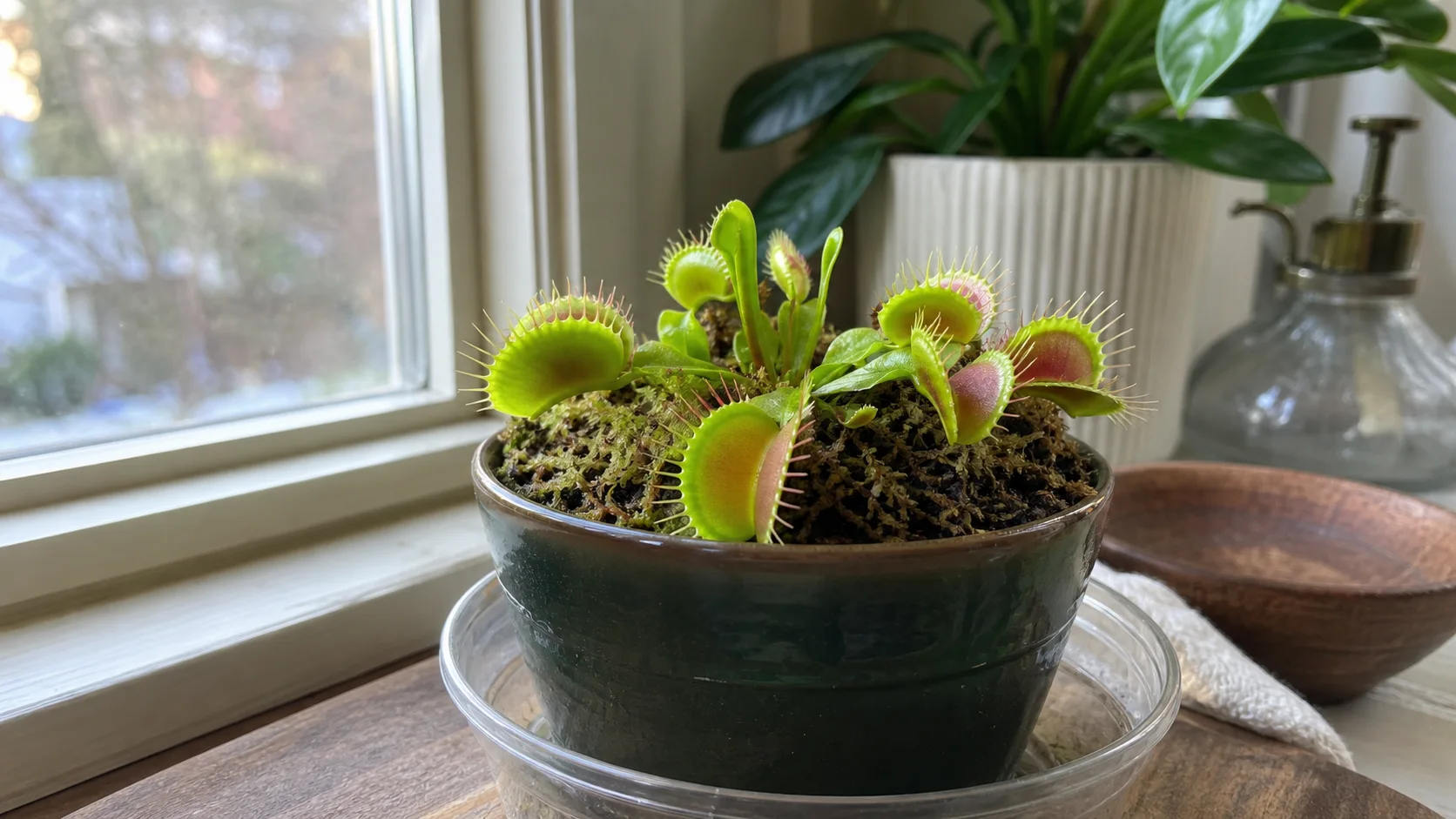
A cool-season windowsill setup calls for matching water and growth expectations to the light that is actually available.
Dormancy: Match It to the Setup
New York Botanical Garden notes that indoor Venus flytraps under strong artificial light may not need the same full dormancy pattern expected outdoors. That is the piece many general care guides flatten into one blanket rule.
A mature outdoor plant should rest through the cold season. A bright indoor grow-light plant may keep growing year-round with only a mild seasonal slowdown. A windowsill plant with weaker winter conditions usually slows down on its own and should be allowed to rest rather than pushed with feeding or extra inputs.
What matters is not one universal dormancy script. What matters is whether your setup supports active growth or naturally pushes the plant into a quieter period.
Common Problems
Symptom Diagnosis Card
| Symptom | Most likely cause | What to do next |
|---|---|---|
| One trap turns black after feeding | Normal trap turnover | Trim only when fully dead and keep watching new growth |
| Several traps blacken and growth stalls | Mineral stress from water | Switch to distilled water and flush the medium |
| Long pale leaves and small traps | Not enough light | Move to stronger direct light or add a grow light |
| Base feels mushy or smells bad | Stagnant conditions or rot | Improve airflow, check drainage, repot if needed |
| Plant slows down in winter but crown stays firm | Seasonal slowdown | Reduce fussing, keep conditions stable |
The main distinction indoor growers need: isolated black traps are normal, whole-plant decline is usually a setup problem.
Common Mistakes
- Using tap water because the plant looked fine for a few weeks.
- Assuming a bright room is the same as direct, strong plant light.
- Keeping the plant in a sealed dome because it came that way.
- Feeding too early, too often, or with food meant for people.
- Potting it in standard houseplant soil.
- Treating every black trap as an emergency instead of checking for healthy new growth.
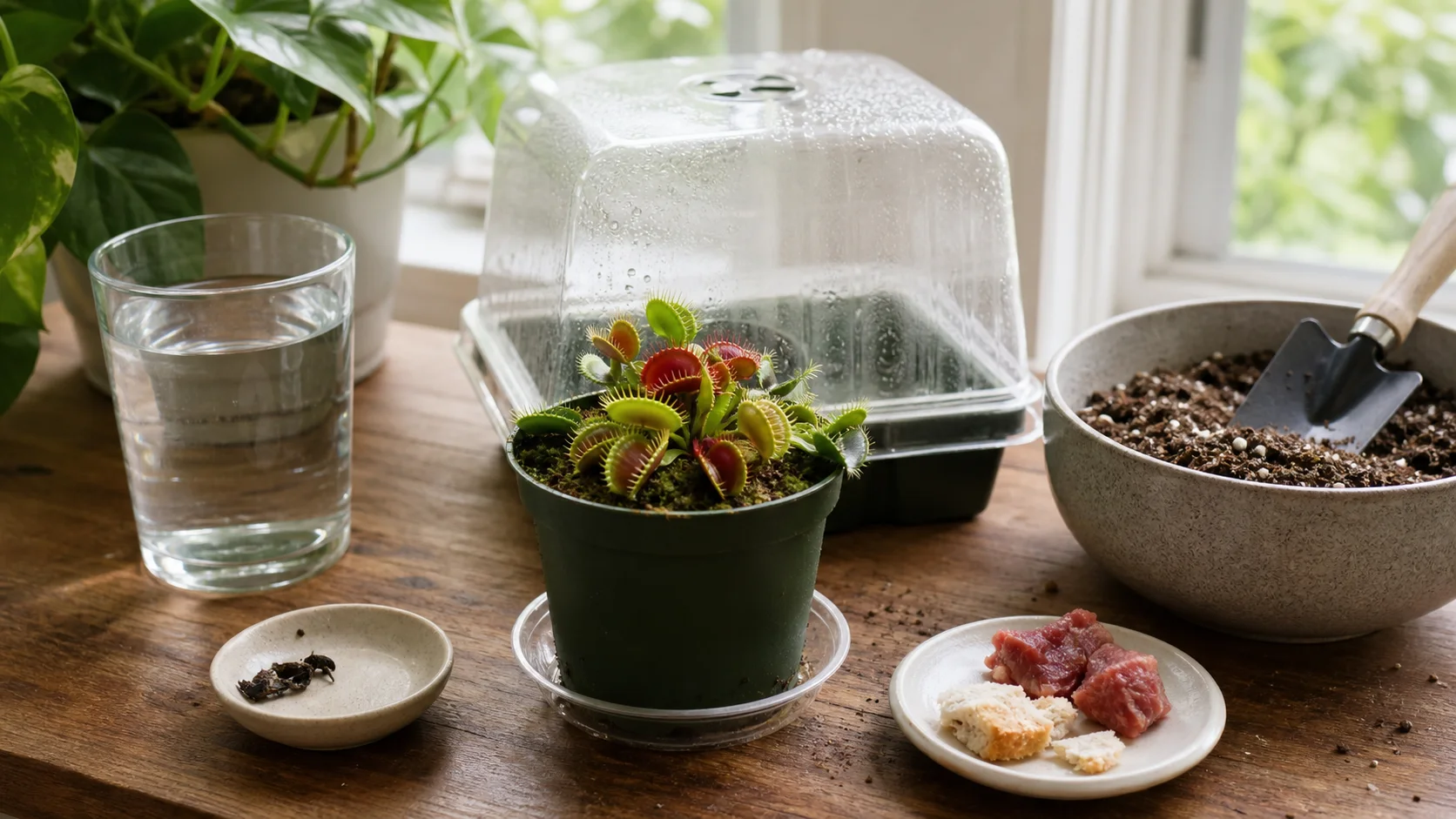
A sealed dome, rich soil, ordinary water, and human food gather several common Venus flytrap mistakes in one setup.
Confused With Terrarium Plants and Easy Desk Plants
A Venus flytrap gets grouped with the wrong care categories all the time.
It is often confused with terrarium plants, because retailers sell it in domes and novelty displays. The display looks humid and exotic, but the real limiting factor is almost always poor light, not humidity.
It is also confused with easy desk plants. A pothos can survive mediocre light and ordinary tap water for a long time. A Venus flytrap usually cannot.
The practical takeaway is simple: if your care idea comes from normal houseplant logic, stop and re-check it before you apply it here.
Pet Safety
The sources reviewed for this article focused on cultivation, not pet toxicology. Do not assume the plant is pet-safe just because the traps are small or the plant is commonly sold as a novelty.
If you have a cat or dog that chews foliage, the safest move is to keep the plant out of reach and verify current toxicity guidance with your veterinarian or a poison-control resource before treating it as safe around pets.
Seasonal Note for Indoor Growers
This article was updated in July 2026, which means most readers using it right now are probably setting up active summer growth, not winter dormancy. That changes the priority list.
In the bright season, focus on light strength, pure water, and not overfeeding. Revisit your dormancy plan in late autumn, when natural light drops and your current setup either proves strong enough to support steady growth or clearly does not.
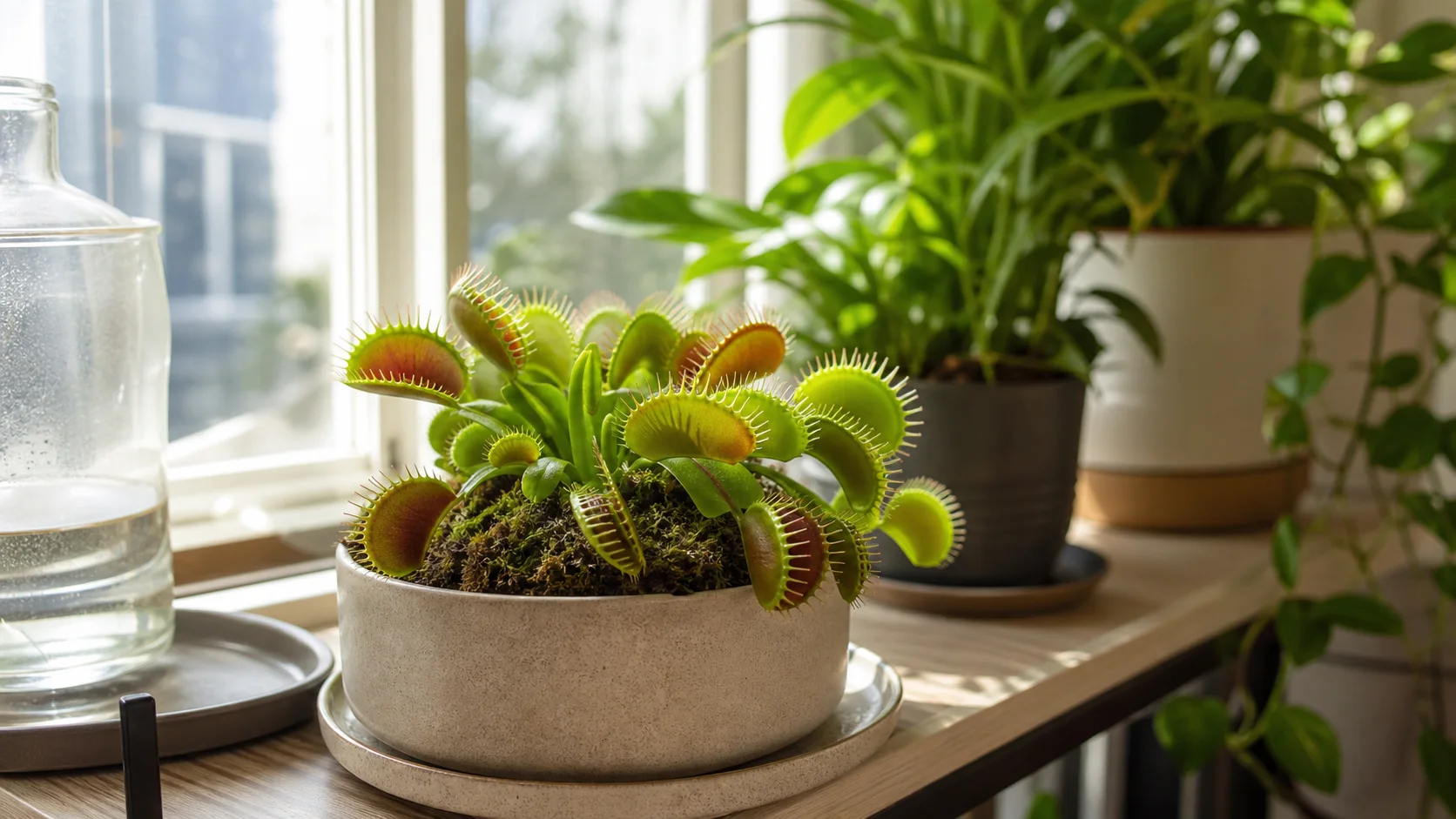
Strong summer light and mineral-free water support active growth before dormancy planning becomes the priority in autumn.
If you are comparing care routines for another houseplant, see Croton Plant Care: Keep the Color and Stop Sudden Leaf Drop for a focused step-by-step guide.
Methodology Note
To update this guide, we reviewed live search results for the main keyword and close variants, checked recurring indoor-grower pain points from search-result snippets for Reddit and Gardening Stack Exchange, and verified the care claims against Iowa State Extension, NC State, University of Alaska Fairbanks, New York Botanical Garden, and the International Carnivorous Plant Society. Community evidence was treated as qualitative signal, while direct care guidance came from the primary horticultural sources.
Real User FAQ
Is one tap watering fatal? Usually no. One accidental tap watering is more of a warning than a death sentence. The risk comes from repeated mineral buildup over time. Switch to distilled or rainwater and flush the medium.
Can I keep a Venus flytrap in a terrarium? Not as a default plan. The common failure pattern is a decorative enclosure with weak light. An open setup with genuinely strong light is one thing. A sealed novelty dome is another.
Does my indoor Venus flytrap need dormancy every winter? Not in exactly the same way for every setup. Outdoor plants need a real seasonal rest. Strong grow-light setups can stay active or only slow down lightly. Windowsill plants often rest naturally as light fades.
Can I feed it dried bugs or dead insects? Fresh, small prey works better than oversized or stale food. If a trap cannot seal properly, the meal often rots instead of digesting. When in doubt, feed less, not more.
Why did a trap close and then reopen? That usually means the trap was triggered without getting a suitable meal, or the food was not small and active enough to complete the digestion process. A single failed trap is not a crisis if the plant keeps making new ones.
Why does the plant look worse after I tried to help it? Because the most common helpful fixes are the wrong ones for this species: tap water, richer soil, extra feeding, and low-light display setups. Strip the care back to pure water, strong light, and the right medium first.
For a related care deep dive, see the low-light indoor plants guide.