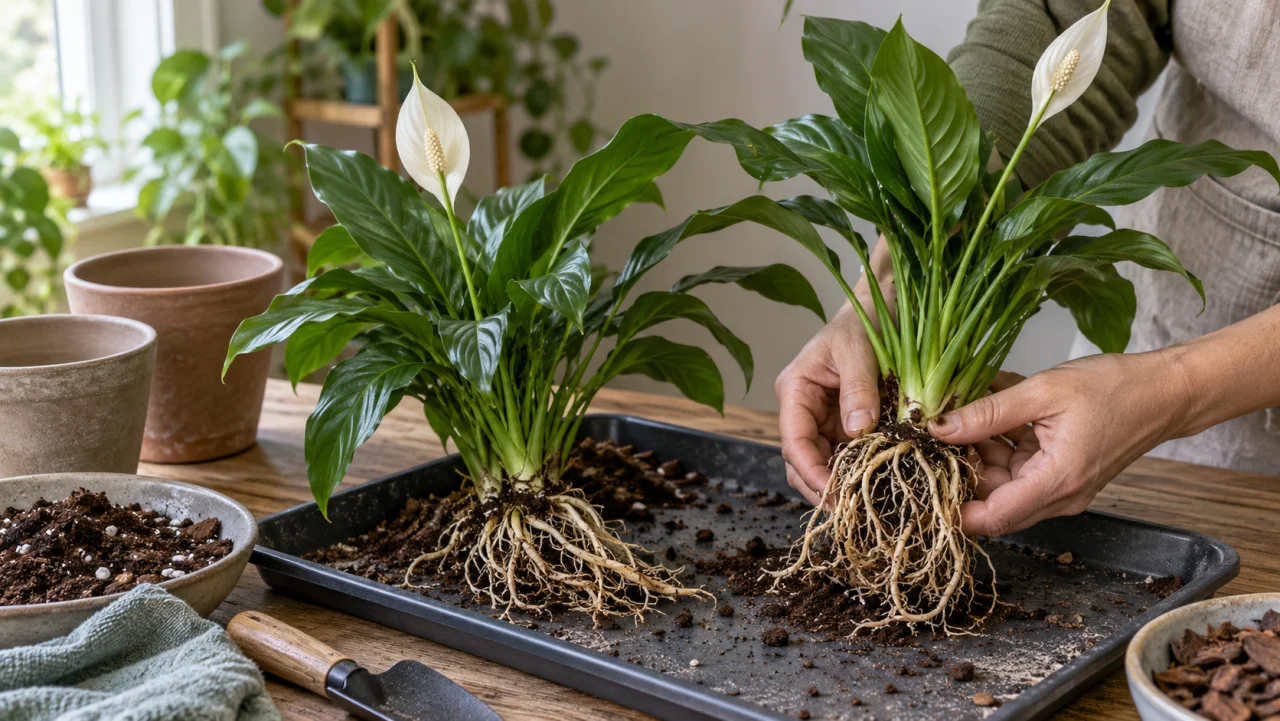
Peace Lily Propagation: Divide Crowns Without Damaging Roots
Dividing a peace lily too soon can leave both halves drooping with too few roots. The next mistake is panic-watering that droop until healthy roots begin to rot. Avoid both with this 30-second rule:
- Divide today only if two or more leaf clusters each have their own firm base and attached roots.
- Repot her whole if crowded roots still belong to one base.
- Wait and diagnose if roots are sparse or mushy, the base is soft, or the plant is already badly wilted.
A detached leaf is not enough. This guide shows the safest split, then exactly when to water, where to place each division, and what to do if she droops afterward.
For simpler recovery, make these aftercare decisions before dividing:
- When to water: Water once after potting and let it drain. Water again only when the root zone is beginning to dry and the pot feels lighter.
- Where to place it: Choose warm, bright indirect light away from direct sun, heaters, cold glass, and air-conditioning vents.
- What droop means: Droop can be temporary transplant stress, not automatic proof of thirst. Check the soil as well as the leaves.
- When to stop: Keep the plant intact if you cannot give every division a growing base and roots. Stop and diagnose if the crown is soft or the roots are mushy or foul-smelling.
Before disturbing the plant, save a clear baseline photo in KnowYourPlant’s identify flow. It confirms the plant and gives you a before view to compare with recovery over the next two weeks.
What Most Propagation Guides Miss
The common leaf-cutting misdiagnosis is assuming that any healthy leaf can become a new peace lily. A leaf may remain green in water, but it generally cannot produce a complete new plant by itself.
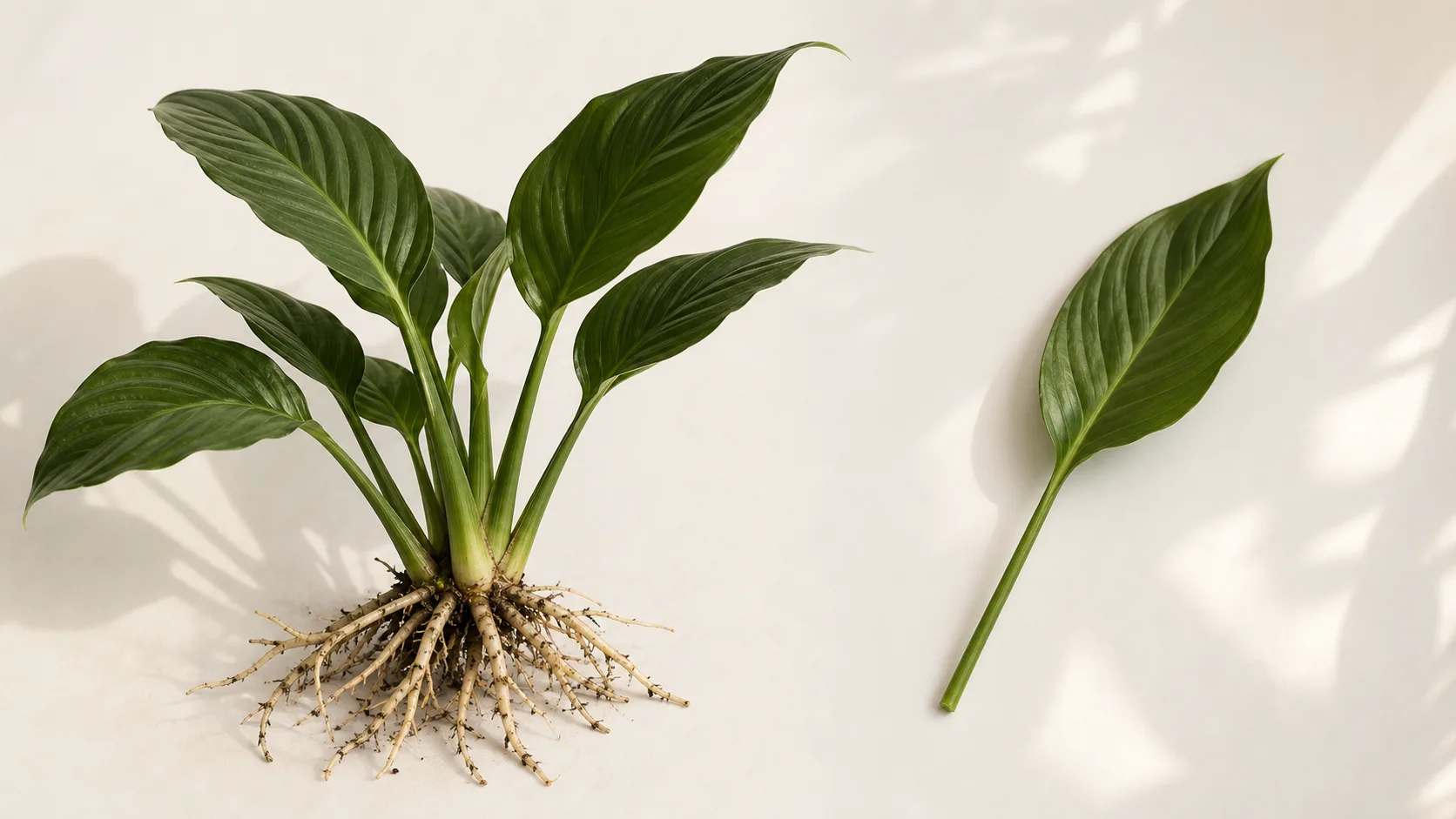
A viable division keeps a shared growing base and attached roots. A detached leaf does not.
Use one plain-English check: each new plant needs its own growing base and roots.
That is the crown-root match, meaning the leaf stalks share a firm base and that same base has roots attached. Trace each proposed division from its leaves to the soil line and into the root mass. If you lose track of which roots belong to which base, do not cut.
Rootbound also does not automatically mean divisible. A peace lily with one growing base may need a larger pot, while a plant with several rooted bases may be divided. Make the fewest useful splits. Two substantial divisions usually have a better recovery margin than several tiny fragments.
Go or No-Go Card
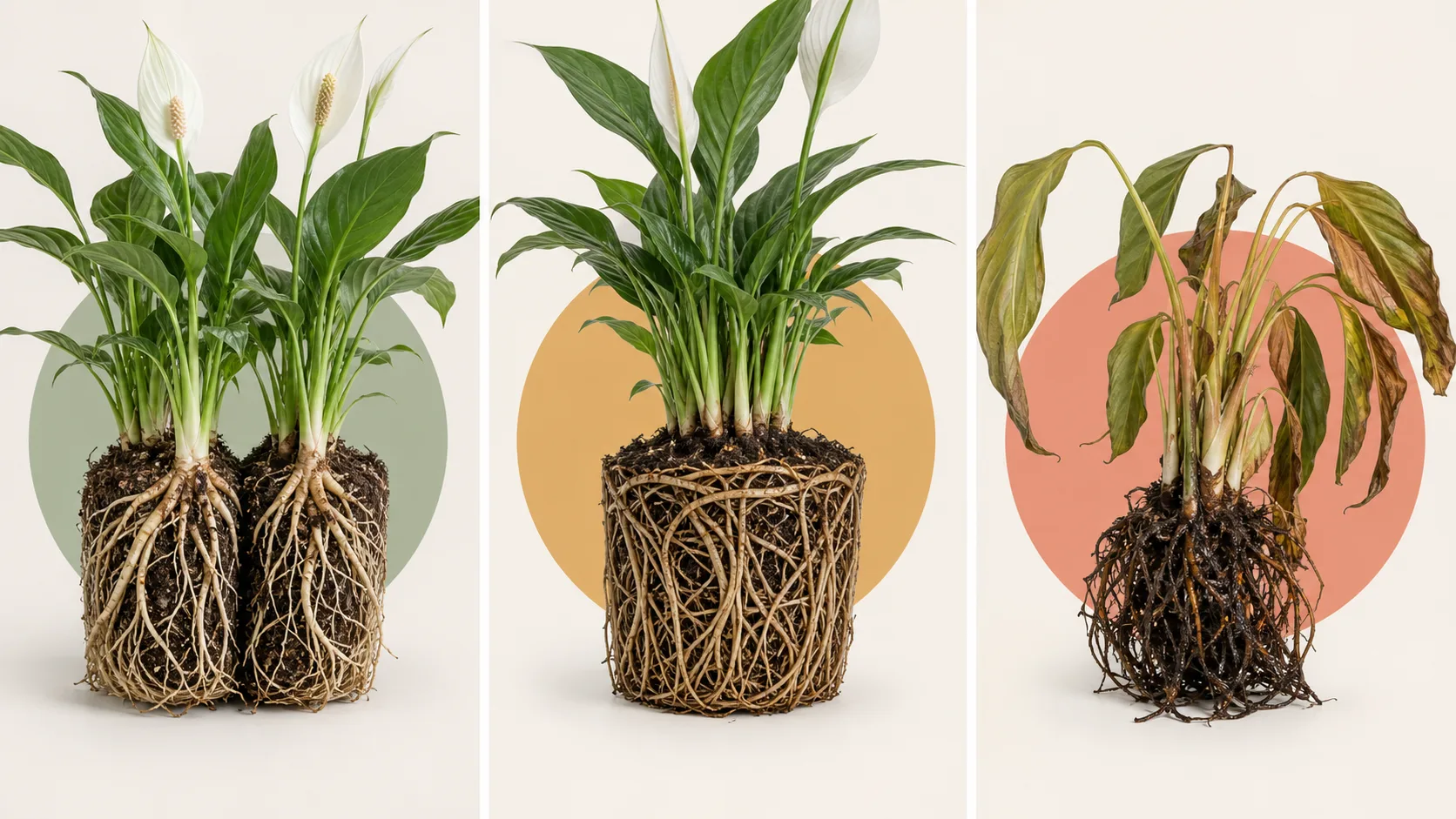
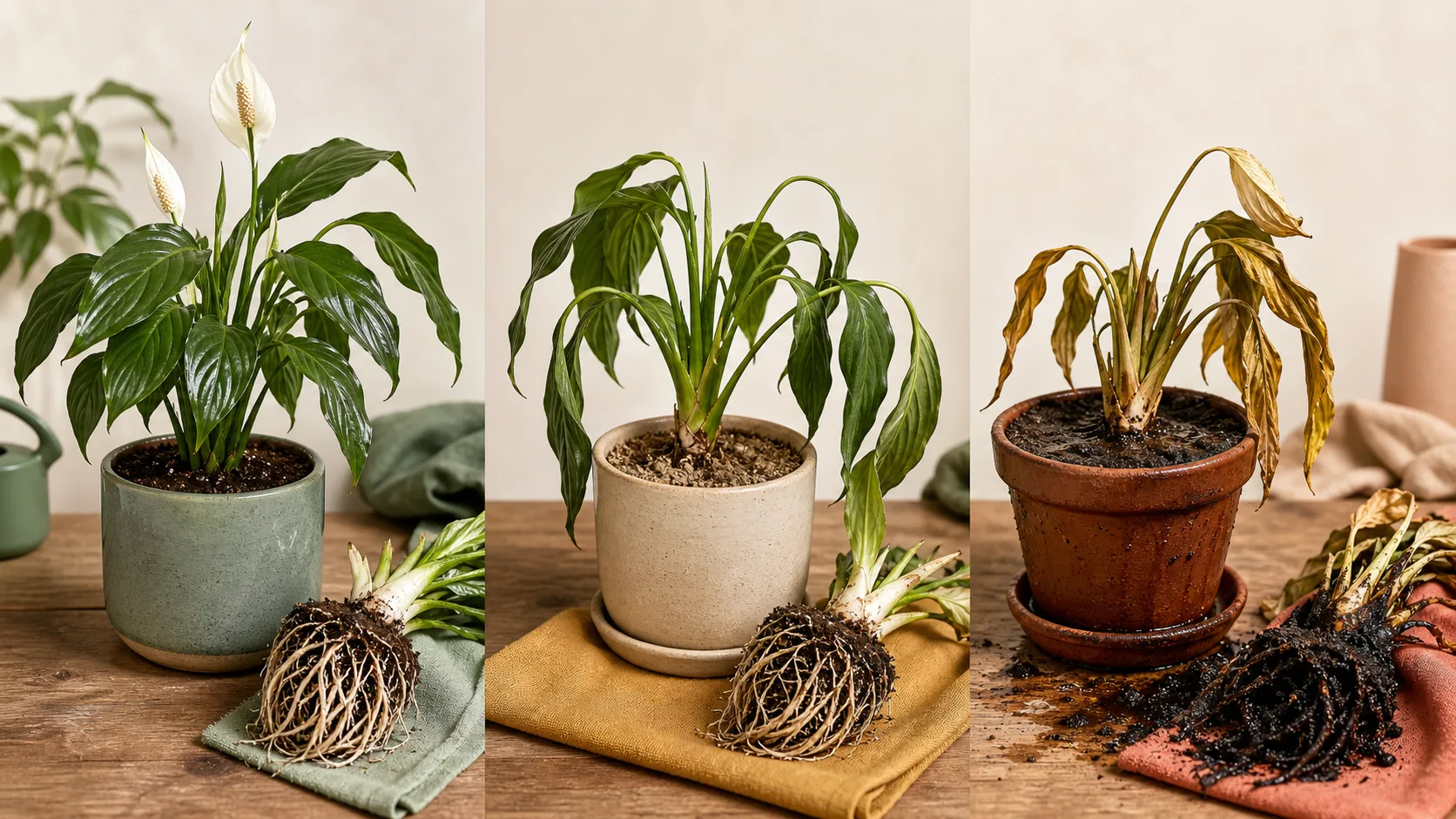
Left: divide. Center: repot the single crown intact. Right: recover before propagation.
| What you find | Decision |
|---|---|
| Two or more firm growing bases, each with attached roots | Go: divide along their natural seams |
| One growing base with crowded or circling roots | No-go: repot the plant intact |
| Several bases, but their roots cannot be separated confidently | No-go: loosen a little mix, then stop if still unclear |
| Sparse roots, recent severe wilt, or an undersized plant | No-go: stabilize it and wait |
| A detached leaf or leaf stalk | No-go: it is not a viable division |
| Soft base, sour mix, or mushy roots | No-go: diagnose damage or use the root rot treatment guide |
If the whole plant is declining, address light, watering, and drainage with the peace lily care guide before routine propagation.
Save Three Proof Photos Before You Cut
Take one photo of the whole plant, one close view where the leaf clusters meet the soil, and one of the loosened root ball. These views give you something concrete to compare after 3, 7, and 14 days. They also expose a weak plan before the cut: if a proposed section has no visible roots of its own, keep the clump together.
The warning is grounded in real beginner confusion. A surfaced Reddit propagation thread described a leaf cutting that still had not rooted after about five weeks. Another home-grower thread reflects the recurring panic over droop after division. These are anecdotal signals, not trials, so the method and moisture advice below remain anchored to the extension sources in the expert layer.
Before You Unpot
Prepare small pots with drainage holes, fresh airy indoor potting mix, a clean blade, a tray, and water. Select each pot for the roots the division has now. Excess unused mix can remain wet for too long.
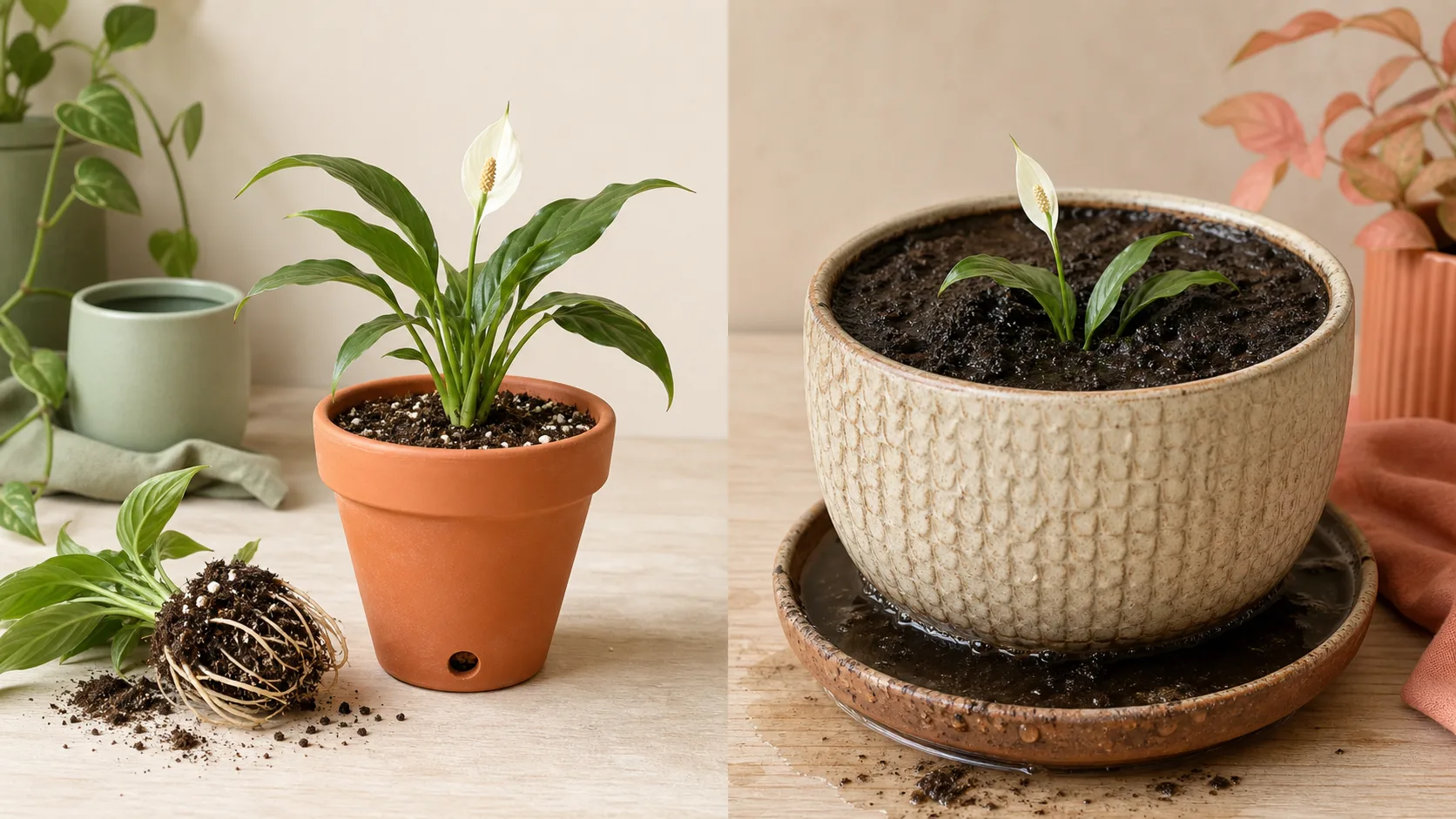
Fit the pot to today’s roots. Oversized wet mix raises the recovery risk.
Work when the mix is lightly damp. Bone-dry roots are easier to snap, while saturated mix is heavy and hides the natural seams. Have the new pots ready so exposed roots do not sit out while you search for supplies.
Spring is convenient, but plant condition matters more than a perfect date. Do not divide a dehydrated peace lily. If the mix is dry and the pot feels light, water it and wait until the leaves recover.
How to Divide a Peace Lily
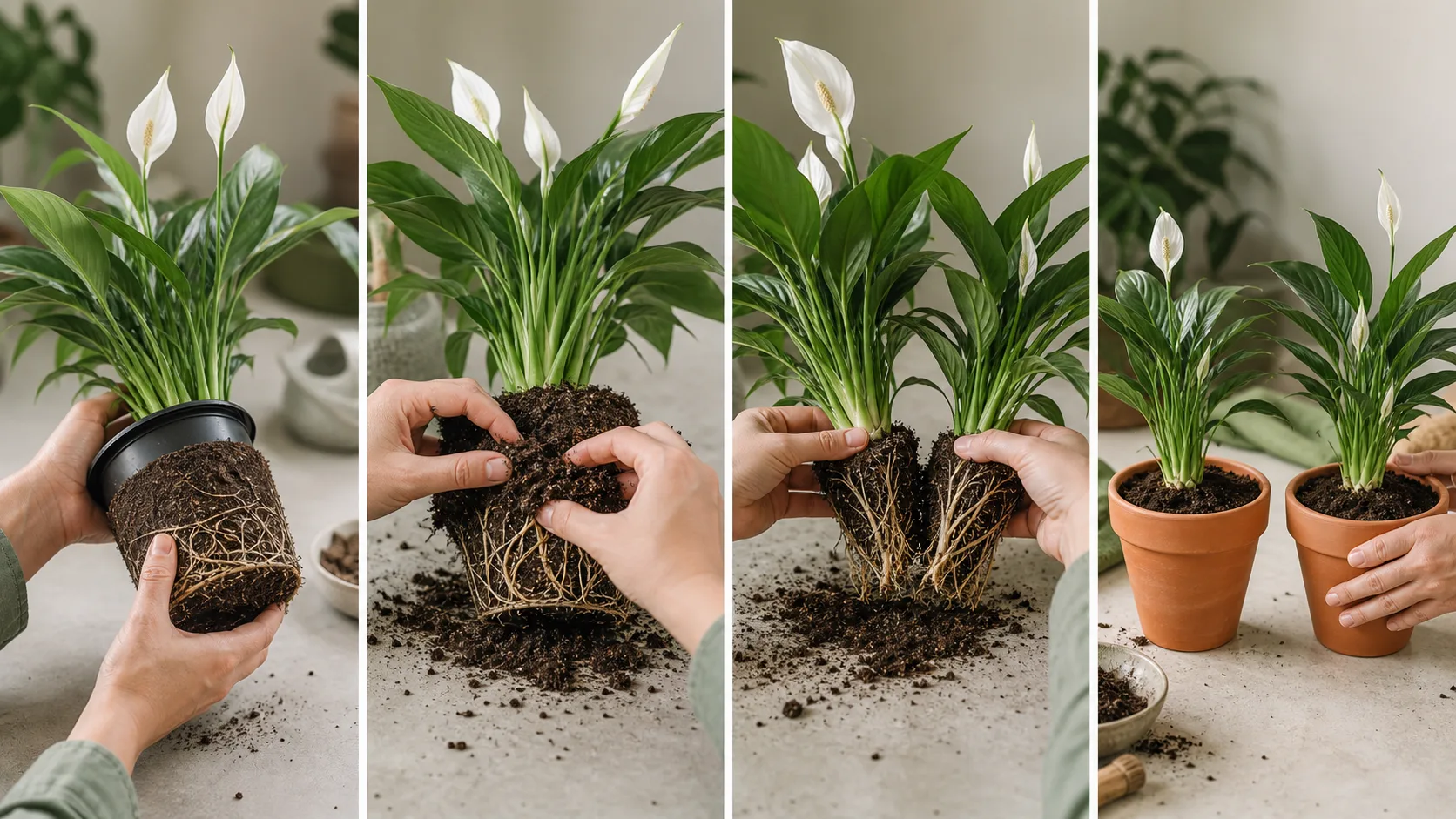
Loosen from the outside, follow the natural seam, and keep both divisions generous.
-
Remove it by the root ball. Lay the pot on its side and ease the plant out. Squeeze a flexible nursery pot or loosen its inner edge. Never pull on the leaves.
-
Expose the bases. Massage loose mix from the outside and around the junctions between leaf clusters. Do not wash every root clean.
-
Find a natural seam. Hold two firm bases and rock them gently apart. A real seam begins to open without the bases tearing.
-
Untangle from the outside inward. Free a few roots at a time instead of pulling straight through the mass. Preserve the main roots even if a few fine roots break.
-
Cut only when necessary. If firm connecting tissue remains between two confirmed rooted bases, make one controlled cut with a clean blade. Never cut blindly through the center.
-
Trim only failed tissue. Remove roots that are clearly hollow, dead, or mushy. Keep firm roots even if they are stained or bent.
-
Repot at the original depth. Spread the roots, add mix around them, and keep the point where the leaves emerge at or just above the soil surface.
-
Water once and drain. Wet the root zone evenly, allow excess water to escape, and empty the saucer or cachepot. Do not schedule the next watering by weekday.
If the division wilts, open Diagnose and record both leaf posture and soil moisture. That pairing helps separate expected transplant stress from thirst or a worsening root problem.
If It Droops After Division, Do This First
Read the leaves with the soil: mild stress, true thirst, and wet-root decline need different actions.
Use the two-signal soil plus leaf rule: read leaf posture and root-zone moisture together before acting.
- Drooping leaves plus damp soil and a heavy pot: Wait. If the growing base remains firm, this is consistent with transplant stress. Keep conditions stable and check again the next day.
- Drooping leaves plus drying soil and a light pot: Water thoroughly, let it drain, and reassess after the roots have had time to take up moisture.
- Worsening collapse plus wet soil, a sour smell, or a soft base: Stop watering. Unpot the division and inspect the roots and growing base.
- One yellow lower leaf plus a firm base: Monitor the overall trend. A single older leaf can be lost after disturbance.
- Several yellowing leaves while the pot remains wet: Check drainage, pot size, light, and roots rather than adding fertilizer.
One droopy afternoon is weak evidence. Gradual firming over several days is encouraging. Spreading collapse while the mix stays wet requires investigation.
The First Two Weeks
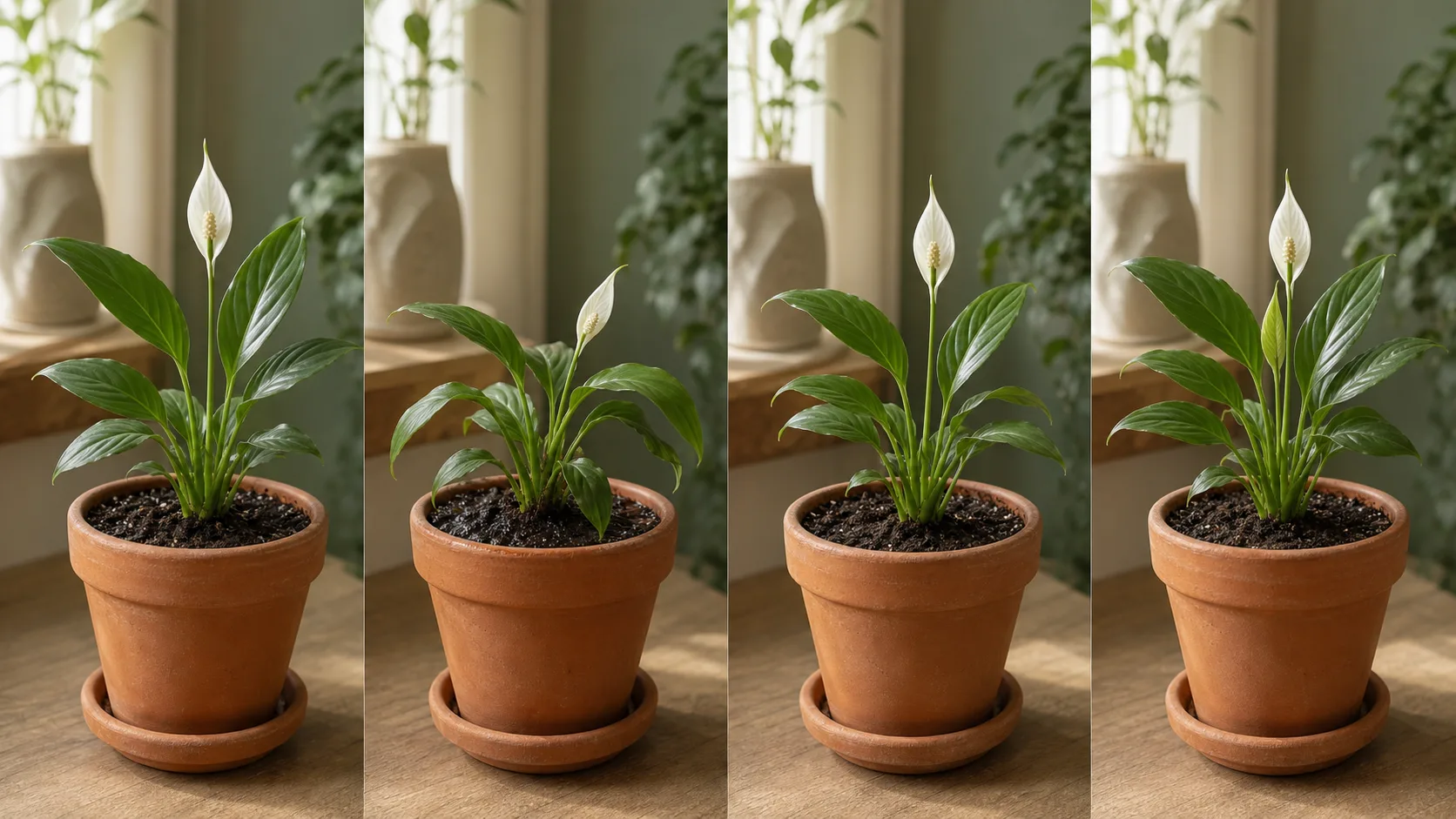
Compare the same plant at days 0, 3, 7, and 14. The direction of change matters more than one droopy moment.
Keep the divisions warm in bright indirect light. Direct sun raises water loss before disturbed roots are ready, while a very dim position can keep the mix wet too long. Lift the pot just after the first drained watering so you know its heavy baseline.
| Check | What to look for | Decision |
|---|---|---|
| Day 0 | Mix evenly moist, drainage finished, crown above soil | Put it in stable bright indirect light and leave it alone |
| Day 3 | Check one finger joint below the surface and lift the pot | Cool or damp plus heavy: wait. Barely damp plus clearly lighter: water and drain |
| Day 7 | Compare leaf angle with the baseline photo | Firmer or stable: continue. Worse while wet: inspect drainage and roots |
| Day 14 | Look for steady posture or a small new leaf | Improvement: resume normal monitoring. Ongoing collapse: diagnose before feeding |
Do not fertilize during this recovery check. If the pot stays heavy and wet across several checks, empty standing water and review pot size, mix density, drainage, and light.
Common Mistakes
- Making every possible split: Each cut reduces the roots available to a division. Stop after the fewest natural separations.
- Watering every droop: Test the root zone and lift the pot first.
- Using a large pot: Fit the container to the present root mass, not anticipated growth.
- Packing dense mix: Roots need air as well as moisture.
- Burying the growing base: Keep it at its previous depth.
- Dividing an unhealthy plant: Multiple yellow leaves, stale wet mix, or a soft base need diagnosis first. See the peace lily yellow-leaf guide.
- Fertilizing immediately: Feeding does not repair disturbed roots and can add stress.
Seasonal Note
UF/IFAS Gardening Solutions recommends propagating peace lilies by division in spring, and North Carolina Extension notes that repotting is commonly done around February or March.
Division outside spring can still be reasonable when severe crowding makes watering difficult. In darker seasons, make fewer divisions, use snug pots, and remember that the mix may dry more slowly.
Expert Source Layer
The practical decisions in this guide follow extension guidance:
- UF/IFAS Gardening Solutions recommends spring division and bright light away from direct sun.
- Clemson Cooperative Extension advises moist but not soggy conditions, no standing water, and increasing pot size by only 1 to 2 inches when repotting.
- North Carolina Extension recommends moisture-retentive but well-drained mix and cautions against overfertilizing.
- University of Arkansas Division of Agriculture describes peace lilies as rhizomatous, clump-forming plants and connects repotting need with serious crowding.
- South Dakota State University Extension notes that overwatering can contribute to root and stem disease.
Together, these sources support a conservative method: follow the plant’s existing structure, preserve firm roots, use a draining pot, and check moisture before reacting to wilt.
Action Plan
Today: Confirm that every proposed division has a growing base and attached roots. Make the fewest splits, pot at the original depth, water once, and drain.
This week: Maintain bright indirect light and stable warmth. Water only when the root zone is beginning to dry.
This month: Watch for firmer leaves and resumed growth. Feed only after the plant is settled and actively growing.
Log today’s split and set recovery reminders in KnowYourPlant. Dated moisture and symptom notes show whether each division is improving and prevent a return to automatic weekly watering.
If you are troubleshooting another common plant symptom, see Peace Lily Drooping: Thirst, Root Stress, or Shock? for a focused diagnosis and recovery plan.
FAQ
Can you propagate a peace lily from one leaf?
Usually not. A detached leaf lacks the complete growing base and root system needed for reliable peace lily propagation, even if it remains green in water.
How many leaves should a division have?
There is no fixed minimum. Choose a firm base with several leaves and a useful group of attached roots rather than a one-leaf fragment. Leave both the new division and parent with enough roots to support themselves.
How long does post-division droop last?
Mild droop may improve over several days or during the first week or two. Inspect sooner if collapse spreads, the pot remains heavy and wet, the mix smells sour, or the base softens.
Should I propagate in water or soil?
Water culture does not remove the need for a viable rooted base. For straightforward home propagation, fresh draining potting mix is usually easier to manage. Keep the growing base above the soil or water line.
What pot size should I use?
Choose a pot only slightly wider than the gathered roots. Clemson’s 1 to 2 inch increase for routine repotting is a useful upper limit. A much larger volume of mix dries slowly.
Should I fertilize after division?
Wait until the division is settled and producing active growth. Freshly disturbed roots need stable moisture and oxygen, not extra fertilizer salts.
Can I divide a flowering peace lily?
You can, but division adds stress while the plant supports blooms. Unless crowding is causing an urgent watering problem, wait until flowering slows.
When should I abandon a split?
Stop before cutting if either section would be nearly rootless. After potting, intervene if the growing base becomes soft, the roots turn mushy, or decline spreads while the soil remains wet. A rootless or rotting fragment is not improved by repeated watering.
Methodology and Freshness Note
Reviewed July 19, 2026. Propagation method, clump-forming growth, seasonal timing, light, moisture, drainage, pot sizing, and disease-risk claims were checked against UF/IFAS, Clemson Cooperative Extension, North Carolina Extension, University of Arkansas Division of Agriculture, and South Dakota State University Extension.
The go/no-go card, fewest-splits rule, and two-signal droop check are editorial decision tools that translate those sources into practical indoor-plant care. Community snippets were used only to identify recurring confusion, not to establish horticultural facts. No first-hand testing or original gallery evidence is claimed.