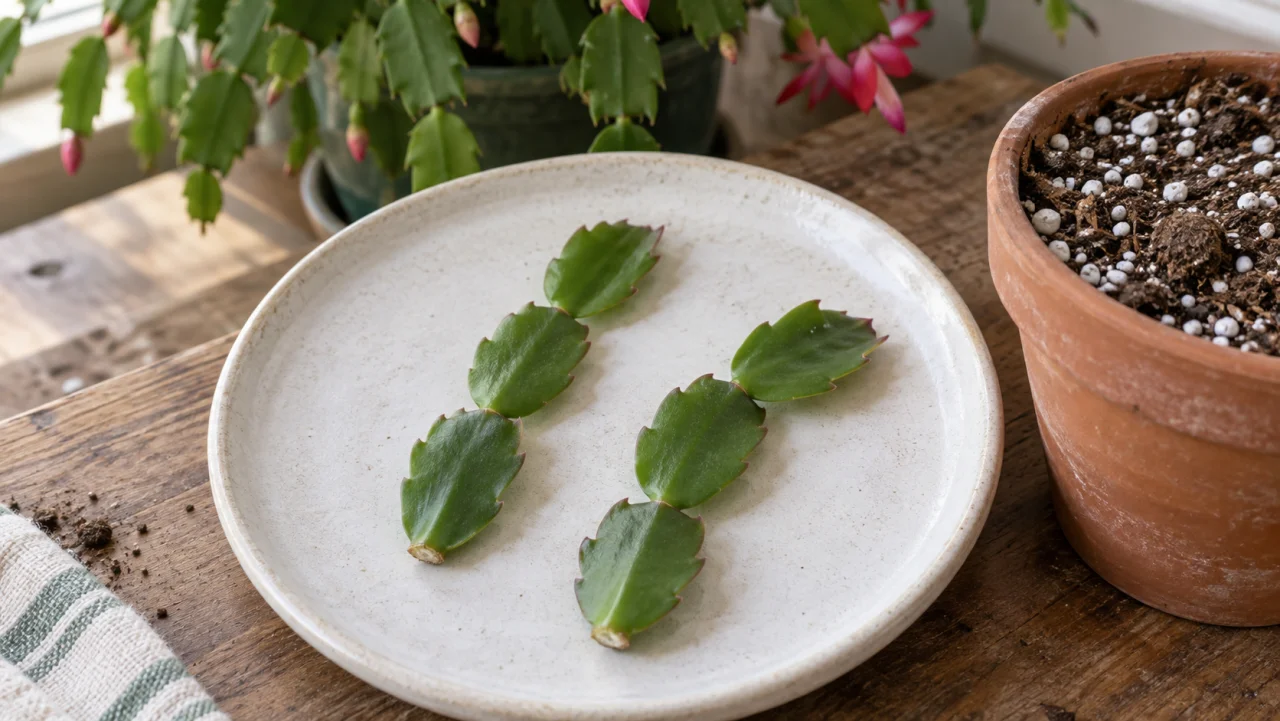
Christmas cactus propagation usually fails in one quiet moment: the cutting is still alive, but it sits in more moisture than it can handle before roots ever form. If you are here with a broken piece in your hand, or a leggy plant you want to turn into two, that is the real job. Not just getting roots, but getting a firm healthy segment through its most rot-prone week.
The good news is that holiday cacti are generous plants. The Royal Horticultural Society says, “It’s very easy to take cuttings from Christmas cacti,” and NC State notes that holiday cactus types are easily propagated by stem cuttings. What most quick guides miss is the practical question real plant owners ask first: is this piece even worth rooting, and what setup gives it the safest start in your home?
What Most Care Guides Miss
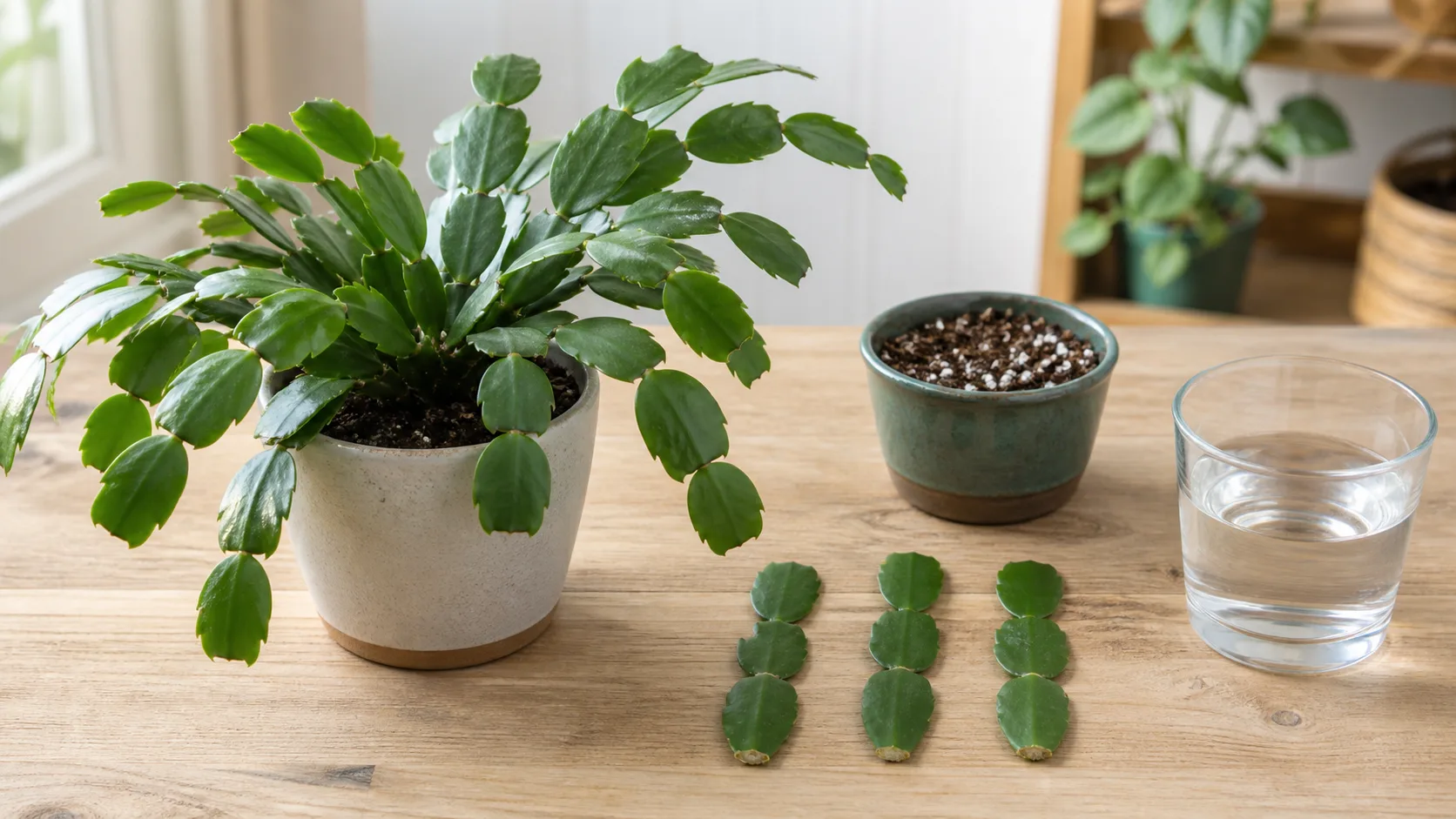
Start with a healthy parent and short multi-segment cuttings, then choose one rooting method you can keep consistently aerated.
Most christmas cactus propagation guides frame the choice as water versus soil. That is usually not the first decision that matters.
The most common misdiagnosis is assuming a failed cutting needed a different rooting method, when the real problem was a weak segment, a damaged base, or too much moisture too early. Before you root anything, check these in order:
- Segment count: two to four joined segments is the safest starting size.
- Firmness: the cutting should feel plump and springy, not soft, papery, translucent, or limp.
- Base condition: the bottom joint should look clean, not crushed, wet, black, or mushy.
- Parent plant health: if the mother plant has active rot or pest pressure, fix that first before taking more pieces.
If the base already looks injured or waterlogged, switching from water to soil will not solve it. A better first move is to trim back to healthy tissue if needed, then let the cut end dry for a few days before rooting.
That one check changes the whole process. Instead of asking, “Which method is best?” ask, “Do I have a viable cutting, and how little stress can I put on it this week?” If you want the wider framework for deciding between water, mix, division, and other techniques, our plant propagation guide lays out the method choices side by side.
Quick diagnosis card: is this piece worth propagating?
Use this before you do anything else.
| Check | Good sign | Warning sign | What to do |
|---|---|---|---|
| Segment size | 2 to 4 joined segments | One tiny weak segment | Choose a sturdier piece if possible |
| Tissue feel | Firm and evenly green | Limp, translucent, or mushy | Discard or recut to healthy tissue |
| Base | Clean joint or neat cut | Split, blackened, or crushed | Trim and let it dry again |
| Parent plant health | No active rot or pest mess | Soft stems, rot, heavy pests | Stabilize the parent plant first |
A lot of us skip this because we are excited to save the fallen piece. I get it. But this fast check saves more cuttings than buying rooting powder or changing jars later.
Christmas cactus or Thanksgiving cactus, and does it matter?
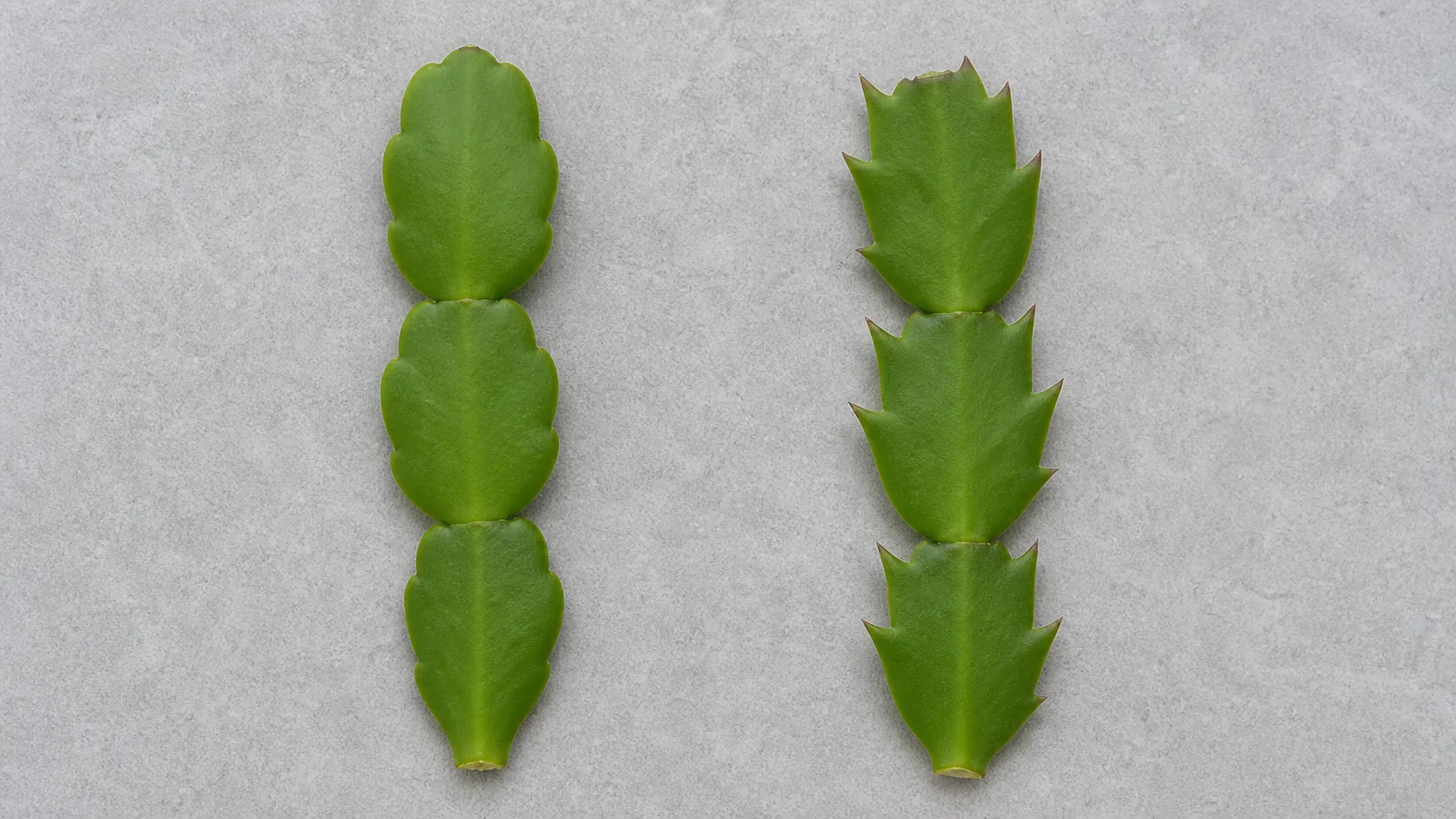
Rounded scallops indicate a true Christmas cactus; sharply pointed segment margins are characteristic of Thanksgiving cactus.
A little, yes, but not in the way people think.
NC State says Thanksgiving cactus is “frequently confused with Christmas cactus,” which matches what most people see at garden centers. True Christmas cactus usually has more rounded stem margins. Thanksgiving cactus tends to have more pointed, claw-like edges. Many plants sold around the holidays are hybrids or mislabeled.
For propagation, the method is still very similar. The more important takeaway is that these are rainforest cacti, not desert cacti. They want bright indirect light, an airy mix, and moisture that is present but never stagnant.
Holiday cactus ID mini decision tree
If you are squinting at the segments and wondering whether the label matters, use this:
- Rounded segment edges, softer outline: likely closer to true Christmas cactus.
- Pointed or toothy edges: likely Thanksgiving cactus, or a hybrid sold as Christmas cactus.
- Store tag says “holiday cactus” and the edges look mixed: treat it like a holiday cactus hybrid and use the same propagation steps below.
That naming mess explains why some articles sound inconsistent. The practical rooting advice is still the same: short healthy segments, a brief callusing period, and a moist but airy setup.
The timing that gives cuttings the best chance
The easiest time to propagate is after blooming, when she shifts back into active growth. That is when the plant has more energy to spare, and you are less likely to interrupt buds or flowers. If you are still stabilizing the parent plant’s routine first, our christmas cactus care guide covers the watering, light, and rebloom conditions that make stronger cuttings more likely.
A few useful benchmarks from expert sources:
- NC State recommends removing two or three stem segments for holiday cactus propagation.
- NC State says to let the cutting callous for a few days before planting.
- NC State says the stems usually root after a few weeks.
- RHS says these rainforest cacti like around 18 to 20°C, or 65 to 69°F, in spring and summer.
Those details keep the process grounded. You do not need giant cuttings, extreme drying time, or harsh succulent-style treatment.
How to take christmas cactus cuttings cleanly
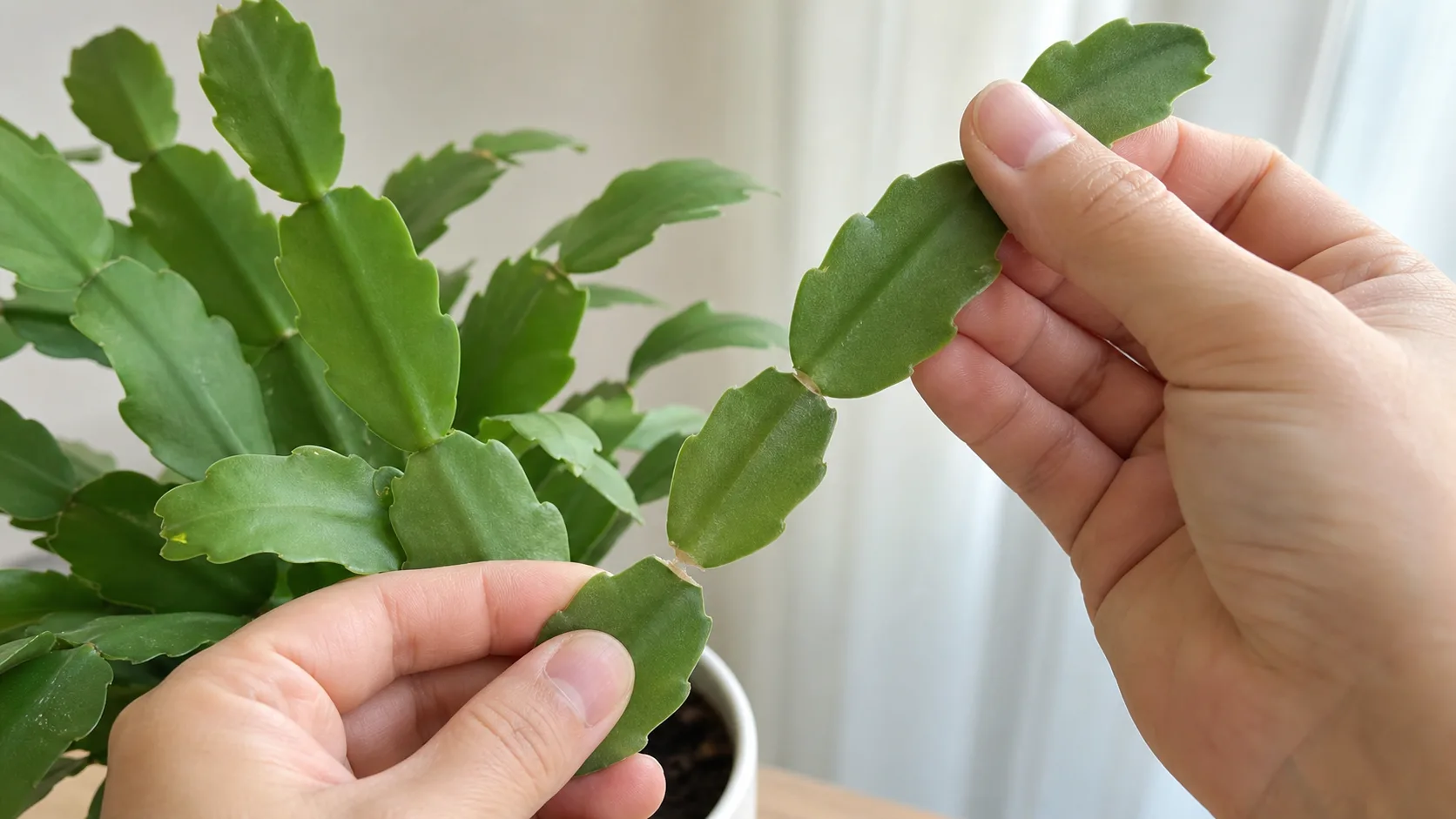
Twisting at a natural joint leaves a small basal wound and avoids slicing through the water-storing segment tissue.
Hold one segment gently and twist at the natural joint. Holiday cactus stems often separate cleanly there. If you use scissors or a knife, make one clean cut instead of sawing through the tissue.
A few small choices make a big difference:
- Cut from healthy outer stems, not from mushy or shriveled sections.
- Take from several spots rather than stripping one side bare.
- If the plant is leggy, use propagation as a light prune and start with the longest outer stems.
- Keep the cutting shaded from hot direct sun right after you remove it.
NC State’s Thanksgiving cactus guidance is simple and useful here: “Remove two or three stem segments with a sharp knife and let it callous over for a few days.” That is the core of a good start.
Let the cut end dry, but do not overdo it
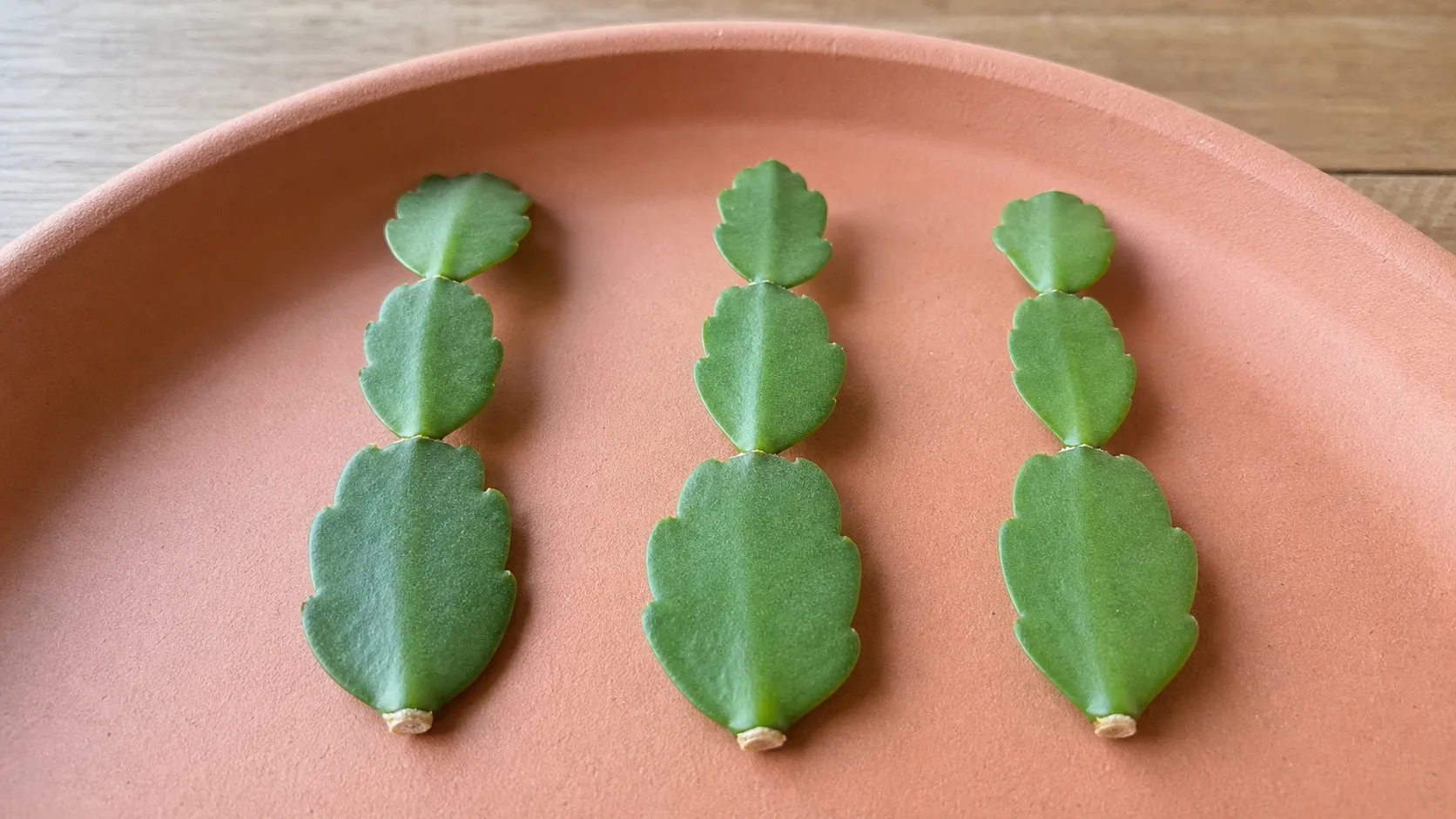
A brief drying period should leave a small dry joint scar, not a shriveled cutting or a broad exposed wound.
This is one of the biggest information gaps in the search results. Fresh holiday cactus cuttings are not desert pads that need to sit around forever. They just need the wound to stop looking wet.
Lay the cuttings in bright indirect light for a few days. In a dry room, the shorter end of that range is often enough. In a humid room, give them a little longer. You are looking for a dry sealed base, not a shriveled segment.
If you skip this step and place a fresh wet cut straight into soggy mix or a deep jar, rot becomes much more likely.
Soil or water, which method is better?
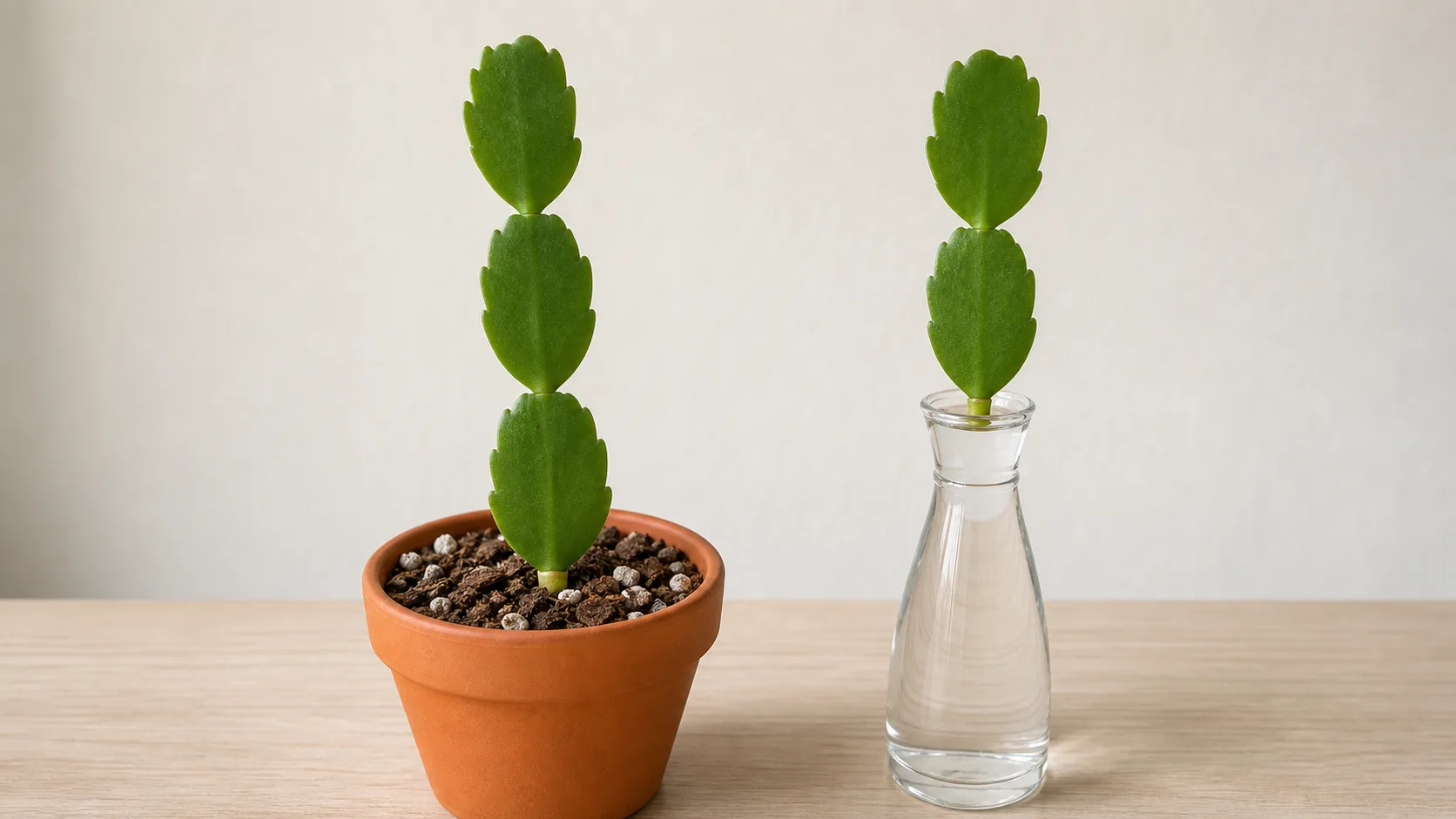
In mix, insert only the base shallowly; in water, support the cutting so only the basal joint contacts water.
Both can work. The better choice depends on your habits more than on internet debates.
| Method | Best for | Main risk | Beginner friendliness | Honest take |
|---|---|---|---|---|
| Rooting in airy mix | Most people, especially over-checkers | Overwatering in a dense pot | Higher | Usually the safer choice |
| Rooting in water | People who want visible roots | Base rot, then transfer stress | Medium | Fine if the water line stays very low |
If you already know you hover over cuttings and “help” them too much, start in a small pot with a light mix. If you need visual proof that something is happening, water rooting can calm that anxiety, but only if the bottom segment barely touches the water.
For the broader rhythm of taking cuttings and not overhandling them, /blog/posts/propagate-pothos-guide/ shows the same principle: stable conditions beat constant fiddling.
How to root christmas cactus in potting mix
This is the method I would hand to most beginners.
- Fill a small pot with a loose airy mix.
- Insert the base of the cutting just deep enough to anchor it.
- Place it in bright indirect light.
- Water lightly once, then let the mix move toward lightly dry before watering again.
NC State describes the right medium as “moist, well-drained, airy potting medium,” and that is exactly the target. Think fluffy and breathable, not heavy and muddy. If you want help choosing a mix, /blog/posts/best-potting-soil-indoor-plants/ gives a practical breakdown of what stays airy indoors.
A small pot matters more than people expect. Oversized pots hold wet soil too long around a cutting with no roots. That is how a healthy segment quietly turns soft at the base.
What the mix should feel like
You do not need a perfect recipe, but you do need the right feel.
- It should drain fast enough that water does not sit heavy around the stem.
- It should still hold a bit of moisture instead of going bone dry for days.
- It should feel open when you pinch it, not sticky or compacted.
If your current potting mix behaves like wet cake batter, it is too dense for a fresh cutting.
How to root christmas cactus in water without inviting rot
Water rooting is not wrong. It just needs restraint.
- Use a narrow glass or jar.
- Let only the bottom of the lowest segment touch the water.
- Keep the rest of the cutting above the waterline.
- Change the water when it looks cloudy, or about weekly.
- Pot up once you have a modest cluster of roots, not just one tiny nub.
Community-style search results keep surfacing the same worry: cuttings turn black or translucent in water before they ever root. That pattern usually points to too much submerged tissue, stale water, or a cutting that went in before the wound had sealed.
If the base darkens and feels slimy, take it out right away. Trim back to firm green tissue if there is any left, let it dry again, and restart. If there is no firm green tissue left, it is kinder to discard it and try a healthier segment.
Start with the pattern, not one cause
If your cutting is struggling, do not change everything at once. Separate the pattern first:
- Base turning black or see-through: too much moisture, damaged tissue, or no callusing period.
- Whole cutting shriveling but base still firm: it may be drying faster than it can root, especially in very warm bright rooms.
- Cutting stays firm but does nothing for weeks: likely slow conditions, not failure, especially in lower light.
- Water roots formed, then the cutting softened after potting up: transfer stress or too-wet mix.
That pattern-first check is more useful than the generic advice to “water less” or “try water instead.” The symptom tells you where the stress is happening.
When a rooted cutting is ready to pot up
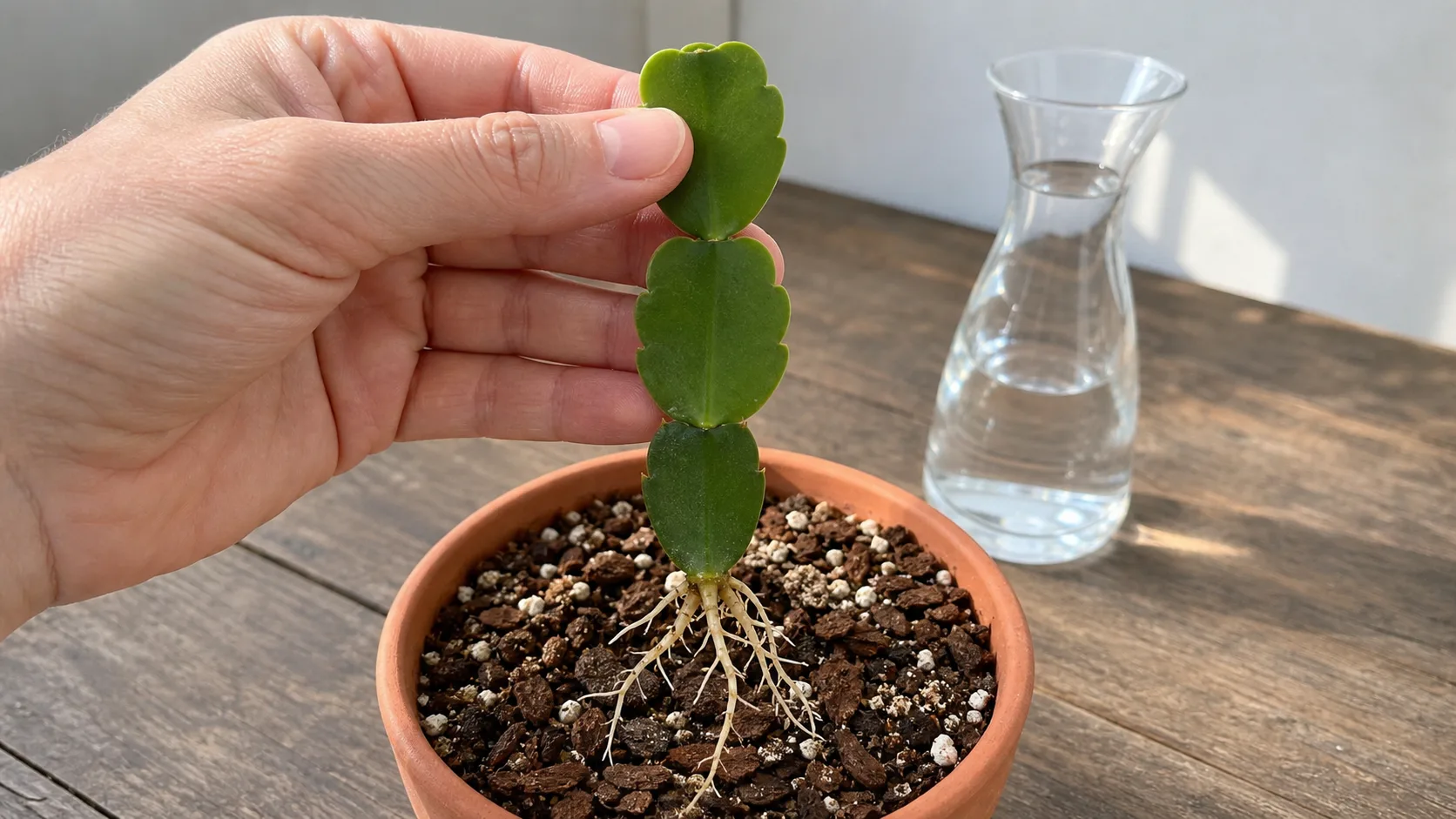
Pot up once a modest branched root system can anchor the cutting in an airy mix without burying the lower segment.
Do not rush this step. A water-rooted cutting is usually ready for mix when most of these are true:
- roots are around 1 inch long or more
- there is more than one root, not just a single thread
- the segment still feels firm
- you are not seeing fresh translucence at the base
- ideally, you can see the first hint that the cutting is settling in, not collapsing
That roughly one-inch benchmark shows up in community-style search snippets, and it is a helpful practical rule, not a rigid law. The bigger point is that one tiny root is not the same thing as a rooted cutting.
After potting up, keep the mix lightly moist at first, then move toward the normal airy slightly drying rhythm. If the cutting softens after transfer, treat it as early root stress, not as a cue to soak it.
If you run into mushiness later, /blog/posts/root-rot-treatment-guide/ and /blog/posts/houseplant-diseases-guide/ can help you separate stem rot from general stress.
Propagation failure triage matrix
When a cutting looks wrong, here is the fastest next step.
| Problem | Most likely cause | What to check first | Best next move |
|---|---|---|---|
| Base turns black | Rot from excess moisture or damaged tissue | Is the bottom mushy or slimy? | Cut back to healthy tissue, dry again, restart if viable |
| Cutting goes translucent | Too much water around unrooted tissue | Was too much of the segment buried or submerged? | Reduce moisture contact, discard if collapse is advanced |
| Cutting shrivels with no roots | Too much drying, weak cutting, or stalled growth | Is the base still firm? Is the room very hot or bright? | Keep light bright but softer, use steadier moisture |
| Water roots form, then cutting declines after potting | Transfer stress or heavy mix | Is the new mix staying soggy? | Repot into airier mix and water more lightly |
| Soil cutting never roots and stays wet | Pot too large or mix too dense | Does the pot stay damp for days? | Downsize pot and use a looser medium |
Common mistakes that cause christmas cactus cuttings to fail
1. Keeping the medium too wet
This is still the main one. RHS warns, “Avoid overwatering too, as the roots can rot in damp compost.” Fresh cuttings are even less forgiving because they do not have an established root system yet.
2. Skipping the callusing step
A fresh open wound plus moisture is an easy path to rot.
3. Using dense soil
If air cannot move through the mix, the base stays too wet for too long.
4. Potting too deep
Only the bottom needs to be anchored. Burying extra segments raises the risk of stem rot.
5. Tugging to “check” for roots
A tiny nudge once in a while is fine. Daily pulling is not. Let the cutting settle.
6. Taking cuttings from a struggling plant
If the mother plant already has root problems, soft stems, or pest damage, propagation becomes a rescue project instead of a clean start.
Seasonal note: what changes in summer, fall, and winter
In warm bright months, cuttings dry and root faster, but they can also dehydrate faster. In cooler months, everything slows down, and wet mix stays wet longer.
That means:
- Spring and summer: check moisture a bit more often, but still avoid soggy soil.
- Autumn: rooting may slow as light drops.
- Winter near bloom time: if the parent plant is full of buds or flowers, wait if you can.
Holiday cacti are not impossible in winter, but they are easier when she is not splitting energy between flowering and recovery.
A simple care plan for today, this week, and this month
Today: choose the firmest 2 to 4 segment cutting you have, inspect the base, and let it dry if it is freshly taken.
This week: root it in airy mix or shallow water, then leave it somewhere bright without harsh sun.
This month: watch for firmness, gentle resistance, and the first signs of settling in, instead of pulling it up every few days.
That is the real caring-reader payoff here. You do not need a complicated propagation station. You need a clean cutting, a breathable setup, and enough patience not to love it to death.
Expert note: the constraints that matter most
The strongest expert agreement across NC State and RHS is not about fancy propagation tricks. It is about environment and restraint.
- NC State treats holiday cactus as an epiphytic plant that prefers a moist but well-drained airy medium.
- NC State’s practical propagation rule is short and clear: take two or three segments, let them callous for a few days, then root them in a suitable mix.
- RHS frames Christmas cactus as a tropical rainforest plant, which is a useful reset if you were about to treat it like a desert cactus and leave the cutting bone dry for too long.
That expert layer supports the same conclusion most home growers learn the hard way: airy moisture is good, stagnant moisture is not.
Pet safety note if pieces fall while you propagate
Holiday cactus is widely treated as a lower-risk houseplant compared with many toxic ornamentals, but fallen segments can still tempt pets to chew. Search-surfaced ASPCA guidance supports a basic caution for stomach upset, and cats may react more dramatically if they chew enough.
So if you are propagating on a low table or windowsill, keep fresh cuttings out of reach. Even when a plant is not considered highly toxic, it is still better if your dog or cat does not snack on it.
For a related hands-on growing walkthrough, use LECA for Plants: A Beginner’s Semi-Hydro Guide for the setup and follow-up care.
FAQ
Can you propagate christmas cactus from a single segment?
You can, but it is less reliable. Two to four joined segments usually give you a sturdier cutting with more stored moisture and a better chance of staying firm long enough to root.
How long should christmas cactus cuttings dry before planting?
Usually a few days is enough. You are waiting for the cut end to dry and seal, not for the whole segment to shrivel. Humid homes may need a little longer than dry ones.
Is it better to root christmas cactus in water or soil?
For most beginners, an airy potting mix is safer because there is less transfer stress later. Water works too if only the base touches the water and you refresh it regularly.
Why did my christmas cactus cutting turn black?
Blackening usually points to rot from excess moisture, damaged tissue, or a fresh cut that never had time to dry. Remove the cutting from the setup right away and inspect whether any firm healthy tissue remains.
How do I know when my cutting has rooted?
Look for quiet signs first: the segment stays firm, does not keep shriveling, and resists a gentle nudge. In water, wait for a small cluster of roots rather than a single tiny thread before potting up.
Can I propagate a piece that fell off by accident?
Yes, if it is still firm and the base is intact. Many accidental pieces are completely usable. Just run the same viability check you would use for a planned cutting.
Do I need rooting hormone for christmas cactus propagation?
No. It can be used if you already have it, but healthy segments, a short drying period, and careful moisture control matter much more than hormone powder here.
How long does christmas cactus propagation take?
Usually a few weeks for rooting, though the exact pace depends on temperature, light, cutting health, and whether you started in water or mix. Slow is not the same thing as failing.
Sources and methodology
This article was built from current search-gap review plus expert references from NC State Extension and the Royal Horticultural Society. Community-style search snippets were used only to understand where beginners get confused, especially around viability, water versus soil, pot-up timing, and rot, not as proof of universal success rates.
Key references:
- North Carolina Extension Gardener Plant Toolbox, Schlumbergera truncata
- North Carolina Extension Gardener Plant Toolbox, Schlumbergera x buckleyi
- Royal Horticultural Society, Christmas cactus plant guide
- Search-surfaced ASPCA holiday-plant safety guidance, used only for a brief pet-safety caution layer