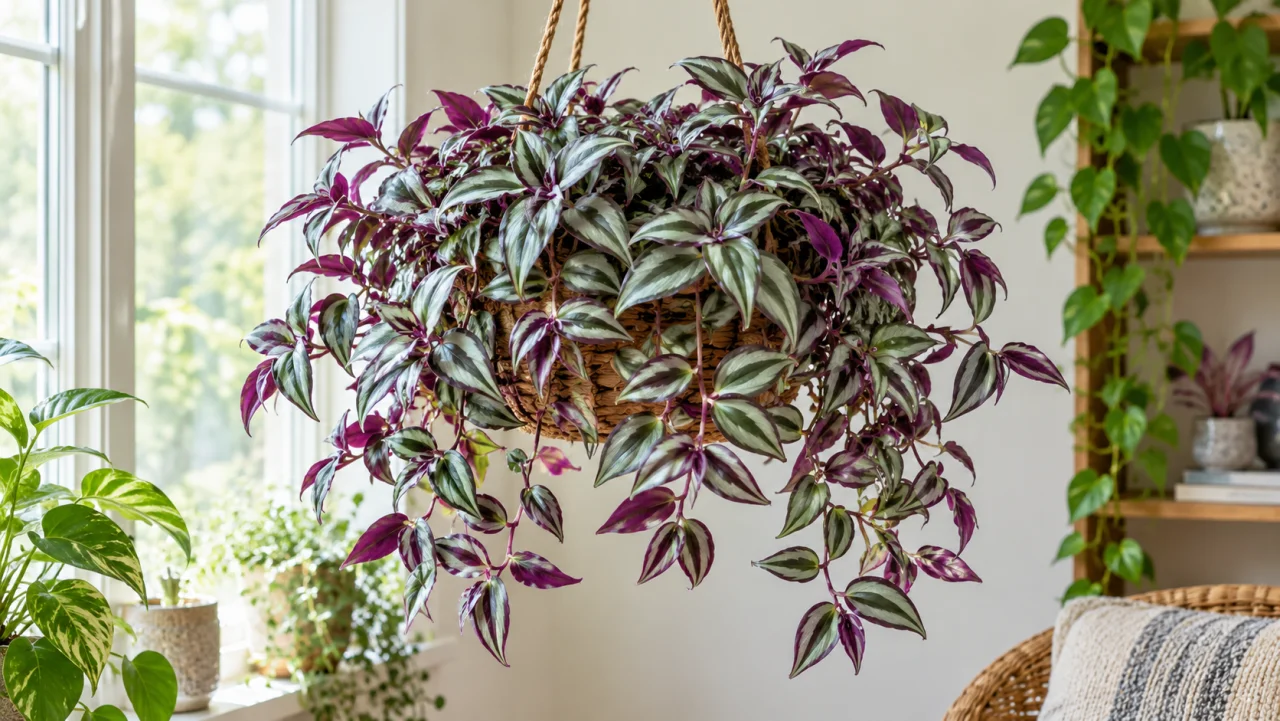
Tradescantia care is easiest when you use one rule: correct light before you correct shape. When the vines stretch between leaves, the color softens toward green, or the top of the pot turns patchy, do not start by fertilizing or repeatedly trimming the same dim-grown stems. Improve the light, judge the next two or three leaves, and only then decide what to pinch, cut, or replant.
We call this the Light-First Reset Rule. It turns four complaints that are often treated separately, fading color, long internodes, a bare crown, and weak cuttings, into one ordered diagnosis. This guide uses that rule through the fundamentals and the renewal moves that keep Tradescantia full, colorful, and genuinely easy to look after long-term.
Quick Rescue Checklist
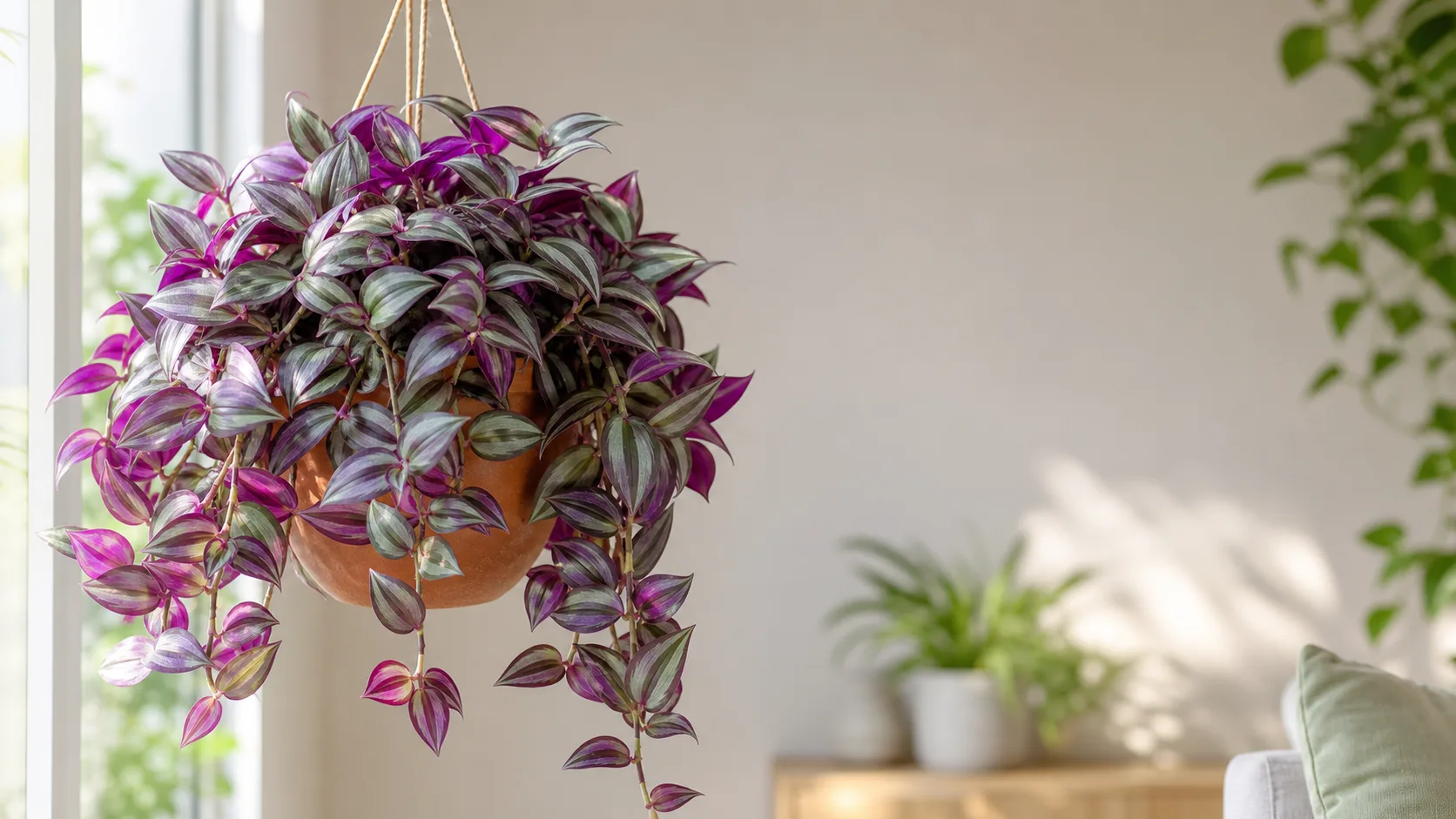
A compact, colorful crown is the baseline; diagnose new growth before changing several parts of the routine at once.
Start with the symptom you can see, then make only the first correction for seven to ten days before changing anything else:
- Fading purple or silver: increase bright, filtered light; judge the change by new leaves, because old color will not return.
- Wide gaps between leaves: move the plant first, then cut and replant the stretched stems so the same low-light growth does not repeat.
- A bare or patchy crown: pinch healthy tips and place several firm cuttings back around the pot’s edge.
- Brown tips: stabilize soil moisture and keep water off the leaves before adding humidity products.
- Soft stems or a sour-smelling pot: stop watering, check drainage, and take only firm cuttings above the damaged tissue.
Fast Fit Check: Is Tradescantia Right for Your Home?
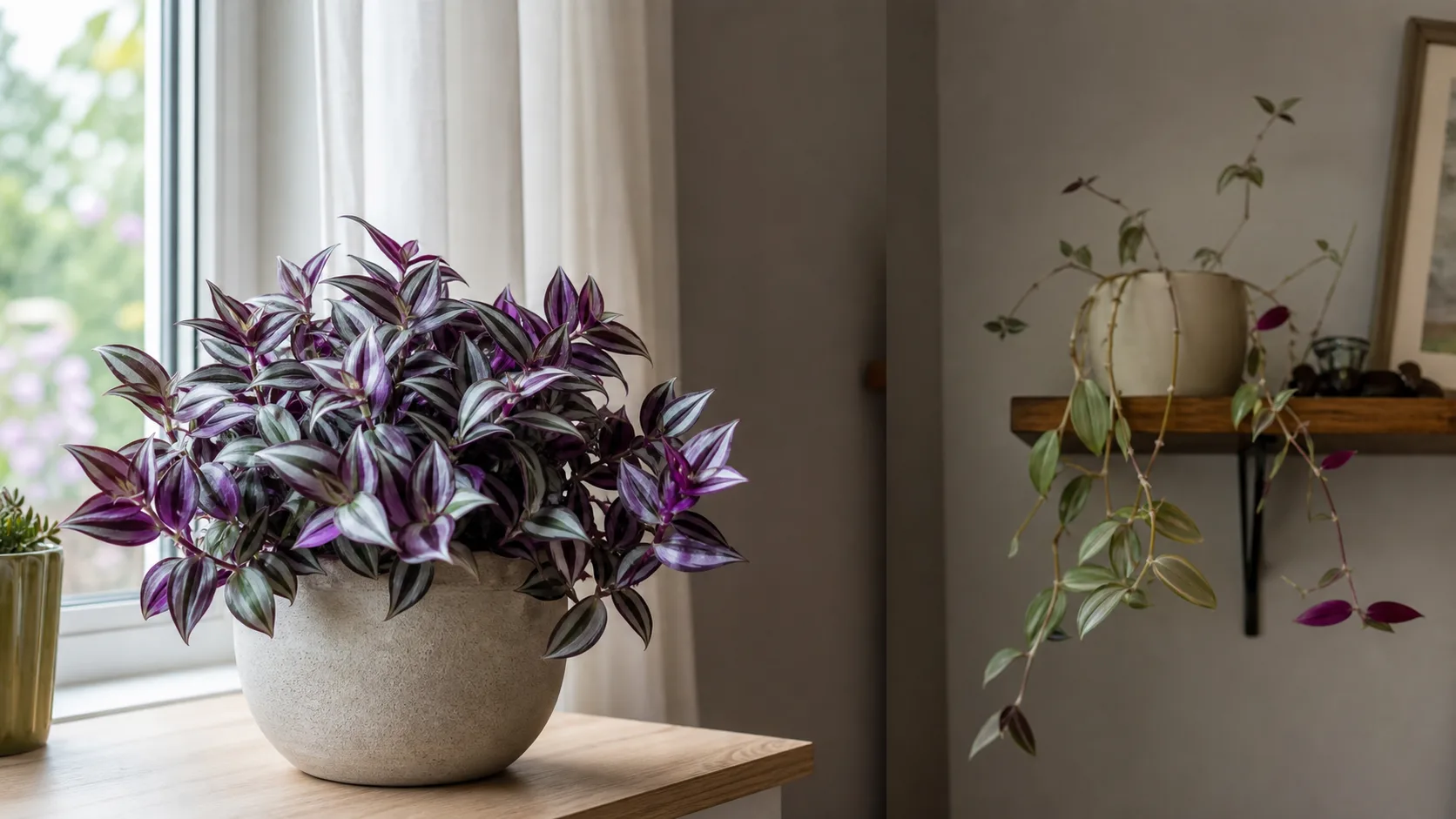
Bright filtered light supports tight nodes and vivid stripes, while a dim shelf produces the sparse, faded growth many owners misread as normal trailing.
| Your home and habits | Good fit | Likely frustration |
|---|---|---|
| Light | A bright window with filtered, morning, or late-afternoon sun; or a properly placed grow light | A dim shelf several metres from a window |
| Maintenance | You are comfortable pinching tips every few weeks in active growth | You want a trailing plant that never needs reshaping |
| Renewal | You are willing to restart healthy cuttings when the crown thins | You expect every original vine to stay leafy forever |
| Pets | The pot can stay securely out of reach | Cats or dogs routinely chew accessible foliage |
Choose Tradescantia if you value fast growth, vivid foliage, and easy propagation enough to trade a few minutes of regular reshaping for them. Choose a heartleaf philodendron or pothos instead if the available position is dim or you want longer intervals between pruning sessions. Those plants can also stretch in weak light, but Tradescantia advertises the mismatch sooner through wider nodes and lost color.
Editorial Review Note
This guide separates three kinds of evidence. Species care claims come from North Carolina Extension Gardener Plant Toolbox pages reviewed July 18, 2026. Owner pain points come from accessible community-search snippets and are used as qualitative patterns, not success-rate data. The Light-First Reset Rule, fit check, and decision tree are the KnowYourPlant editorial team’s practical synthesis of those two layers; they are not presented as a controlled trial.
Which Tradescantia Are You Growing?
The name tradescantia covers a handful of different trailing houseplants, and care advice that suits one type doesn’t always apply to another. It’s worth knowing which one you have before going too deep into specifics.
The most common types grown indoors are:
- Tradescantia zebrina, the classic inch plant with silver and purple striped leaves
- Tradescantia fluminensis, green or variegated in white and green, with slightly smaller leaves
- Tradescantia pallida, solid deep purple, sometimes called purple heart
All three grow as trailing plants, root easily at the nodes, and prefer bright indirect light indoors. The differences show up mainly in how much light each one needs to hold its best color. According to the North Carolina Extension Gardener Plant Toolbox, Tradescantia pallida develops its best foliage color in stronger light and becomes noticeably greener when grown in lower-light conditions. Purple heart really does need that brightness to stay richly pigmented. Zebrina shows its stripes best in filtered, consistently bright conditions. Fluminensis is a little more forgiving in lower light but still stretches and fades without enough.
When you come across general spiderwort advice online, double-check whether the article is about these indoor trailing types or the hardier outdoor spiderwort species. They are different plants with different growing habits, and outdoor care advice doesn’t transfer cleanly to your hanging basket. If you’re newer to houseplants and want a broader orientation to what trailing plants need, the beginner indoor plant care guide is a good place to start.
What Most Care Guides Miss
Most tradescantia articles stop at “bright indirect light” and “keep moist.” That’s not wrong, but it leaves out the part that actually explains what’s happening when your plant starts to look sparse or faded.
The key thing guides rarely explain clearly: tradescantia legginess and color loss are almost always the same problem. When there isn’t enough light, the plant does two things simultaneously. It spaces out its leaf nodes to reach further, and it reduces the pigmentation that costs energy to produce. You end up with longer bare stems AND duller color at the same time, happening for the same underlying reason.
This matters because the fix isn’t about adjusting your watering or fertilizing routine. It’s about position. Move the plant to a brighter spot, and both problems start to reverse. That’s the check to make first, before anything else.
The common misdiagnosis is treating legginess as a pruning problem rather than a light problem. Pinching and cutting back will help temporarily, but if the plant goes back into the same dim corner, you’re managing a symptom rather than fixing the cause.
What Plant Owners Keep Asking About
Community search snippets reviewed for this guide repeatedly paired the same problems: a pot balding at the top, uncertainty about where to cut a long vine, and cuttings rotting after the parent plant stretched in weak light. These are qualitative owner reports, not controlled trials, but the pattern explains why this guide treats light correction, pruning, and cutting quality as one workflow rather than three unrelated tips.
Symptom-to-Action Decision Tree
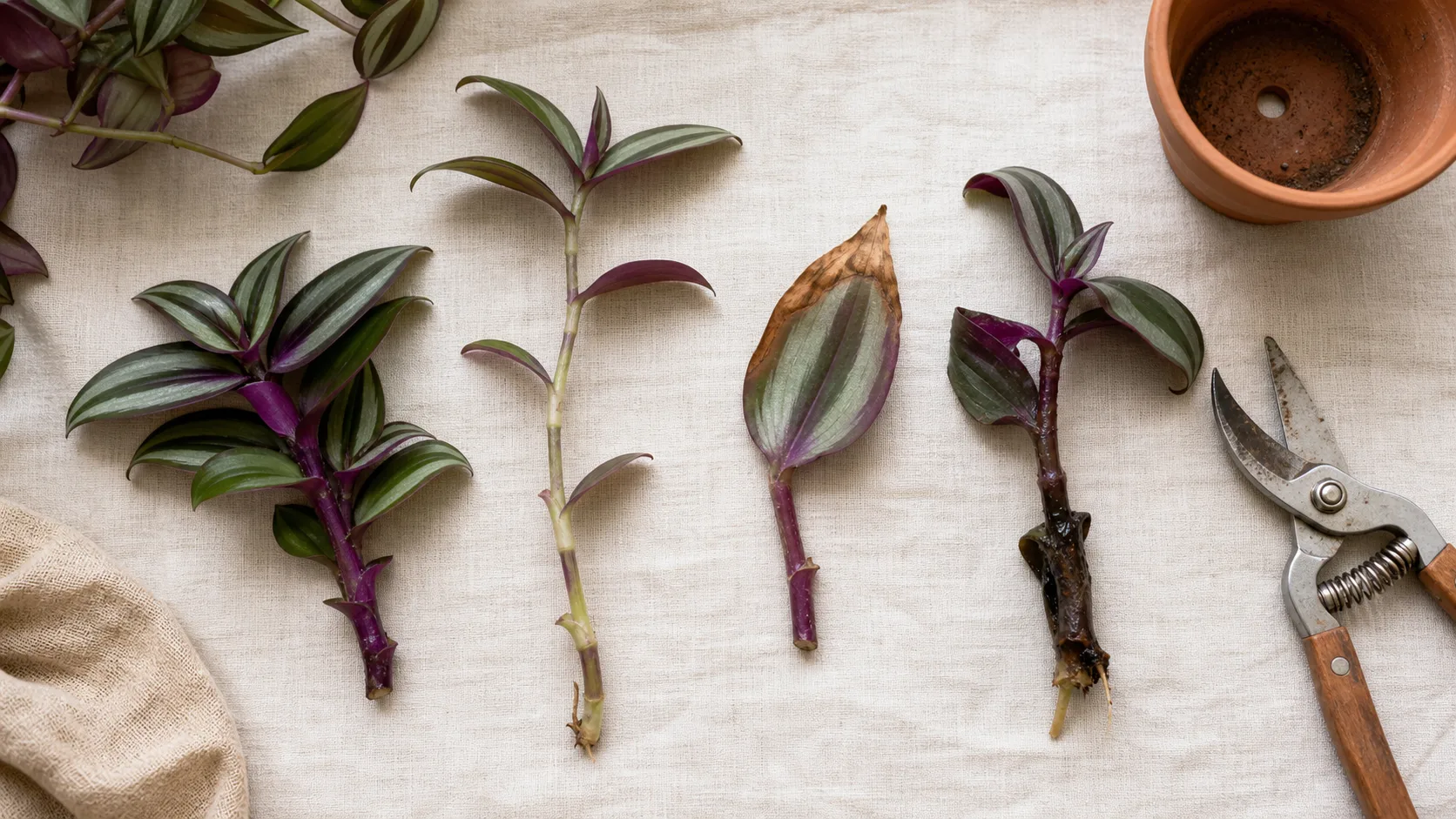
Firm compact growth, stretched pale stems, crisp tips, and a soft dark base point to different first actions.
| What you see | Inspect first | First correction | Do not do first |
|---|---|---|---|
| Color fading and spaces between nodes widening | Distance and direction from the nearest window | Increase filtered light; rotate weekly if one side is reaching | Add fertilizer to force greener growth |
| Long vines with a bare crown | Whether new growth is compact or also stretched | Fix light, then cut above healthy nodes and replant firm tips | Pinch only the very end of already bare vines |
| Brown tips but firm stems | Wet leaves and large wet-to-dry soil swings | Water at soil level when the top layer dries | Mist the foliage repeatedly |
| Soft base, yellowing, or sour soil | Drainage holes and how long the mix stays wet | Pause watering and salvage firm stem sections | Put weak, wet stems straight into water |
| Cuttings rot before rooting | Stem firmness and node placement | Recut to clean, firm tissue with a visible node | Use pale, collapsing sections just because they are long |
This order matters. When several symptoms appear together, correct the growing environment before rebuilding the shape of the plant.
Evidence Behind the Light-First Reset Rule
| Decision in this guide | Evidence used | How strongly to apply it |
|---|---|---|
| Increase filtered light when color fades and nodes widen | NC State’s T. zebrina page notes lower-leaf and color loss in low light; its T. pallida page notes greener foliage in shade | Strong first check for fading plus stretched new growth |
| Pinch compact stems to encourage branching | NC State genus and species guidance recommends pinching to encourage new, denser growth | Strong maintenance step after placement is corrected |
| Let zebrina dry slightly between waterings | NC State’s T. zebrina guidance pairs slight drying with lower rot risk | Apply to the top layer, not as permission to leave the entire root ball bone-dry |
| Replant firm cuttings to rebuild a sparse crown | Extension guidance confirms easy node rooting; owner reports repeatedly ask how to refill balding pots | Practical synthesis; success depends on healthy tissue, light, drainage, and season |
The evidence is specific enough to order the checks, but it does not support rigid watering dates, guaranteed rooting times, or a single window distance for every home.
Light: Where Color and Fullness Actually Come From
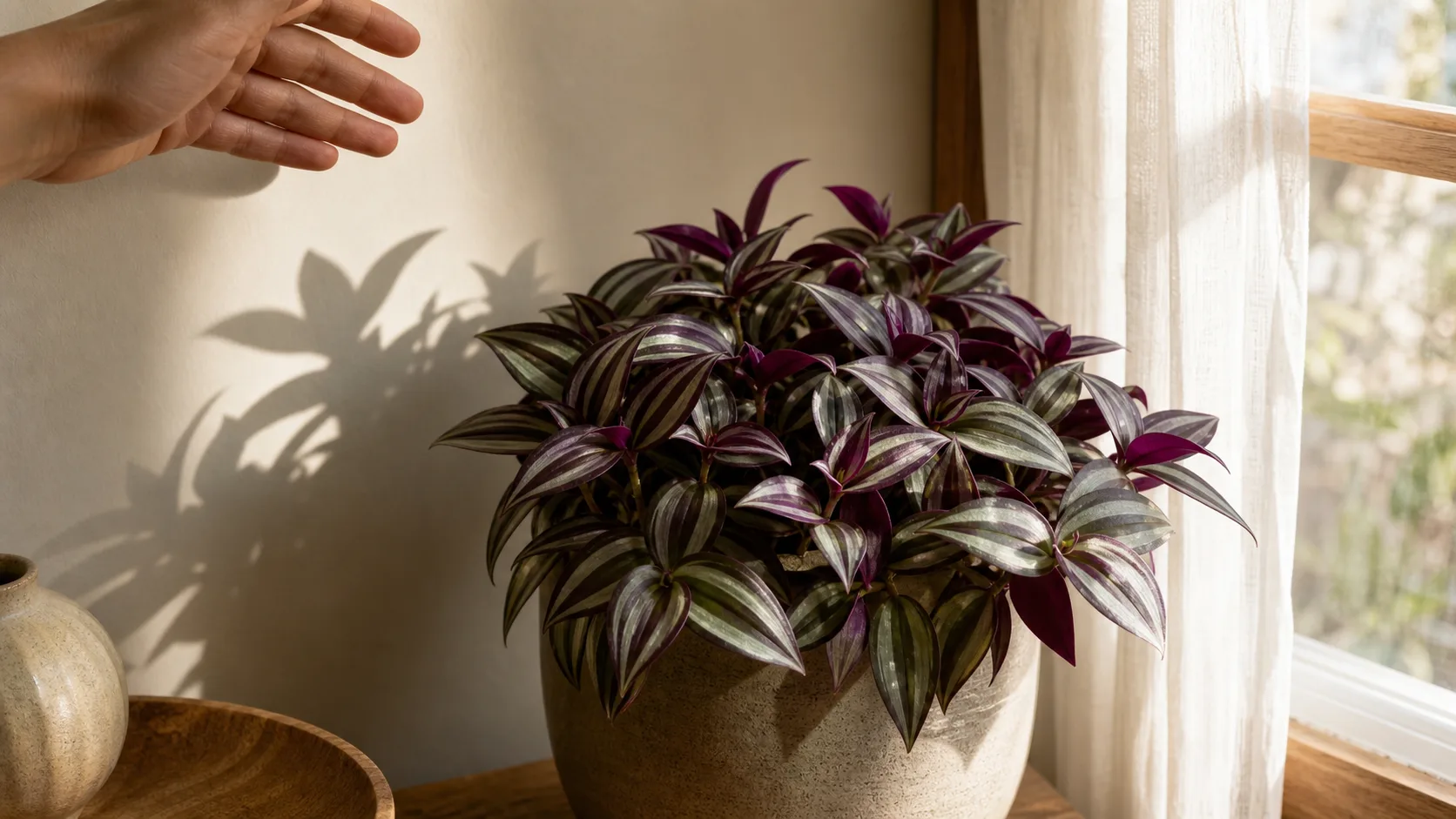
Filtered window light that casts a clear shadow is a more useful placement clue than the phrase bright indirect light alone.
In a well-lit spot, leaf clusters are tighter and the color stays vivid. A position near a window with morning or afternoon sun tends to work well. East or west-facing windows are reliable choices. South-facing works too if there’s some filtering, especially in summer when the sun angle is higher.
If you’re working with a space that doesn’t get much natural light, a grow light placed close enough to the plant can substitute effectively. The guide to grow lights for indoor plants covers what to look for and how to position them so the plant actually benefits rather than just sitting under a lamp that isn’t doing much.
Direct midday sun through glass can scorch the leaves or bleach out the variegation. If you notice pale patches on the upper surface rather than general fading across the whole leaf, she may be getting too much direct sun rather than too little. The NC State Extension Gardener Plant Toolbox notes that Tradescantia fluminensis in particular needs afternoon protection in stronger sun to avoid leaf scorch.
A simple test: hold your hand flat about 30 centimetres above the plant at the brightest part of the day. A sharp, clear shadow means real light. A faint or blurry one means she’s probably working harder than she looks to stay alive, stretching and fading in slow motion.
Watering: Moist, Not Soggy
Tradescantia likes to stay evenly moist but should never sit in waterlogged soil. The roots are fine and rot quickly when drainage is poor.
A simple approach: press your finger into the top couple of centimetres of soil. When that layer feels dry, it’s time to water. In a bright spot during active growth, that usually means watering every few days through warmer months and pulling back in winter when growth slows and water use drops significantly.
The NC State Extension Gardener Plant Toolbox recommends allowing the soil to dry slightly between waterings for Tradescantia zebrina specifically to reduce the risk of root and stem rot. Soggy soil is one of the most reliable ways to damage a Tradescantia that otherwise looks healthy.
The two most common watering mistakes are keeping the soil persistently wet and letting it dry out so fully that the lower leaves start to drop. Both lead to crispy brown tips and patchy growth over time. Uneven moisture, watering heavily then waiting too long before the next drink, also makes the plant look ragged rather than full.
Make sure the pot has drainage holes. Soil that drains slowly puts Tradescantia roots at risk much faster than it would with sturdier tropicals.
Why Tradescantia Gets Leggy and What to Do About It
Leggy growth is not a failure. Tradescantia is a trailing plant and the vines will keep extending over time. The problem is when the vines grow very long while the top of the pot thins out and the plant loses the dense, leafy look that makes it worth having.
Two things accelerate legginess: not enough light and skipping regular maintenance.
Pinching is the main maintenance move that keeps Tradescantia looking like a full plant rather than a collection of long bare stems with leaves only at the ends. Pinching the tip off a stem redirects the plant’s energy into side growth, which makes the crown thicker. You don’t need to remove much, just the growing tip between your thumb and finger. The NC State Extension Gardener Plant Toolbox confirms that pinching back stems on all three common indoor Tradescantia types encourages new growth and is one of the most effective tools for preventing the spindly look.
For stems that have already grown very long or lost most of their lower leaves, pinching the tip alone won’t restore the look. The practical move is to cut the stem back further and either discard the stretched piece or use it as a cutting. On Tradescantia zebrina specifically, a hard prune in spring, cutting vines back significantly to encourage dense new growth, is a normal part of annual maintenance rather than a rescue operation.
Pruning and Replanting Diagram
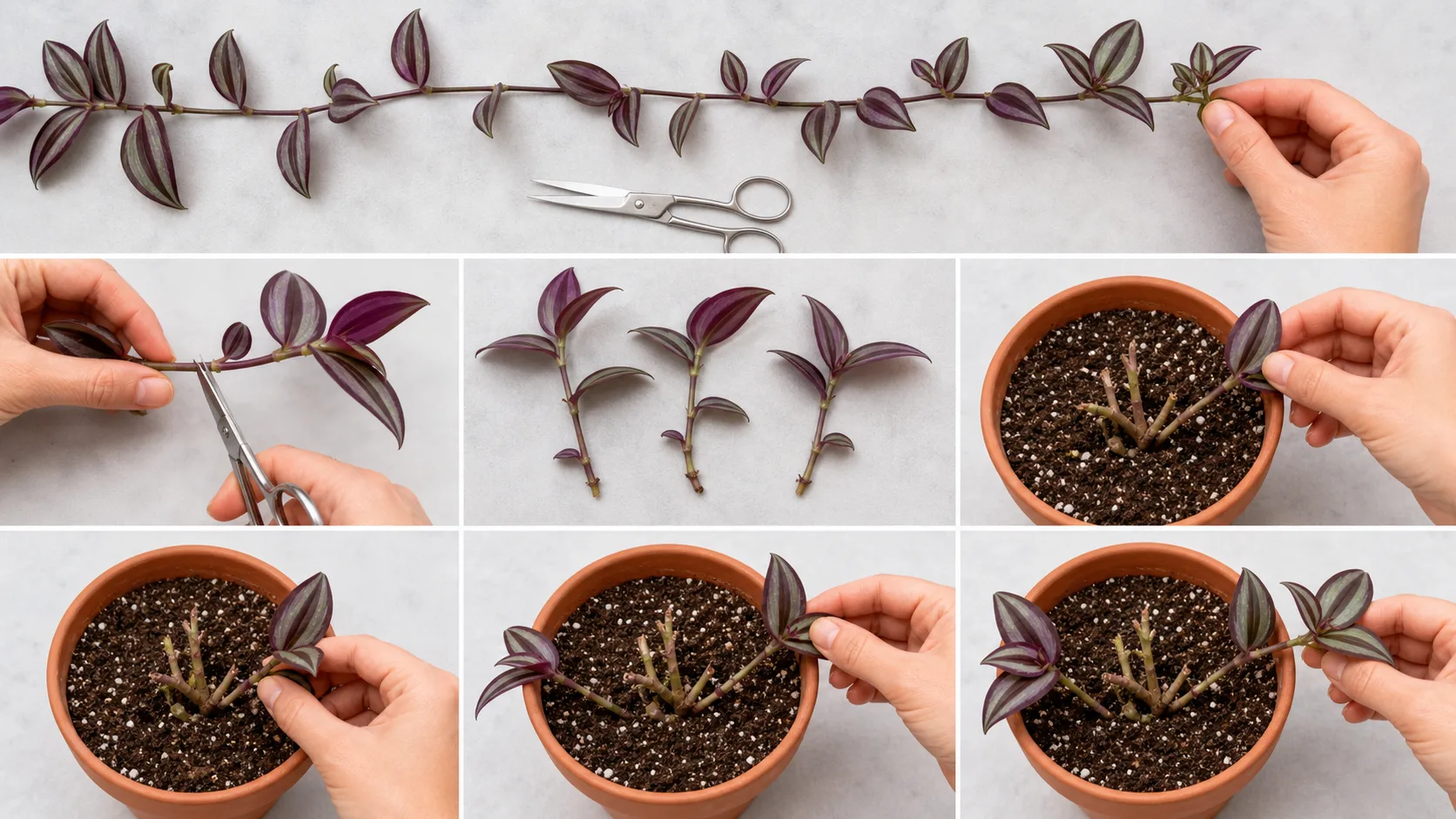
Cut below a healthy node for propagation, keep firm tips, and place several cuttings around the sparse crown to rebuild density.
Use the nodes, the joints where leaves meet the stem, as your landmarks:
parent vine
    leaf        leaf        growing tip
      \\          \\             /
-------[node]-----[node]-----[node]----
          ^           ^          ^
      new roots    cut here   pinch here

pot reset
  1. Keep a firm tip with 2-3 leaves and at least one node.
  2. Remove the lowest leaf so that node can contact soil.
  3. Insert several cuttings around the sparse crown, node below the mix.
  4. Leave short parent stems in place; healthy nodes can branch again.
For routine pinching, remove only the growing tip just above a node. For a leggy reset, make the lower cut just below a healthy node on the piece you want to root. Never bury a long strip of leaves; one clean node in contact with lightly moist mix is the useful part.
Visual brief and alt text: a side-by-side close-up should show a Tradescantia stem with the node, pinch point, and lower propagation cut labeled, followed by three prepared cuttings placed around a sparse pot crown. Alt text: “Tradescantia stem diagram showing a node, the pinch point above it, the propagation cut below it, and cuttings replanted around a sparse crown.”
Real-World Reset Example: From Greened-Out Vines to a Full Crown
Consider the common owner scenario reflected in the community questions reviewed for this article: a zebrina sits on a bookcase away from the window, its new leaves turn mostly green, the gaps between nodes widen, and the pot looks empty on top even though vines still hang below it.
The recovery sequence is deliberately staged. First, move it close to a bright east-facing window and watch the next two or three new leaves. If they emerge more compact and better striped, the light diagnosis is supported. Second, cut the healthiest firm tips into sections with two or three leaves, discarding pale or soft lengths. Third, replant those tips around the crown with one node in the mix. Finally, pinch only the compact new tips during active growth. The old green leaves do not recolor; progress is a denser crown and better-pigmented new growth. This is an illustrative, source-backed recovery pattern rather than a claim from a controlled before-and-after trial.
The Tradescantia Renewal Calendar
Most care guides treat pinching and restarting cuttings as emergency moves for a neglected plant. They work much better as a regular cycle. Here’s how to frame it across the year:
Spring (the renewal window): This is the best time for a hard prune if your plant has gotten leggy over winter. Cut vines back significantly, pot the healthy cuttings back into the same container to rebuild density, and move the plant to its best-lit summer position. New growth comes in quickly in spring with longer days.
Summer (active growth, light maintenance): Growth is fastest now. Pinch tips every two to three weeks to keep the crown bushy. If you’re seeing any yellowing at the base of longer vines, that’s normal shedding as the plant focuses energy upward. Watering frequency increases, so check the soil every couple of days.
Autumn (slow down, hold position): Growth slows as day length shortens. Reduce watering gradually. Avoid fertilizing after the leaves start to look less actively productive. If you’re in a northern climate and the plant is near a window, watch for cold draft exposure as temperatures drop.
Winter (rest and reassess): Tradescantia slows significantly. Water only when the top few centimetres of soil are dry. Don’t fertilize. This is a good time to assess the plant’s shape so you know what to address in spring. Low indoor light in winter is when leggy growth tends to accelerate, so if you have a grow light, winter is when it earns its place.
Starting With Cuttings
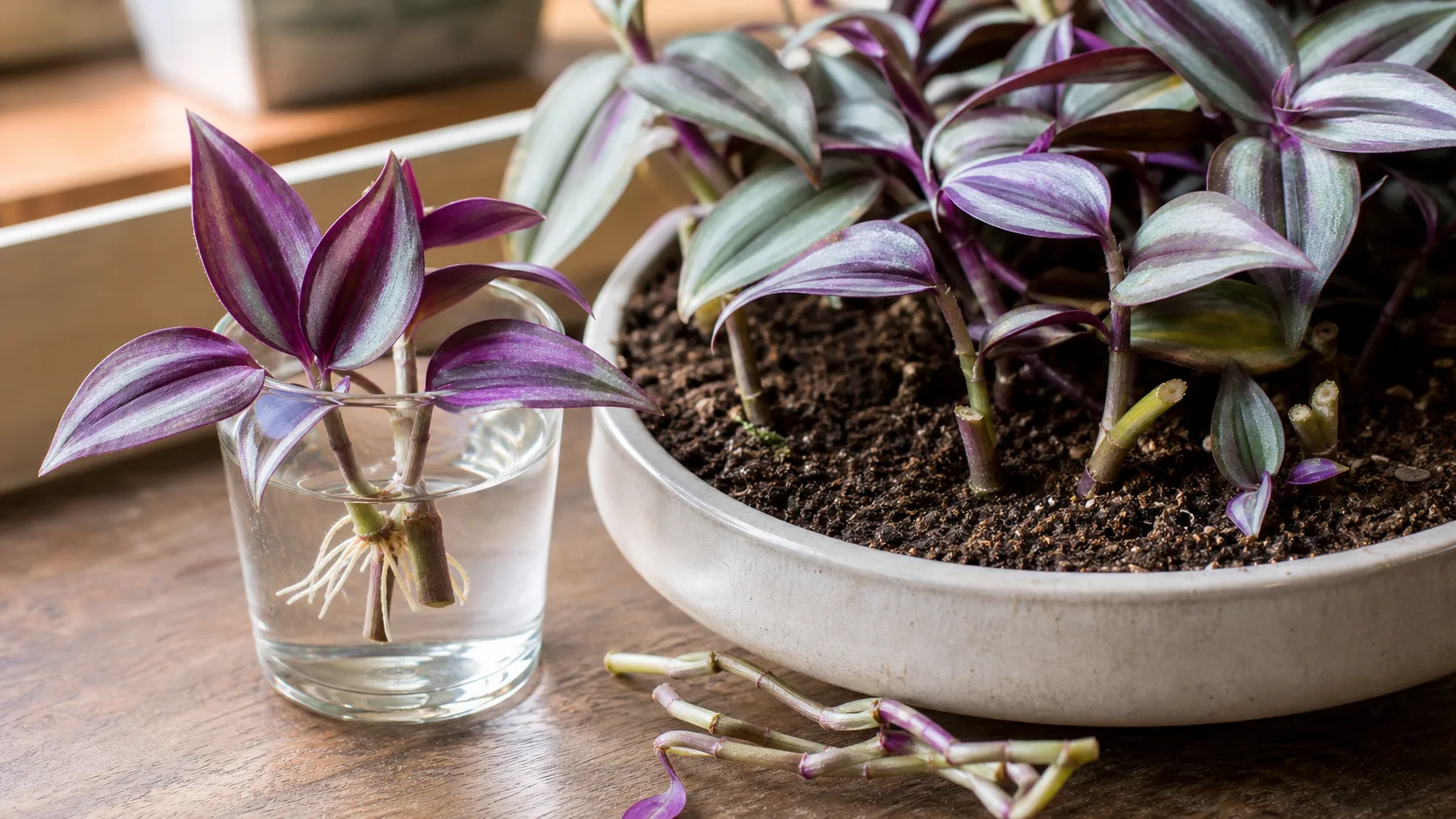
Choose firm, well-colored node cuttings; water rooting and direct soil rooting can both work when the starting tissue is healthy.
One of the most useful things about Tradescantia is how reliably she roots from stem cuttings. This matters for care because when a pot starts to look sparse, the fastest way to restore it is usually to take cuttings and pot them back into the same container alongside the existing plant.
A cutting doesn’t need to be complicated. Look for a healthy stem section with at least two or three leaves and a visible node, the joint where a leaf meets the stem. Remove the lower leaves that would sit below soil or water level. You can root it in water or directly in damp potting mix.
The most important detail is stem quality. Not all cuttings are equal, and this is where propagation failures usually happen:
- Ideal cutting: a firm, well-colored stem from a plant that’s been in good light. Roots form quickly and reliably.
- Stretched stem from a low-light plant: pale, with wide spacing between nodes. These root less reliably, and when they do root, the resulting plant often stays weaker until it gets proper light.
- Stem from an overwatered plant: soft near the base, possibly with some discoloration. These are prone to rotting in water before roots form. If you’re trying to propagate from a soggy plant, let the soil dry out properly for a couple of weeks first, then reassess which stems are still firm enough to take.
If your whole plant looks stretched and pale, getting her into better light and letting the soil dry out properly before taking cuttings will improve your results significantly. The same node-placement principles that apply to most trailing plants apply here; the propagating pothos guide covers node selection and rooting technique in detail if you want a step-by-step walkthrough.
Brown Tips and Crispy Edges
Brown or crispy leaf tips are a common frustration with Tradescantia, and they can come from several different causes that are easy to confuse.
Inconsistent moisture is the most frequent reason. If the soil swings between very wet and very dry, the plant responds by crisping the tips of older leaves. Getting into a steadier watering rhythm usually stops the problem from spreading, though existing brown tips won’t green up again.
Wet leaves are another common cause. Tradescantia doesn’t like water sitting on the foliage for extended periods, especially indoors where air circulation is lower. Watering at soil level rather than overhead keeps the leaves dry and removes this variable entirely.
Leaf scorch from too much direct sun shows up as pale or bleached patches on the upper surface, not just tips. That’s a different problem with a different fix: move the plant slightly back from the window or filter the light with a sheer curtain.
Cold drafts can also cause brown tips. Tradescantia is sensitive to temperatures below about 10 degrees Celsius and doesn’t do well near windows or exterior doors in winter. If the browning appears mainly on the tips closest to a window and gets worse in colder months, check whether cold air is coming through.
The order to check: moisture consistency first, then leaf wetness, then light intensity, then temperature. Most cases come down to the first two.
Pet Safety
Tradescantia is considered mildly toxic to cats and dogs. The sap can cause skin irritation on contact, and ingestion typically leads to digestive upset. If you have curious pets, it’s worth keeping the plant somewhere they can’t easily reach, or choosing a different plant for low shelves and floor positions. The guide to cat-safe houseplants has alternatives if you need something that can safely go anywhere in the home.
Finding the Right Spot in Your Home
Tradescantia suits a shelf near a window where the vines can trail down, a hanging basket in a bright spot, or a windowsill where morning or late afternoon light reaches it regularly.
She’s not well-suited to low-light corners, and she’s sensitive to cold drafts and temperatures below about 10 degrees Celsius. Keep her away from windows or doors that let in cold air in winter.
She handles typical indoor humidity without needing misting or humidity trays, but she does prefer a stable environment over frequent temperature swings.
For anyone new to Tradescantia, getting the light right first makes everything else easier. The watering frequency, how fast you need to pinch, how often you’re dealing with legginess: all of those adjust once the plant is in a position that genuinely works for her.
If you are comparing care routines for another houseplant, see Schefflera Plant Care: Light, Water, Pruning, and Leaf Drop for a focused step-by-step guide.
Frequently Asked Questions
How often should I water a Tradescantia? In a well-lit spot during the growing season, check every two to three days by pressing your finger into the top couple of centimetres of soil. Water when that top layer feels dry. In winter or in lower light, the plant uses water more slowly, so you’ll water less often. There’s no universal schedule that works for every home; the soil check is more reliable than a calendar.
Can I propagate Tradescantia in water? Yes. Cut a healthy stem section with at least one node and remove the leaves that would sit underwater. Place it in a glass of water near a bright window. Roots typically appear within one to two weeks. Once roots are a centimetre or two long, pot the cutting into moist soil. Choose healthy, firm stems; weak or pale stems from a low-light plant tend to rot before they root.
Is Tradescantia safe for cats and dogs? No, Tradescantia is considered mildly toxic to cats and dogs. Contact with the sap can cause skin irritation, and ingestion typically leads to digestive upset. It’s not in the same category as highly toxic plants, but it’s worth keeping out of reach of pets that chew on leaves.
Does Tradescantia need humidity? Less than you might expect. She handles average indoor humidity without needing misting or a humidity tray. What she’s more sensitive to is cold drafts and temperatures below about 10 degrees Celsius, so keep her away from windows that let in cold air in winter. If the tips are crisping and you’ve ruled out watering inconsistency, check whether she’s sitting in a dry air current from a heater or vent.
When is the best time to prune a Tradescantia hard? Spring is ideal. Longer days and warming temperatures mean the plant pushes new growth quickly after a hard cut. A spring prune, followed by potting the best cuttings back into the same container, gives you a visibly denser plant before summer even hits its stride.
Your Next 15 Minutes
Do not change water, fertilizer, light, and potting mix at once. Photograph the newest three nodes, check how sharply the plant casts a shadow at its brightest hour, and inspect the base for firm versus soft tissue. If growth is firm but stretched, improve light and wait for two or three new leaves. If those leaves emerge tighter, use the pruning diagram to reset the shape. If the base is soft or the mix stays wet for days, address drainage and salvage only firm cuttings instead. That sequence gives you an observable result before the next decision.
Care information in this article is based on the North Carolina Extension Gardener Plant Toolbox genus and species pages for Tradescantia, Tradescantia zebrina, Tradescantia fluminensis, and Tradescantia pallida, reviewed July 2026.