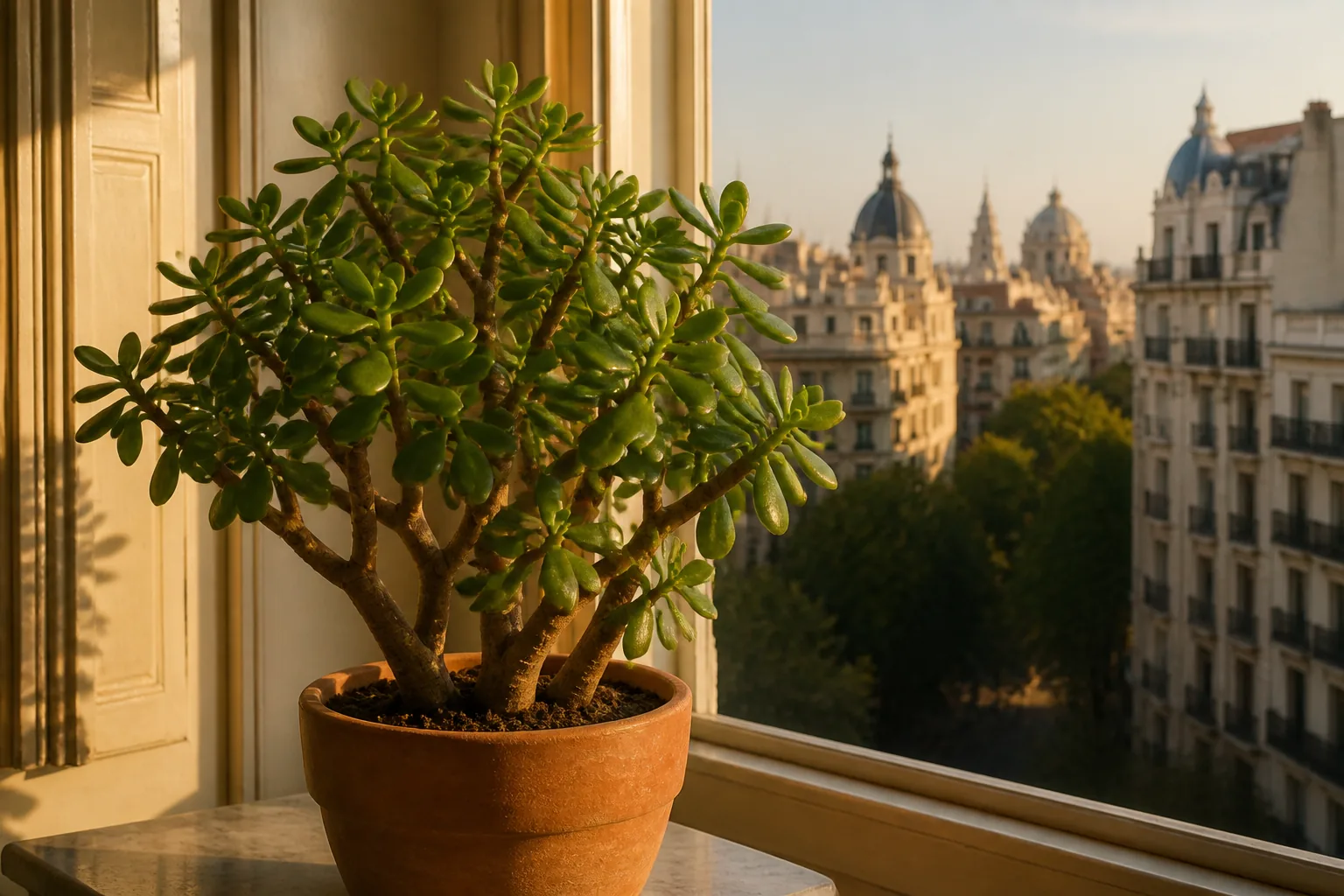
Buenos Aires has a workable seasonal match for Crassula ovata, with an outdoor climate-match score of 70/100. The score does not say whether a plant can live in your home. It compares the city’s outdoor normals with the climate envelope measured at quality-filtered records in the species’ native range, then separates that outdoor comparison from the care pressure on a potted indoor plant.
The useful answer is seasonal: the strongest fully suitable outdoor window is January–April, and November–December. A broader, marginal window is January–April, and November–December, but marginal months need day-by-day judgment and a protected, shaded position. Indoors, use the monthly calendar below to decide when to check the pot sooner or later. It is deliberately not a fixed watering schedule.
The direct climate answer for Buenos Aires
Atmospheric and drying conditions are the largest mismatch in Buenos Aires. Use the monthly pressure as a prompt to inspect the mix sooner or later, never as permission to water a pot that is still wet. The city’s low-temperature signal reaches 5.0°C in the coldest part of the normal year, while the hot-temperature signal reaches 31.9°C. Those are outdoor climate values, not indoor room measurements.
The local pattern is not a generic season swap. In the 1991–2020 NASA POWER normal, March is the wettest month and June is the driest, while outdoor solar input peaks in December and bottoms out in June. For an indoor Jade Plant in Buenos Aires, those signals matter because pot drying can change even when your room temperature changes only a little.
The overall score is rounded to the nearest five. That is intentional: reanalysis grids, occurrence locations, a city’s microclimates, and the difference between outdoor weather and an actual room do not justify single-point precision.
What this local climate means for a Jade Plant
A Jade Plant stores water in its leaves and stems, so the city signal should change when you inspect the pot, not lower the threshold for watering it. Keep the plant in the brightest practical window, let a fast-draining succulent mix dry through the root zone, and use firm leaves plus compact new growth as evidence that light and watering are working together.
Seasonal light is the first local variable to watch. Crassula ovata generally needs several hours of direct indoor sun to stay compact; a bright-looking room without rays on the leaves can still leave it stretching and using water slowly. When the local solar normal falls, preserve the best window position and expect dry-down to take longer before assuming the plant needs more water.
An outdoor stay can help only after gradual acclimation and while nights remain safely above the cold limit. Move the plant into bright shade first, increase direct exposure in steps, and keep rain from repeatedly saturating the pot. In hot, humid cities, airflow and a protected position matter more than chasing an outdoor score; in colder cities, bring the plant back inside before the marginal season begins.
Outdoor climate match: 70/100
95/100 — Cold-Night Compatibility. Buenos Aires sits mostly inside the occurrence-derived habitat envelope.
45/100 — Warm-Season Heat Compatibility. Buenos Aires departs materially from the habitat envelope.
100/100 — Outdoor Solar-Climate Compatibility. Buenos Aires sits mostly inside the occurrence-derived habitat envelope.
30/100 — Precipitation And Humidity Compatibility. Buenos Aires is the clearest macroclimate constraint.
70/100 — Seasonal-Rhythm Compatibility. Buenos Aires overlaps the habitat envelope but needs seasonal management.
The weighted score uses cold 30%, heat 20%, moisture 20%, light 20%, and seasonality 10%. Cold receives the largest weight because Crassula ovata is frost-sensitive and a single cold exposure can matter more than a modest mismatch in annual averages. “Light” here means outdoor solar climate, not the light at a particular windowsill.
Native climate versus Buenos Aires
The plant Climate DNA was built from 70 spatially thinned GBIF occurrence records within the POWO native range of southeastern Mozambique to the southeastern Cape Provinces. CHELSA 1981–2010 values were sampled at those coordinates, then summarized with robust percentiles so a small number of extreme records could not define the whole envelope. The city side uses the NASA POWER custom 1991–2020 climatology for a consistent long-term monthly comparison.
| Signal | Native occurrence envelope (p10–p90) | Buenos Aires normal |
|---|---|---|
| Coldest-month minimum | 3.8 to 11.7°C | 5.0°C low-temperature signal |
| Warmest-month maximum | 24.7 to 30.0°C | 31.9°C hot-temperature signal |
| Annual precipitation | 370 to 962 mm | 1109 mm |
| Relative humidity | 54 to 62% | 76% |
| Outdoor solar climate | 16.3 to 19.4 MJ/m²/day | 17.3 MJ/m²/day |
These comparisons describe macroclimate. Crassula ovata is a sun-adapted succulent, but regional open-sky solar radiation still cannot tell you how many hours of direct light reach a leaf through a particular window.
Month-by-month Jade Plant care calendar
| Month | Mean temp | Colder-night signal | Humidity | VPD | Pot-check pressure | Outdoors | What to do |
|---|---|---|---|---|---|---|---|
| January | 24.4°C | 17.4°C | 69% | 0.95 kPa | moderate | suitable | A shaded outdoor stay is climate-compatible after gradual acclimation; keep checking soil moisture. |
| February | 23.7°C | 16.4°C | 71% | 0.84 kPa | moderate | suitable | A shaded outdoor stay is climate-compatible after gradual acclimation; keep checking soil moisture. |
| March | 22.1°C | 15.0°C | 74% | 0.71 kPa | moderate | suitable | A shaded outdoor stay is climate-compatible after gradual acclimation; keep checking soil moisture. |
| April | 18.7°C | 11.9°C | 76% | 0.51 kPa | low | suitable | Growth and drying are slow; extend the observation interval instead of following a fixed watering day. |
| May | 15.3°C | 9.1°C | 80% | 0.35 kPa | low | indoors | Keep the plant indoors and away from cold glass or drafts; let the pot dry further before rechecking. |
| June | 12.2°C | 6.2°C | 81% | 0.27 kPa | low | indoors | Keep the plant indoors and away from cold glass or drafts; let the pot dry further before rechecking. |
| July | 10.9°C | 5.0°C | 82% | 0.24 kPa | low | indoors | Keep the plant indoors and away from cold glass or drafts; let the pot dry further before rechecking. |
| August | 12.4°C | 5.7°C | 80% | 0.29 kPa | low | indoors | Keep the plant indoors and away from cold glass or drafts; let the pot dry further before rechecking. |
| September | 14.1°C | 7.5°C | 78% | 0.36 kPa | low | indoors | Keep the plant indoors and away from cold glass or drafts; let the pot dry further before rechecking. |
| October | 17.1°C | 9.8°C | 76% | 0.46 kPa | low | indoors | Keep the plant indoors and away from cold glass or drafts; let the pot dry further before rechecking. |
| November | 20.1°C | 12.4°C | 72% | 0.65 kPa | low | suitable | A shaded outdoor stay is climate-compatible after gradual acclimation; keep checking soil moisture. |
| December | 22.8°C | 14.8°C | 69% | 0.86 kPa | moderate | suitable | A shaded outdoor stay is climate-compatible after gradual acclimation; keep checking soil moisture. |
The low-temperature column uses NASA POWER’s monthly minimum-average climatology, not a forecast and not a room reading. The drying column is vapor-pressure deficit calculated from the monthly temperature and relative humidity. It compares atmospheric drying pressure between months but does not measure water leaving your specific pot.
How to use the watering-pressure signal
The pressure scale is relative within Buenos Aires. A high-pressure month means the local mix of temperature, humidity, and atmospheric drying suggests checking the substrate earlier than in a low-pressure month. It never means “water now.” Pot diameter, root density, substrate, indoor heating or air conditioning, and distance from the window can easily outweigh the outdoor monthly signal.
Use the same observation loop all year: feel or probe the root zone, note the pot’s weight, look for active growth, and compare how long drying took after the previous watering. If the mix is still moist, wait. If it is dry at the depth appropriate for the pot and the plant is actively using water, water thoroughly and let the excess drain.
The 12-month climate dossier for Buenos Aires
This section expands the table into month-to-month changes. Each comparison uses only the stored 1991–2020 city normal and the occurrence-derived plant envelope; it does not infer the conditions inside a particular room.
January in Buenos Aires: low cold risk, moderate check pressure
Buenos Aires’s January profile pairs a 24.4°C mean with 69% humidity and 105 mm of modeled precipitation. From December to January, the mean changes +1.6°C, solar input changes -0.6 MJ/m²/day, and VPD changes +0.1 kPa. Its 31.9°C heat signal exceeds the native-record p90 of 30.0°C. Action: A shaded outdoor stay is climate-compatible after gradual acclimation; keep checking soil moisture. For a Jade Plant, keep several hours of direct indoor sun where possible and let the succulent mix dry through before watering again. Use leaf firmness and pot weight together so a seasonal climate change does not become automatic watering.
February in Buenos Aires: low cold risk, moderate check pressure
For February in Buenos Aires, the climate normal reads 23.7°C, 71% relative humidity, and 22.9 MJ/m²/day of solar input. From January to February, the mean changes -0.7°C, solar input changes -3.1 MJ/m²/day, and VPD changes -0.1 kPa. Its 30.7°C heat signal exceeds the native-record p90 of 30.0°C. Action: A shaded outdoor stay is climate-compatible after gradual acclimation; keep checking soil moisture. For a Jade Plant, keep several hours of direct indoor sun where possible and let the succulent mix dry through before watering again. Use leaf firmness and pot weight together so a seasonal climate change does not become automatic watering.
March in Buenos Aires: low cold risk, moderate check pressure
The Buenos Aires signal for March is defined by 15.0°C on the low side, 28.9°C on the high side, and 0.71 kPa VPD. From February to March, the mean changes -1.6°C, solar input changes -3.8 MJ/m²/day, and VPD changes -0.1 kPa. Both temperature signals remain inside the broad p10–p90 native-record envelope. Action: A shaded outdoor stay is climate-compatible after gradual acclimation; keep checking soil moisture. For a Jade Plant, keep several hours of direct indoor sun where possible and let the succulent mix dry through before watering again. Use leaf firmness and pot weight together so a seasonal climate change does not become automatic watering.
April in Buenos Aires: low cold risk, low check pressure
In Buenos Aires, April brings 106 mm modeled precipitation, a 76% humidity normal, and low pot-check pressure. From March to April, the mean changes -3.4°C, solar input changes -5.4 MJ/m²/day, and VPD changes -0.2 kPa. Both temperature signals remain inside the broad p10–p90 native-record envelope. Action: Growth and drying are slow; extend the observation interval instead of following a fixed watering day. For a Jade Plant, extend the dry interval and protect the brightest stable window position. Firm leaves and compact new growth are better evidence than a calendar; soft leaves in wet mix point to roots or light, not thirst.
May in Buenos Aires: high cold risk, low check pressure
May places Buenos Aires at 15.3°C mean temperature with a dormant-like growth signal and indoors outdoor status. From April to May, the mean changes -3.4°C, solar input changes -3.8 MJ/m²/day, and VPD changes -0.2 kPa. Both temperature signals remain inside the broad p10–p90 native-record envelope. Action: Keep the plant indoors and away from cold glass or drafts; let the pot dry further before rechecking. For a Jade Plant, extend the dry interval and protect the brightest stable window position. Firm leaves and compact new growth are better evidence than a calendar; soft leaves in wet mix point to roots or light, not thirst.
June in Buenos Aires: high cold risk, low check pressure
The practical June reading for Buenos Aires: 8.0 MJ/m²/day outdoors, 0.27 kPa VPD, and low relative check pressure. From May to June, the mean changes -3.1°C, solar input changes -1.9 MJ/m²/day, and VPD changes -0.1 kPa. Both temperature signals remain inside the broad p10–p90 native-record envelope. Action: Keep the plant indoors and away from cold glass or drafts; let the pot dry further before rechecking. For a Jade Plant, extend the dry interval and protect the brightest stable window position. Firm leaves and compact new growth are better evidence than a calendar; soft leaves in wet mix point to roots or light, not thirst.
July in Buenos Aires: high cold risk, low check pressure
Buenos Aires’s midyear July normal spans a 5.0°C low signal to a 18.0°C high signal, with 82% humidity. From June to July, the mean changes -1.3°C, solar input changes +0.8 MJ/m²/day, and VPD changes -0.0 kPa. Both temperature signals remain inside the broad p10–p90 native-record envelope. Action: Keep the plant indoors and away from cold glass or drafts; let the pot dry further before rechecking. For a Jade Plant, extend the dry interval and protect the brightest stable window position. Firm leaves and compact new growth are better evidence than a calendar; soft leaves in wet mix point to roots or light, not thirst.
August in Buenos Aires: high cold risk, low check pressure
By August, Buenos Aires records 12.4°C mean temperature, 66 mm modeled precipitation, and a dormant-like macroclimate growth band. From July to August, the mean changes +1.5°C, solar input changes +3.2 MJ/m²/day, and VPD changes +0.0 kPa. Both temperature signals remain inside the broad p10–p90 native-record envelope. Action: Keep the plant indoors and away from cold glass or drafts; let the pot dry further before rechecking. For a Jade Plant, extend the dry interval and protect the brightest stable window position. Firm leaves and compact new growth are better evidence than a calendar; soft leaves in wet mix point to roots or light, not thirst.
September in Buenos Aires: high cold risk, low check pressure
The late-season September combination in Buenos Aires is 78% humidity, 0.36 kPa VPD, and 16.0 MJ/m²/day solar input. From August to September, the mean changes +1.7°C, solar input changes +4.0 MJ/m²/day, and VPD changes +0.1 kPa. Both temperature signals remain inside the broad p10–p90 native-record envelope. Action: Keep the plant indoors and away from cold glass or drafts; let the pot dry further before rechecking. For a Jade Plant, extend the dry interval and protect the brightest stable window position. Firm leaves and compact new growth are better evidence than a calendar; soft leaves in wet mix point to roots or light, not thirst.
October in Buenos Aires: high cold risk, low check pressure
For a Buenos Aires Jade Plant, October is kept indoors, with low relative pot-check pressure and a 17.1°C mean. From September to October, the mean changes +3.0°C, solar input changes +3.9 MJ/m²/day, and VPD changes +0.1 kPa. Both temperature signals remain inside the broad p10–p90 native-record envelope. Action: Keep the plant indoors and away from cold glass or drafts; let the pot dry further before rechecking. For a Jade Plant, extend the dry interval and protect the brightest stable window position. Firm leaves and compact new growth are better evidence than a calendar; soft leaves in wet mix point to roots or light, not thirst.
November in Buenos Aires: low cold risk, low check pressure
November shifts Buenos Aires to a active growth signal, backed by 20.1°C mean temperature and 72% humidity. From October to November, the mean changes +3.0°C, solar input changes +4.4 MJ/m²/day, and VPD changes +0.2 kPa. Both temperature signals remain inside the broad p10–p90 native-record envelope. Action: A shaded outdoor stay is climate-compatible after gradual acclimation; keep checking soil moisture. For a Jade Plant, extend the dry interval and protect the brightest stable window position. Firm leaves and compact new growth are better evidence than a calendar; soft leaves in wet mix point to roots or light, not thirst.
December in Buenos Aires: low cold risk, moderate check pressure
Closing the climate year, December in Buenos Aires shows 14.8°C on the low side, 0.86 kPa VPD, and moderate check pressure. From November to December, the mean changes +2.7°C, solar input changes +2.3 MJ/m²/day, and VPD changes +0.2 kPa. Its 30.4°C heat signal exceeds the native-record p90 of 30.0°C. Action: A shaded outdoor stay is climate-compatible after gradual acclimation; keep checking soil moisture. For a Jade Plant, keep several hours of direct indoor sun where possible and let the succulent mix dry through before watering again. Use leaf firmness and pot weight together so a seasonal climate change does not become automatic watering.
How Buenos Aires differs from the other 9 cities
Within this 10-city cluster, Buenos Aires ranks #1 for overall outdoor match, #4 for cold severity, #8 for heat, #8 for annual precipitation, #7 for humidity, and #6 for solar input. These are descriptive ranks within this selected cluster, not claims about every city.
The nearest climate profile in the cluster is São Paulo, with a normalized distance of 0.497; the most contrasting profile is Dubai at 1.586. The largest mean-temperature difference from São Paulo appears in July (-4.7°C), while the largest VPD difference occurs in January (+0.5 kPa).
| Month | Mean temp vs São Paulo | Humidity vs peer | Solar vs peer | VPD vs peer |
|---|---|---|---|---|
| January | +2.2°C | -15.0% | +7.0 MJ/m²/day | +0.5 kPa |
| February | +1.4°C | -13.0% | +3.6 MJ/m²/day | +0.4 kPa |
| March | +0.7°C | -12.0% | +1.6 MJ/m²/day | +0.3 kPa |
| April | -1.0°C | -9.0% | -2.0 MJ/m²/day | +0.2 kPa |
| May | -1.7°C | -5.0% | -2.9 MJ/m²/day | +0.1 kPa |
| June | -3.8°C | -2.0% | -3.6 MJ/m²/day | -0.0 kPa |
| July | -4.7°C | +2.0% | -3.6 MJ/m²/day | -0.1 kPa |
| August | -4.5°C | +4.0% | -2.8 MJ/m²/day | -0.2 kPa |
| September | -4.6°C | +3.0% | +0.5 MJ/m²/day | -0.2 kPa |
| October | -3.2°C | -1.0% | +2.4 MJ/m²/day | -0.1 kPa |
| November | -0.6°C | -7.0% | +5.2 MJ/m²/day | +0.1 kPa |
| December | +0.9°C | -12.0% | +6.7 MJ/m²/day | +0.4 kPa |
This nearest-neighbor table is useful when advice from another city looks tempting: it shows exactly which months and climate signals transfer reasonably and which do not.
The biggest mismatch and the first three adjustments
Atmospheric and drying conditions are the largest mismatch in Buenos Aires. Use the monthly pressure as a prompt to inspect the mix sooner or later, never as permission to water a pot that is still wet. That mismatch is why the page keeps outdoor suitability separate from local care pressure: a poor outdoor cold match can coexist with a perfectly manageable indoor plant.
- Drying control: Track how long the pot takes to dry. Local air and ET pressure change the check interval more reliably than a weekly schedule.
- Heat management: Use bright shade, airflow, and a soil check during the hottest months; heat alone is not a reason to water wet soil.
- Seasonal reset: Change the care rhythm when the growth band changes; do not carry a summer routine unchanged into the slow season.
If you are moving a plant outside, acclimate it gradually in bright shade. Reverse the move before the first marginal cold month. A forecast always outranks a climate normal for a decision on a particular day.
Confidence and limits
The plant Climate DNA confidence is high (78/100). It reflects sample size, geographic coverage across 53 quarter-degree cells, and coordinate-precision reporting. The city side uses one consistent NASA POWER source and period for every page in this cluster, which improves comparison but cannot resolve neighborhood, elevation, coastal, building, or room-level differences.
This model does not claim a physiological survival threshold. GBIF occurrence locations show where records exist; CHELSA and NASA POWER describe modeled macroclimate; neither dataset observes your plant, pot, or window. Use the result as a prioritization aid and combine it with current forecasts and direct observation.
Methodology and sources
- Taxonomy: GBIF Species API record; accepted name Crassula ovata.
- Native distribution: Plants of the World Online; Southeastern Mozambique to the southeastern Cape Provinces.
- Occurrences: GBIF occurrence search; bad coordinates, uncertainty over 10 km, non-native countries, cultivated/introduced status, duplicates, and licenses other than CC0/CC-BY were excluded.
- Plant climate: CHELSA-climatologies V2.1, 1981–2010, CC0-1.0.
- City climate: NASA POWER Climatology API, custom 1991–2020 climatology, service v2.9.7. NASA POWER referencing guide.
Continue your Jade Plant plan
Start with the Jade Plant Climate DNA profile to see the occurrence-derived native climate envelope, continue with the complete Jade Plant indoor care guide, browse the Jade Plant climate guides by city, then compare another city climate:
- Jade Plant care in Tokyo
- Jade Plant care in Seoul
- Jade Plant care in Hong Kong
- Jade Plant care in Bangkok
Turn the climate signal into observations
Use KnowYourPlant to identify your plant, log what you see, and keep care notes for the conditions in your actual home.
Open KnowYourPlant