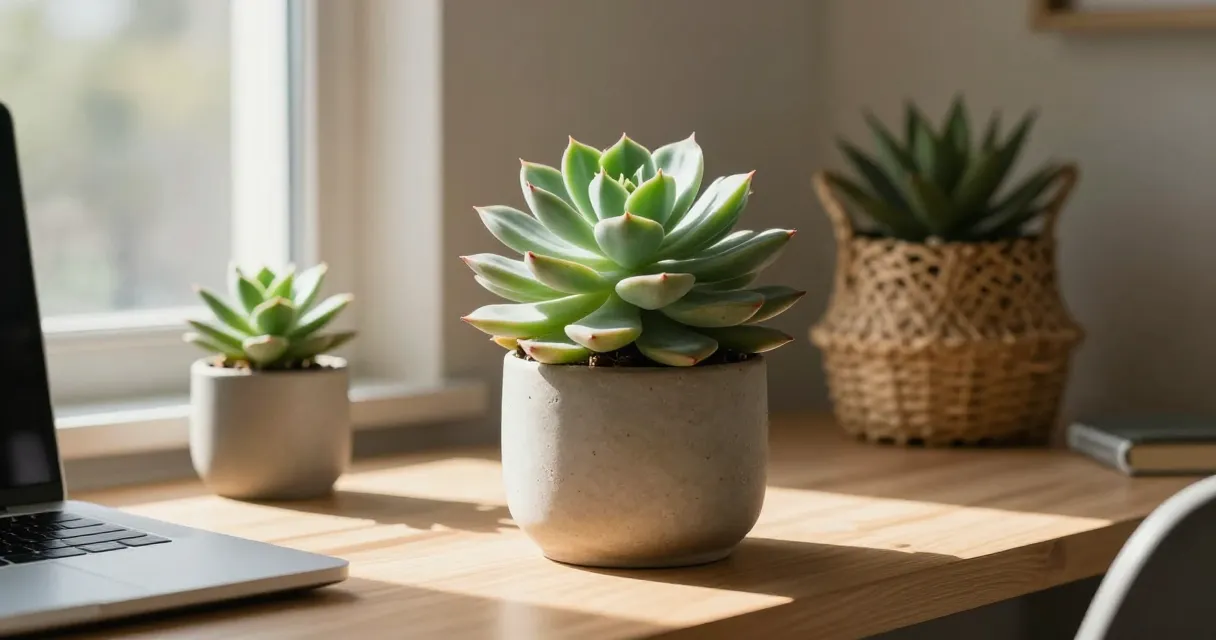
Succulent Care Guide: Everything Beginners Need to Know
Succulents look like they were designed to be easy. Thick leaves, sculptural shapes, tiny footprints on a windowsill. They seem like the plant world’s answer to “I want something beautiful but I’m forgetful.”
And in some ways, that’s true. But there’s a specific way succulents want to be cared for, and if you miss it, they decline slowly and quietly until one day you realize the leaves are mushy and the stem is rotting. The good news: once you understand how they think (mostly water and light), succulents genuinely are one of the most rewarding plants you can grow indoors.
“Succulents are surprisingly easy to kill with kindness. The single most important thing you can do is water less than you think you should.” - Summer Rayne Oakes, plant educator and author of How to Make a Plant Love You
How Succulents Think About Water
The number one reason succulents die indoors is overwatering. Not neglect. Overwatering.
Succulents evolved in places where rain is rare and intense: deserts, rocky hillsides, coastal cliffs. They’ve built water storage directly into their leaves, stems, and roots. That’s why the leaves feel thick and plump - they’re holding reserves for the dry season.
Indoors, the dry season never comes. We water on a schedule, the soil stays damp, and the roots sit in moisture they weren’t built to tolerate. They rot.
The right approach: Water deeply, then let the soil dry out completely before watering again.
In summer, that might mean watering every 7-14 days. In winter, once a month or less. What matters isn’t the calendar but the soil: stick your finger 2 inches in. Completely dry? Time to water. Still a little damp? Wait.
When you do water, water thoroughly, until it drains out the bottom. Shallow watering encourages shallow roots and leaves deeper soil damp without the plant being able to reach it.
Seasonal Watering Schedule
| Season | How Often | Notes |
|---|---|---|
| Spring | Every 7-10 days | Active growth, increase gradually |
| Summer | Every 7-14 days | Watch for heat stress; water in morning |
| Autumn | Every 14-21 days | Taper off as growth slows |
| Winter | Every 3-5 weeks | Minimal - let soil dry completely |
“The soil should feel like a wrung-out sponge that’s been sitting for a day - drier than that, actually. If it still holds any coolness or moisture, wait.” - Debra Lee Baldwin, author of Succulents Simplified
Reading Your Plant’s Leaves
The leaves are talking. Learn to listen.
Signs you’re overwatering:
- Leaves are soft, translucent, or mushy (especially lower leaves)
- Stem feels soft at the base
- Soil smells slightly off
Signs you’re underwatering:
- Leaves are wrinkled or puckered, not plump
- Leaves feel thin and papery at the tips
- Plant leans or looks deflated
Wrinkled leaves look alarming but they’re actually hopeful. She’s just thirsty. Give her a thorough drink and check back in 24 hours. The leaves will plump back up. If they’re also soft or mushy, that’s a different situation entirely - see the diagnosis guide below.
What Your Leaves Are Telling You: A 5-Step Diagnosis
Before scrolling to the problems table, work through these five steps. They’ll get you to the actual cause faster.
Step 1: Touch the leaves.
Are they soft and mushy, or firm but wrinkled, or firm and smooth but changing color?
- Soft and mushy, especially lower leaves: go to Step 2
- Firm but wrinkled or puckered: go to Step 3
- Firm and smooth, but yellowing, browning, or bleaching: go to Step 4
- No leaf problems, but strange growth pattern: go to Step 5
Step 2: The soft/mushy check (overwatering)
Press the stem gently at the soil line.
- Stem is also soft, dark, or smells off? Root rot has started. Unpot immediately, cut away any black or brown mushy roots with clean scissors, let the plant air-dry for 1-2 days, then repot in fresh dry succulent soil. Hold off watering for at least two weeks.
- Stem still firm? The leaves caught it early. Stop watering completely, let the soil dry out fully, and wait. She’ll usually recover on her own if the roots are still healthy.
Step 3: The wrinkled leaf check (underwatering)
Wrinkled, puckered leaves mean she’s thirsty.
- Last watered more than 10 days ago? Water deeply now, let it drain fully, and check back in 24-48 hours. The leaves should plump back up.
- Last watered less than 10 days ago? The soil may not be draining fast enough. Press down 2-3 inches. Still damp? The problem isn’t frequency, it’s the soil mix or pot drainage.
Step 4: Firm leaves with color changes
- Pale, bleached, or brown dry patches: sunburn, usually after moving to direct afternoon sun too quickly. Transition future sun exposure gradually over 1-2 weeks.
- Yellow-orange, especially lower leaves: excess moisture over time, or early root stress. Check whether the soil is staying wet too long.
- Dropping leaves at the slightest touch: temperature shock or a sudden environmental change. Check for nearby drafts, vents, or a recent move.
Step 5: Strange growth patterns
- Plant leaning toward one side: normal light-seeking. Rotate the pot 90 degrees every two weeks to keep growth even.
- New growth is stretched, with large gaps between leaves: etiolation from insufficient light. The stretched stem won’t shrink back, but moving to a brighter spot stops new growth from continuing to reach.
- Tiny white clusters at the base or tucked into leaf crevices: mealybugs. Treat immediately with 70% isopropyl alcohol on a cotton swab, and repeat weekly.
Light: More Than You Think
Succulents need a lot of light. More than most people expect, and more than most rooms provide.
Outdoors, they live in full sun. Indoors, the closest you can offer is a south-facing window with direct sun for several hours. East or west-facing windows work too, though growth will be slower.
A 2019 study by the University of Georgia Extension found that succulents grown in fewer than 4 hours of direct light per day had significantly higher rates of etiolation (stretching) and were more susceptible to root rot due to slow soil drying. Light isn’t just about growth - it’s about keeping the watering cycle healthy.
What happens in low light: the plant etiolates. It stretches toward the light, getting leggy and pale. The spacing between leaves increases. The compact rosette shape you fell in love with gets loose and tall. It’s not dead, but it’s reaching.
If you don’t have good natural light, grow lights are a genuine solution. A full-spectrum LED set to 12-14 hours a day, placed 6-12 inches above the plant, can replace a sunny window completely. See our guide to grow lights for indoor plants for specific recommendations.
Light Guide by Window Direction
| Window Direction | Direct Sun Hours | Succulent Result |
|---|---|---|
| South-facing | 6+ hours | Thrives, compact, full color |
| East-facing | 3-4 hours morning | Good, slightly slower growth |
| West-facing | 3-4 hours afternoon | Good - watch for sunburn in summer |
| North-facing | 0 direct hours | Stretching, poor long-term |
One note on sunburn: if you move a succulent from low light suddenly into direct afternoon sun, the leaves can bleach or develop brown patches. Transition gradually over 1-2 weeks.
Soil: Drainage Is Everything
Regular potting soil holds too much moisture for succulents. It’s designed for plants that want consistently moist conditions - the opposite of what your succulent needs.
What succulents want is a mix that drains fast and dries out quickly. Research published in HortScience found that cacti and succulents grown in mixes with 50% or more inorganic material (perlite, pumice, or coarse sand) showed 60% lower rates of root disease compared to those grown in standard potting mixes.
Option 1: Buy a cactus/succulent mix. Most garden centers carry them. Look for one with perlite or coarse sand already mixed in.
Option 2: DIY mix (better). Combine regular potting soil with 50% perlite or coarse grit. This dramatically improves drainage and aeration. Avoid fine beach sand - it compacts and makes drainage worse.
Soil Drainage Comparison
| Soil Type | Drainage Speed | Dry-Out Time | Succulent Suitability |
|---|---|---|---|
| Standard potting mix | Slow | 1-2 weeks | Poor |
| Cactus mix (store-bought) | Medium-fast | 5-7 days | Good |
| 50/50 potting + perlite | Fast | 4-6 days | Excellent |
| 70/30 perlite/pumice grit | Very fast | 2-4 days | Excellent (for serious growers) |
The goal is soil that, when you pour water in, drains through in seconds - not soil that holds water like a sponge.
Pots and Drainage Holes
Always use a pot with a drainage hole. No exceptions. Water that can’t escape sits at the bottom and rots roots, even in good succulent soil.
Terracotta pots are ideal. They’re porous, so excess moisture evaporates through the walls - a forgiving buffer if you water slightly too often. For more on why terracotta works so well, check our terracotta pots guide.
Glazed ceramic or plastic pots work too, but they hold moisture longer, so you’ll need to water less frequently. Avoid pots that are too large - in a big pot, the roots can’t dry out the soil before the edges get waterlogged. A pot roughly 1-2 inches wider than the plant is ideal.
Temperature and Humidity
Most succulents are comfortable between 60-80°F (15-27°C) - basically, wherever you’re comfortable.
What they don’t like: frost, drafts, and high humidity. Keep them away from air conditioning vents in summer and cold drafts in winter. If you live somewhere cold, bring outdoor succulents in before the first frost.
Humidity isn’t usually a problem in most homes, but bathrooms and kitchens with poor ventilation can be too moist for succulents long-term.
Fertilizing (Lightly)
Succulents don’t need much fertilizer. Too much can burn roots or cause soft, weak growth that’s more vulnerable to pests. Feed once in spring and once in early summer with a balanced liquid fertilizer diluted to half strength. Skip entirely in autumn and winter when the plant is resting.
Choosing the Right Succulent for Your Light
Not all succulents are equal. If your space is darker than ideal, this matters.
| Light Situation | Best Choices | Avoid |
|---|---|---|
| Bright south window | Echeveria, Sedum, Crassula, Aeonium | Nothing - all work |
| East/west window | Aloe, Gasteria, Haworthia | Echeveria (will etiolate) |
| Low light / north window | Haworthia, Gasteria | Most rosette types |
| Grow lights (12-14h/day) | Any species | Nothing - all work |
Haworthia and Gasteria are the unsung heroes of succulent care indoors. They actually evolved in the shade of rocks and other plants, so they’re far more likely to stay compact and happy in a less-than-perfect spot than an Echeveria that will slowly stretch itself sad.
Month-by-Month Succulent Care Calendar
Most succulent guides treat care as a fixed routine: water this often, give this much light. But succulents respond to the seasons, and your care should shift accordingly. This calendar gives you a starting point for each month - always let the soil, not the date, make the final call.
| Month | Watering | What to Watch |
|---|---|---|
| January | Every 4-6 weeks | Short days mean slow soil drying. Don’t rush the next watering. |
| February | Every 3-5 weeks | Days start lengthening. Watch for the first signs of new growth. |
| March | Every 2-3 weeks | Active growth begins. Check the soil more frequently now. |
| April | Every 10-14 days | Spring growth picks up. Introduce half-strength fertilizer if you see new leaves forming. |
| May | Every 7-10 days | Peak growing season. Best month for repotting if needed. |
| June | Every 7-10 days | If moving plants outdoors, transition over 2 weeks to prevent sunburn. |
| July | Every 7-14 days | Water in the morning, not during afternoon heat. Watch closely for mealybugs. |
| August | Every 7-14 days | Good month to propagate leaf cuttings and offsets. |
| September | Every 14-21 days | Start tapering off. Give one last dose of fertilizer early in the month. |
| October | Every 2-3 weeks | Bring outdoor succulents inside before the first frost. Stop fertilizing. |
| November | Every 3-5 weeks | Dormancy is settling in. Resist the urge to water when the soil still feels slightly cool. |
| December | Every 4-6 weeks | Rest period. Minimal watering, minimal intervention. Let her sleep. |
The hardest months for most people are November through February, when the instinct to water is stronger than the plant’s actual need. Trust the soil, not the calendar.
Common Problems and Fixes
| Problem | Likely Cause | Fix |
|---|---|---|
| Mushy, translucent leaves | Overwatering / root rot | Stop watering, check roots, repot if needed |
| Leggy, stretched growth | Not enough light | Move to brighter spot or add grow light |
| Wrinkled, puckered leaves | Underwatering | Deep water - leaves plump in 24-48h |
| Leaves turning brown and crispy | Sunburn or heat stress | Transition away from intense midday sun |
| Dropping lower leaves naturally | Normal aging | No action needed |
| White crusty deposit on soil | Mineral buildup from tap water | Flush soil with filtered water occasionally |
| Tiny white fluff at base or leaves | Mealybugs | Wipe with 70% isopropyl alcohol, repeat weekly |
| Rust-colored speckles on leaves | Spider mites | Isolate, treat with neem oil or insecticidal soap |
Care Summary
| Factor | Succulent Preference |
|---|---|
| Light | 6+ hours bright/direct; south window ideal |
| Water | Deeply, let dry completely between waterings |
| Spring/summer watering | Every 7-14 days |
| Autumn/winter watering | Every 3-5 weeks |
| Soil | Fast-draining: 50% perlite + 50% cactus mix |
| Pot | Terracotta with drainage hole |
| Temperature | 60-80°F (15-27°C) |
| Humidity | Low to moderate |
| Fertilizer | Half-strength liquid, spring + early summer only |
FAQ
How often should I water succulents indoors? Every 7-14 days in spring and summer, every 3-5 weeks in autumn and winter. Always check the soil first - if it’s not completely dry 2 inches down, wait. The calendar is a starting point; the soil is the truth.
Why are my succulent leaves wrinkled? Wrinkled or puckered leaves mean she’s thirsty. Give her a thorough watering (until water drains out the bottom) and the leaves should plump back up within 24-48 hours. If they’re soft or mushy rather than just wrinkled, that’s overwatering - two very different situations that can look similar at first glance. Use the leaf diagnosis guide above to tell them apart.
Can succulents survive indoors without direct sunlight? Some can. Haworthia and Gasteria genuinely do well in bright indirect light. Most other succulents, especially Echeveria, Sedum, and Crassula, will stretch and decline without direct sun. A grow light is the best solution if your windows are limited.
What’s the best soil for succulents? A mix of 50% regular potting soil and 50% perlite, or a commercial cactus/succulent mix with added perlite. The goal is soil that dries out completely within 4-7 days after watering.
Why is my succulent stretching and getting leggy? Not enough light. This is called etiolation - the plant is reaching for more sun. Move it to a brighter spot or add a grow light. The stretched stem won’t shrink back, but new growth will be more compact once it gets adequate light.
Can I use regular potting soil for succulents? You can, but it holds too much moisture and dramatically increases the risk of root rot. If you’re going to use regular potting soil, mix it with at least 50% perlite to improve drainage.
Are succulents safe for cats and dogs? Most common succulents are non-toxic, but there are exceptions. Aloe vera is toxic to cats and dogs (causes digestive upset). Most Echeveria, Haworthia, and Sedum are pet-safe. When in doubt, check the ASPCA toxic plant database before buying.
How do I know if my succulent has root rot? If lower leaves are mushy and the stem feels soft at the base, root rot is likely. Unpot the plant and look at the roots. Healthy roots are white or tan; rotted roots are brown, black, and mushy. Trim away the rot with clean scissors, let the plant air-dry for a day or two, then repot in fresh dry soil.
When should I repot my succulent? When roots are visibly growing out of drainage holes, when the plant looks too big for its pot, or when soil stays wet longer than 5-7 days (often means the soil has compacted). Spring is the best time. See our repotting guide for step-by-step instructions.
The Honest Truth About Indoor Succulents
Most succulents will survive indoors. Very few will truly thrive unless they get enough light. If your home is darker than you’d like, lean toward Haworthia (the little striped ones with translucent tips), Gasteria, and Aloe. They handle less-than-perfect conditions far better than most Echeverias or Sedums.
If you have a sunny windowsill or a grow light, your options open up considerably.
🌿 Want plant care reminders that actually match your home?
Get personalized watering and care alerts by plant type, pot size, and season.
Download KnowYourPlant