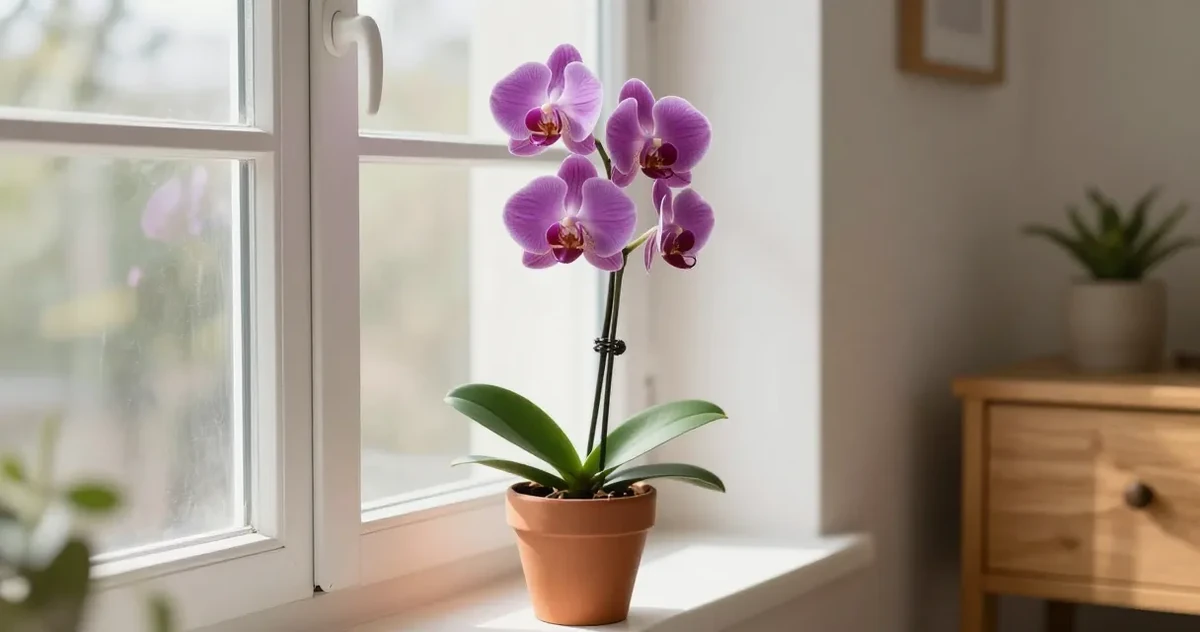
Orchid care isn’t complicated. It’s just different from everything else you’ve grown.
You brought home a orchid in full bloom, watched it flower for weeks, then one morning the last petal dropped and it’s been silent ever since. Now you’re not sure if it’s alive, dead, or somewhere in between. This is where most orchid stories end — but it doesn’t have to be yours.
Most people either water orchids to death trying to be attentive, or abandon them in a corner assuming they’ve given up. The truth is somewhere much more manageable: orchids want less from you than you think, but they want it consistently.
This guide is for Phalaenopsis orchids, the ones with the arching sprays of flat, moth-like flowers you find at the grocery store, the garden center, everywhere. Phalaenopsis account for roughly 80% of all orchid sales worldwide, and for good reason: they’re the most forgiving of the orchid world, and they really can bloom again. You just need to understand how they think.
How Often to Water an Orchid
This is where most people go wrong, and it’s not their fault. Orchids look like they should be watered often: they’re tropical, they’re dramatic. But the roots need to dry out between waterings, and most people keep them too wet.
According to the American Orchid Society, overwatering is the single most common cause of orchid death. That surprises people, but it makes sense once you understand where Phalaenopsis come from: in nature, they grow attached to tree trunks and branches, where rain arrives fast and drains away completely. There’s no soil to hold moisture. Their roots expect dry periods.
The rule of thumb: Water once every 7 to 10 days in summer, every 10 to 14 days in winter. But forget the calendar. Look at the roots instead.
Orchids sold in clear plastic pots are packaged that way for a reason: so you can see the roots. When the roots are plump and green, she has enough water. When they turn silvery-grey and slightly wrinkled, it’s time.
How to water properly: Take the pot to the sink and run room-temperature water through the bark for about 30 seconds. Let it drain completely. Never let an orchid sit in a saucer of standing water. That’s a slow path to root rot.
The popular advice to use ice cubes? Skip it. Orchids are tropical. Cold shocks the roots. Lukewarm water is fine.
Light: Where Your Orchid Actually Wants to Live
Orchids want bright light, but not direct afternoon sun. A south-facing window with sheer curtains, or an east-facing window with morning light: those are the sweet spots.
Signs she’s getting too much sun: the leaves turn yellowish or get a reddish tinge, and in bad cases you’ll see bleached patches where the sun hit directly. Move her back or add a sheer curtain.
Signs she’s not getting enough light: the leaves are a deep, dark green (healthy-looking, actually wrong) and she refuses to bloom. Orchids bloom more readily when they’re slightly light-stressed. Deep green means she’s comfortable but not flowering.
Healthy Phalaenopsis leaves are a medium green, slightly glossy. Not dark, not yellow. Think “fresh spinach” not “dark kale.”
Humidity: The Part Most Guides Skip
Most orchid care guides don’t mention humidity, and it’s one of the reasons people struggle through winter. Phalaenopsis are native to tropical and subtropical Asia, where humidity is naturally high. Indoors in winter, especially with central heating running, the air gets uncomfortably dry for them.
They do best at 50-70% relative humidity. You don’t need a tropical greenhouse, just a bit of awareness.
The simplest approach: set the pot on a shallow tray filled with pebbles and a little water. As the water evaporates, it raises the local humidity around the plant without wetting the roots. Keep the pot sitting above the waterline. It sounds like a minor thing, but if your orchid is in a heated room and the leaves look slightly wrinkled even after watering, low humidity is often the culprit.
A humidifier near a cluster of tropical plants works well too. Orchids, peace lilies, and ferns all appreciate similar humidity levels, so grouping them benefits everyone. (More on peace lily care indoors.)
One thing to avoid: misting directly on the leaves. It feels helpful but doesn’t meaningfully raise humidity, and water sitting in the leaf joints overnight can encourage rot.
If you’re building out a plant corner with multiple tropicals, grouping plants that share similar humidity needs makes care easier across the board. Our guide to air-purifying plants covers a range of tropical plants, many of them do well alongside orchids for exactly this reason.
The Right Pot and Soil Matter More Than You Think
Regular potting soil will kill an orchid. She needs airflow around her roots: that’s the whole point of bark mix. In nature, Phalaenopsis roots cling to tree bark. They breathe. Packing them in dense, moisture-retaining compost suffocates them.
Use orchid bark mix, not regular potting soil. Any garden center should carry it labeled as “orchid mix” or “epiphyte mix.”
On pots: clear plastic is ideal because it lets you watch the roots. Terracotta is porous and dries out faster, which lowers overwatering risk, but you lose the root visibility. If you’re new to orchids, clear plastic until you’ve got the watering timing down. Once you can read the roots confidently, terracotta is worth considering. (Our terracotta pots guide covers the pros and cons for different plant types.)
Pot size matters too. Orchids like to be slightly snug. A too-large pot keeps the bark wet too long and the roots rot. Repot only when the roots are visibly escaping the pot or when the bark has broken down to mush, usually every 2 years.
Fertilizing: Less Is More
During the growing season (spring through summer), fertilize once a month with a balanced orchid fertilizer, diluted to half strength. The phrase growers use is “weakly, weekly”: you can also fertilize at quarter strength every time you water. Either works.
A visual check for correct dilution: after mixing liquid fertilizer into your watering can, it should look almost clear, like very faint tea. If it has noticeable color, dilute further. Concentrated fertilizer burns orchid roots fast.
In autumn and winter, stop fertilizing. She’s resting.
Don’t fertilize a newly purchased orchid for at least two months. Nursery growers fertilize heavily before sale; adding more will burn the roots.
After Blooming: Don’t Give Up on Her
When the flowers drop, most people throw the plant away. That’s the saddest part of this story, because she’s not done.
After the last flower falls, look at the spike (the long green stem that held the flowers). You have two options:
Option 1: Cut the spike down to the base. The plant puts energy into root and leaf growth, and eventually sends up a new spike. This takes longer (6 to 12 months) but tends to produce a healthier, stronger-blooming plant.
Option 2: Cut the spike just above a node (one of the little brown bumps on the stem). Sometimes, not always, a side branch will emerge from that node and bloom again within a few months. Worth trying on a healthy plant.
Either way, keep caring for her the same. She’s not dead. She’s just resting.
Getting an Orchid to Rebloom
The trigger for reblooming is a temperature drop at night. Phalaenopsis need a difference of about 10°F (5-6°C) between day and night temperatures for 4 to 6 weeks to initiate a new flower spike. University of Florida IFAS Extension research on Phalaenopsis culture confirms this cool-night treatment is the most reliable way to induce blooming in home conditions, more reliable than fertilizer adjustments or light changes.
In autumn, when indoor temperatures start to drop slightly at night, move the orchid to a cooler spot near a window. Not drafty, just cool. Nighttime temps around 55-60°F (13-16°C) for 4 to 6 weeks is often enough.
You’ll know it’s working when a small green nub appears at the base of the plant, between the leaves or near the roots. That’s the new spike. Point it toward the light and leave it alone.
When it blooms, a healthy Phalaenopsis spike can hold flowers for 2 to 4 months, one of the longest bloom durations of any common houseplant.
Orchid Care Through the Seasons
Orchids follow the same seasonal rhythm even indoors, and adjusting your care to match it makes a real difference.
Spring (March to May): This is when she wakes up. Start fertilizing again after a winter break, and increase watering frequency slightly as the days lengthen. If you see a new leaf emerging, that’s a good sign. New roots are common in spring too: look for bright green tips on silver-grey root strands.
Summer (June to August): The most active growing season. Water every 7 to 10 days, fertilize monthly, and watch that she isn’t getting scorched by strong afternoon sun. Air conditioning can drop humidity quickly, so keep the pebble tray going in summer as well.
Autumn (September to November): The most important season for reblooming. As indoor temperatures drop slightly at night, move her somewhere cooler near a window. Stop fertilizing. This is the temperature differential she needs to initiate a new flower spike. Watch for a small green nub appearing between the leaves.
Winter (December to February): Reduce watering to every 10 to 14 days. No fertilizing. If she’s in a heated room, keep the pebble tray going. Position her near the light but away from cold glass, cold drafts coming through a window frame can damage the leaves.
Common Problems and What They Mean
Yellow leaves (lower leaves only): Normal. Orchids shed older leaves as they grow. One leaf yellowing and dropping from the bottom is just the plant’s cycle.
Yellow leaves (all over): Too much direct light, or sitting in water. Check both.
Wrinkled, limp leaves: Underwatering, or root rot (damaged roots can’t take up water even when moisture is present). Check the roots: healthy roots are firm and green or silver, rotted roots are brown and mushy.
No new leaves, no growth: Normal in winter. If it persists into spring with good light and regular watering, she likely needs repotting into fresh bark.
Sticky residue on leaves or stem: Check for scale insects, small brown bumps that look like part of the plant. Wipe off with a damp cloth and a little diluted rubbing alcohol.
Orchid Care at a Glance
| What | Details |
|---|---|
| Light | Bright indirect; east or south window with sheer curtain |
| Water | Every 7-14 days, when roots turn silver-grey |
| Humidity | 50-70%; pebble tray or humidifier in dry/heated seasons |
| Soil | Orchid bark mix only, never regular potting soil |
| Fertilize | Half-strength orchid fertilizer monthly (spring/summer only) |
| Temperature | 65-80°F day; 55-60°F nights for 4-6 weeks to trigger blooming |
| Repot | Every 2 years, or when roots visibly escape the pot |
🌿 Need reminders tailored to your exact plant setup?
KnowYourPlant tracks your species, pot size, and season to tell you exactly when to water and what to fix.
Try KnowYourPlantFAQ: Orchid Care
How often should I water my orchid?
Every 7 to 10 days in summer, every 10 to 14 days in winter, but the roots tell you more reliably than any schedule. Silver-grey and slightly wrinkled means it’s time. Green and plump means she’s good.
Why won’t my orchid rebloom?
Most likely she hasn’t had the temperature drop she needs. Move her near a window in autumn where nights cool to around 55-60°F (13-16°C) for 4 to 6 weeks. That cool-night differential is the trigger. Also check the light: if the leaves are a deep, dark green, she may not be getting enough light to initiate a bloom spike.
Should I cut the spike after the flowers fall?
You have two options: cut it to the base (produces a stronger new spike in 6-12 months) or cut above a node (may produce a shorter side bloom sooner). If the plant looks at all stressed or the roots look pale and sparse, cut to the base and let her recover properly.
How do I know if my orchid has root rot?
Remove the pot and look at the roots. Healthy roots are firm, green when wet, silver-grey when dry. Rotted roots are brown, mushy, and may smell a little off. If you find them, trim the bad ones with clean scissors, let the roots air dry for a few hours, then repot in fresh bark.
Can orchids grow in regular potting soil?
No. Regular potting soil stays too wet and blocks the airflow that Phalaenopsis roots need. Always use orchid bark mix or a coarse epiphyte mix. This is the one non-negotiable in orchid care.
Orchids have a reputation for being difficult, but most of that comes from watering them like regular houseplants. Give her bark, good light, a bit of humidity, and the patience to let her dry out between waterings, and she’ll reward you with flowers that last for months.
The silence between blooms isn’t failure. It’s just the part of the cycle that happens before the flowers come back.